Rail Freight At A Crossroads
I take the headline from this article in Rail Magazine, which is entitled Coal power station closures place rail freight at “important crossroads”.
The article talks about how the closure of coal-fired power stations and the reduction in size of the steel industry, will bring about fundamental changes to the pattern of freight on the railways.
The rail freight industry must develop new markets to take more and more trucks off the roads.
The article says that the industry is looking for government support to improve the East Coast Main Line, the West Coast Main Line and the routes to Felixstowe.
I would also add in the routes that serve the poorly-sited London Gateway, which mean too many noisy and smelly Class 66 locomotives pull freight across North London.
Life is about give-and-take, so it would be wrong to electrify routes that could be used by freight, without the freight companies investing in new electric locomotives.
But Class 66 diesel locomotives are a cheap solution that can go anywhere, that are unloved by those living by rail lines and also by drivers.
Diesel locomotives also mean that they make port and distribution depot operations safer and more efficient. You wouldn’t want idiots with cranes in an area with masses of overhead wires.
Incidentally, the Class 66 locomotives do not meet the current European emission regulations.
But solutions have been designed and are now available.
- The Class 88 locomotive is an electro diesel locomotive, that is primarily an electric locomotive, with a large on-board diesel engine, for use when there is no electrification.
- The TRAXX Last Mile locomotive may also be suitable for some routes, but is probably two big for the small British loading gauge.
I feel that as Vossloh Espana, who make the Class 88, has just been taken over by Stadler, who seem to me to have a reputation for innovation, that the Class 88, may be our best hope for less intrusive freight trains.
It is worth looking at how the Class 88 would help on one route that I know well; Felixstowe to Peterborough and then up the East Coast Main Line to the North.
The route is as follows.
- Felixstowe to Ipswich – A branch line that is not electrified. The Port of Felixstowe have said that they would pay for dualling some of the branch, but they haven’t and have pushed fir the removal of passenger trains from the branch.
- Ipswich to Peterborough – Except for a few miles to Haughley Junction the line is not electrified.
- Peterborough to Doncaster – The East Coast Main Line is electrified, but many freight trains now use the Great Northern Great Eastern Joint Line through Lincoln.
- North of Doncaster – Some routes to Leeds, Newcastle and Scotland are electrified.
So a quick naive look, might say that a Class 88 would be ideal for the route.
But.
- A new Class 88 would probably be more expensive to lease than an old Class 66.
- The Class 66 has a power output of 2,460 kW, whereas the Class 88 has only 700 kW from its diesel.
The freight industry’s preferred option is probably that all routes are electrified, but not at their expense!
But even then there are no new electric locomotives, that fit the UK loading gauge! The freight industry is probably looking jealously at the elderly Class 90 locomotives used for London-Norwich trains and hoping that the line gets electric multiple units.
I’m certain that for cost reasons, the industry would prefer to stick to its beloved Class 66.
I think that London is key to weaning the freight companies away from the dreadful Class 66 locomotives.
When the Gospel Oak to Barking Line has been electrified, London could be in the position to ban Class 66 locomotives from that line and the North London Line, if a few extra pieces of electrification were performed.
But it won’t happen!
I would also like to see the Government make freight companies run locomotives that met the current European regulations.
Before GOBlin Electrification – Crouch Hill
I’d never been to Crouch Hill station before, but I went to take these pictures.


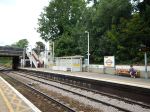

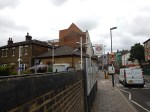
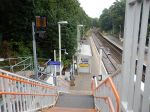

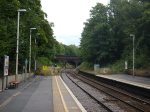


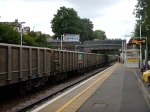
It is another tidy station with fairly long platforms, steep staircases and no lifts. Although unlike Leyton Midland Road, the station is in a cutting, rather than on a viaduct.
My pictures were as you can see interrupted by a dreaded Class 66 locomotive, with all its noise and smell passing through. After electrification, hopefully we’ll see something more environmentally-friendly like an elderly Class 90 or a brand new Class 88 locomotive. Unfortunately, I think we’ll see mainly Class 66s pulling freight trains for some years, as there are so many of them and they seem to be pretty reliable, although unloved by the drivers.
The Noisy Class 66 Locomotive
The Class 66 locomotive used on UK railways is not a friendly beast as it makes a lot of noise and smell. There is a Wikipedia section on Cab Design Problems, which says this.
The British trade union ASLEF has complained that the locomotives are unfit and unsafe to work in, citing a lack of air conditioning, and poor seating and noise levels.
I’ve spoken to various Class 66 drivers and many don’t like the working environment, but like things like the reliability.
If you type “Class 66 noise” into Google, you find some interesting articles.
One interesting point about Class 66 locomotives is that they don’t meet the new emission regulations and so no more can be ordered. The details are all here on Wikipedia.
Because of this and the noise and smells the locomotives, I think that they should where possible, not work trains through built-up areas.
London Overground’s 2026 Map
Transport for London (TfL) have published a map of what they feel the London Overground will look like in 2026.
Most of the changes actually will occur next year, so I suspect there will be other things added before 2026.
My money would be on some of these being completed.
- Electrification of the Dudding Hill Line as a westward extension of the Gospel Oak to Barking Line to rejoin the North London Line.
- A More Comprehensive Interchange at West Hampstead station.
- Some developer-led station rebuilds and perhaps additions.
- Reopening Of the Hall Farm Curve to enable services between Chingford and Stratford, with a stop at Lea Bridge.
- Extra Overground branded services in a loop across South London.
With the exception of the electrification of the Dudding Hill Line and the works at West Hampstead, most of the other projects could probably be classed as smallish ones in terms of cost to TfL. But they may have a high return.
At present the Overground is being upgraded to take five-car trains, but judging by this picture taken at Camden Road station, it would appear that where they can fit them in, platforms are being readied for the next upgrade to six cars.
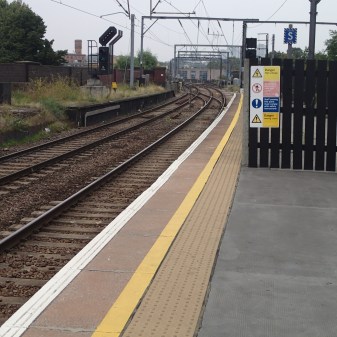
Platform Extension At Camden Road Station
TfL have said, that where stations can’t be extended selective door opening will be used. As the Class 378 trains are walk-through and have a full information system, I’m sure the self-loading cargo, will get used to it.
This afternoon, I travelled along the North London Line and it would also appear that TfL are taking the opportunity presented by the platform lengthening to widen a few of the narrower platforms, like those at West Hampstead. This picture was taken at Brondesbury Park.
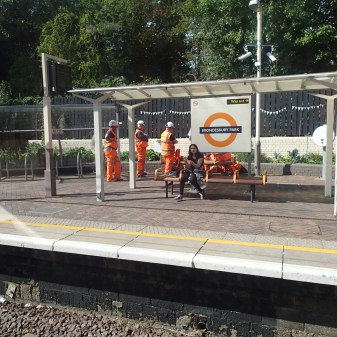
An Oasis At Brondesbury Park
It would appear that they’ve created a much wider platform with a roof and a garden.
TfL also don’t seem to be using a one-size-fits-all at the stations. Too often railway lines seem to be designed to a very limited set of rules to save costs. The London Overground inherited a series of run-down and mismatched stations, which they have almost used to advantage. Some like Hampstead Heath, were probably beyond saving, so they have rebuilt them to a station that befits their location.
In asddition, three external factors will drive the development of the London Overground; freight, the need for the development of more homes and commercial properties of all sorts and Crossrail.
Freight
The Overground gives over a lot of paths to freight, especially on the northern lines. A lot of these trains are still hauled by unfriendly Class 66 diesel locomotives. Alternative electric locomotives or the new Class 88, should be an aspiration for all lines that go through cities.
Bear in mind that once, the Midland Main Line, the Great Western Main Line and the Gospel Oak to Barking Line are electrified, which should all be complete by 2020, the Dudding Hill Line would be the only line, habitually used by freight trains in the northern part of London, not to be electrified.
So for freight reasons alone, I would think electrifying the Dudding Hill Line is a good idea.
But expect a few surprises if Option 1 is implemented, as Transport for London and especially the Overground has a history of doing the unexpected but excellent. Look at the one platform solution at Clapham Junction, where the West and South London Lines of the network meet.
Development of New Homes and Commercial Properties
London may need new railways to cope with the increased population, but it also needs new homes and commercial properties. Land in London is at a premium, but see what was done here in building flats over the new Dalston Junction station.
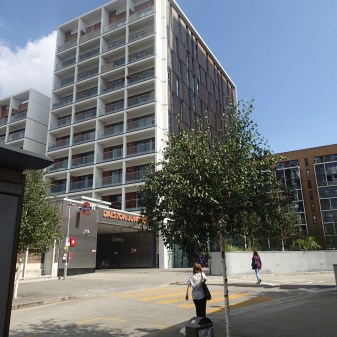
Residential Development Over Dalston Junction
It is not the highest quality of developments, but it was probably the best that could be done at the height of the recession. Small scale development is already taking place at some stations like Highbury and Islington and West Hampstead.
But in this country, we have some very good architects and developers, so I would expect to see some innovative development proposals all round the London Overground.
I must admit, that if I had to live in a modern development, surely one on top of a well-connected railway station is probably best!
Crossrail
London’s new railway; Crossrail, will change a lot of things in London’s transport system.
As a simple example if I go to Heathrow from home, the journey takes about an hour and twenty-two minutes. But after Crossrail is running, the journey will take less than an hour.
But this means, I’ll take the East London Line to Whitechapel to connect with Crossrail.
In addition, Crossrail and the Overground have interchanges at Stratford, Whitechapel and probably by 2026 at Old Oak Common.
So I suspect that many journeys in London will change because of Crossrail.
Predictions made now will be valueless after Crossrail opens in 2019.
An Unpleasant Experience
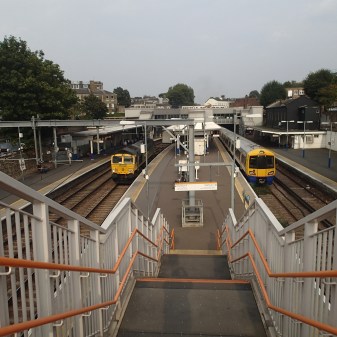
I took this picture at Highbury and Islington station from the second footbridge, that links the platforms to the Emergency Exit.
An Approaching Class 66
I have talked about the noise of Class 66 locomotives before in this post, where I said this.
It is important that rail locomotives are improved, as the current mainstay, the Class 66 is not liked by those who live on busy freight routes, due to its noise. I’ve also talked to drivers, who feel they have other problems too.
I could have been more critical. The Class 66 to the left of the picture was pulling a heavy freight train and passed under me, whilst working hard.
The noise was bad, but not as bad as the stink of the exhaust of the massive diesel engine.
I remarked on this to a member of the station staff, who was tidying up underneath the bridge and he said he hated them.
As there are now alternatives, surely pure diesel engines like the Class 66, that don’t meet the latest environmental regulations, should at lest be banned from operating in heavily-populated built-up areas.
In fact, as this line is electrified, what is a Class 66 doing on this line anyway?
Musings On Freight And The New Thames Tunnel On The Goblin Extension
It may seem strange that freight has such a large affect on the Gospel Oak and Barking Line, which is essentially a passenger railway across North London.
But at the Barking end of the line there could be very good connections to London Gateway and the other end has good connections to the main routes to the north. So a container unloaded at the port, which is destined for say the large distribution centre at Daventry, could go on a train up the Goblin to the West Coast Main Line. Other large distribution centres are planned or being constructed, like the one at Radlett, so we will see more trains from the London Gateway taking this route as the port gets larger.
In a few years time, the line will be carrying a lot of freight trains, many of which will be hauled through at night. At least the line is being electrified, so the noisy thuds of the dreadful Class 66 locomotives will hopefully be replaced by smooth electric power.
If a new Thames Tunnel is built between Barking and Thamesmead, this will be a game changer, if it is a tunnel that is capable of taking the biggest freight trains. It should probably be built to the loading gauge of the Channel Tunnel, so allowing any train capable of using the Channel Tunnel to be able to use the new link.
London Gateway is one of the few ports capable of handling the new breed of ultra large container ships. Obviously, this will generate more freight train traffic for the UK out of London Gateway, but will some of these containers be destined for Europe? At present there is a route to get them onto HS1 for the Channel Tunnel, but a new Thames Tunnel might give opportunities for these trains to go along the North Bank of the Thames and then through the tunnel to pick up the North Kent Line for HS1. The advantage is that it avoids sending trains through the crowded North London rail system. Obviously freight going from Europe to London Gateway for onward shipping, could be routed in the reverse direction.
Increasingly, over the last few years there has been a significant stirring of the practice of sending freight trains through the Channel Tunnel. Car components and perishable fruit, are just two of the cargoes seeing an increase.
We will see a large increase in future with exports such as complete cars going both ways on special trains. Although, it’s a common site in Europe, large trains of new vehicles are rarely seen here.
All of these flows will probably be best routed through the new Thames Tunnel and over the upgraded Goblin.
We shouldn’t forget that the main reason for a rail tunnel between Barking Riverside to Thamesmead is to vitalise the housing developments in the east of London, as I outlined in A Divided City.
But could the Goblin Extension be used for extra passenger trains given that it would link HS2 at Old Oak Common to HS1 at Ebbsfleet via the North Kent Line.
During the day there probably aren’t enough paths for an intensive service from the North via HS2 to link with HS1. And anyway, is the demand there for direct trains between say Paris and Manchester or Cologne and Leeds?
But it would allow overnight sleeper services, which might be a better proposition.
On the other hand to run a regular service from Old Oak Common to Ebbsfleet might be worthwhile, especially if it stopped regularly in between, at say Abbey Wood, Barking, Walthamstow and West Hampstead.
Innovations In Diesel Locomotives
All across Europe there is a shortage of locomotives to pull both freight and passenger trains. In some ways this may well be good news, as it could be said that the economies of some countries are at last picking up.
In the UK, there have been orders for the new Class 68 to pull both freight and passenger trains and for some more of the ubiquitous Class 66. As the latter class doesn’t meet the current emission standards, the order for the Class 66 will probably be the last for the type. In my view that is a good thing, as I’ve talked to drivers and although the engines are reliable, the working environment could be better. They also aren’t popular with some residents, who live near busy freight routes, as they aren’t the quietest.
So in the UK, we’ve seen a scraping around for motive power, and this partly explains, why some elderly engines, like the Class 20, I saw a couple of days ago, are still working.
But we have also ordered some new Class 88, which are an electric engine, with an on-board diesel engine, so are capable of going all over the network. So for say Felixstowe to Manchester via the routes through London, could be done without changing the engine en route.
I also found another interesting idea on the web yesterday. This article in Global Rail News describes the delivery of a new TRAXX locomotive in Germany. What is unique about the TRAXX P160 DE is that instead of one large diesel engine, it has four smaller ones. So the power can be adjusted to the load, therefore using less fuel and creating much less noise.
This technique has been used on some diesel multiple units like the Class 185 used by Trans Pennine. On their hilly routes, some parts need more power than others, so these trains have an eco-mode.
Over the next few years, we will see a lot more serious developments with respect to more power, better fuel economy and less noise.
Enthusiasm For Class 68 And Class 88
I found this article from Rail Engineer about the new Class 68 and Class 88 locomotives that will soon be pulling freight and passenger trains on the UK rail network.
The article is enthusiastic about the two classes, but notes that the Class 68 will not meet the toughest EU pollution regulations. This is particularly appropriate given that the UK and some European countries are suffering high levels of air pollution. The Rail Engineer article says this about compliance to the new regulations.
The CAT engines meet European Stage IIIA emission standards, and can be modified to meet 2012 IIIB emission standards by replacing the exhaust silencer with a diesel particulate filter. However, because of the UK’s restricted loading gauge, this would involve considerable re-design work if it were to be applied to the Class 68.
It is important that rail locomotives are improved, as the current mainstay, the Class 66 is not liked by those who live on busy freight routes, due to its noise. I’ve also talked to drivers, who feel they have other problems too.
As an engineer, I feel that the best solution is the next generation of locomotives like the Class 88, which will be a 200 kph electric locomotive with an on-board diesel for running on non-electrified track. I wrote about the Class 88 here.
Freight Trains At Ipswich
On my trip to the dentist in Felixstowe yesterday, I changed trains at Ipswich. There was a wonderful example of the problems that the Bacon Factory Curve is designed to eliminate, as two freight trains going to and from London, passed through the station at the same time.
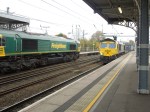

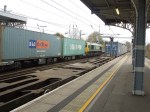


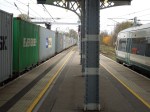
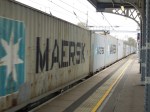

One thing that worries me, is that these trains were going through a busy station, where lots of people were waiting for trains like I was. Is this a good idea from a Health and Safety point of view?
Many of these trains, are routed by the North London and Gospel Oak to Barking lines to complete their journey.
When the curve is fully operational, they will go on a more direct route, via Stowmarket and Peterborough.
But will those who live on that line be complaining of very noisy Class 66 locomotives at all hours of the day and night?
Incidentally, as a lot less freight trains will be travelling to or from London, they should be able to use the direct line through Ipswich station, which is between the main lines used by passenger trains to stop at platforms 2 and 3. This will certainly make things less frightening and probably a lot safer.
 The Anonymous Widower