The New Depot For Class 800 Trains At Swansea
The electrification to Swansea station may not be ready until 2024, but it looks like they have a depot for thew new Class 800 trains.


This illustrates how badly Network Rail got their planning for electrifying the Great Western Main Line.
Sorting Out The Late Great Western Electrification
I could have added something like And Other Issues to the title of this post.
An article in the June 2016 Edition of Modern Railways entitled GWR To Order More ‘387s’ starts with the statement.
Govia Thameslink Railway’s fleet of 29 Class 387/1 EMUs is to be retained by the operator and will not be transferred to Great Western Railway, according to industry sources.
It seems that not only do GTR have trouble with their staff and the new Class 700 trains, but also with other train operators too.
So GWR have snapped up the other fourteen ordered by Porterbrook and supplemented this with an order for fifteen new build units.
This means they have got their required 29 trains to go with the eight they ordered some time ago.
Unfortunately, building more Class 387 trains, which would probably help the rolling stock shortage caused by the non-working Class 700 trains, especially as it appears Bombardier has spare capacity, is not on, as changes to crashworthiness regulations mean that these trains can’t be produced after September 2016.
So it’s probably very lucky, that the Great Western doesn’t have much working electrification.
One paragraph in the article gives some news about the progress of Bombardier’s IPEMU technology. Thios is said.
Industry sources confirm that options for some of the GWR order to be produced as independently powered EMU (IPEMU) variants fitted with batteries for operation away from electrified routes are still being explored. This would enable GWR services to Gatwick Airport and on some of the Thames Valley branches to be worked by ‘387s’ prior to electrification. Any decision to look seriously at this proposal will depend on final electrification timescales being confirmed by Network Rail.
Using IPEMUs on the routes mentioned would be a sensible move.
It would also appear from the article that GWR is going to order more Class 800 bi-mode trains from Hitachi.
There is also this article in Rail Technology Magazine entitled Perry Confirms New GWR Class 801 Will Be Bi-Mode.
As the Class 801 electric train and the Class 800 bi-mode train are more of less identical except for the diesel engines, conversion between the two types is possible.
TransPennine Express Buys Spanish Trains
After Arriva Rail North bought 98 Civity trains from CAF, which I wroye about in Arriva Rail North’s New Trains, it probably wasn’t much of a surprise that TransPennine Express have gone to the same source for twenty-five new trains, as is detailed in this article in Global Rail News. This is said.
The new fleet, which will be maintained by Alstom at Longsight depot, will consist of 12 five-car Civity EMUs from CAF – financed by Eversholt Rail – and 13 five-car loco-hauled intercity trains.
The announcement follows an order placed earlier this year with Hitachi for 19 bi-mode train sets. Both fleets of new trains are due to be delivered between 2018 and 2019.
If there is a surprise, it is that they are going for locomotive-hauled sets or rakes of coaches.
The 12 five-car Civity EMUs will be running between Liverpool/Manchester and Edinburgh/Glasgow. According to the CAF data sheet, there will be a 200 kph version available, so these could mix it with other operators’ Class 800 trains.
The article also says this about the locomotive-hauled rake of Mark 5 coaches.
In addition to the new CAF trains and carriages, Beacon Rail-owned Class 68 locomotives will be leased from Direct Rail Services to operate intercity services between Liverpool and Newcastle.
So it would appear that the Class 68 locomotives could work Liverpool to Newcastle before the line is fully electrified. They would also be ideal for routes to Hull and Scarborough.
I would also suspect, that as the Class 88 electro-diesel locomotive is very similar to a Class 68, that these locomotives could also work some of the services, once the route is partially electrified.
The Mark 5 coaches, are probably similar to those being built for the Caledonian Sleeper. One question that has to be asked, is why haven’t TPE opted to bring some of the legendary Mark 3 coaches up to a modern standard.
- The concept of a quality set of coaches with a locomotive at one end has been proven to work in East Anglia, on Chiltern and on Deutsche Bahn.
- The conversion of doors, toilets and other issues, might mean that new coaches are better value for money.
- New coaches are probably good for at least thirty years.
- All the basic design has been paid for in the Caledonian Sleeper order.
- One of the five coaches in each set, could have a driving cab integrated into one end, so there would be no need for a separate driving van trailer.
- Have CAF applied all their designs for the modular Civity train to build a train, where you just plug a suitable locomotive into one end?
- New coaches sell seats, especially if they are designed for a good passenger experience.
- If you want six, seven or more coaches, you could probably just slot them into the rake.
I suspect that CAF have seen a gap in the market and have produced a design for a rake of coaches, that will appeal to the UK. I think we could be seeing these coaches appearing elsewhere.
At the end of the day, it all comes down to cost, reliability, flexibility and the quality of the passenger experience.
It does look to me, that by virtue of good design and manufacturing capacity, that CAF seem to have nicked a nice order from under the noses of the big companies.
- CAF could probably deliver coaches in 2018.
- Suitable locomotives are already in the UK and Stadler/Vossloh would probably oblige with a few more.
- The Class 68 locomotive doesn’t seem to generate bad reports in the media.
- The three previous points, might mean that TPE could be running new reliable trains earlier than anybody thinks.
- The Civity family is proven and is being built for Arriva Rail North.
- Hitachi haven’t probably got the capacity to build more Class 800 trains early enough.
- Bombardier haven’t built a high-speed Aventra, although they might have the capacity, but not a diesel variant.
I certainly think that TPE have got a good replacement at an affordable price for the overcrowded Class 185 trains.
Virgin’s New Train On Test
I took this picture near to Stevenage.
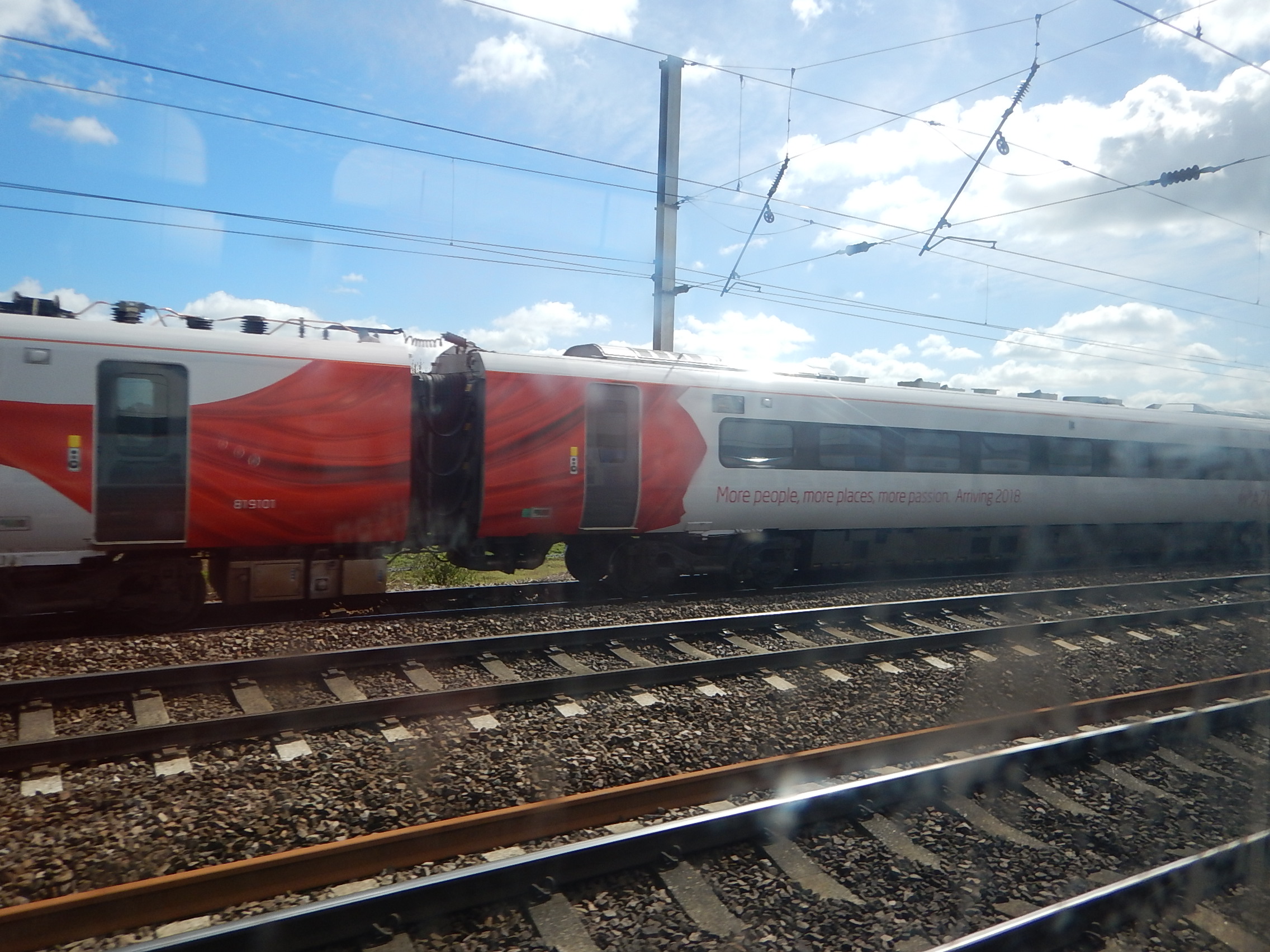
Virgin’s New Train On Test
Virgin’s new Class 800 train is under test.
Cardiff To Southampton By Electric Train
When I was waiting on Bath Spa station to return to London, a Class 158 train from Cardiff stopped at the station, on its way to Brighton via Southampton.
The train travels the full length of the Wessex Main Line from Bristol Temple Meads to Southampton, using the soon-to-be-electrified South Wales Main Line and the electrified West Coastway Line to complete the full route.
I wondered how much of the route will be electrified, once Cardiff to Bristol is hopefully electrified in the next few years. The current date for wires to Cardiff is December 2018.
I would estimate the length of the non-electrified section between Southampton and Bath is about sixty to sixty-five miles.
So it would appear that, the line could be within range for a Class 387 train or a new Aventra, with an IPEMU capability.
Obviously, Great Western Railway could also run a five-car Class 800 train on the route, using the on-board diesels to bridge the gap.
One way or other by 2020, Cardiff to Southampton will be run by electric trains, with a much increased capacity.
Musical Trains On TransPennine Express
The moving on of the inadequate Class 185 trains on TransPennine Express (TPE) seems to have started with this article in Rail News entitled Hitachi scoops 95-car TPE train deal. This is said.
- TPE have signed a deal for the delivery of nineteen five-car Class 802 trains for delivery from 2019.
- The trains will normally run at 125 mph, but will have a 140 mph capability, subject to track and signalling.
- The Class 802 trains will have 161 more seats than the Class 185 trains.
- A second fleet of twenty-five trains will be ordered by TPE for delivery in 2018.
It’s also said that TPE will retain about half of the existing Class 185 trains.
In Future Fleet in the TransPennineExpress Wikipedia entry, this is listed as their future fleet.
- Thirteen sets of five-car Intercity carriages for TransPennine routes with a top speed of 125 mph, with deliveries, starting in 2017.
- Twelve sets of five-car EMUs for Scottish routes with a top speed of 125 mph, with deliveries, starting in 2018.
- Nineteen sets of five-car Class 802 trains for TransPennine routes, with deliveries, starting in 2019.
The third fleet of nineteen trains have been ordered and I feel pretty sure, Hitachi will deliver them on time from Newton Aycliffe.
But what types of trains will be delivered for the first and second requirements?
Class 387 Trains
Twenty-nine Class 387 trains have been built and there are another twenty-eight on order.
- A proportion of the trains will be going to Great Western Railway (GWR), which is a sister company to TPE, to run Thames Valley services out of Paddington.
- Because of the late delivery of the Great Western Electrification, some could end up sitting in sidings.
- They are only a four car train, but as some Electrostars come in five car sets, I suspect that they can be lengthened to the required five cars.
- They are only a 110 mph train, but then so are the Class 350 trains, currently working Manchester Airport to Glasgow services for TPE.
Although Class 387 trains don’t quite meet TPE’s speed requirement, they could provide a valuable interim service, whilst awaiting the delivery of the new trains.
Class 387 Trains With An IPEMU Capability
A Class 379 train was used for the prototype IPEMU or Independently Powered Electric Multiple Unit, which was successfully demonstrated in public service early in 2015.
This train has a range of upwards of fifty miles using on-board energy storage, charged on the main line from the overhead electrification.
The Class 379 and 387 trains are both Electrostars and are closely related, so it is very likely, that a Class 387 IPEMU can and will be developed.
A Class 387 IPEMU could be able to serve the following routes.
- Liverpool to Newcastle via Manchester and Leeds.
- Manchester Airport to Blackpool, Barrow and Windermere.
- Blackpool and Preston to Leeds via the Calder Valley Line.
- Manchester to Chester.
- Manchester to Sheffield via the Hope Valley Line.
I also think, that as experience of the trains is accumulated, other routes would become possible.
Class 802 Trains
The Class 802 trains are the ones ordered for the major part of services across the Pennines, but they have a major problem. It would be unlikely, that Hitachi could deliver the trains until after the rest of the trains have been delivered starting in 2019.
Aventra Trains
The Aventra is Bombardier’s successor to the Electrostar.
- It is designed as a modular train, that comes in a range of lengths. So far four car Class 710 trains and nine car Class 345 trains have been ordered.
- Modern Railways disclosed in the April 2016 Edition, that a 125 mph version of the new Aventra train is coming.
- It has been designed to be a very efficient train.
- According to Modern Railways, the trains are designed to be able to handle both commuter and longer-distance services.
- All Aventras are wired so that on-board energy storage can be fitted.
- As it will be a more efficient train than the Electrostar, range using on-board energy storage would probably be longer.
So it would appear that a 125 mph five-car Aventra, that can extend routes and bridge electrification gaps will be available.
The two requirements for TPE will now be examined.
The First Requirement
The first requirement for thirteen trains for TransPennine routes could be met by.
- Shortened five-car formations of InterCity 125s released by delivery of Class 800 trains to Great Western Railway (GWR) and Virgin Trains East Coast.
- Five-car Class 221 trains released by Virgin Trains.
- Five-car Class 222 trains released by East Midlands Trains.
- Five-car Class 387 trains with an IPEMU capability.
- Five-car Aventras with an IPEMU capability.
- Lengthening the existing Class 185 trains by adding two new cars.
- More Class 802 trains.
Option 1 – Every train operating company will be after these and there is a lot of work to do. But they would do the job.
Options 2 and 3 – What trains could be used to release the Class 221 and Class 222 trains?
Option 4 – Five-car Class 387 trains can be created. But would 110 mph trains be fast enough and would the IPEMU capability allow TPE to run the routes they require?
Option 5 – 125 mph Aventras with on-board energy storage, could probably do the job. But will they be available for delivery in 2017? I doubt it!
Option 6 – I doubt Siemens would like to lengthen Class 185 trains, but as an interim they could run as six car trains. But until the Class 802 trains arrive, they’re needed across the Pennines.
Option 7 – Not probably a possibility for delivery in 2017, unless Hitachi find how to 3D-Print trains at a rate of one a day.
TPE Needs More Capacity Now
The big problem, is that TPE needs extra capacity across the Pennines now! It should also be noted that the Ordsall Chord could open in December 2017, which will create a need for more trains.
TPE could decide to just muddle through until 2017, but I think they would like some extra capacity, otherwise all the euphoria of the new franchise, will be flushed down the toilet
The only trains that could be running across the Pennines, before the end of 2016, are Class 387 trains with an IPEMU capability. In fact, they could probably be running in time for the May 2016 timetable change.
I have believed for some time, that they could work the routes across the Pennines between Leeds and Manchester.
If TPE did go down this interim route, then it would be likely that the thirteen new trains ordered for this route would be 125 mph Aventras with an IPEMU capability.
Bombardier would love that if it turned out to be successful, as publicity of using batteries to extend the range of a 125 mph train must open up some very lucrative markets all over the world.
The Second Requirement
The second requirement used on the Scottish routes could be.
- Class 350 trains until new trains are delivered.
- Class 387 trains to add capacity to or replace the existing fleet.
- Class 802 trains
- 125 mph Aventra trains
All except the Class 350 trains could be five car trains and the Class 802 trains and the Aventras are 125 mph trains or faster.
140 mph Running
One complication is that at some time in the 2020s, the East Coast Main Line and West Coast Main Line will be able to accept 140 mph running. So the Scottish services, may end up bein worked by Class 802 trains.
Airport Expresses
An intriguing possibility is to use Class 387/2 trains as used on Gatwick Express on some services.
- TPE services call at Manchester Airport and Liverpool South Parkway for Liverpool Airport.
- The Class 387/2 trains have an interior designed for airport passengers.
- The trains could be delivered as five car trains.
- The trains could have an IPEMU capability.
Manchester and Liverpool Airports are very ambitious and probably would like connections to places such as Chester, Nottingham and North Wales.
Conclusions
There are a large number of possibilities and a massive need for an interim solution, which will probably use some of the available Class 387 trains, with or without an IPEMU capability.
The final solution will come down to a choice between.
- Thirteen Class 802 trains with a bi-mode capability and twelve Class 802 EMUs
- Twenty-five Aventras, of which at least thirteen would have an IPEMU capability.
I might find the Class 185 trains inadequate, but as new trains arrive, inevitably some of the diesel multiple units will be cascaded to other operators.
I think there’ll come a time, when TPE has just Class 802 trains and/or Aventras, with some trains having a bi-mode or IPEMU capability.
When there is electrification between Leeds and Manchester and if Aventra IPEMUs were handling the parts of the network without electrification, then TPE could rightly claim that they were running an all-electric fleet, which must give a green edge to their marketing.
Some bi-mode Class 802 trains could be converted to EMUs and hopefully would be able to cruise to across the Pennines at over 125 mph and to Scotland at 140 mph on the flagship routes.
- Liverpool to Edinburgh via Manchester, Leeds and Newcastle.
- Liverpool and Manchester to Glasgow via the West Coast Main Line.
It will be an interesting decision, as to which trains are chosen for the extra twenty-five trains.
The only certainty is that TPE will get a very good price.
The West-Facing Bay Platforms At Reading Station
Reading station has three west-facing bay platforms, numbered 1, 2 and 3.
They are used as follows.
- Platforms 1 and 2 for local services to Basingstoke, Newbury and Bedwyn.
- Platform 3 for Cross Country reversing trains.
Whilst I was at Reading yesterday, a Cross Country train reversed in a higher numbered platform.
These are some pictures of the bay platforms.
The View From Above
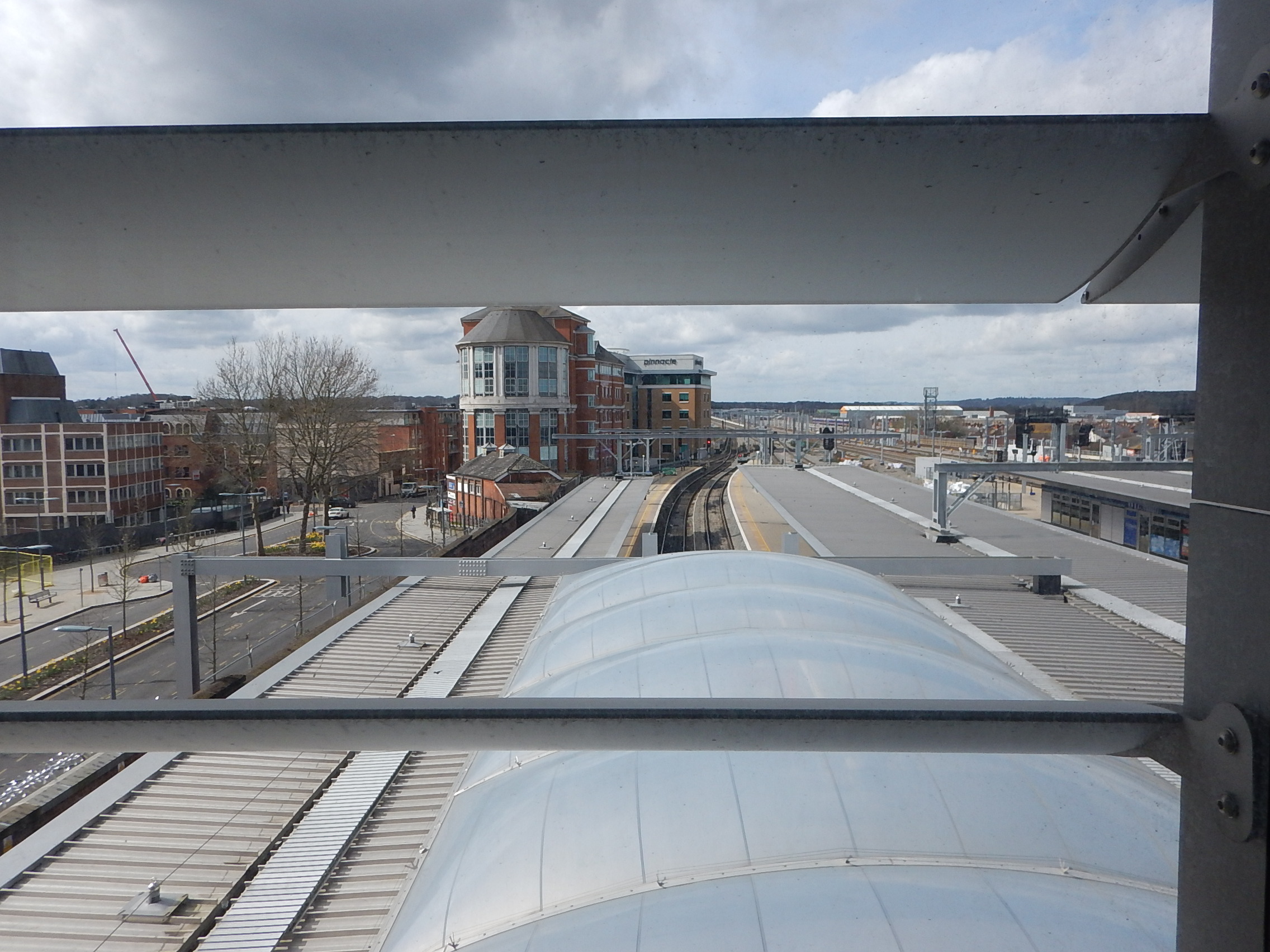
The Layout Of Bay Platforms 1, 2 and 3 At Reading Station
Note that the electrification gantries are in place across the three tracks.
The Platforms From Ground Level
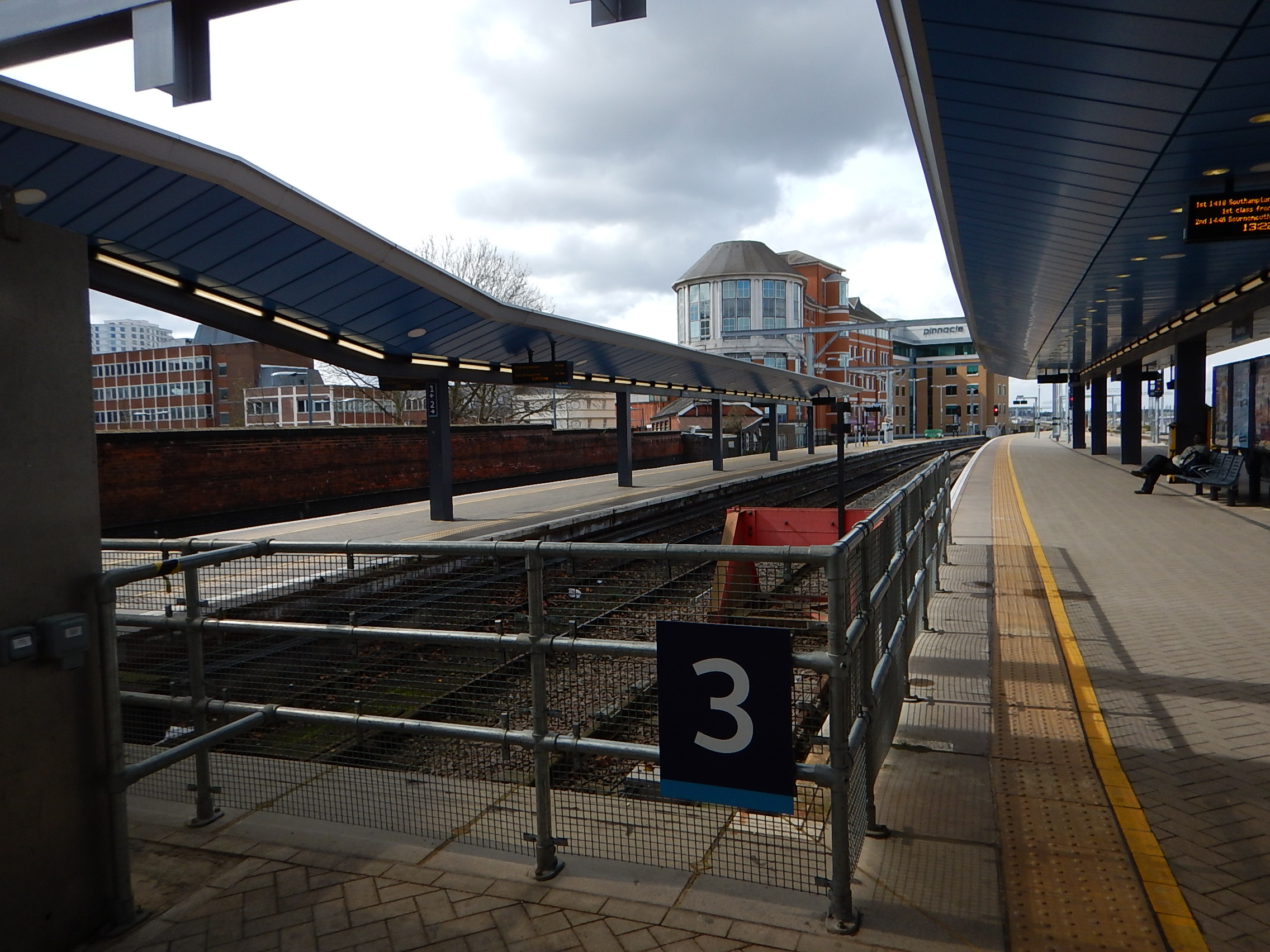
Platforms 1, 2 and 3 At Reading Station
Note how good the access is to the platforms. To the right of Platform 3, is platform 7, which is used for Down trains for the Berks and Hants route and for reversing Cross Country services.
So passengers arriving on a Cross Country train from say Manchester to Bournemouth or Newcastle to Southampton train on Platform 7 have these choices if they need to change trains.
- They could walk across from their train to a local service from platforms 1, 2 or 3.
- They could walk to the other end of the platform and get a local train from the east-facing platforms 4, 5 or 6.
- They could use lifts or escalators to cross the massive bridge to get a train on the Great Western Main Line to London or the West.
- They could also walk across to local services or in future, Crossrail to London.
And of course, they could walk out of the nearby station entrance and get a bus, taxi or their own transport.
Is there a station in the UK, where changing trains comes with so less hassle?
Ready For The Electrification
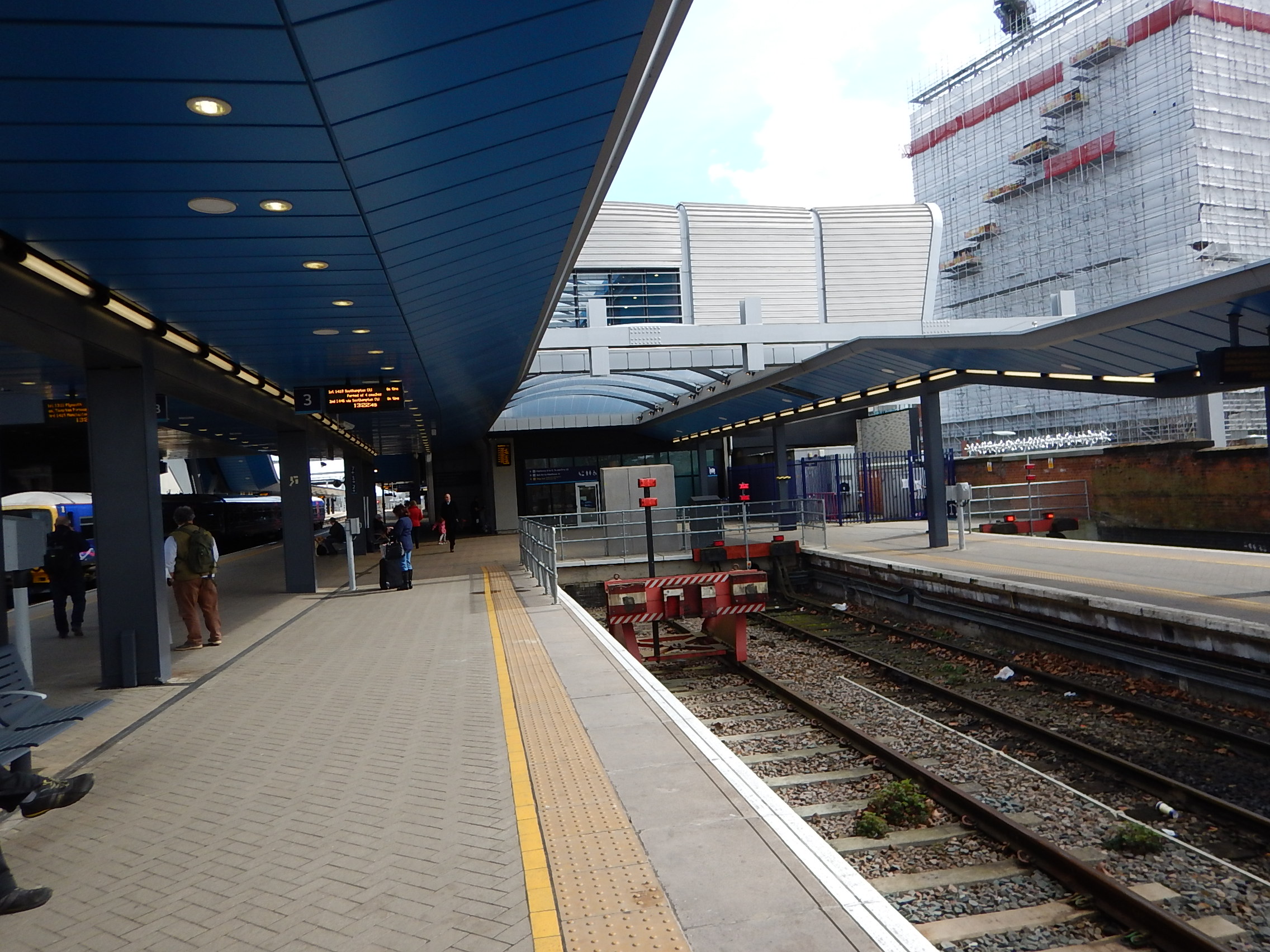
Looking Back At The Buffer End Of The Bay Platforms 1, 2 And 3 At Reading Station
Note that the gantries seem to have been designed into the station and are ready for the wires, with a nice secure steel plate to which to bolt them.
I can’t see the Heritage Taliban arguing about this design of catenery.
The Length Of The Platforms
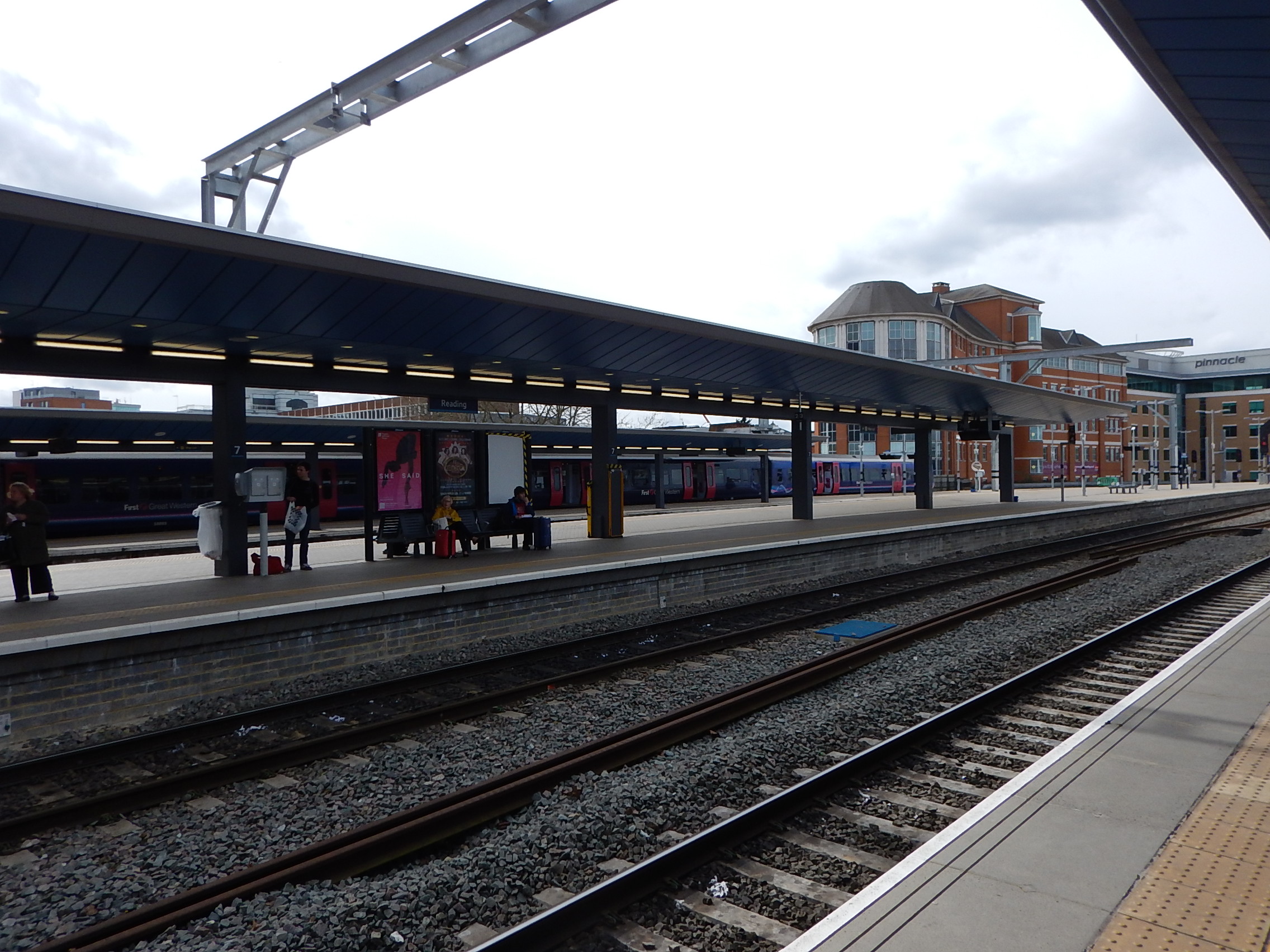
Platform Length Of The Bay Platforms 1, 2 And 3 At Reading Station
Note the three-car diesel multiple unit in the platform. I haven’t measured the platform, but I think they are long enough for a five car Class 800 train.
Future Use Of The Bay Platforms
At I said earlier the three platforms are used for local services to Basingstoke, Newbury and Bedwyn and reversing Cross Country trains., but there are two major purposes for which the bay platforms might be used.
The Test Track for Class 800 Trains
When the electric track between Didcot and Reading has been energised, it will be used as a test track for the new Class 800 trains. This article from the Witney Gazette gives more details.
The first three trains are due to be shipped to the UK early next year to begin an extensive test programme, which will include high-speed running on the line between Didcot and Reading once the installation of overhead electric power cables is completed later next year.
Roger Ford in the April 2016 Edition of Modern Railways said this.
Energisation for test running is now scheduled for September this year.
So will one of the bay platforms be used to reverse the train?
I’ve no idea! But the showman in me, would certainly do it, just for the publicity it would generate!
On a serious side, tests could also be performed on the train/platform/passenger interfaces.
Charging Platforms for IPEMUs
Great Western Railway would probably want to get their Class 387 trains into revenue service as soon as possible.
In the September 2015 edition of Modern Railways, there is an article entitled Class 387s Could Be Battery Powered. This is said.
Delivery as IPEMUs would allow EMUs to make use of as much wiring as is available (and batteries beyond) while electrification pushes ahead under the delayed scheme, and in the longer term would allow units to run on sections not yet authorised for electrification, such as Newbury to Bedwyn. The use of IPEMUs might also hasten the cascade of Class 16x units to the west of the franchise.
To run IPEMUs from Reading to Bedwyn or Basingstoke, would need them to be charged.
These bay platforms would be ideal for charging the trains and would mean that Basingstoke, Bedwyn and Newbury would get electric shuttles to Reading.
Conclusion
The team that designed Reading station, deserve a few gold stars.
Azuma Has Arrived
This article on Global Rail News is entitled Richard Branson unveils Virgin East Coast’s ‘Azuma’ Class 800/1.
You wouldn’t expect Branson to play second-fiddle to Great Western Railway on new trains.
Azuma means East, so will GWR give them a name that means West in Japanese?
Adonis Promises Milk And Honey In The Future, But The North Needs Unblocking Now!
I don’t have much time for Lord Adonis, as I always think that unelected politicians who change sides are a bit like the Vicar of Bray.
And lets face it, he was part of Tony Blair’s gang of idiots, who felt that licking Dubya’s arse and making war in Afghanistan and Iraq was more important than creating proper transport links across the north.
But they were only following the lead set by Harold Wilson, when he cancelled the Picc-Vic Tunnel. Wikipedia says this about how the need for the tunnel has been and is being fulfilled.
In 1992, the Metrolink system opened and linked both stations via tram, negating the requirement for a direct rail connection to an extent. In 2011, the Ordsall Chord was announced; it is an overground railway scheme designed to directly link Manchester Piccadilly and Manchester Victoria in a comparable fashion to Picc-Vic.
Wouldn’t it have been better to dig the tunnel in the first place?
I heard Lord Haskins and Chris Hyomes from Railfuture on Wake Up To Money this morning and they were aggressive in demanding that something happen sooner rather than later.
After my last trip to Huddersfield and writing Welcome To Huddersfield, I can say, that the Class 185 trains are a sick joke inflicted on the North by Tony Blair as Prime Minister and Gordon Brown as Chancellor. The trains are both too short and to few in number.
And then we have Lord Adonis saying on BBC Breakfast, that the line needs to be electrified as soon as possible.
So how long will the misery of the TransPennine routes continue before the line is electrified? 2022 is mentioned!
In my view there are four solutions for acceptable trains across the Pennines.
- Introduce the first bi-mode Class 800 trains on the route.
- Introduce the first bi-mode Class 800 trains on the East Coast to release InterCity 125s for the route.
- Introduce some locomotive-hauled stock.
- Create Class 387 trains with an IPEMU capability, so they could use energy storage to bridge the electrification gaps.
One of these must be implemented before the end of this year.
The first two options are impossible, as the Class 800 trains won’t be ready for passenger service until 2017.
I also think that Option 3 would be unacceptable to passengers, but is probably impossible, as there are no modern diesel locomotives available and probably very few coaches in good condition.
So we’re left with the Class 387 IPEMUs.
- They are modern four car electric trains, with everything passengers expect. Only wi-fi is missing.
- The IPEMU technology was successfully demonstrated in early 2015 using a Class 379 train.
- I rode the demonstrator and was impressed for what that is worth!
- Bombardier have won awards for the technology.
- There are well upwards of twenty four-car trains available or being built, that could be modified.
- There are rumours that IPEMUs could be used on the Great Western.
- They can work in eight or twelve car trains, where platforms allow.
- They can travel for over fifty miles on battery power, after charging on electrified track. So Leeds to Manchester is no problem!
- Liverpool to Newcastle and Edinburgh via Leeds could be served by 110 mph electric trains.
Would a Northern Powerhouse built on battery trains be acceptable to politicians?
In my view, it will have to be, as Derby-built Bombardier Class 387 trains with an IPEMU capability are all we’ve got.
I shall be listening to George Osborne tomorrow!
A Trip To Cardiff
Yesterday, I went to Cardiff to see Ipswich lose to Cardiff City.
These are some pictures I took on the way.



I think it is true to say that the electrification is being put up by snails and there seems to be little progress since I wrote Passing Didcot Power Station twelve months ago.
Note the following.
- Very little seems to be happening around Reading station, except the erection of a few masts.
- The cause of a lot of the trouble – the HOPS train at Swindon.
- The depot for the Class 800/801 trains at Filton Triangle.
- The extra platforms at Cardiff Central station.
- The work at Cardiff to create a new Central Square.
A lot of the work, that is this side of Bristol, is a total disaster.
 The Anonymous Widower