Crossrail Gets More Good Publicity
The third most visited story on the BBC’s web site today, is this story about Crossrail. Here’s the first paragraph.
Skeletons unearthed in London Crossrail excavations are Black Death victims from the great pandemic of the 14th Century, forensic tests indicate.
The story is even the subject of a Channel 4 program on April 6th.
Crossrail is certainly showing how to use archaeology as a publicity tool.
Crossrail Goes To Reading
I talked about this happening in this post nearly a year ago.
Now according to various reports like this one in Modern Railways, it’s going to happen.
I do think sometimes that the planning of Crossrail wasn’t done by those possessed of great imagination, unlike some of those involved in the actual building of the railway.
Extending to Reading would appear to be an improvement that doesn’t need much new infrastructure or trains.
If you look at extending the Shenfield branch of Crossrail, there is no suitable station, as the only large conurbation; Chelmsford has a very cramped station.
The Station Is Rising At Custom House Station
Some of the supports for the Crossrail station at Custom House have now been erected.
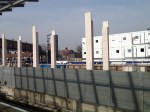

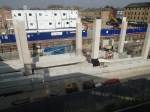

I met two Laing O’Rourke engineers, who were working on the project on the bridge and they said that in three months, a lot of the station will have been assembled.
They also said that the finish of the concrete was much better having been built in a factory than if it had been made on site.
Crossrail’s Portals To The Past Exhibition
Crossrail have opened another exhibition called Portals To The Past, showing the various archaeological discoveries they have made.

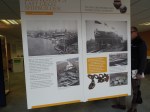
It wasn’t as large as last year’s exhibition, but nevertheless, if you’re in the area it’s worth a look.
There was also a knowledgeable engineer answering questions.
The Bridge Over The Gipping
I took this picture of the bridge that has been built to take the Bacon Factory Curve over the River Gipping.
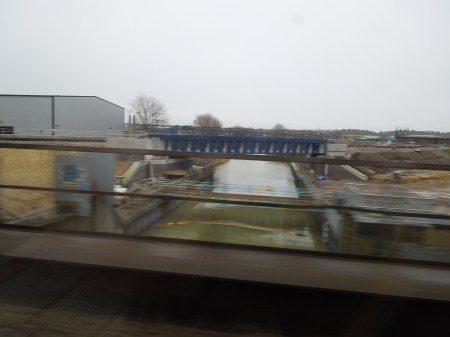
The Bridge Over The Gipping
The works seem to be getting on well and there were gangs of men laying the concrete sleepers for the two tracks, as I passed.
Network Rail were going to close the West Coast Main Line in the Watford area for track works this Summer and in February next year. But these closures have been cancelled, according to this article in Modern Railways. It looks like that some nifty project management has been applied. So often this type of major project ends up causing troubles all round, as the project management is non-existent.
Here, Network Rail deserve praise, especially, if it works out as planned.
A Victory For Good Project Management
Network Rail were going to close the West Coast Main Line in the Watford area for track works this Summer and in February next year.
But these closures have been cancelled, according to this article in Modern Railways.
It looks like that some nifty project management has been applied.
So often this type of major project ends up causing troubles all round, as the project management is non-existent.
Here, Network Rail deserve praise, especially, if it works out as planned.
Hackney On The Rise
BBC Radio 5 asks this morning about views on the economy. I sent them this text.
Three years ago, I retired to Dalston after a stroke stopped me driving. Every month the area gets better and a lot is down to the London Overground, which takes people to jobs, shopping and leisure activities. It shows how investment in transport can improve the lot for us all! Next year Tottenham gets the overground. We live in interesting times.
So has the Overground really improved things?
I first rode the Overground towards the Olympic Park in July 2010, before I moved here in December of that year. Since that first short run, the system has expanded. but gone are the dingy stationsa, dirty trains and lack of staff of the pre-Overground era. The Class 378 trains, started as three cars, but as they couldn’t handle the demand, they were lengthened to four cars and now they’re going to five. Have we ever built a railway, for which much-need extra capacity can be provided so easily?
But the capacity is needed, as more and more people use the line contributing to the affluence and well-being of the areas it serves, like Hackney.
You could call the Overground a rebranding exercise, but that would be unfair. Give a railway line, better clean stations, reliable frequent trains, visible staff and a simple ticketing system and the passengers will arrive. Visitors will also come and bring prosperity to an area.
London will use the Overground to run trains on the Lea Valley Lines to Tottenham, Enfield, Cheshunt and Chingford. North East London will surely be on the up.
One of the great things about the way the Overground is implemented, as effectively a rebuilt, resignalled and fully-staffed train line first with a deep clear of trains and stations and Oyster ticketing, means that the concept can be brought in, in affordable stages.
I suspect that the Lea Valley lines have a good enough line and signalling for a few years, so it’ll be the grotty and unstaffed stations, and the ticketing, that get the most attention at first. As new Cl;ass 378 trains are delivered, they can of course be run in combination with the ageing Class 315 trains on the lines at present, as their bigger brother, the Class 379 does already. Dripping new trains in surely gives passengers hope that something is happening to improve their dismal line.
With a grand project like Crossrail, you only see the improvement, when the line opens. With the Overground, the upgrade is continuous and now the London boroughs seem to be getting involved in the development of the stations, many of which are on prime sites.
I suspect that the way the Overground has been implemented could be applied to various train lines around the country. The Cambridge to Ipswich line, which I know well could benefit, especially if the main line was electrified for freight and the various councils got involved, to facilitate the development of the stations. Bury St. Edmunds station, is a classic, where a good architect could create a mixed housing and commercial development that did justice to the town.
I believe that if you get the railway right, then the investment and development around stations will follow.
Changes At Tottenham Hale
Tottenham Hale station and the associated bus station, is an important transport interchange in North London. It suffered badly in the August 2011 riots, but some would claim that the 1960s design of the area was better after the modifications.
I went there today to go to the Staples, as that is my nearest. I was surprised to see that the bus station has now been demolished and work is starting on a major upgrade of the station and the roads in the area. there’s a lot more about it, with some good maps here on the TfL website.
My first thought was about time too! Hopefully, those that have demolished the bus station, will move on to Highbury and Islington station next.
Is This Going To Be A Beautiful Roof?
The roof on the Canary Wharf Crossrail station is coming on, as these pictures show.
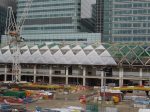
Is it going to be a beautiful roof, using some of the best technology at our disposal?
After all, when Barlow, Brunel and Cubitt created their grand stations, they used the best and created masterpieces for us to enjoy nearly two centuries later.
Will they be joined by some modern masterpieces from Crossrail?
 The Anonymous Widower