SSE Comments On COP28
The title of this post is the same as that of this press release from SSE.
SSE Chief Executive, Alistair Phillips-Davies, said:
“We knew going into COP28 that the world wasn’t moving fast enough to decarbonise. The commitment to triple renewables by 2030 is welcome, as is the inclusion, for the first time, of explicit language on the need to transition away from fossil fuels.
“Codifying and securing international endorsement for ambitions like these is very welcome; however, the challenge now is to deliver the tangible actions needed to make them a reality.
“In the power sector, this means speeding up policy and decision-making so that it is easier to invest and build the infrastructure we need to actually deliver net zero, from offshore wind farms to electricity grids and flexible power plants.
“At COP28 there was no shortage of businesses willing to invest but there was a common frustration at the pace of progress on the ground, and this is something we need to address for all our sakes.”
I would agree with what he said.
- Especially about speeding up policy and decision-making and delivering more electricity grids.
- The last paragraph probably applies to a lot of countries.
Surprisingly, energy storage is not mentioned.
Could that be because SSE are going down the route, where hydrogen is created and that is either used in gas-guzzling industries to reduce their carbon-emissions or stored until needed?
Fashion Companies Pledge To Invest In Bangladesh First Offshore Wind Project
The title of this post, is the same as that of this article on offshoreWIND.biz.
This is the sub-heading.
Fashion companies, BESTSELLER and H&M Group have pledged to invest in the first utility-scale offshore wind project off the coast of Bangladesh, which is being developed by Copenhagen Infrastructure Partners (CIP) together with local partner Summit Power.
These four paragraphs give a lot more detail.
The announcement was made Tuesday at the ongoing COP28 in Dubai.
The 500 MW offshore wind project, which is in early-stage development, could significantly increase the availability of renewable energy in one of the fashion industry’s most important manufacturing countries, said the non-profit organisation Global Fashion Agenda (GFA).
More than 70 per cent of the fashion industry’s GHG emissions come from upstream activities and current operations predominantly rely on non-renewable energy sources, such as petroleum, gas, oil, and coal, said GFA.
To ensure and accelerate decarbonisation, GFA is advocating collective investments by fashion brands in new renewable energy generation.
This would appear to be one of those circular stories, where a lot of parties benefit.
- There will be less greenhouse gas emissions from manufacturing in Bangladesh.
- Jobs will be created in the renewable energy industry in Bangladesh.
- The fashion industry gets product with a smaller carbon footprint.
- The fashion industry gets a safe investment for its spare cash, that improves their product.
It might also create an industry in Bangladesh, that makes steel structures for the world’s offshore wind industry.
But consider.
- As of June 2022, Bangladesh had 25.7 GW of electricity generation.
- Much of Bangladesh’s electricity is generated by gas.
- Bangladesh is aiming for a 7 % growth rate so will need a lot more electricity.
500 MW is literally a drop in the ocean.
This Goggle Map shows most of Bangladesh and the location of the wind farm, by Cox’s Bazar, which is marked by a red arrow.
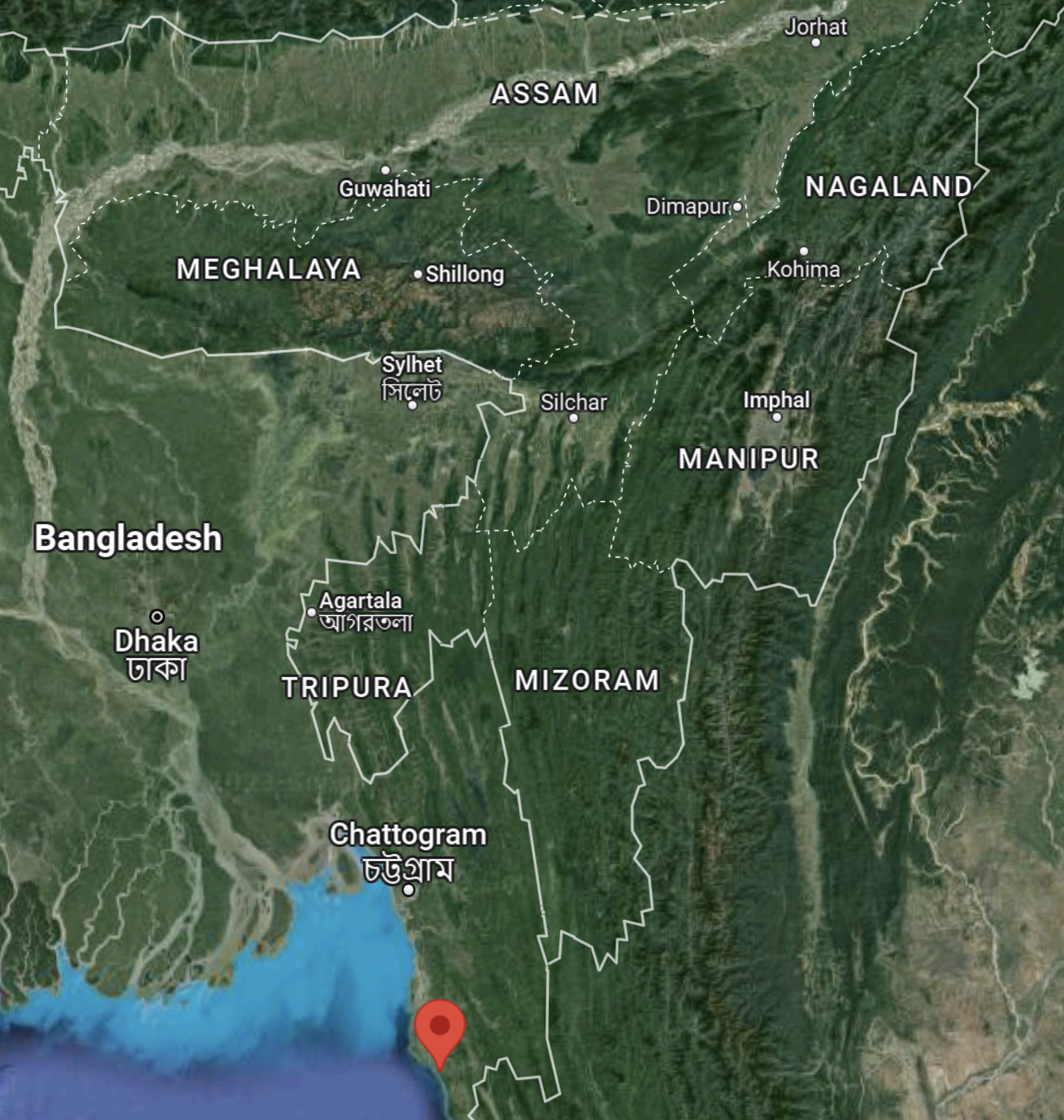
I shall be interesting to see how this and other similar projects develop.
RWE Partners With Masdar For 3 GW Dogger Bank South Offshore Wind Projects
The title of this post, is the same as that of this article on offshoreWIND.biz.
This is the sub-heading.
RWE has signed an agreement with UAE’s Masdar as a partner for its 3 GW Dogger Bank South (DBS) offshore wind projects in the UK.
These three paragraphs outline the deal.
The partners acknowledged the signing of the new partnership during a ceremony at COP28 in Dubai.
Masdar will acquire a 49 per cent stake in the landmark renewables projects while RWE, with a 51 per cent share, will remain in charge of development, construction, and operation throughout the life cycle of the projects.
RWE’s proposed DBS offshore wind project is made up of two offshore wind farms, Dogger Bank South East and Dogger Bank South West (DBS East and DBS West), each 1.5 GW, which are located over 100 kilometres offshore in the shallow area of the North Sea known as Dogger Bank.
Note.
- Masdar is an energy company headquartered in Abu Dubai.
- The Chairman of Masdar is President of COP28.
Does this deal indicate that wind farms are good investments for those individuals, companies and organisations with money?
 The Anonymous Widower