Heathrow Bid To Duck ‘£40m’ Crossrail Bill
This is the title of a small article in the Business section of today’s Sunday Times
Heathrow is annoyed that the Office of Rail and Road rejected their plan to charge every train that uses the line to the Airport, £597, with a maintenance charge of £138,
So they are going for a judicial review.
This is the last sentence of the article.
It (Heathrow) argues that it is unfair to make air passengers – who may never use Crossrail – subsidise the new line.
Consider.
- If passengers use Crossrail, this will mean they won’t have to pay the high prices on the expensive Heathrow Express, which only takes you to the inaccessible-for-many Paddington.
- Crossrail will be the route of choice of many passengers to and from Heathrow. As an example, three out of four of my closest stations will be a single change via Crossrail to Heathrow.
- When Crossrail opens, I suspect only unknowing and the rich will use Heathrow Express.
- Did Crossrail pay for the new Stockley Viaduct, which will increase capacity on the route to Heathrow?
- Many passengers, who have Freedom Passes (As I do!), won’t put Heathrow on their list of London Airports, unless they get free travel to the Airport on Crossrail. Boris promised it!
- Will passengers be able to use contactless ticketing to Heathrow Airport, as they can to Gatwick?
With the decision on the next South East runway to be made this week, Heathrow seems to be reinforcing the view that many hold of the Airport – It operates in a selfish culture, that is more about profits, than passengers, the Airport’s many neighbours and the environment.
A Short Walk Around Ilford Station
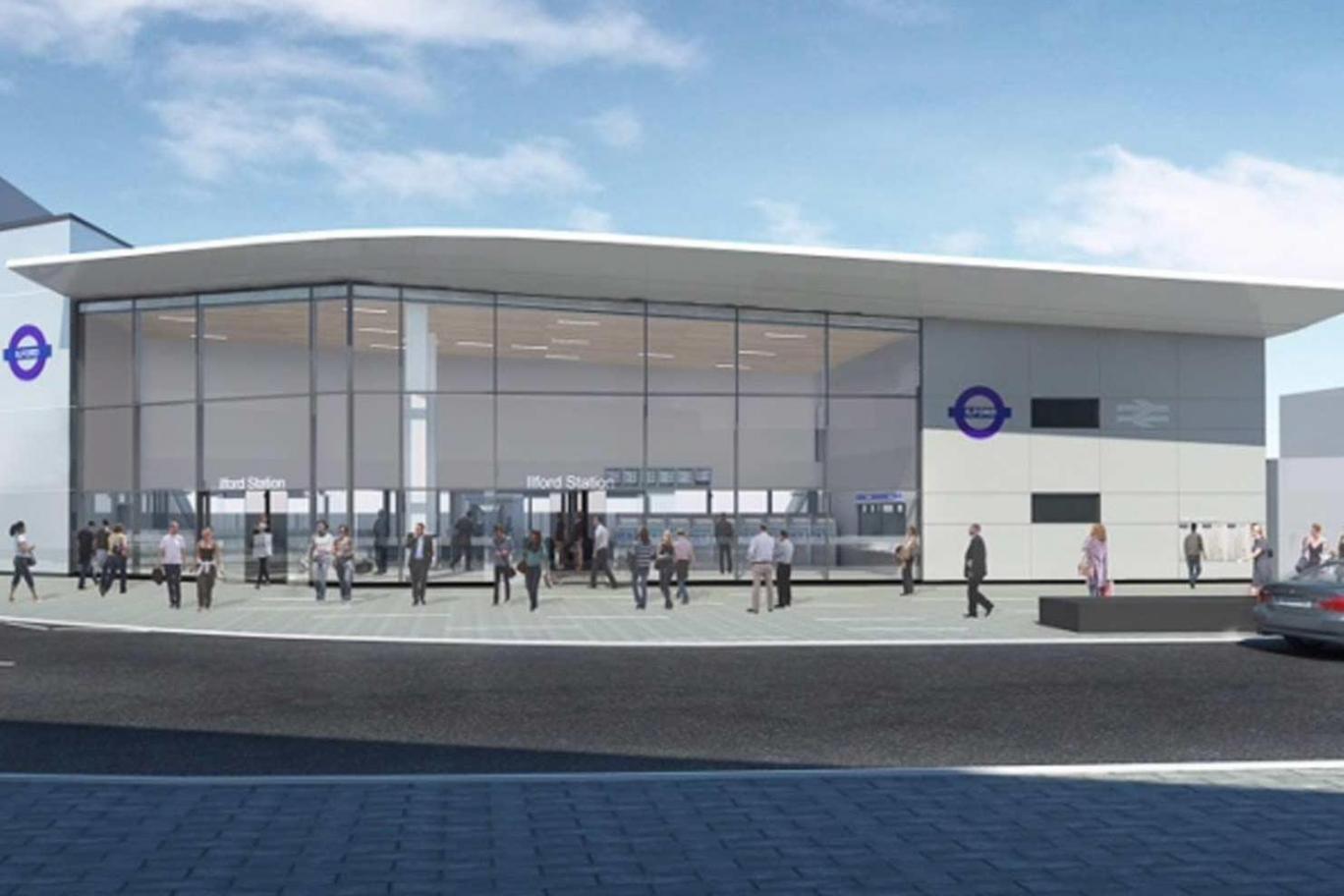
Several reports like this one in New Civil Engineer, have talked about a rebuild of Ilford station for Crossrail. This picture shows how it could look.
As the station now has a new entrance on York Road, I went for a walk around the station.





I walked up the stairs at the London end of the station, through the new entrance and then circled to the front entrance, where I reentered the station.
This Google Map shows the station.
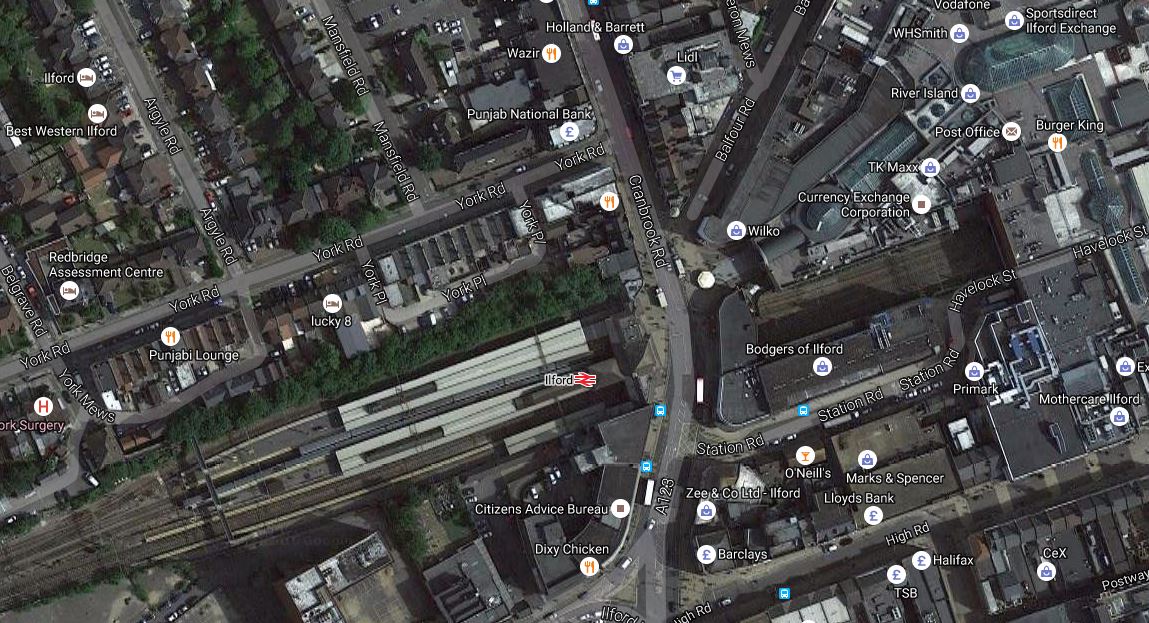
Ilford Station And The Town Centre
If the standard of the York Road entrance to the station is anything to go by, I think that Ilford will have a last laugh in all those Essex jokes.
I wonder how much the footfall in the Exchange Shopping Centre will increase when Crossrail opens.
Will c2c Push For Access To Stratford And Liverpool Street?
On Sunday in An Excursion To Shoeburyness, I indicated how instead of coming back the way I came via West Ham, I got off at Stratford and did some shopping at Eastfield.
But would c2c like to serve Stratford and Liverpool Street more?
The Current Weekend Service From Shoeburyness To Stratford And Liverpool Street
Currently two trains per hour (tph) run from Shoeburyness to Stratford and Liverpool Street at weekends, when there is no conflicting engineering work.
Incidentally, with my excursion, I think that I had to come back by c2c as the Great Eastern Main Line was closed for Crossrail work.
If nothing this engineering disruption shows the value of Southend being served by two independent rail lines.
The Stratford Effect
The Queen Elizabeth Olympic Park and the Shopping Centre at Stratford will have a porofound effect on the operation of c2c’s trains.
This page on the c2c web site is entitled Christmas shoppers get direct c2c trains to Stratford.
This is said.
c2c will run two trains an hour on both Saturdays and Sundays that divert to Liverpool Street instead of Fenchurch Street. These will provide direct access to the Westfield Stratford City shopping centre plus easy access to London’s West End. This is in addition to the two trains an hour that run to Chafford Hundred, for the Lakeside shopping centre, as part of c2c’s existing service.
I think the news item dates from 2014, but it does show a level of intent.
There is also this article in the Southend Echo, which is entitled Extra trains planned as West Ham’s stadium move puts added pressure on c2c network.
This is said.
TRAIN operator c2c are running extra and longer trains for fans travelling to West Ham matches at the club’s new stadium in Stratford.
This won’t be a problem for weekend matches, but what about matches on weekday evenings?
c2c’s spokesman went into more detail.
When asked about direct trains running from Southend to Stratford to make the journey as quick and simple as possible for fans, c2c said they already run direct trains to Stratford from Southend and Basildon,but not Grays, and there will be two trains per hour direct to Stratford most weekends – and two more trains per hour to West Ham.
From Grays, all four trains an hour go to West Ham.
For weeknight games and during weekend engineering work, all trains run to West Ham.
At present, the weekend trains between Shoeburyness and Stratford, satisfy the weekend sopping and football, but what about other events at the Olympic Park? The Queen Elizabeth Olympic Park is only going to get busier.
So are the current services really what c2c and its customers want and need?
Car parking is fairly comprehensive at the outer stations according to this page on the c2c web site.
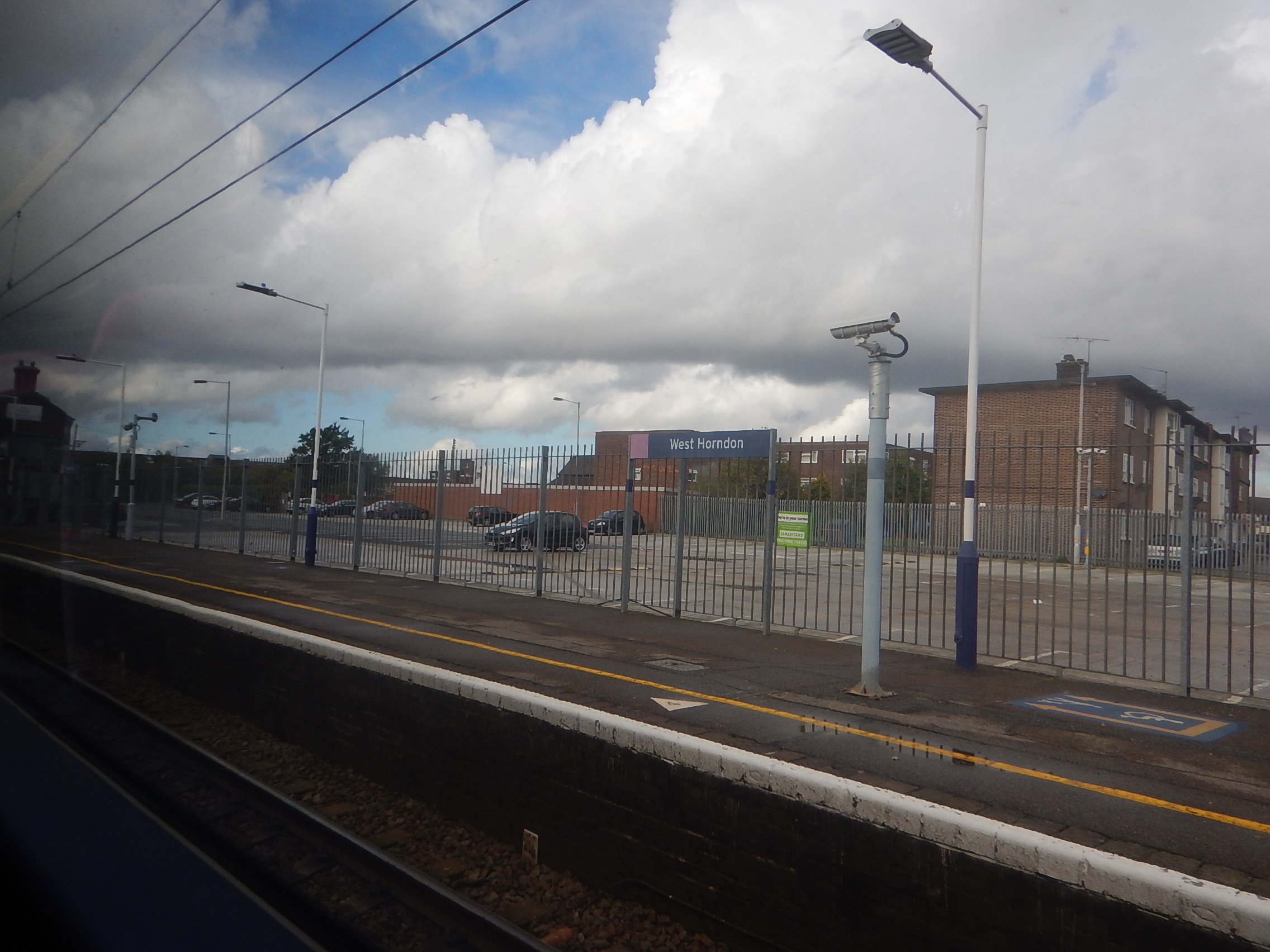
It wasn’t very busy on the Sunday I took this picture at West Horndon station, but for encouraging weekend leisure trips, the availability of car parking must be an asset.
I would imagine that c2c are pushing the authorities for permission to run evening services into Liverpool Street via Stratford.
The Crossrail Effect
When you talk about any of London’s railways, this herd of elephants, with its 1,500 passenger capacity Class 345 trains, always bursts into the room.
For c2c trains to get to Stratford, they need to take the Gospel Oak to Barking Line (GOBlin) between Barking and Woodgrange Park, where they join the slow lines into London.
This map from carto.metro.free.fr shows the lines around Woodgrange Park station.
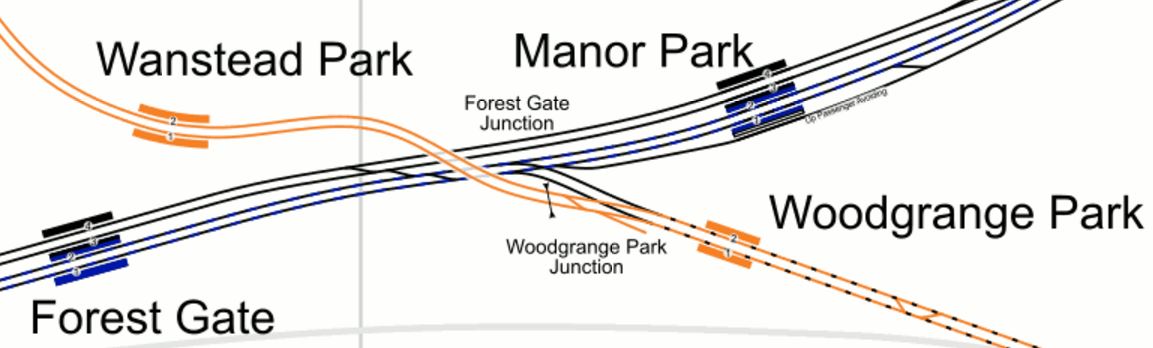
As the GOBlin is currently being electrified and improved, I suspect that there will be no operational problems on the short stretch of shared line.
Will there be problems though, after Crossrail opens and there are increased frequencies of trains to and from London?
In the Peak, Crossrail will be running 16 tph to and from Shenfield, so as they are only running 8 tph in the Off Peak, I suspect that at weekends, there will be capacity for c2c’s 2 tph to Stratford.
It is interesting to look at Crossrail’s proposed Peak service on the Shenfield branch.
- 8 tph between Shenfield and Paddington
- 2 tph between Shenfield and Reading
- 2 tph between Shenfield and Maidenhead
- 4 tph between Gidea Park and Liverpool Street
This says to me, that there are probably paths in the timetable to squeeze 4 tph in the Off Peak into Liverpool Street, as the Gidea Park service is Peak-only.
Access To Liverpool Street
Liverppool Street station has two problems.
- There are not enough platforms – This is a difficult one to solve, although Crossrail might only need a single platform to handle the limited number of services not going through the core tunnel. London Overground regularly turns 4 tph in a single platform.
- The platforms are too short – This will be remedied once Crossrail trains are using the core tunnel.
I’m certain, that in a few years Liverpool Street in the Off Peak, will be able to handle 2 tph with a length of 12-cars for c2c.
It is interesting to note, that my train on Sunday was only eight-cars. Was this because of limitations at Liverpool Street?
Should c2c Stop At Woodgrange Park?
Currently, they don’t, but after the GOBlin is reopened would it be a good idea to create a step-free change to get to and from a lot of stations across North London.
The change at Barking between the two lines is not easy and the alternative is to improve it.
c2c Needs Access To Crossrail
c2c’s current route structure has no connection to Crossrail.
As an example to go from West Horndon to Heathrow Airport, you’d need to change twice.
- At West Ham onto the Jubilee Line.
- At Stratford onto Crossrail.
Neither change is a short walk, but both are step-free in busy stations.
If however, it’s a Saturday or Sunday, you could take a train to Stratford and I suspect when Crossrail opens, just wait on the same platform until a Heathrow train arrives.
It should be remembered, that c2c runs an all-Electrostar fleet and I suspect that these are Crossrail compatible with respect to platform height, so the change at Stratford would be easy with heavy cases, buggy or even a week-chair.
What Will The Future Hold?
From what I have written, it would certainly be possible for there to be two 12-car trains every hour in the Off Peak between Shoeburyness and Liverpool Street calling at Basildon, Upminster and Stratford.
But this would have limitations and possible problems.
- Passengers from stations like Grays would want the Crossrail connection too!
- If it is needed in the Off Peak, is it needed in the Peak?
- Would passengers changing at Stratford cause congestion?
There would also be the mother of all battles between the train companies involved, to make sure they kept market share.
My ideal world scenario would be something like.
- 4 tph all day go into Liverpool Street.
- 2 tph on both c2c routes through Basildon and Grays go into Liverpool Street.
- Chafford Hundred is served from Liverpool Street
- Ticketing is such, that Stratford to Southend can use either route and either Southend station.
- c2c trains to and from Liverpool Street, call at Woodgrange Park for the GOBlin.
My wish list may not be possible, but there is certainly tremendous scope for improvement.
We could even see, a station like Grays, Pitsea or Southend becoming a Crossrail terminus.
Who knows? I don’t!
West Ealing Station – 12th October 2016
I took these pictures at West Ealing station.



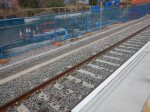


It looks like the new bay platform 5 is ready, but little progress seems to have made on the new station building.
There’s still no information, as to when the service on the Greenford Branch, becomes a four trains per hour (tph) shuttle.
What we do know is that this page on the Crossrail web site has some nice images of the station, that will rise behind the hoardings.
Wikpedia says that initial services on Crossrail will be.
- 4tph Abbey Wood to Heathrow Terminal 4
- 2tph Shenfield to Reading
- 2tph Shenfield to Maidenhead
There will also be another 2 tph running between Abbey Wood and West Drayton in the Peak.
All this in addition to other Great Western Railway services running to and from Paddington.
Services On The Greenford Branch
Passengers on the Greenford Branch will have to change to get to and from Paddington and I suspect some will moan.
But for many passengers from Greenford to the West End, the City or Canary Wharf, they will have an easier journey with just one change at West Ealing.
Consider.
- The Greenford Branch shuttle frequency of 4 tph fits well with the Crossrail and Paddington services.
- I suspect that every shuttle arriving from Greenford will arrive so that passengers for London can just walk across the platform and get a train to Central London.
- The maximum wait for a Crossrail train to Liverpool Street will be seven and a half minutes all day.
- If passengers need to cross between the shuttle platform and the Westbound Crossrail platform there will be a bridge with stairs and a lift.
These are the timings before and after Crossrail opens between Greenford and Liverpool Street.
- Currently, using the Metropolitan Line across Central London – 66 minutes
- Crossrail and the shuttle – 31 minutes plus how long it takes to change trains at West Ealing.
Greenford to Canary Wharf gives these timings.
- Currently, changing to the Underground at Paddington – 75 minutes
- Crossrail and the shuttle – 37 minutes plus how long it takes to change trains at West Ealing.
And these timings apply between Greenford and Heathrow Terminal 4.
- Currently, changing at Ealing Broadway – 54 minutes
- Crossrail and the shuttle – 28 minutes plus how long it takes to change trains at West Ealing.
I suspect that each 4 tph shuttle will be timed to arrive at West Ealing, so that someone with a child in a buggy and a heavy case has time to cross the line using the bridge and the lifts.
Trains On The Greenford Branch
The Greenford Branch is not electrified and there seem to be no plans to electify the whole line.
But if you look at the pictures, that I took yesterday, you’ll see the foundations for the gantries are there to electrify the bay platform 5 .
Initially, the shuttle will have to be run by something like the current Class 165 trains.
Simple mathematics says that to provide a four tph shuttle two trains will be needed.
There would be no major infrastructure changes, as the line is mainly double-track, so the trains could probably pass easily. But there might need to be an additional crossover to allow trains to run on the correct line.
But these trains have their problems, which were illustrated yesterday, when a fit young lady with a toddler in a buggy didn’t board the train as fast as she would have done at a typical Overground station with a modern Class 378 train.
As Crossrail will be run to a tight schedule, I doubt that TfL want serious loading delays with wheelchairs, buggies and heavy luggage.
So this means that modern trains must be provided on the Greenford Branch.
There has been a lot of speculation on the Internet, that the Greenford Branch, like the Romford to Upminster Line in the East of the capital, should become part of the London Overground.
This might be a sensible idea, especially as London Overground from 2018 will have some spare modern weheelchair-friendly Class 172 trains,, once the Gospel Oak to Barking Line is fully electrified and running new electric Class 710 trains.
On the other hand, the fleet of eight Class 172 trains, will probably be very much in demand by other train operating companies, as with a change of seats, they’d be ideal for many routes outside of London.
As Baldrick would say, there is a cunning plan, that could be enabled.
The platforms at West Ealing station are all being made step-free for the two types of trains that will use them; Crossrail’s 345s and GWR’s 387s.
This applies to all of the Western Crossrail stations and looking at the bay platform 5 at West Ealing, that has been built to the standard height.
So this would mean that GWR’s 387s would be able to use the platform, once it is electrified, which looks like is happening.
But these trains wouldn’t be able to use the branch, unless it was electrified.
However, London Overground’s new Class 710 trains, would also fit the bay platform.
The Class 710 train, like Crossrail’s 345 are members of Bombardier’s new Aventra family of trains.
As Bombardier demonstrated battery trains in public service nearly two years ago, there has been speculation that Aventras will have a battery capability to do journeys away from the overhead wires.
This is the best information so far!
This article in Global Rail News from 2011, which is entitled Bombardier’s AVENTRA – A new era in train performance, gives some details of the Aventra’s electrical systems. This is said.
AVENTRA can run on both 25kV AC and 750V DC power – the high-efficiency transformers being another area where a heavier component was chosen because, in the long term, it’s cheaper to run. Pairs of cars will run off a common power bus with a converter on one car powering both. The other car can be fitted with power storage devices such as super-capacitors or Lithium-Iron batteries if required.
Bombardier have confirmed the wiring for onboard power storage to me.
Consider use of Class 710 .
- The length of the Greenford Branch is just 4.3 km., so out and back from West Ealing should be within the typical 50 km. range quoted for battery trains.
- The batteries could be used to handle regenerative braking at the various stops to save electricity.
- There would be no need to put up any overhead wires on the branch.
- The Class 710 trains are four-car trains, so would be sufficient capacity for the medium future.
- The Class 710 trains are optimised to call at stations in the shortest time possible. So could we see a faster service on the branch?
- The Class 710 trains are friendly to wheelchairs, buggies and heavy luggage.
- The Class 710 train would just look like a mini-Crossrail train.
- Bombardier would love to have a live demonstration of their battery technology on a line close to Heathrow Airport.
I wouldn’t be surprised to see London Overground taking over the Greenford Branch and using Class 710 trains running on batteries on the route.
Will Crossrail And Its Class 345 Trains Set Mobile Connection Standards For The UK?
Search for “Class 345 trains 4G” or “Class 345 trains wi-fi” and you find reports like this on London Reconnections about the Class 345 train.
This or something like it, is said in several of these reports.
According to the accompanying press notes both free wifi and 4G services will be delivered on board, as will multiple wheelchair and luggage spaces.
It would be very embarrassing for London’s flagship multi-billion pound project, if it wasn’t correct.
So it would appear that I could board a Class 345 train at Shenfield and watch a video all the way to Heathrow or Reading.
But where does this leave Thameslink?
Their Class 700 trains have been designed without wi-fi, 4G and power-sockets as I said in By Class 700 Train To Brighton And Back.
But at least Siemens felt that the Department for Transport, who ordered the trains, were out of step with reality and appear to have made provision to at least fit wi-fi.
This article on Rail Engineer is entitled Class 707 Breaks Cover and it describes the Class 707 train, which is a sister train to the Class 700. This is said about the two trains and wi-fi and toilets.
Thameslink (or the Department for Transport which ordered the trains) decided not to include Wi-Fi in the Class 700s, a questionable decision that has now apparently been reversed. Fortunately, Siemens had included the technology framework in the design so, hopefully, the upgrade will not require too much effort. Suffice it to say that South West Trains has included Wi-Fi in its specification for Class 707s.
Reversing the story, Thameslink Class 700s are all fitted with toilets. However, South West Trains has decided not to include toilets in its Class 707 specification given that the longest journey time is less than one hour and their inclusion would reduce the overall capacity of the trains.
So it appears that Siemens may have future-proofed the trains.
This article on the Railway Gazette describes the third fleet of the Siemens trains; the Class 717 trains for Moorgate services. This is said.
Plans for the installation of wi-fi are being discussed with the Department for Transport as part of a wider programme for the GTR fleet.
So at least something is happening.
But how close will mobile data services get to the ideal that customers want.
- 4G everywhere from the moment you enter a station until you leave the railway at your destination station.
- Seamless wi-fi, so you log in once and your login is valid until you leave the railway.
It will be tough ask to achieve, as it must be valid on the following services.
- Crossrail
- Thameslink
- London Overground
- London Underground
- All train services terminating in London.
And why not all buses, trams and taxis?
On a related topic, I believe that for safety and information reasons, all bus and tram stops and railway stations must have a quality mobile signal and if it is possible wi-fi.
One life saved would make it all worthwhile.
The Crossrail Mile End Park Ventilation Shaft Is Revealed
The hoardings have been partially removed from the Crossrail Mile End Park Ventilation Shaft.
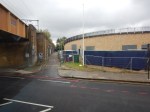


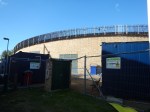

The top line of pictures were taken from the top of a 277 bus, whilst the others were taken a day later from the ground.
It’s certainly starting to look like the visualisation.

This humble ventilation and evacuation shaft could be one of the most-copied features of Crossrail.
A Walk From Moorgate To Liverpool Street Station
This morning, I walked from Moorgate to Liverpool Street station, when it was quiet.



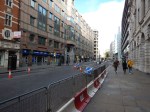




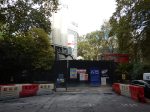
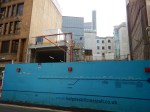


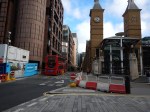



I took a route through Finsbury Circus, and was thus able to look at the various Crossrail works in the area.
These are some comments about the area, often based on this page on the Crossrail web site, which details the urban realm around Crossrail stations in the City of London.
Moorgate
Moorgate station will be much changed from the current station.
Reading the Crossrail web site, gives the impression that the majority of passengers will generally walk to the station from perhaps their office, a bus or a taxi. This is said.
- Reducing carriageway width in Moorgate and increasing footway space.
- Introduction of a central pedestrian median in Moorgate to improve crossing at a key pedestrian crossing point and improve accessibility for all users.
- A new pedestrianised public space will be created on Moorfields between New Union Street and London Wall, with access limited to emergency and service vehicles only.
- Moorfields south of Moor Place will act as a ‘secure zone’ outside the new station entrance in which vehicles access will be controlled via station controlled retractable bollards.
- Away from the raised carriageway areas regular kerb heights are retained in close proximity to the station entrance in Moorfields, Moorgate and Fore Street which allow for comfortable boarding of taxis via wheel chair ramps. The closest regular height kerbs to the station are located approximately 30m from the station entrance on Moorfields and Moorgate.
All is part of a wider plan in the City of London, which will probably result in a more pedestrian- and cyclist-friendly city.
Buses On Moorgate
Nothing is said about buses on Moorgate, which are important to me, as they stop at the end of my road, with Northbound and Southbound stops within a hundred metres of my house.
I have two main bus routes, that will take me to and from Moorgate; the 21 and the 141.
I can remember as a child the London trolleybuses, one of which was the 641, which was replaced by the 141 bus.
This link shows where the Balls Pond Road and Mildmay Park cross about sixty years ago and the present day, perhaps seventy metres from my house.
I find it very convenient.
Moorgate is served by four main bus routes; the 21, 43, 76 and 141, all of which except the 76 go between Bank and Old Street stations.
I don’t know how the buses will be reorganised after Crossrail, but I suspect that the current stops will be used initially and only changed, when a new pattern of use emerges.
Crossrail and the Moorgate rebuild could effect the buses in several ways.
- Many new passengers will get a bus to and from Moorgate.
- I would suspect that Crossrail could cut the number of private cars in the centre of London.
- The better walking route to Liverpool Street station in the dry, might mean more bus passengers.
- The improved Great Northern Metro might increase or reduce passengers using the buses at Moorgate.
- Moorgate’s taxi-friendly design, may mean the station get choked by back-cabs and Uber.
\the rebuilding of Bank and London Bridge stations will also have an effect.
I suspect Transport for London, suspect what is going to happen, but the reality will only be found, when all the new lines, stations and walking routes are open.
Finsbury Circus
Finsbury Circus is an oasis in the City and Crossrail will hand it back after completion, with a hopefully-tasteful ventilation shaft in the middle.
Black Redstarts
Black Redstarts are quite a rare bird in the UK, but it appears that London has a population.
A notice in Finsbury Circus Gardens gave more details.
The Central Line
The Central Line isn’t built deep under buildings in central London, but it goes under the roads. At Liverpool Street station, I get the impression that it ran between the station and the next door Broad Street station (now Broadgate), before going South under Old Broad Street and then curving to the West under Throgmorton Street to go to Bank station.
You can get an impression of the depth of the Central Line from the length of the escalators at Liverpool Street station.
This extract taken from the Wikipedia entry for the Central London Railway, which was the predecessor of the Central Line, describes the construction of the tunnels.
To minimise the risk of subsidence, the routing of the tunnels followed the roads on the surface and avoided passing under buildings. Usually the tunnels were bored side by side 60–110 feet (18–34 m) below the surface, but where a road was too narrow to allow this, the tunnels were aligned one above the other, so that a number of stations have platforms at different levels. To assist with the deceleration of trains arriving at stations and the acceleration of trains leaving, station tunnels were located at the tops of slight inclines.
So you have a stack of lines and tunnels at Liverpool Street station.
- Close to the surface is the Metropolitan and Circle Lines going across the front of the station, roughly East-West
- 18-34 metres down the Central Line runs perpendicularly to the sub-surface lines.
- Crossrail is the deepest line in an East-West direction.
Crossrail is also building a pedestrian walkway in an East-West direction, that goes under the Central Line and above the level of the Crossrail running tunnels.
Are Crossrail Developing A Philosophy For Linking With Other Lines?
I have now written some posts about rail lines that have strong connections to Crossrail.
- In The Great Northern Metro, I described how a Great Northern Metro was being developed that had a very strong connection to Crossrail at Moorgate.
- In Extending Crossrail To Gravesend, I showed how Crossrail was having multiple effects along the North Kent Line.
- In The Future At Shenfield Station, I reprinted some comments, which said that Shenfield will become an important interchange.
All are different solutions, individually designed for the interchange.
Crossrail At Reading
If you look at the Reading station page on the Crossrail web site, nothing of substance is said, except the obvious.
Reading station requires relatively little work to prepare for the new Elizabeth line service.
But then you’d expect that as Reading station was only reopened after a complete rebuild in 2014. If the station hadn’t been designed to accept Crossrail efficiently, it would have been a design disaster of the highest order.
If say you are travelling from Bristol and want to go to say Bond Street you will have two possible routes.
- Stay on the train to Paddington and change to Crossrail there.
- Change to Crossrail at Reading.
I would appear that the change at Paddington is a short walk and an escalator down, but I have read nothing about how you will change trains at Reading.
Will it be a walk across a platform at Reading or an escalator up to the bridge and then another one down?
Judging by the London Bridge experience, I suspect it’ll be the escalator route.
As you have two options for the interchange, I doubt it will take long for passengers to work out what is their best route. They would also have the option to change their mind en route.
Some of the biggest winners will be passengers between say Bristol and stations between Reading and London, as they will probably have a relaxed change at Reading, rather one in a busy Paddington.
Crossrail At Shenfield
A lot of the reasoning at Reading for long-distance passengers applies at Shenfield, as you can change at Shenfield, Stratford and Liverpool Street for many services.
Crossrail At Abbey Wood
Passengers to and from North Kent only have one station to interchange with Crossrail, unlike those from the East and West.
Some information says that it will be a cross platform interchange at Abbey Wood station, but it could be a double escalator transfer.
It should be clear next year, when Abbey Wood station, is more complete.
The High-Frequency Interchange
If you look at stations and the frequency of Crossrail trains to and from Central London in trains per hour (tph) you get.
- Abbey Wood – 12 tph in Peak, 8 tph in Off Peak
- Shenfield – 24 tph in Peak, 16 tph in Off Peak
- Paddington – 24 tph in Peak, 16 tph in Off Peak
- Shenfield – 12 tph in Peak, 8 tph in Off Peak
So certainly going into Central London, you probably won’t have long to wait for a train.
Coming out, you might develop a philosophy if you need to catch a specific train out of Paddington or Liverpool Street.
The tube-like frequency of Crossrail will be a great help to passengers.
Interchange Between Crossrail And The Central Line At Stratford
This double cross-platform interchange is working at Stratford, where the Shenfield Metro and the Central Line have shared a platform, as long as I can remember. It actually dates from 1946.
At present there are 6 tph on the Shenfield Metro and 24 tph on the Central Line.
Crossrail will introduce other high-frequency interchanges like this.
Interchange Between Crossrail And The Great Northern Metro
At Moorgate, the frequencies of the two lines will be.
- Crossrail – 24 tph in the Peak and 16 tph in the Off Peak
- Great Northern Metro – 14 tph in the Peak and 10 tph in the Off Peak
The longest time you are likely to wait in the Peak is about four minutes, with six minutes in the Off Peak.
Obviously, you’ll still have to walk between the two platforms and the first train that comes might be going to the wrong destination.
I think Irene’s Law, that works so well for the Underground, could work equally well for Crossrail and lines linked to it, like the Great Northern Metro.
Interchange Between Crossrail And The Victoria And Piccadilly Lines
There is no direct interchange between Crossrail and the Piccadilly and Victoria Lines.
But there is cross-platform interchange between the Great Northern Metro and the \Victoria Line at Highbury and Islington station.
So will passengers going between Crossrail and the Nortern reaches of the Victoria Line do the double change at Moorgate and Highbury and Islington stations? I think East Londoners with their honorary degrees in ducking and diving will!
And then to get on the Piccadilly Line going North, it’s just another cross-platform interchange at Finsbury Park.
It won’t be a route on the tube map, but I’ve just calculated that if you’re going from Oakwood to Heathrow Central, it’ll be twenty minutes quicker than taking a direct run on the Piccadilly Line.
Interchange Between Crossrail And The Northern Line
Crossrail has interchanges with both branches of the Northern Line.
- City Branch at Moorgate
- Charing Cross Branch at Tottenham Court Road
As both branches are 20 yph now and will only increase, the longest wait to chanmge to the Northern Line will be little more than three minutes.
Interchange Between Crossrail And Thameslink
Both lines have a frequency of 24 tph, where they meet at Farringdon station.
If the interchange is an easy one, this one must work with the minimum of delay.
Interchange Between Crossrail And The East London Line
At Whitechapel, the frequencies of the two lines will be.
- Crossrail – 24 tph in the Peak and 16 tph in the Off Peak
- East London Line – 20 tph from 2019 all day.
The longest time you are likely to wait is about four minutes.
As the interchange will be a couple of escalators, it will be an easy one.
Conclusions
I said this earlier.
All are different solutions, individually designed for the interchange.
But until proven otherwise, they would appear to be easy and fast.
One factor that seems to fall out, is that if you have an interchange between two high-frequency lines, the interchange can be easy and fast.
Interestingly, train services at stations served by Crossrail are slated to be increased.
- Abbey Wood is getting extra Thameslink services and possibly other services made possible by Thameslink’s unblocking of London Bridge.
- Liverpool Street is getting more services because of new trains on the London Overground.
- Liverpool Street, Shenfield and Stratford are getting more services because of the new Abellio franchise and a billion pound purchase of new trains.
- Moorgate is getting more services because of the creation of the Great Northern Metro.
- Paddington and Reading are getting more services, courtesy of the Great Western Electrification.
I don’t think we’ve seen the last of the positive affects of Crossrail.
Extending Crossrail To Gravesend
When I started to write Along The North Kent Line, I didn’t think that my conclusions would involve Crossrail.
I was wrong, so I’ve decided to write about extending Crossrail to Gravesend as a separate post.
Crossrail to Gravesend
Under Future in the Wikipedia entry for Gravesend station, this is said.
In December 2008, the local authority for Gravesend (Gravesham Council), was formally requested by Crossrail and the Department for Transport, to sanction the revised Crossrail Safeguarding. This safeguarding provides for a potential service extension, from the current south of Thames terminus at Abbey Wood, to continue via the North Kent Line to Gravesend station. The Crossrail route extension from Abbey Wood to Gravesend and Hoo Junction, remains on statute. With current services from Gravesend to London Bridge, Waterloo East and London Charing Cross being supplemented by highspeed trains from the end of 2009 to St Pancras, the potential in having Crossrail services from central London, London Heathrow, Maidenhead and/or Reading, terminating at Gravesend, would not only raise the station to hub status but greatly contribute towards the town’s regeneration.
So it would appear that the route is safeguarded to Gravesend and Hoo Junction and it remains on statute.
Current Services At Gravesend
At present, Gravesend station has the following typical Off Peak service.
- 2 trains per hour (tph) Highspeed services in each direction between London St. Pancras, Ebbsfleet International and Faversham and the East.
- 2 tph Southeastern services between London Charing Cross and Gillingham.
- 4 tph Southeastern services between London Charing Cross and Gravesend.
From 2019, Thameslink are saying that they will be running two tph between Rainham and Luton via Dartford and Greenwich.
This will mean that eight tph in each direction will go between Gravesend and Dartford, with another two tph going between Gravesend and Ebbsfleet International.
Because of the new Thameslink service, the train frequency between Gravesend and Gillingham will increase from the current four tph to six tph.
Gravesend As A Crossrail Terminal
I think that although Gravesend will be the nominated terninal for Crossrail, the trains will actually reverse direction at Hoo Junction, so there will be no need to use any platform space at Gravesend to prepare the train for its return journey.
Gravesend and Hoo Junction, will work very much like London Bridge and Cannon Street, where trains call at the first station and are reversed at the latter. Hoo Junction would just be a depot and a set of sidings.
I also think that the facilities at Hoo Junction could be built with minimal electrification, as the Crossrail Class 345 trains may have enough onboard energy storage to handle movement in depots and remote wake-up, which I discussed in Do Bombardier Aventras Have Remote Wake-Up?.
Class 345 trains have an auto-reverse ability which I talked about in Crossrail Trains Will Have Auto-Reverse. Will this be used to turn the trains at Hoo?
Crossrail’s Service To Abbey Wood
At present, Wikipedia is saying this will be the Morning Peak Crossrail service from Abbey Wood station.
- 4 tph to Heathrow Terminal 4
- 6 tph to Paddington
- 2 tph to West Drayton
With this Off Peak service.
- 4 tph to Heathrow Terminal 4
- 4 tph to Paddington
This gives totals of 12 tph in the Peak and 8 tph in the Off Peak.
Crossrail Frequency To Gravesend
What the current North Kent Line can handle would probably determine how many Crossrail trains travel to Gravesend and Hoo Junction.
But Crossrail won’t be short of seats to really provide a superb service to and from the Gravesend.
I think that 4 tph could probably be fitted into the timetables between Abbey Wood and Gravesend. This would give.
- 10 tph between Abbey Wood and Dartford
- 12 tph between Dartford and Gravesend.
Six of the trains between Abbey Wood and Gravesend would be the two hundred metro long trains of Crossrail and Thameslink.
As the signalling is all new, I suspect that the line could cope.
The service level does generate some questions.
- Would Thameslink need to run a twelve-car train on the Rainham to Luton service?
- Dartford is a big winner, so will the other services from Dartford be re-routed?
- How many services would stop at Greenhithe for Bluewater?
- How would Crossrail’s Western destinations be allocated between Abbey Wood and Gravesend?
Connecting To Ebbsfleet International
I think it is essential that Crossrail connects to Continental train services and as the cross-London line goes nowhere near to St. Pancras, the connection must be made at either the draughty Stratford International or the truly dreadful Ebbsfleet International.
Talk about choosing the lesser of two evils, one of which; Stratford, should but doesn’t have Continental services!
So the connection between the Crossrail, Thameslink and the North Kent Line and Ebbsfleet International must be improved.
Possible connections could be.
- A shuttle bus from Northfleet station.
- A decent people mover or travellator from Northfleet station
- A shuttle bus from Gravesend.
- More train services from Gravesend.
There is of course the option of creating a proper rail link. But that would be expensive.
I think that as the number of trains stopping at Northfleet station will be somewhere around ten tph in each direction, a frequent shuttle bus might be a good option to start with.
The problem with the trains, is that there is only two tph between Gravesend and Ebbsfleet International.
Building The Crossrail Extension
I have a feeling that once Crossrail is running successfully, the traffic will define, if, when and how any extension to Gravesend is built.
But the creation of the extension to Gravesend and Hoo Junction will not be a massive undertaking.
- The depot and other facilities at Hoo Junction will have to be built.
- Could the depot at Hoo Junction be without electrification? If the Class 345 trains have sufficient onboard energy storage, which I believe could be the case and I wrote about in Bombardier’s Plug-and-Play Train, then this is a serious possibility, which would save money and time in building the depot.
- All platforms are probably long enough for the Class 345 trains.
- The Crossrail train specification says that trains must have the potential to be converted for third rail operation. The similar Class 710 trains will have this capability.
- Judging by my observations in Between Abbey Wood And Belvedere Stations, I feel that Abbey Wood station is probably capable of handling the same number of trains as it is planned on opening, even if some go further down the line.
- The signalling would have to be adjusted for the new service pattern. But thre signalling has been upgraded!
But there would be no tunnelling and no major electrification on the North Kent Line.
Perhaps, the only major expenses would be.
- Building the depot/reversing sidings and facilities at Hoo Junction.
- Any extra trains needed.
- The cost of any rail link into Ebbsfleet International station.
So I doubt, we’ll be talking large numbers of billions.
Related Posts
A Design Crime – Ebbsfleet International Station
Between Abbey Wood And Belvedere Stations
Connecting North Kent And The Medway Towns To Ebbsfleet International Station
 The Anonymous Widower