The Mayor’s Plans For East London River Crossings
This article on the BBC is entitled Mayor accused of ‘betrayal’ over Silvertown river tunnel.
I made my feeling clear about the tunnel in No To Silvertown Tunnel . I started by saying this.
My personal feelings about the Silvertown Tunnel are that it is irrelevant to me, except that it might help some trucks bring goods that I buy online or at a local shop. Although as a sixty-eight year-old-widower living alone, I don’t think my transport needs through the tunnel will be high.
I don’t drive after my stroke and I like that lifestyle, except when last night it takes me three trains, a coach and a taxi to get back from watching football at Ipswich. But that tortuous late night journey was caused because NuLabor spent my tax money on pointless wars that will haunt us for generations, rather than in extending and renewing our rail system, that will nurture and enrich our future.
I don’t think, that I’ve changed my views much.
The Mayor is actually proposing five river crossings.

Five New Thames Crossings
Here my thoughts on each
Rotherhithe – Canary Wharf Bridge
This is detailed in Wkipedia as the Rotherhithe Crossing or Brunel Bridge.
Wikipedia says this about the location.
The preferred location for the bridge identified in the feasibility study would be between the Impound Lock close to Cascades Tower on the northern (Canary Wharf) bank, and at Durand’s Wharf park on the southern (Rotherhithe) bank.[2]
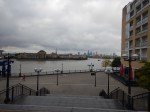
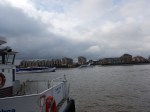
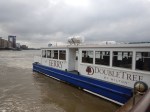
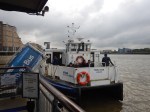
There is currently a Thames Clippers ferry shuttle between these two points. The Jubilee line parallels the route of the proposed bridge, with the nearest stations at Canada Water and Canary Wharf.
I took these pictures of the current ferry from Canary Wharf pier.
The bridge has its own web site, with a dramatic picture on the home page.
The visualisations show a bridge, that I think few would dislike. I certainly don’t!
- It’s dramatic.
- It would be open to pedestrians and cyclists.
- It would be the longest bascule opening bridge in the world.
- It would allow tall ships to pass through.
But above all I suspect that Marc and Isambard would have approved.
Canary Wharf – North Greenwich Ferry
If Canary Wharf to Rotherhithe can sustain a ferry, then surely a ferry at the other side of Canary Wharf connecting to North Greenwich with the O2, must be viable.
This Google Map shows the Thames between Canary Wharf and North Greenwich.

Canary Wharf And North Greenwich
It is not the longest ferry link, but there are questions to be answered.
- Does the ferry go right into the heart of Canary Wharf or only as far as the bank of the Thames?
- Does the ferry go all round the O2 to North Greenwich Pier or call at a new pier on the west side of the Greenwich Peninsular?
- Will the ferry be fully accessible?
- Will the ferry accommodate bicycles?
- Will the ferry be free, as is the current Woolwich Ferries?
- How many boats will be used?
I think that there could be an opportunity to design an integrated ferry and pier, that would be all things to all users.
It certainly shouldn’t be boring and if possible it should call at the heart of Canary Wharf.
Silvertown Tunnel
In my view the Silvertown Tunnel is just another route for some travellers and possibly their goods to take between the two banks of the Thames.
Categories of traffic across the river through a new Silvertown Tunnel would include.
- Individuals, groups and families, who don’t necessarily need a vehicle. But sometimes choose to take one.
- Individuals, groups and families, who absolutely need to take a vehicle.
- Vans and trucks collecting or delivering goods.
- Buses and coaches
- Taxis, mini-cabs and private hire vehicles.
One thing that has been said about the Silvertown Tunnel is that it will be funded by a toll and some reports have said that the Blackwall and Rotherhithe Tunnels will be tolled as well.
London already has a congestion charging system for areas in the centre and I suspect that this could be updated to charge for the cross-river tunnels.
We’ve never had a toll to get across the Thames in London, with even the Woolwich Ferry being free, so I suspect that a toll would reduce cross-river vehicular traffic.
Remember that, when tunnels were built under the Thames in Central London, there was few quality alternatives with the exception of the Northern and Victoria Lines and the original undeveloped Thameslink.
But over the last few years, cross-river and other public transport has been getting better. And it still is!
Consider.
- In the last year, a lot has been disclosed about Crossrail and its enormous Class 345 trains.
- We’ve also seen the opening of the new London Bridge station and can see the improvements taking place in South London.
- We’ve also seen the arrival of the Night Tube.
- Capacity is being increased on the cross-river East London Line and the Jubilee, Northern and Victoria Lines.
- We have Night Thameslink, so will we see a Night Crossrail?
Other developments will follow.
The only certainty is that we will be seeing a large increase in quality public transport, over, under and on the Thames.
I think for the first time in my life, there could be two competing ways of getting across the Thames; driving through a tunnel or using public transport.
Cost, convenience, needs and possibly an all-singing-and-dancing computer or phone app will tell you where to go.
As I said earlier, if the Silvertown Tunnel is built, it will be just another route for travellers, with perhaps a higher, but fixed cost.
If it is built, I think there should be conditions.
- The Blackwall, Rotherhithe and Silvertown Tunnels should all have tolls.
- Crossrail and Thameslink should have a great deal more Park-and-Ride capacity.
- All buses, coaches, mini-cabs, taxis and trucks in Central London should be low emission.
I also think that large areas of Central London, like the City and Oxford Street should be pedestrianised and some are on track for this to happen.
Much of the decision about the Silvertown Tunnel revolves around politics.
Sadiq Khan, has said he’s in favour of the tunnel with conditions, but he is up against a formidable movement that don’t want the tunnel built at any price.
I also find it interesting, that Ken Livingstone was in favour of the Silvertown Tunnel. But Ken brought in congestion charging.
I wouldn’t be surprised, if there’s some researchhanging aroiund in TfL, that says that a tolled road crossing will cut traffic. But it’s the sort of research no-one would believe.
So perhaps a tolled Silvertown Tunnel with conditions will be a good idea.
But only because there are now alternatives!
Gallions Reach DLR
The BBC article says this about this proposal.
A DLR crossing at Gallions Reach, helping support the development of around 17,000 new homes across Newham and the Royal Borough of Greenwich
It is different to the original proposal of a Docklands Light Railway extension to Dagenham Dock, which stayed on the North bank of the Thames.
This map shows the area of London from Gallions Reach to Abbey Wood.
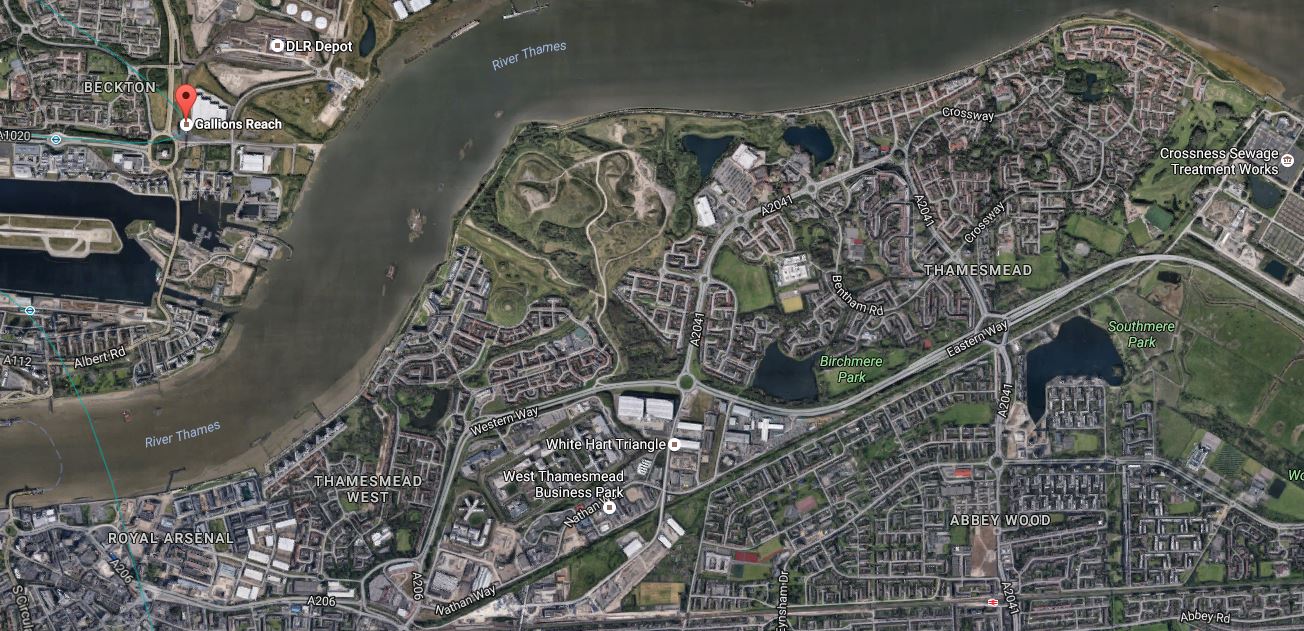
Gallions Reach To Abbey Wood
Note.
- Gallions Reach DLR station is marked with the red arrow.
- Just to the North of Gallions Reach station is the main DLR depot, which would probably be an excellent site to start a tunnel.
- The tunnel would probably emerge on the South bank of the Thames to the West of Thamesmead.
- It could then weave its way along the side of the main road.
- The North Kent Line with Abbey Wood and Belvedere stations runs along the bottom of the map.
- Crossrail could be extended to Gravesend.
- Crossrail should also be extended Ebbsfleet International for European rail services.
If the DLR extension went from Gallions Reach DLR station to Abbey Wood station it will be a loop on Crossrail serving a lot of areas ripe for quality housing and commercial development.
It certainly looks a feasible area to think about taking the DLR.
Barking Riverside Overground Extension
When I first heard about the Thamesmead Extension of the Gospel Oak to Barking Line, I thought it was a good idea.
As it is mentioned in the Mayor’s plans, I suspect that building the extension is getting nearer to reality.
Certainly provision has been made in the design of the Barking Riverside Overground Extension to extend the line under the river if required.
Joined Up Connections
If you take out the Silvertown Tunnel, which is the only one of the five crossings for which you need a vehicle, you get a route along the Thames from Canada Water To Barking.
- Walk from Canada Water to the Rotherhithe – Canary Wharf Bridge
- Cross the Rotherhithe – Canary Wharf Bridge
- Walk to the Canary Wharf – North Greenwich Ferry
- Take the Canary Wharf – North Greenwich Ferry to North Greenwich
- Take the Emirates Air-Line to Royal Victoria
- Take the DLR to Gallions Reach and on to Thamesmead
- Take the Gospel Oak to Barking Line to Barking
It’s an interesting route using various means of transport.
Boom In Cycle-Rail Journeys
The title of this post is the title of this article in Rail Magazine.
These two statistics are given.
- Cycle-rail journeys have increased by 40% since 2010.
- The number of journeys where a bike was parked at the station increased by 75% in the same period.
You certainly see a lot more bikes on trains.
I think in the next few years will see more restrictions on bike usage on trains. Sometimes, there are just too many bikes, pushchairs and enormous cases on trains and there’ll come a point, when train companies try to cut the numbers.
I was talking to one of the driver managers of a company introducing the new Class 800 trains. He felt that the designers had not incorporated enough cycle places.
We shall see if he’s right, when the trains are serving their first summer.
As passengers have the space in the locomotive at present, if they turn up with a bike in the future and are told there there is no room, it will be an unholy row!
From Monument To Westminster Along The East-West Cycle Superhighway
I walked the East-West Cycle Superhighway in two sections, as I crossed the bridges to have lunch on the South Bank by the Tate Modern.


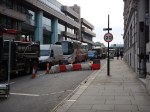


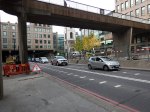





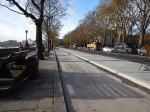


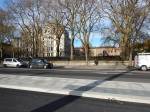


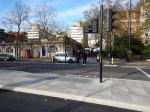


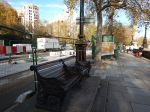


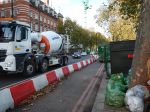
It certainly is getting a move on, with some sections almost ready to open.
A few notes follow.
The Arthur Street Site
A new block is being created on this site, but before that happens, the site is being used to access the underground parts of Bank station.
This map from a TfL document show the site.
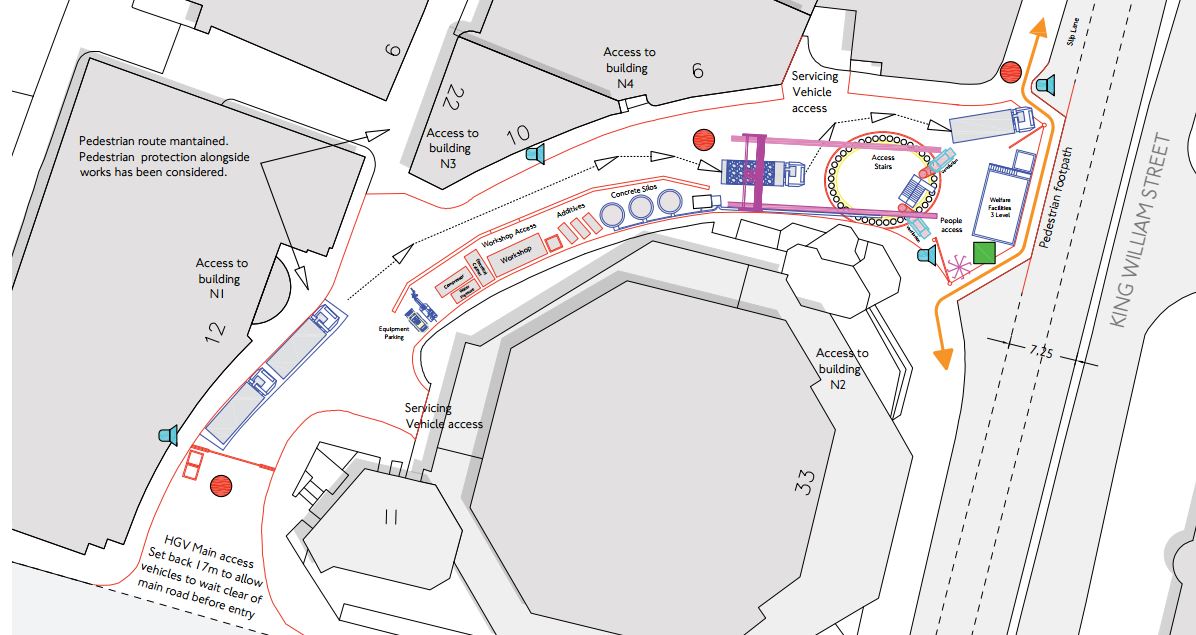
The Arthur Street Site
This fact sheet explains how the Arthur Street Site is to be used. This is said.
To deliver the proposed station improvements there is a need for a worksite in Arthur Street. This site is above the new tunnel alignment, and enables access via a shaft directly down to the new tunnel. This separates the underground tunnelling works from the extensive demolition and basement construction works on the Cannon Street site, facilitating an earlier completion of the tunnelling works and a reduction of the overall impact of the project on the City.
As with everything in the City of London, it all seems very crowded.
Along Upper Thames Street
As the pictures show the Cycle Superhighway is going on the North side of this road.
This road has always been jammed solid with cars, taxis and a lot of trucks.
The construction phase of the Cycle Superhighway isn’t exactly helping traffic flows.
The Millennium Inclinator
The Millennium Inclinator is by the Millennium Bridge and I used it to get up the steps to the bridge, before crossing to get some lunch on the South Bank.
Westward From Blackfriars
After lunch, I crossed back to the North over Blackfriars Bridge and followed the Cycle Superhighway to Westminster station.
Conclusions
As with Cycle Superhighway CS5 from Oval to Pimlico, from what I could see, it seems to be well-designed and built.
I’ll look forward to hiring a bike at one end and riding it to the other.
Walking The Cycle Superhighway CS5 From Oval Station To Pimlico
The pictures tell the story, as I walked from Oval tube station to Pimlico along Cycle Superhighway CS5


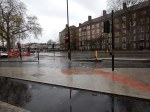


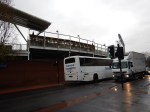


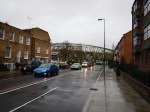

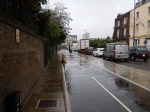


This is the official Transport for London map for CS5.
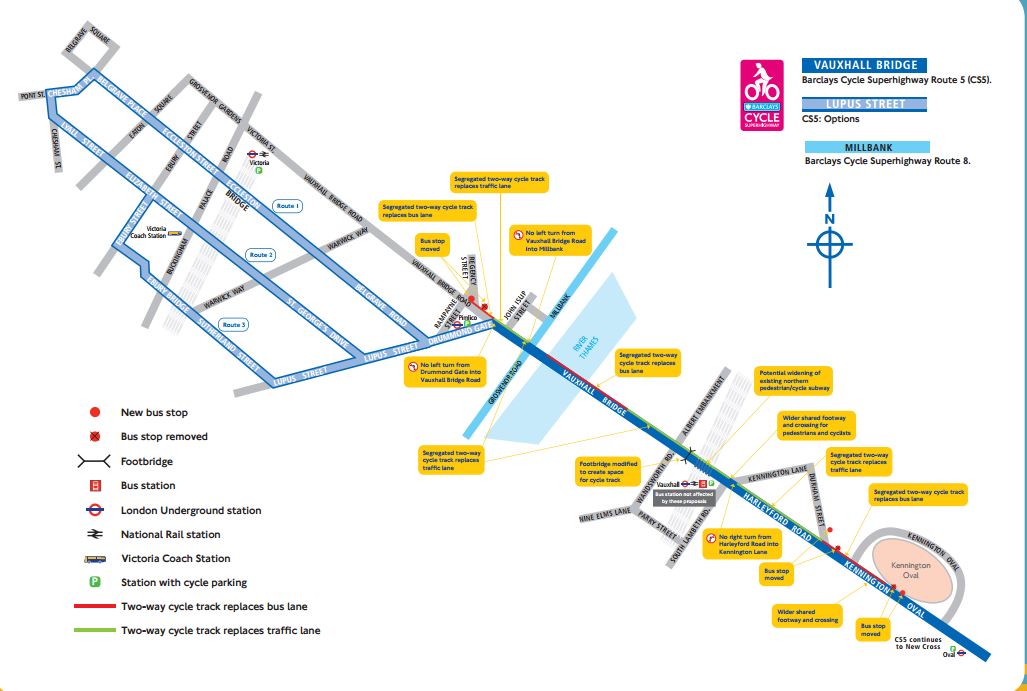
Cycle Superhighway CS5
This is a Google Map from Oval Station To Pimlico

From Oval Station To Pimlico
Some of my thoughts.
- The route is an easy one to cycle, as it is virtually flat.
- I was impressed with the way that the designers of the Cycle Superhighway had threaded it through the area, with good attention to bus stops, traffic signals and signage.
- Before I walked towards Pimlico, I had a quick walk in the direction of Kennington and checked out the other cycle routes being constructed. The walking routes were good.
- I particularly liked the bike rental station in the dry in a railway arch. How many people like getting on a wet saddle? The Brownlees perhaps!
- The route was also an easy one to walk, as the designers had catered for walkers in the design.
- The builders had done an excellent job in making all the surfaces good for cyclists and walking.
- I was a bit surprised on how fast I was walking.
- I did feel though, that at times, there was a very crowded line of traffic alongside an almost empty cycle lane. The Jeremy Clarksons of this world might say something.
If all the Superhighways are designed and built to this standard, they will be a big asset to London.
I think in areas, where people are objecting to their imposition, they may actually win a few friends.
It’s a long time, since I was the parent of a young child and even longer since I used to cycle about four miles to school in the midst of the traffic.
But I would have no worries about my thirteen-year-old granddaughter cycling on a track like I saw today.
Cycling Across De Beauvoir Town
When I wrote Walking From Haggerston Station To Mare Street, I hadn’t realised how the scheme to effectively convert Middleton Road into a car-free route, would affect De Beauvoir Town.
Look at this Google Map, which shows the car-free route across London Fields.

Car-Free Route Through London Fields
The map is rather vague about what happens when it crosses the Kingsland Road and all it shows is a wavy line, which if you enlarge it and use a magnifying glass, has something like Northchurch Road written on it. This Google Map shows the area from Southgate to Kingsland Roads.
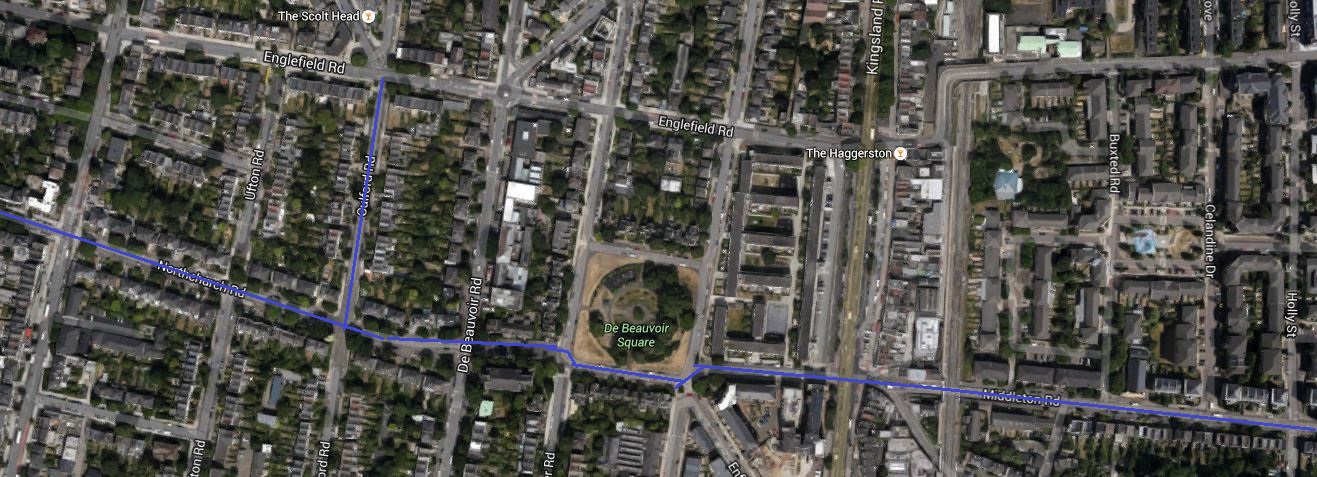
Cycling Across De Beauvoir Town
I think as Middleton Road links up to the South Side of De Beauvoir Square, that the downward kink in the route is De Beauvoir Square, so the route goes past St.Peter’s Church and then up Northchurch Road. For the first part of Northchurch Road, the route is following the route of the Cycle Superhighway CS1, that goes up Culford Road.
The two cycling routes are marked in blue on the map.
If the traffic scheme in London Fields is made permanent, I think I will be pleased, as it would give me a car-free cycle route from my house to the Cultural Quarter of Hackney.
If there were Boris Bike stations in De Beauvoir and London Fields, I wouldn’t even have to buy a bike.
On the other hand the London Fields scheme could generate a lot of cycling traffic through De Beauvoir Town.
Others might not be so pleased!
Later I walked the route and there are photographs of it in Walking From De Beauvoir Town to London Fields
Walthamstow Doesn’t Like Going Dutch!
This article from the Waltham Forest Guardian is entitled Grand opening of mini Holland scheme dominated by angry protestors.
I have posted it, as we are getting the Cycle Superhighway through where I live in the northern part of D Beauvoir Town in the near future and there are various opposing groups wanting or not wanting road closures and different parking restrictions.
As a Control Engineer, who has quite a bit of experience of dealing with complex liquid flow systems in chemical plants, I think that Councils tend to take a too definitive approach to the problem.
So my experience of chemical plants was in the late 1960s and we used an amazing PACE 231R. But that machine was the state-of-the-art computer of its day for solving differential equations. The computer was also the unrecognised star of the amazing rescue of the astronauts on Apollo 13.
The aim of the modelling in the chemical plant was to get different chemical streams flowing at the right rate into various reaction vessels, where they could be safely reacted and handled. The reaction products would then flow off in a controlled manner in other directions.
On a chemical plant the flows are controlled by various measures, but typically by valves, of which a domestic example is your mains water stop cock.
Often after modelling the flow system, it was found that the various valves were set almost to a fixed position for normal running of the plant.
If you look at traffic flows in say Walthamstow Village, as in the article, or De Beauvoir Town, you have an area bounded by main routes, which is crossed in a random manner by buses, cars, cyclists, pedestrians and trucks.
So what is different between modelling fluid and traffic flows?
Mathematically, it is the same process, but there is no variable method for regulating traffic flows.
The only regulation in De Beauvoir Town and other traffic systems is the brain of cyclists, pedestrians and regular drivers, who adapt their route according to their knowledge.
What the Mini Holland system in Walthamstow and other systems try to do is modify the thought processes of regular uses. The problem is that it may do that with the regular uses, but it doesn’t influence say your casual driver, who ventures into the area.
So in Walthamstow the local businesses and others see the drop in traffic and protest.
We need to apply more subtle ways of regulating the traffic, through areas like Walthamstow Village, that are understood by everybody.
- Speed limits should be set to twenty and they should be enforced. The Police need all the money they can get, so I would be happy to see mobile enforcement cameras on the top of Police vehicles parked at the side of the road.
- Computer-controlled traffic lights can be used as restrictors, so for instance at a notorious place where rat-runners enter an area, a pedestrian-crossing with lights could be placed. Timings could be adjusted automatically to the day of the week and time of the day.
- Speed humps aren’t as affective as they used to be. Perhaps car suspensions are better and Councils have softened them, so they don’t get sued?
- Cambridge has used rising bollards, that are automatically opened by certain vehicles, like buses, taxis, fire engines and ambulances.
- Even physical gates can even be opened and closed at various times. Suppose to calm an area, there was a need to shut off a road past a church. Why couldn’t it be opened on Sundays?
We are not being innovative enough.
Solutions like mini Hollands and just shutting routes are just too simplistic for a complex city like London.
As an aside, I’m old enough to remember London’s first experiment in traffic managment.
Green Lanes through Harringay in the 1960s was even more crowded with traffic than it is today. So traffic lights were put every fifty metres or so between Harringay Green Lanes and Turnpike Lane stations. There are quite a lot less lights today.
It cut the traffic through the area, but we all diverted through the side streets and made the lives of residents hell!
Manchester Has Ways Of Dealing With Cyclists
I took these pictures in Manchester City Centre.
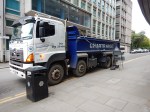

These trucks with no sideguards wouldn’t be allowed in London. Why does Manchester allow them?
From The Kelpies To The Falkirk Wheel
I walked from The Kelpies to the Falkirk Wheel. This Google Map shows the route.
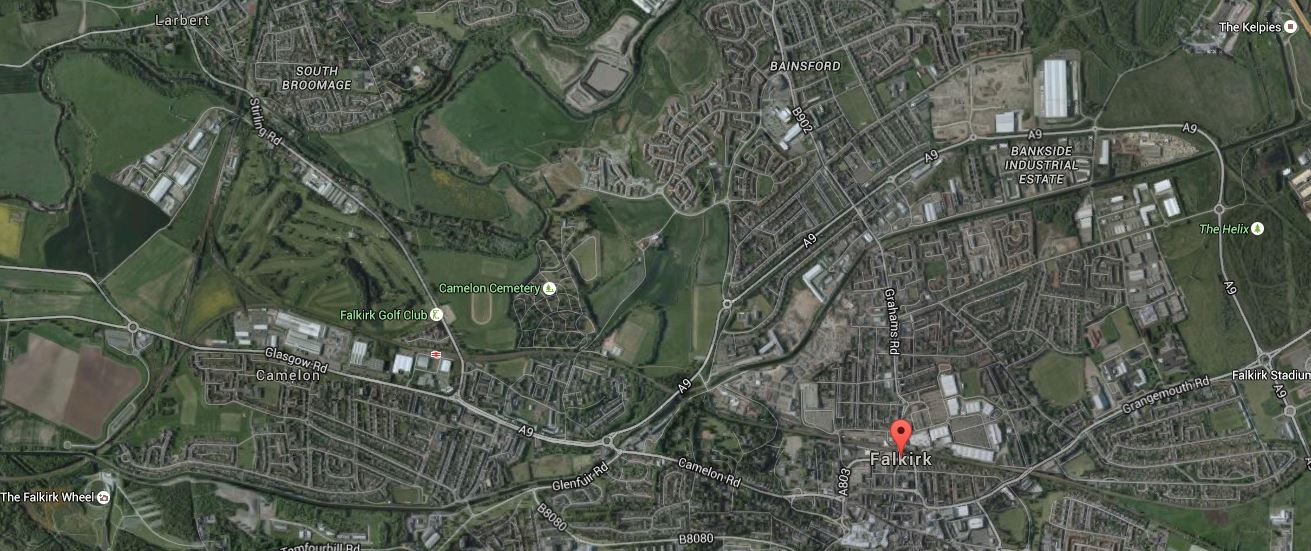
Kelpies To The Falkirk Wheel
I estimate it was about five miles and it is pretty flat with no steep hills. The red arrow shows the centre of Falkirk, with The Kelpies in the top right and the Falkirk Wheel in the bottom left corners respectively.
These are pictures I took along the route.




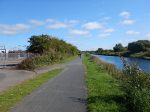


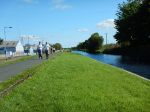


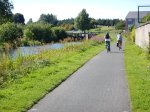


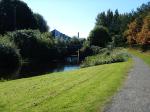


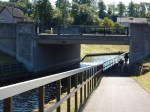


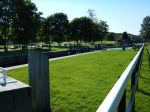


What was a great help was the restaurant called the Gambero Rosso by the Forth And Clyde Canal, where I had an excellent lunch.
The one thing that would have helped was a Boris-style bike you could hire at one end and leave at the other. They have a version of these bikes in Stirling.
Are Adverts Pointless?
I’m just watching the Tour de France on ITV4, as I put together the next couple of IKEA cabinets for my kitchen.
The adverts are completely aimed at the wrong person.
1. There has been two different companies trying to sell me Funeral Insurance. Why would I want a funeral and anyway, I won’t be going or remember it. We should just post our bodies to the nearest hospital for dissection practice or a pet food factory to do something useful.
2. There are also adverts for Skoda cars. I don’t drive and have no interest in the sort of boring cars bought by plebs. Or in any car forv that matter unless it doesn’t pollute my walking space.
3. Santander Bank. Only idiots, bank with Head Offices in other countries. Remember Iceland and Scotland!
4. Petplan, Pets are for the lonely and conservative.
5. Loans. I don’t need to borrow money.
6. Car Insurance. See point 2.
7. Barbecues. I hate them!
When somebody invents a television that doesn’t show adverts or trailers in live television, I’ll buy one.
Walking Cycle Superhighway Route 1 From My House To Liverpool University
As I did this in an hour, it wasn’t the University in Liverpool, but their London Campus in Finsbury Square to which I walked along Cycle Superhighway Route 1.
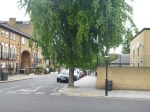
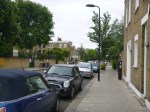

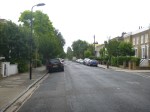
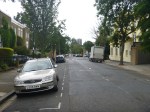


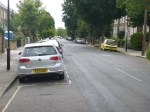

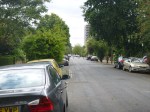
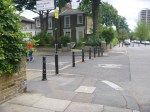
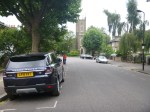
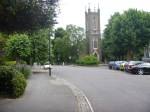


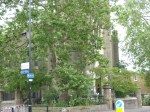

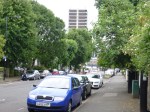

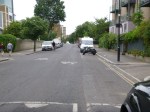


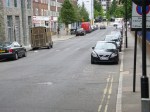

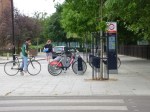


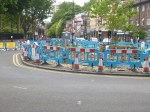


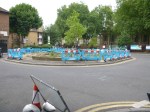


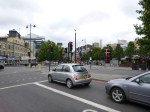
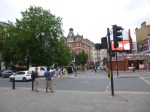
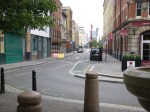
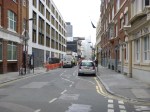
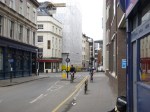

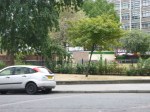

I joined the Sperhighway at the junction of Culford and Tottenham Roads about a hundred metres from my house.
Note that the pictures are generally in order going North to South, with some pictures taken looking back.
I think it is true to say that it is a pretty good cycling route, which from Dalston to the City is pretty flat, with very little cross traffic. I think that the major junctions will be light-controlled.
I do hope they put bike hire stations all along the route.
 The Anonymous Widower