Malaysian Fabrication Company Enters Offshore Wind Market With IJmuiden Ver Alpha Contract
The title of this post, is the same as that of this article on offshoreWIND.biz.
This is the sub-heading.
Malaysia Marine and Heavy Engineering Holdings Berhad (MHB), through its wholly-owned subsidiary Malaysia Marine and Heavy Engineering (MMHE), has secured a subcontract for its first offshore substation high-voltage direct current (HVDC) platform required for TenneT’s 2 GW offshore wind project in the Netherlands
These two paragraphs outline the project.
The Malaysian contractor confirmed the award from Petrofac on 29 November and said the OSS HVDC platform consists of a topside and jacket for the IJmuiden Ver Alpha project.
The subcontract scope consists of construction engineering, fabrication, mechanical completion, load out and sea fastening, and architectual works on engineering, procurement, and construction (EPC) basis.
A third paragraph, indicates, that this contract could be the first of a few.
In addition, the parties will also collaborate towards the possibility of fabrication works for two additional offshore substation units of similar size.
This story illustrates how wind farm developers are looking for more places to build their infrastructure.
In An Elegant Solution, I talked about an idea called a D-Floater. Five are shown being transported in this picture.
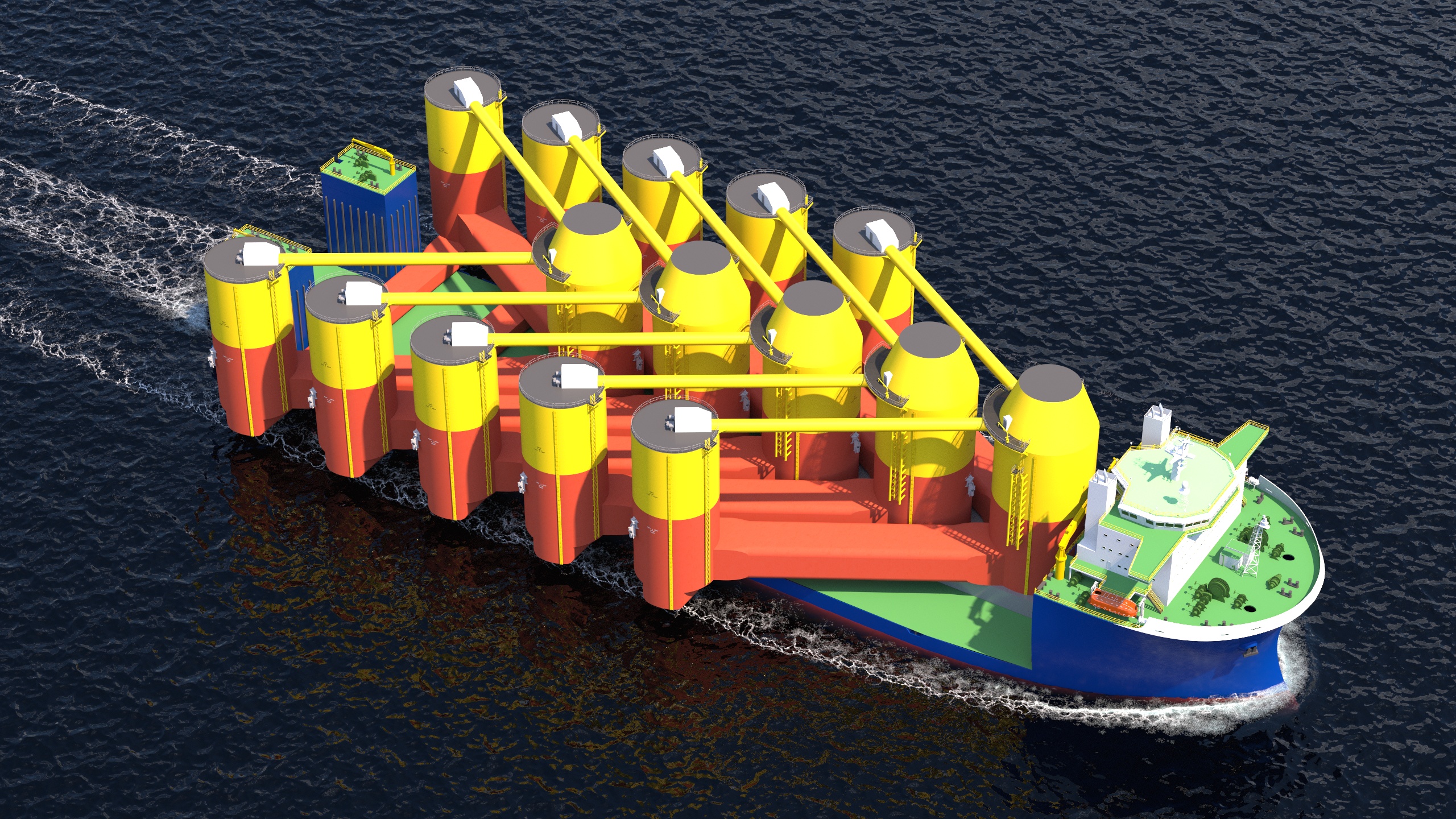
The idea is from a Swedish company; Bassoe Technology.
This would enable transport costs from faraway places to be reduced.
Nearer to Europe, the Black Sea ports of the Ukraine could be an ideal place to build infrastructure, as the country used to have the required skills, ports and steel-making capabilities.
But first Putin must be put back in his box!
Stackable Floating Wind Platform Gets DNV Approval
The title of this post, is the same as that of this article on offshoreWIND.biz.
This is the sub-heading.
DNV has awarded Bassoe Technology an Approval in Principle (AiP) for a 17 MW D-Floater floating wind foundation, designed to withstand extreme 50-year typhoon conditions in the South China Sea.
I wrote about this technology in An Elegant Solution.
This visualisation shows five D-floaters being transported on a ship.
DNV Approval makes it more likely that the design will be deployed in the near future.
Floating Offshore Wind Could Reach Full Commercialisation By 2035, Research Says
The title of this post, is the same as that of this article on offshoreWIND.biz.
This is the sub-heading.
Floating offshore wind could reach full commercialisation by 2035, said 60 per cent of respondents in the latest research that was done by DNV, with 25 per cent believing it will be as early as 2030.
I’ll go along with that, but as a serial disruptive innovator, I believe full commercialisation could be earlier than 2027.
It will be for these reasons.
Capacity Factor
There is reason to believe from the figures from existing floating wind turbines, that the capacity factor is very good and could be higher than those of turbines with fixed foundations.
Wikipedia says this about the world’s first commercial floating offshore windfarm; Hywind Scotland.
In its first 5 years of operation it averaged a capacity factor of 54%, sometimes in 10 meter waves.
If other floating technologies show as good capacities as this, then the technology may well find it easier to attract finance.
Design
We have only seen a couple of designs deployed; Hywind and WindFloat.
There will be plenty more to come.
This visualisation shows five D-Floaters being transported on a ship.
Note.
- D-Floaters are being developed by Bassoe Technology.
- As many floats will be manufactured, a long way from their final mooring, why not make them easy to transport.
- Other companies are developing floats that can be bolted or welded together from standard components.
I wouldn’t be surprised if one design came to dominate the market.
This might be a good thing, as it would surely speed up deployment of floating wind farms.
Construction And Installation
This video shows the construction and installation if Principle Power‘s, Windfloat prototype.
Note.
- All the construction and assembly is done in a dock with a suitable crane.
- This is much easier than doing it the assembly out at sea, as has to be done with turbines with fixed foundations.
- I suspect that with the best design of float and turbine, high rates of turbine assembly can be achieved.
- Health and Safety will prefer this type of assembly.
I suspect other floating wind turbines will be similarly assembled.
Suppose you were assembling 15 MW floating turbines at a rate of one per day, that would be a production rate of over 5 GW of turbines per year from just one dock.
Early Delivery Of Power
I suspect that to build a floating wind farm, one of the first things to be towed out would be the substation to which all the turbines will be connected.
- This could even be floating.
- I’ve seen floating sub station designs, that incorporate energy storage and hydrogen production.
Once the substation is fully-installed and tested, floating turbines could be towed out, anchored, connected to the substation and immediately start to produce electricity.
I have built a lot of cash-flow models in my time and I believe that one for say a 2 GW floating wind farm would be very friendly to proposers, investors and operators.
There’s A Lot Of Sea Out There!
And after nearly sixty years of offshore semi-submersible platforms in UK water, we now how to work in the conditions.
In ScotWind Offshore Wind Leasing Delivers Major Boost To Scotland’s Net Zero Aspirations, I said this, about the total capacity, that will be developed under the ScotWind leasing round.
- Adding up these fixed foundation wind farms gives a capacity of 9.7 GW in 3042 km² or about 3.2 MW per km².
- Adding up the floating wind farms gives a capacity of 14.6 GW in 4193 km² or about 3.5 MW per km².
Note.
- You appear to get ten percent more capacity in a given area of sea with floating wind farms.
- The energy density of floating wind farms is 3.5 MW per km².
I suspect investors will prefer the floating wind farms.
Lower Visibility
Floating wind farms will generally be further out to sea and less likely to be objected to, than installations nearer to land.
Maintenance And Updating
Floating wind farms can be towed into port for servicing and updating, which must ease the process.
Project Management
I believe that floating wind farms, are projects, that would benefit highly from good project management.
Sometimes, I wish I was still writing project management software and I am always open to offers to give my opinion and test anybody’s software in that area!
Finance
I can see that floating wind farms could offer better cash flows to investors and this will make them invest in floating wind farms at the expense of those with fixed foundations.
Conclusion
For all these reasons, but with my instinct telling me that floating wind farms could offer a better return to investors, I wouldn’t be surprised if floating wind farms came to dominate the market.
An Elegant Solution
There’s an old English expression about couples lying in bed like spoons.
I wonder, if this analogy is used in other languages like Swedish.
Swedish company; Bassoe Technology have certainly used the stacking technique of spoons or bodies in the design of their innovative wind-turbine floats, which they call D-Floaters.
This visualisation shows five D-floaters being transported on a ship.
Note.
- The D-Floaters do look strong and sturdy.
- There are several competing floats for wind turbines based on triangles.
- There is probably an optimal cost between transporter ships and D-Floaters.
Given that these structures may be moved thousands of miles before installation, this method of transportation must be economic.
The loaded ship does remind me of one of the bath toys my kids had in the 1970s.
 The Anonymous Widower