More Thoughts On Dalston Junction To Hayes
In February this year, I wrote Should Trains Run From Dalston Junction To Hayes?
I finished the post like this.
So is New Cross the least used direct southern destination on the East London Line? Also, was it only included in the East London Line for historic reasons, as it had been a Metropolitan Line destination?
If so, it might be an idea to see if extension of the four trains per hour services terminating at the station is possible. Perhaps two could go Hayes and two to Orpington, which would double the frequency to both places from New Cross.
I could also have said in the summing up, that this would give four trains per hour from Dalston Junction to Lewisham, with all its connections to South East London and Kent.
This morning, I was reading an article on London Reconnections about extending the Bakerloo Line, entitled Death, Taxes and Lewisham: Extending the Bakerloo.
So it got me thinking!
I returned to my original article and had the following blasphemous thought.
Is Transport for London, so obsessed with using the supposed spare capacity on the Bakerloo Line, that it doesn’t think straight about what to do with this line?
Consider the following points.
- Passengers like the Overground model and many rate it higher than the Underground.
- When Crossrail and Thameslink and the East London Lines are up to capacity of twenty-four trains per hour, the increase in capacity will change London’s transport system dramatically, as there will be an H-shaped network with interchanges at Farringdon, Whitechapel and possibly some other places.
- Most trains going to Kent and South East London start from Victoria, which is not well placed for some of the important parts of Central London. Would extra connections to a twenty-four trains per hour East London Line at Penge and Brockley be a better route for many passengers?
- I feel that there would be a backlash, if the Hayes Line became part of the Bakerloo Line, just like there was when Thameslink wanted to stop all Sutton Loop Line trains at Blackfriars! If you’ve been commuting for years in First Class from Hayes into Cannon Street for the City, I don’t think you’d be happy if your train was a smaller one-class, crowded Underground train. But you might accept an Overground train to Canada Water for the Jubilee Line or Whitechapel for Crossrail and the Metropolitan/Circle/District Lines.
- Thameslink together with the Bakerloo Line and an upgraded Jubilee Line will create a resilient North-West to East routing, that could withstand the occasional serious failure. The East London Line provides that resilient link in the East.
- Thameslink doesn’t connect with the Central Line, but the East London Line could at Shoreditch High Street.
I’m coming more to the conclusion that there is no way that a long extension to the Bakerloo Line would be needed. Perhaps it should be extended in a loop down the Old Kent Road to Camberwell, to get high-quality rail services into that area.
Should East London Line Services To New Cross Go Further?
Four services per hour on the East London Line have their Southern terminus at New Cross station and could these venture further into South London?
At the moment these services terminate in a bay Platform D, which is just a walk across from the trains going South. But when coming North, you have to go over the step-free bridge to get from Platform A to Platform D.
In the next few years, various developments will happen, that will affect travel in the area bordered by New Cross, Cannon Street and Whitechapel.
- London Bridge and Thameslink will be improved, so interchange between Cannon Street services and Thameslink will be much easier.
- Hopefully, access to the Underground at London Bridge will be eased by the redevelopment of the station.
- Will the Thameslink improvements increase the capacity into Cannon Street?
- Crossrail will open.
- The Metropolitan/District and Circle Lines will have been fully upgraded with bigger trains and new signalling.
- The Jubilee Line will have been upgraded.
- Bank station will have been upgraded.
- There will be large numbers of office developments around the City, increasing the numbers of needed final destinations.
I believe that the increasing flexibility will mean passengers will be less likely to use the same route.
I also believe that passengers will switch between London Bridge/CannonStreet and the East London Line destinations of Canada Water, Whitechapel and Shoreditch High Street.
Many more will want to change at New Cross!
If the East London Line services started South of New Cross and just called at Platform A on their way North, just as London Bridge/Cannon Street services do, this would this give a simple change for Northbound passengers.
If you were on a Tunbridge Wells to Cannon Street train and wanted to go to Whitechapel for Crossrail, you would get off at New Cross and wait for an East London Line train on the same Platform A.
This interchangeability of Northern destinations, is unlocked by sending East London Line trains past New Cross.
Can East London Line Services To New Cross Go Further?
After Crossrail and an upgraded Thameslink opens, it will take some time for passenger numbers to stabilise.
These figures will decide if it is worthwhile to extend the services past New Cross.
The other constraint will be whether paths are available to continue to Lewisham and beyond.
The simplest plan would be to run the four trains per hour to Lewisham and then run two trains to both of Orpington and Hayes.
Extra Interfaces On The East London Line
I would also build the following interchanges on the East London Line.
- Central Line at Shoreditch High Street. This can’t be done until Crossrail opens.
- A New Penge station to connect to the Chatham Main Line
- A high-level Brockley station to link to the Nunhead to Lewisham Line.
There may also be scope for linking the East London Line to Thameslink. It is probably a pity, that the East London Line serves West Croydon rather than East Croydon, as the latter station has so much better connectivity.
Today, I visited South East London and I can make these observations.
New Cross Station
I wrote Changing At New Cross, when I looked at New Cross station.
I can’t see any obvious reason, why East London Line trains have to terminate at New Cross. I suspect, that it’s only for historic reasons, as that’s what the Metropolitan Line did many years ago.
St. Johns Station
I wrote Investigating St. Johns Station, when I looked at St. Johns station.
My only feeling about this station is that if it were to be upgraded to the standard passengers expect, it could be a valuable step-free interchange station between an extended East London Line and the services into and out of Cannon Street.
Lewisham Station
I wrote Changing At Lewisham, when I visited Lewisham station
If it were to be served by four trains per hour on the East London Line, with two trains per hour going to Hayes and the other two to Orpington, Lewisham would be an important interchange to increase the connectivity between South East and North East London.
Catford and Catford Bridge Stations
I wrote An Opportunity At Catford, when I looked at the twin stations of Catford and Catford Bridge and can say this.
- Currently, all trains through Catford Bridge station are going to and from Hayes.
- All trains through Catford are Thameslink ones between Blackfriars and Sevenoaks.
- Track exists to send trains between Catford Bridge to and from Orpington.
If cross-platform interchange could somehow be provided between the two northbound and the two southbound lines at Catford/Catford Bridge, this would give passengers from Hayes and Orpington a big choice of Northern destinations.
Effect On Dalston Junction
If the four trains per hour shuttle service between Dalston Junction and New Cross was replaced by two trains per hour to each of Orpington or Hayes, it probably wouldn’t have much overall effect on the Dalston Junction to New Cross section of the line, but what would the timings look like?
Currently trains leave Dalston Junction in the Off Peak at 04, 19, 34 and 49 past the hour taking twenty-two minutes to get to New Cross. They then return at 07, 22, 37 and 52.
So the 04 train gets to New Cross at 26, returns at 37 and gets back to Dalston Junction at 59, which means it waits eleven minutes at New Cross and six at Dalston Junction.
New Cross to Hayes takes thirty minutes, so that would be fifty two minutes from Dalston Junction to Hayes.
Would that be fast enough for each train to do one trip each hour?
I suspect that one of Transport for London’s timetabling experts could devise a pattern.
More Trains Through The Thames Tunnel
At present there are sixteen trains per hour through the Thames Tunnel.
- 4 – Dalston Junction to New Cross
- 4 – Dalston Junction to West Croydon
- 4 – Highbury and Islington to Crystal Palace
- 4 – Highbury and Islington to Clapham Junction
Which means that as there is a theoretical limit of twenty-four trains per hour, there are another eight paths available.
In Increased Frequencies On The East London Line, I wrote that London Overground have plans to introduce the following extra services.
- From 2018, there will be an extra two trains per hour between Dalston Junction and Crystal Palace.
- From 2019, there will be two additional trains between Dalston Junction and Clapham Junction.
So that would mean that there are still possibly another four paths available.
I would assume that the extra trains would be accommodated at the Northern end by just tightening the turn-round times.
I can’t believe that it won’t be long before Transport for London come up with ways of using the remaining four paths.
If they are planning to turn back two extra trains from Crystal Palace and two from Clapham Junction at Highbury and Islington, I can’t believe that they couldn’t turn back another four services at Dalston Junction. Assuming the extra trains to Crystal Palace and Clapham Junction, this would give the following frequencies.
- 12 tph between Highbury and Islington and Dalston Junction.
- 24 tph between Dalston Junction and Surrey Quays.
The core section of the East London Line will interface in 2020 with the following lines.
- Crossrail at Whitechapel will be 24 tph
- The Jubilee Line at Canada Water will be 36 tph
- The Victoria Line at Highbury and Islington will be 36 tph by 2016.
Father and son, Marc and Isambard Brunel, will be spinning in their graves, to see what their Nineteenth Century engineering curiosity-turned-marvel has become.
The Emergence Of Overground Transport Hubs
More trains on the East London Line between Dalston and Clapham Junctions is to be welcomed.
I use the well-connected Clapham Junction, if say I’m going to Southampton, Portsmouth or many other places, as it means I can avoid the difficulty of getting to Waterloo or Victoria.
The one problem with Clapham Junction in my view is that Thameslink or the Gatwick Express doesn’t call at the station.
Even so, Clapham Junction, Dalston Junction and Stratord are evolving as the major hubs on the Overground Network.
In the next few years, the following stations will become major hubs.
- Whitechapel because of its important location on Crossrail
- Old Oak Common because of its connections to Crossrail and HS2
- Hackney Interchange (Central plus Downs) because it joins the North London Line to the West Anglia Lines.
Will Lewisham, Crystal Palace or other stations join this elite group?
Southeastern
Southeastern is the train operating company that operates most of the train services to South-East London. Kent and East Sussex.
The company has three sub brands.
- Highspeed operates high-speed service on the Channel Tunnel Rail Link using Class 395 trains.
- Mainline operates traditional long distance services to Kent and East Sussex.
- Metro runs services to South East and South London.
London Overground makes to secret of the fact that it would like to bring the Metro services under its control.
I would very much welcome this takeover for the following reasons.
- As a North Londoner, who grew up in the North, South London trains are very much a mystery to me and Southeastern’s information could be substantially improved.
- The East London Line and Southeastern services could be properly co-ordinated.
- When the Overground took over the West Anglia Lines, there was a definite improvement in stations and customer service.
- The whole of Southeastern’s Metro and Mainline network needs to be brought into Transport for London’s Oyster and contactless bank card ticketing.
Hopefully, the takeover will happen, when the franchise is up for renewal in 2018.
Crossrail Extension To Ebbsfleet International And Gravesend
I wrote Crossrail Extension to Gravesend after a visit to the area and I feel that it would be possible to extend Crossrail, so that it served both Ebbsfleet International and Gravesend stations.
This would enable a direct link between Heathrow Airport and Continental trains and you’d only need to change once if you were going to Gatwick, Luton or Stansted Airports.
Conclusions
On a brief look, there is a lot of potential to extend the New Cross branch of the East London Line to Lewisham, Hayes, Orpington and perhaps some more places.
Get it right and it might not be the best thing to have a long extension of the Bakerloo Line.
Changing At Lewisham
Lewisham station is a major station in South East London, where several routes meet. The Docklands Light Railway also serves the area.
This Google Map shows the lines in the area.
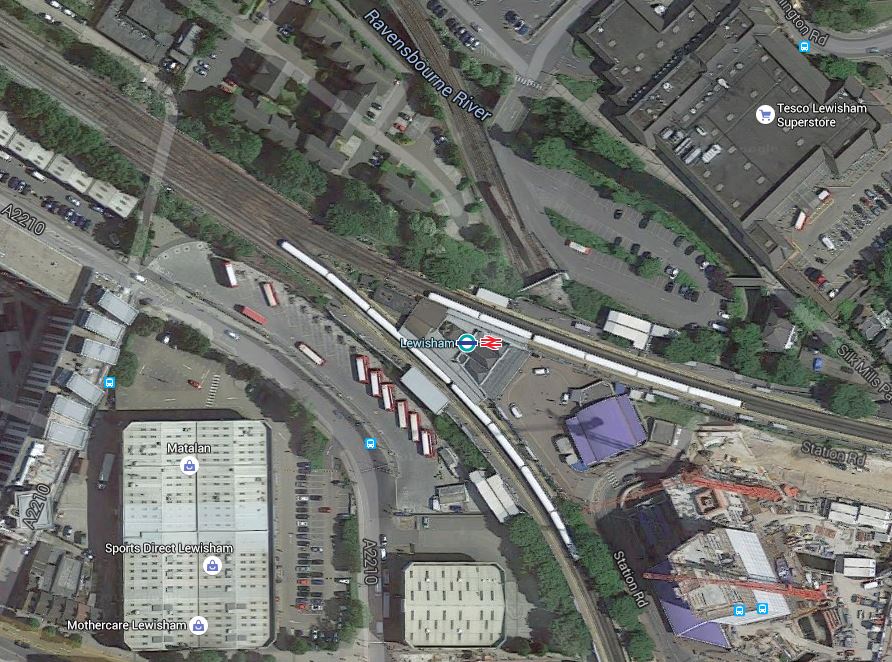
Lewisham Station
Note how there are two pairs of platforms, with one pair going off top the East towards Kent and another pair going South towards Beckenham and Hayes. These are pictures of the station.
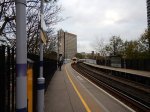
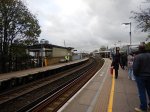
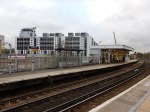


According to a section called Services in the Wikipedia entry for the station, there are typical off-peak service in trains per hour.
- 4 to London Charing Cross
- 8 to London Cannon Street
- 2 to London Victoria
- 2 to Orpington
- 4 to London Cannon Street via Sidcup or via Bexleyheath both returning via Greenwich
- 2 to Hayes
- 4 to Dartford via Bexleyheath
- 2 to Gillingham via Woolwich Arsenal
In addition there are twelve services on the Docklands Light Railway to Bank
Some of these services come via New Cross.
It would seem to me, that if Transport for London achieve their aim of taking over some or all of Southeastern’s services, there could be scope for simplification, or even a simple extension of the historic New Cross service to Lewisham.
But if you look at the Google Map of the station, I think it would be very difficult to create a terminal platform.
So it would seem easier for services to go past Lewisham to stations like Hayes and Orpington.
Investigating St. Johns Station
St. Johns station is a curious one, in that it is just two platforms on the slow lines, amongst a forest of lines.
This map shows the lines around St. Johns station to Lewisham, New Cross and New Cross Gate stations.
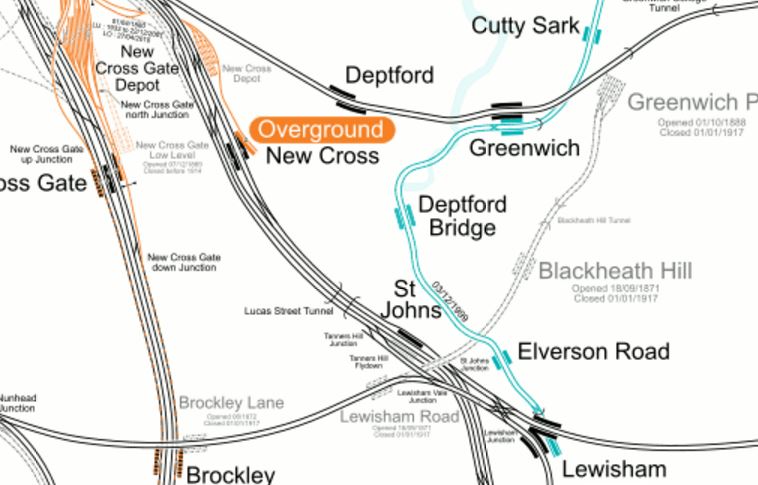
Lines Around St. Johns And Lewisham Stations
These are pictures I took of the station.


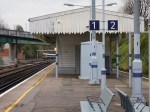


As the pictures show, it is a fairly basic station, although it does get over half a million passengers a year.
On the other hand, it does have Southbound services to Lewisham, Orpington, Hayes, Slade Green and a host of places all over South East London.
I believe that if the station were to be upgraded with step-free access to the street, a nice warm waiting room, a coffee stall and excellent information, then this station would become the preferred interchange for passengers on East London Line trains wanting to go to and from many places in South East London.
Changing At New Cross
If you get an East London Line Class 378 train and want to continue your journey South from New Cross station, you often just walk across the platform to catch your next train.
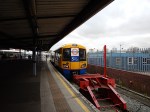
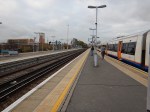
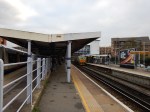
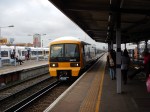
The pictures show how I changed at New Cross for St. John’s station.
There is no problem going South but coming North, you have to climb over the bridge from platforms A or B to get to platform D. The walk is step free, but modern station layouts would be designed, so that you walk across between trains or wait on the platform for a few minutes, until your train arrives.
In an ideal world Northbound East London Line services would start from Platform A, with Platform B being reserved for services to Cannon Street.
New Cross Gate station uses a layout with the East London Line trains calling at the outermost platforms.
This would not be possible at present with the trains terminating at New Cross in Platform D, as they have no means to get to Platform A, without reversing out and crossing the busy lines through the station.
But if the East London Line trains terminated South of New Cross, this would not be a problem.
The service frequency from New Cross to Dalston Junction would still be the same as now, but there would be differences.
- Passengers joining the railway at New Cross wanting to use the East London Line to go North would have to cross the step-free footbridge, just as passengers for Cannon Street do now.
- Usually, because the Northbound East London Line train is waiting, you can sit and wait in a warm train, rather than on a draughty platform.
- Passengers from St. John’s, Lewisham and other stations in the South might avoid at least one change of train, by using East London Line trains.
Remember too, that from 2019, Crossrail will run through Whitechapel, giving better access to the West End, Paddington. Heathrow and East London. Charing Cross and Cannon Street aren’t exactly connected well to Crossrail. This will surely see a lot of passengers going between New Cross and Whitechapel.
An Opportunity At Catford
I’d never been to Catford before, but several things drew me to the area.
- Catford Bridge station is mentioned as a possible stop for the Bakerloo Line Extension.
- Maps show it is very close to Catford station and I wondered why they weren’t one station.
- Catford is mentioned in the Appendix of TfL’s Transport Plan for 2050, as a place for a new link and/or station.
This Google Map shows the two stations.
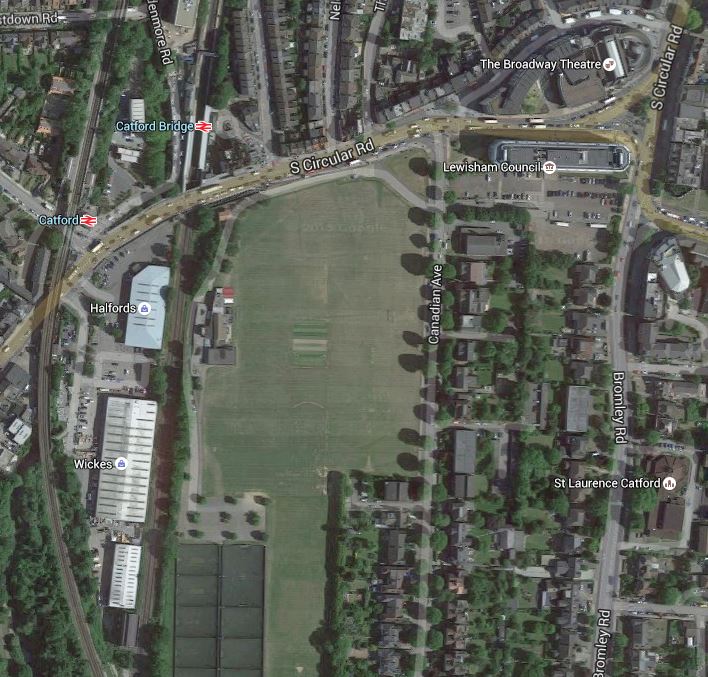
Catford Stations
The two stations are only about eighty metres apart and they are not that far from Catford Town Centre. The big drawback is that the road between the stations and the centre is the dsreaded South Circular Road, so it is busy with traffic.
To be fair to Lewisham Council, they have produced this document entitled Catford Town Centre Local Plan.
The plans are sensible and envisage improving the area of the two stations considerably.
This pictures show the area now.


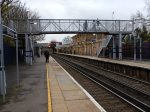


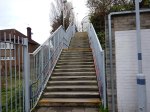


Barratts are building a large number of dwelling on the former Catford Stadium site between the stations. They call it Catford Green and there are more details on the Lewisham Council web site. This is said on the council web site.
The development – located between Catford’s two stations and Ladywell Fields – will comprise 13 blocks up to a maximum of eight storeys in height, along with associated landscaping, including naturalisation of the River Ravensbourne and the creation of a public plaza between the stations, plus a footbridge to Doggett Road.
I’m no architect, but even I can see that the site has a lot of possibilities, especially as the lines through Catford are on a viaduct and are thus higher than the lines through Catford Bridge. So perhaps this natural slope could be used to advantage.
Remember too, these facts.
- Over a million people use both stations in a year.
- Interchange passengers are over fifty thousand a year.
- I think it is true to say that neither station is very customer-friendly and I suspect Catford is rather cold and draughty.
- Catford station will see new Class 700 trains in a few years, as it is on Thameslink.
The effects that the last fact will have on passenger numbers, won’t be negative.
I think it will be unlikely if the two stations are not linked to each other and the town centre by an imaginative development, within the next few years.
 The Anonymous Widower