How Did They Do That?
Normally, the new five-coach trains have their new car inserted next to the end car at the northern end. So how did this train have its extra car inserted at the southern end?

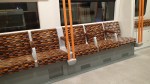
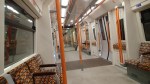
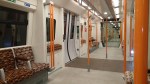
Note how the interior of the new cars are brighter. The dull seats are those reserved for the elderly, disabled and pregnant.
As I don’t think there is a turning loop on the East London Line, the train was either modified this way or it was sent on a jolly somewhere, perhaps to test out compatibility with a new route or back to Bombardier for some special maintenance.
Since most of the trains on the East London Line are now five-car, it does seem that the trains are less crowded.
On the whole, this train lengthening would appear to passengers to have been a pretty painless exercise, although I’ve heard rumours of a few teething troubles with the trains.
According to some Transport for London documents, the trains will go to six-cars some time before 2030, so if that is as painless as the two previous extensions, it is a validation of the quality of Bombardier’s cut-and-shut design for the trains.
When Crossrail opens and is joined to the East London Line at Whitechapel, I have a feeling, that many more passengers will use the East London Line to access the new line to places like Heathrow and Paddington, so the extra capacity will be fully used.
When I grew up in London just after the war, you’d see a short line on the tube map that was the East London Line. Mo-one thought, that this line would become the expanding East London Line we have today.
Where will it go by say 2030?
It will probably be joined to the Central Line at Shoreditch High Street and there will be extra branches in both North and South to handle the twenty-four trains in each hour for which the infrastructure of the line is capable.
It all goes to show how you can sometimes create new rail lines without spending billions of pounds.
Crossrail and Thameslink may get all the publicity, but London Overground’s policy of continuous improvement on the East London Line, is a philosophy that could be copied on many railway lines in the UK, Europe and the wider world.
Should Trains Run From Dalston Junction To Hayes?
The East London Line currently runs at 16 trains per hour, but changes to the signalling and lengthened platforms will allow 24 6-car trains per hour, in the near future.
In my speculation about tram-trains in Croydon, I realised that you could get from Dalston Junction to Hayes with just one change at New Cross, in about 64-67 minutes with a delay of about 10-15 minutes caused by the change, although the change going south is just walking across the platform.
So in a few years time, when ERTMS allows us to run trains closer together would it be a good idea to use some of the extra capacity in the East London Line to run trains direct from Dalston Junction to Hayes via New Cross and Lewisham. I believe even two trains an hour would make a lot of difference.
1. Timings between Dalston Junction and Hayes would drop to about 52-54 minutes.
2. It would give people who live North of the Thames easy access to Lewisham, which is well-connected to Kent. Otherwise you need to go to one of the terminals that serve the area. And often that is the dreaded Victoria.
3. Once Crossrail opens, it will also give those South of the Thames a second route to the line by going direct to Whitechapel, instead of going to either Abbey Wood or Woolwich.
4. Hayes to Heathrow by Crossrail changing at Lewisham and Abbey Wood will be around 1:56, whereas just changing at Whitechapel will be 1:33. What also illustrates the speed of this route is West Croydon to Heathrow via Whitechapel and Crossrail could be about 1:26.
5. It would surely give an alternative route under the river and enable people to get home when problems exist on the primary routes.
The East London Line has very much been a quiet success, that has been enjoyed by those who live in the area it serves. So why shouldn’t we widen its catchment area?
Crossrail will bring a tremendous amount of extra passengers into London. So we must develop the infrastructure that links it to as much of London as possible. Thameslink is being upgraded and to many, the East London Line is just as valuable as a North South route.
If you link Hayes to the East London Line, why not link Orpington to it via Lewisham. Two trains per hour to Orpington, would give an excellent four trains an hour to Lewisham.
I obviously don’t know Transport for London’s passenger figures, but in the four years since the East London Line reopened, I’ve only gone to New Cross once, where I wasn’t going to catch a train on from the station.
So is New Cross the least used direct southern destination on the East London Line? Also, was it only included in the East London Line for historic reasons, as it had been a Metropolitan Line destination?
If so, it might be an idea to see if extension of the four trains per hour services terminating at the station is possible. Perhaps two could go Hayes and two to Orpington, which would double the frequency to both places from New Cross.
I think the only objectors would be Southastern.
If nothing else, this analysis shows how complicated London’s rail network is and how difficult it is to get the train patterns right.
The Overground And Its Class 378 Trains Turn Up In A Computer Game
My Google Alert picked up this article onPCGames, entitled Train Simulator 2015: hands on with the London Overground train.
It’a well-written article and worth reading.
But I won’t be investing in the game, as I’ve never played a computer game and probably never will.
I certainly wouldn’t play this game, as it seems to be South London-based and doesn’t simulate the iconic East London Line, with the historic Thames Tunnel.
If I want to experience a Class 378 train and the East London Line, all I need to do is walk to Dalston Junction station and take any southbound train.
And with my Freedom Pass, it’s all free! Although the excellent cafes in Dalston aren’t!
The Problems At London Bridge
There have been lots of problems in the evening peak at London Bridge and the Thameslink Program has issued this apology.
On this page on the Thameslink Program web site, this is said.
From 5 January 2015, for three years until January 2018, no Bedford to Brighton Thameslink trains will call at London Bridge station. A reduced service will run between Brighton and London Bridge in the off-peak and a very limited service will run in the peak.
Effectively, whilst London Bridge is rebuilt, these trains will not go through the station.
One of the solutions being applied to the current trouble is to reduce the number of trains between London Bridge and West Croydon in the evening peak times.
So you need another route to get the passengers home to West Croydon. The obvious one is to avoid London Bridge entirely and take the Jubilee Line to Canada Water or the District/Metropolitan Line to Whitechapel, where from both stations you get an Overground train to West Croydon.
But the problem with this is the lack of capacity on the East London Line. This is being cured by delivering a fifth carriage for the Class 378 trains. But not many seem to have turned up yet. I’ve only seen one 5-car train twice and I travel on the line regularly.
With my project management hat on, it strikes me that the capacity upgrade on the London Overground and particularly the East London Line should have been completed before the major interim changes and capacity reductions at London Bridge. In fact according to this Transport for London document, the East London Line should have been running five car services by December 2014.
So what has delayed the arrival of the fifth carriages?
Could it be that the delivery of the new Class 387 for Thameslink jumped the queue for building by Bombardier in front of the fifth carriages for the Class 378?
Could The East London Line Be Extended To Ebbsfleet?
A few months ago, I speculated in a post called Can We Extend Overground Connectivity In North London, about what to do for northern termini if the number of trains through the core of the East London Line (ELL) is increased from 16 to 24 tph. This capsacity increase is one of Transport for London’s objectives for the line, which would create a second high-capacity link between North and South London, fanning out to several termini at both ends, just as Thameslink does.
There is probably not the problem of finding termini south of the river, as there is an intricate network of lines, where the extra trains could go.
But after looking looking at taking Crossrail to Dartford and Gravesham, I think that it might be better to send some of the ELL trains past New Cross, which of all the southern terminals is probably the less likely to be able to turn round many more extra trains an hour.
Trains would go to Ebbsfleet from New Cross by way of the following stations.
St. Johns
Lewisham – for DLR
Blackheath
Charlton
Woolwich Dockyard
Woolwich Arsenal – for DLR
Plumstead
Abbey Wood
Dartford
Greenhithe – for Bluewater
If it had a Reading-style bridge connection to Eurostar and Highspeed services at Ebbsfleet, this would give much needed connectivity in getting passengers to and from South and Central London and Crossrail.
The only disadvantage is that you would be swapping a fast train for a slow one.
I estimate that Ebbsfleet to Abbey Wood would take about twenty minutes. By comparison Abbey Wood to Heathrow on Crossrail will take fifty-three minutes. Going from Ebbsfleet to Heathrow via St. Pancras will probably take just under the hour, but you’ll have to negotiate A Fur Coat And No Knickers Station, that is St. Pancras.
But there are several advantages.
1. As was pointed out here, Crossrail going past Abbey Wood will need third-rail capable trains. The East London Line is third-rail like most of the lines south of the Thames and I think it is unlikely that it could ever be powered by overhead electrification, due to the size limitations of the Thames Tunnel.
2. As these trains would go through the Thames Tunnel to destinations in the North, this would effectively add more much needed terminal capacity to the terminals serving South of London.
3. There is plenty of space at Ebbsfleet to build a proper terminal platform for the East London Line.
4. Ebbsfleet could also be given the capability of accepting third-rail through trains to and from the South.
5. There is no new infrastructure, except for building the extra platforms at Ebbsfleet.
6. The large new garden city at Ebbsfleet gets much better connections to South and East London.
7. Hopefully, the improved connectivity of Ebbsfleet will improve ridership on Southeastern’s Highspeed services and possibly get more services from both the South East and Europe.
8. There could be a connection to Gatwick on the Redhill to Tonbridge line.
9. Ebbsfleet will become another transport interchange on the outskirts of London to go with Ealing Broadway, Cheshunt, Clapham Junction, East Croydon, Reading, Shenfield, Stratford, Tottenham Hale and Watford. Where will the next one be created?
In some ways a lot of this speculation is unnecessary.
If the Channel Tunnel Rail Link had been built better, so that there was a simple interchange with Crossrail and the Underground at Stratford, then passengers would have the choice of using that station instead of St. Pancras. It was also designed as the bleakest and most unwelcoming station in the UK.
I do wonder though, if Transport for London are keen to get hold of the Dartford lines, so that they can sort out the mess.
Selective Door Opening On The East London Line
Selective door opening (SDO) is used in several stations on the London Underground like Baker Street, Camden Town and Moorgate. No-one seems to mind, especially as at stations where it is used, there is usually an automated announcement.
On Friday I saw this notice on the East London Line of the London Overground.
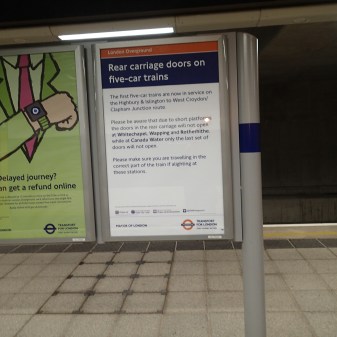
Selective Door Opening On The East London Line
Hopefully, SDO should work well on the Class 378 trains of the Overground. After all the continuous design of the trains will mean that unless the train is very busy, it should be much easier to get to an operational door.
According to Wikipedia, the SDO is controlled by GPS. So we have the door opening on a train running beneath London’s streets, being controlled by a satellite system.
As time goes on, more and more it seems that trains are becoming sentient beings with seats in them!
I wonder how long it will be before a version of the technology used on the 141 bus that counts the passengers, is giving TfL accurate loading information on some of their trains!
Up And Down On The East London Line
My memories if the East London Line don’t go back very far, as I probably only ever used the line once before I moved to Dalston in 2010. I think it must have been around 2000, when I was travelling from Brighton to my youngest son’s house in Bow. I changed trains at New Cross Gate to get to Whitechapel, from where I must have used the Metropolitan Line to Mile End, near to where he lived.
Comfortable and clean it wasn’t! The trains weren’t as bad as the travelling urinals of the North London Line, but the A Stock were forty years old and very tired.
I posted here about the step-free access improvements on the London Overground, so I thought I’d check them out.

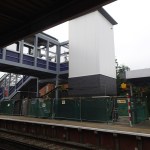
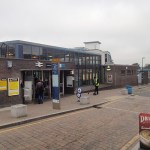

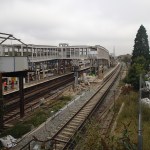

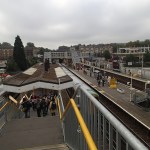
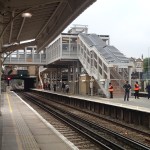
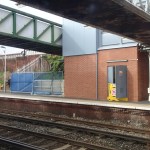
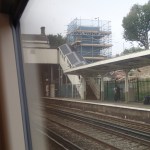
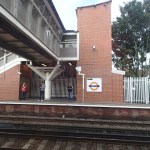
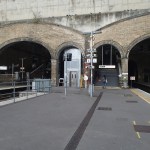
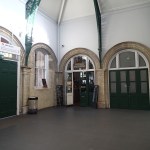

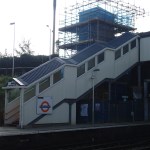

The pictures show my route from Dalston Junction to New Cross, from where I walked to New Cross Gate for a train to Crystal Palace. After a refreshment stop at the excellent Brown and Green cafe at the flagship southern terminus of the East London Line, I retraced my steps stopping to look at the improvements at Honor Oak Park and Brockley.
Of the stations south of Surrey Quays on the New Cross and Crystal Palace branches only Sydenham will not be substantially step-free by early next year. At Sydenham though it is effectively two stations, one for each direction, which means with planning, difficult stairs can be avoided.
Several excellent new cafes and coffee stalls, seem to be setting up in the stations.
The future is definitely looking up on the East London Line.
A good start has definitely been made on bringing some of the stations in South London into the twenty-first century.
Steel Flying Arches At Shadwell Station
These pictures show the steel flying arches at Shadwell station on the East London Line. They appear to be similar in form to the brick arches at Chorley.

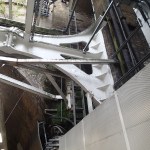
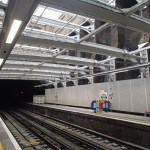
The purpose of these structures is to stop the walls of the cutting collapsing inwards.
They’re not pretty or elegant, but they seem to work!
How We Use A Cross-City Railway
London has two main North-South cross-city railways; Thameslink and the East London Line, which are shortly to be joined by a third East-West line; Crossrail.
These three lines are characterised by a tunnelled central core, with branches fanning out on either side. This means that if the branch you live on is paired with another branch on the other side of the city, you will probably have to change trains in the centre if you want to go to an alternative branch.
It’s not just London, who use this sort of layout. Birmingham, Cardiff, Liverpool and Newcastle in this country have similar cross-city trains or metros, and I suspect that worldwide there are quite a large number.
I did a journey a few weeks ago, which illustrates how we use these lines. I’d been to my doctor’s surgery, which is close to Haggerston station and afterwards I needed to go to Norwood Junction, which is on the West Croydon branch of the East London Line.
As it was raining hard, instead of waiting for the next West Croydon train on an exposed platform, I took the first train. I then hopped-off this train at Canada Water and hopped-on my desired train, after waiting for a few minutes in a dry underground station.
This hop-off-hop-on behaviour at a convenient station in the core will get increasingly common, as more and more branches are added to these cross-city lines.
If you use National Rail’s Journey Planner for say Sutton to Luton, some routes offered, involve a change of train at either Blackfriars or St. Pancras using Thameslink. But in the current Thameslink, these changes are not same platform ones, like they are on the East London Line and hopefully will be on the upgraded Thameslink, when it opens in 2019.
Crossrail takes this concept to a whole new level!
Most if not all of the central core stations are island platforms, so that if you are on a train from Abbey Wood to Heathrow, but want to go to Maidenhead, you just hop-off and then hop-on the first train that calls at Maidenhead, using a convenient Central London station. But the island platform, also allow you to reverse direction on a hop-off-hop-on basis. So Abbey Wood to Shenfield becomes a simple step-free one-change journey.
Sadly, there is no central core island platform station on Thameslink and the East London Line. This is probably more to do with adapting existing stations, rather than a less than perfect design.
But imagine what a lovely station the below-ground Thameslink station at St. Pancras would be with a large light and airy, central island platform with trains behind platform edge doors! Perhaps it could have a welcoming coffee-shop, where you could refresh yourself and meet friends.
Improving The Overground
Transport for London’s Transport Plan for 2050 says this about improving the Overground, with particular reference to creating a circular railway by extending the Goblin.
An option for doing this, could be an extension of the Overground in stages, creating new links initially where most feasible.
It does also say that new stations might be added to existing lines, giving a particular mention for Camberwell.
As I found on my trips Tracing the Goblin Extension, most of the infrastructure is already there and in many places, all it needs is innovative timetabling of the extra trains.
Buried in the report are possible plans on improving my local Overground service on the East London Line.
- Better late night and overnight services on the Overground.
- Automatic Train Operation on the core of the line from Dalston Junction to Surrey Quays to increase service frequency from 16 tph to possibly as high as 24 tph.
- Six car trains on the Overground.
At the moment the East London Line has 16 four-car trains an hour in the core route, so 24 six-car trains will mean an increase of capacity of 2.25.
It will be needed, as who knows how many passengers will use the line to get to Crossrail at Whitechapel?
Once Crossrail opens, so many regular journeys I do, like to Ipswich, Oxford Street, Paddington and Heathrow could involve going to Whitechapel and then using the new line.
It should also be said as regards the East London Line, that the report says nothing about extending the line to Willesden in the west or Stratford in the east, by reopening the Eastern Curve at Dalston. This was talked about when the East London Line was created, but I think that passenger numbers might have increased more than they thought they would, so five and possibly six car trains have had a priority.
I shall be adding a bit of speculation about what might happen to the Overground in the next few days. I’ll put links here for ease of reading a post with more jumps than a whole bunch of frogs.
An Overground Station For Camberwell?
Are There Any Sensible Places For New Stations On The Overground?
But whatever happens, it looks like it’s all go on the Overground. In some ways, this disparate collection of lines in and around London, shows how the new breed of railway managers and engineers in the UK are very sensible and cost conscious , and have the needs of the passengers very much to the fore.
 The Anonymous Widower