The Bletchley Flyover
The Bletchley Flyover is a large flyover that allows trains to cross the West Coast Main Line at Bletchley station.
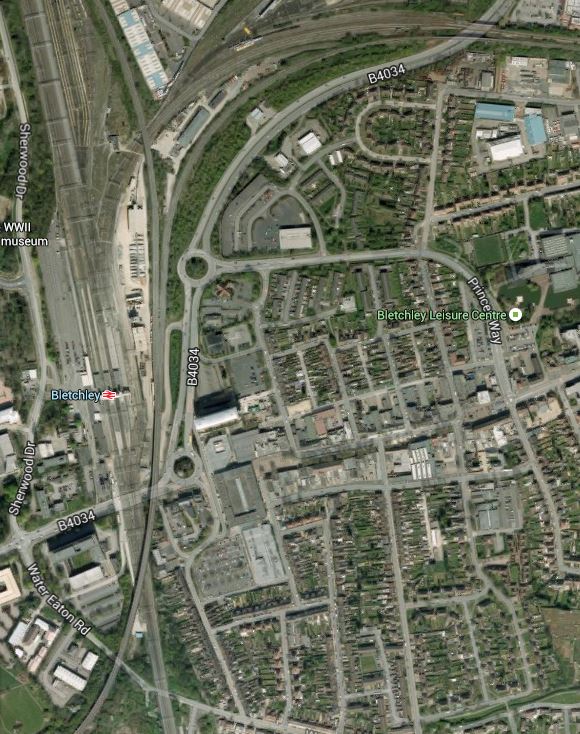
This Google Map shows the area of Bletchley station and the flyover.
Bletchley Flyover
The double-track Bletchley Flyover starts in the South-West corner of the map and crosses the West Coast Main Line at an acute angle before, splitting into two separate double-track lines, alongside the station and north of the circular roundabout.
- One branch goes North along the West Coast Main Line to Milton Keynes.
- One branch goes East along the Marston Vale Line to Fenny Stratford and Bedford.
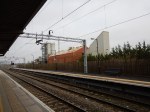
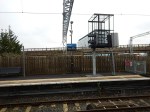
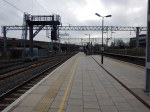
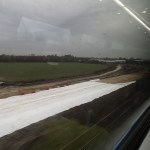
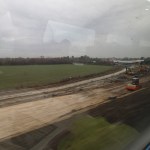
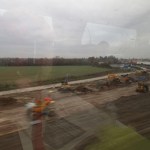
It is a massive structure as these pictures show.

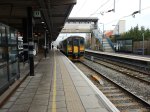
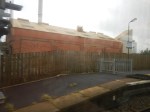
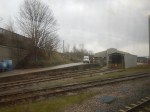
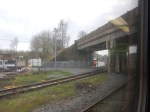
I think the problems of incorporating the following services through Bletchley are going to be challenging.
- Oxford to Milton Keynes
- Marylebone to Milton Keynes via Aylesbury.
- Oxford to Bedford.
- Freight Services.
This section in the FAQ of the East West Rail web site is entitled What train services will run on East West Rail (Western Section)? It says that frequencies of one train per hour will be run, but that more information will be released in 2016.
Will one probably four car train per hour be enough?
This would mean that two trains per hour would visit Milton Keynes. As Platform 2A at Milton Keynes Central can accommodate five car trains and it is electrified, it would appear that that station is ready for the East West Rail Link.
The difficulty also depends if the passenger services stop at Bletchley.
The current plans talk of two high-level platforms on the flyover.
This enlarged Google Map shows the platforms and footbridge at Bletchley station and the flyover.

Bletchley Station Platforms And The Bletchley Flyover
Note.
- The entrance to the station is on the west side.
- The two island platforms are 2/3 and 4/5, with two outer platforms 1 and 6.
- Trains on the Marston Vale Line terminate in Platforms 5 and 6.
- The flyover is the easternmost pair of lines.
- It splits into the Milton Keynes and Bedford lines level with the footbridge.
- The two proposed high-level platforms would be on the narrower part of the flyover, south of the footbridge.
A second entrance to Bletchley station has been proposed for the east side in Saxon Street.
One other thing that could help, is there are aspirations to move the concrete plant out of its location between the flyover and Bletchley station. It is certainly no asset to the area.
The following train services, would appear to have to use the flyover.
- Oxford to Milton Keynes
- Milton Keynes to Oxford
- Marylebone to Milton Keynes
- Milton Keynes to Marylebone
If trains between Oxford and Bedford, didn’t need to call at Milton Keynes, they would also be able to go straight over the flyover.
If they did need to call at Milton Keynes, then a train from Oxford to Bedford could take the following route.
- Over the flyover taking the branch to Milton Keynes.
- Call at Milton Keynes in an appropriate platform.
- Reverse out and then call in either Platform 5 or 6 at Bletchley.
- Reverse out and then take the Marston Vale Line.
Effectively, they would call at both the new high-level and current platforms at Bletchley station.
If I was running a train service from say Norwich or Ipswich to Oxford, to maximise my passenger levels, I would want my trains to call at the following stations.
- Cambridge
- Bedford – To also connect to services to Nottingham and Sheffield.
- Milton Keynes – To also connect to services on the West Coast Main Line.
The FAQ says that trains between Oxford to Bedford would not go to Milton Keynes.
I know that passengers would complain, if they had to stand on a draughty Bletchley station for say ten minutes, whilst waiting for a train to Milton Keynes, to get their Glasgow train.
To further complicate matters will other services could want to go between Milton Keynes and Bedford. On current plans, it is probably impossible without a reversal of direction at Bletchley.
A perfect design, would have a double-track chord connecting the Marston Vale Line to the Northbound West Coast Main Line.
Future Rail Developments At Milton Keynes
The Milton Keynes area and its stations at Bletchley, Bow Brickhill, Fenny Stratford, Milton Keynes Central and Wolverton, are in for a lot of development in the next few years.
The East West Rail Link
This map shows the East West Rail Link.

East West Rail Link
Note how it crosses the West Coast Main Line at Bletchley and has a connection to Milton Keynes Central.
The Wikipedia entry for Bletchley station has a section called Future. This is said.
The Marston Vale Line is the passenger carrying remnant of the Varsity Line. As of 2014, the line beyond Bletchley through Winslow to Bicester Town is closed to passenger traffic, with goods traffic going only as far as Newton Longville sidings for the waste disposal site there. The high level crossing (officially named the “The Bletchley Flyover” – built in 1959 as part of the Modernisation Plan, with 7 x 56 ft (17 m) spans and then expected to be used by 80 trains a day) over the WCML at Bletchley remains in place and in occasional use. There is a funded plan to re-open the line to passenger traffic via Bicester to Oxford by 2019 and an unfunded desire to rebuild it from Oxford right through to Cambridge. A key element of the plan is to build a Bletchley high level station so that passengers may transfer between the lines. (Note that there is no corresponding east to north route).
It is obviously, a bit out of date, as the East West Rail Link is now planned and funded to Bedford.
This Google Map shows the track layout at Bletchley with the Marston Vale Line joining from the East and Fenny Stratford station.

Bletchley Station And The East West Rail Link
Note.
- Stadium MK at the top of the map.
- The East West Rail Link can be seen curving to the west to the south of Bletchley station.
- The flyover over Bletchley station.
- Fenny Stratford station is to the south west of the large building at the east.
- The next station to the East is Bow Brickhill.
Bletchley will become a more important station.
East West Rail Link Services From Milton Keynes Central
The Wikipedia entry for Milton Keynes Central has a section called East West Rail. This is said.
From 2019, services are planned to operate (over a rebuilt East West Rail Link) to Oxford via Bletchley, Winslow and Bicester Town; and also to London Marylebone via Aylesbury and High Wycombe. Extension of the Oxford service to Reading has been mooted.
This will definitely need some more platforms at Milton Keynes Central, other than the single one 2A built for the still-born extended Marston Wale service to Milton Keynes.
I published some pictures in Platform Space At Milton Keynes Central, which show that there is some space.
Implications For Bletchley
I have now written The The Bletchley Flyover to cover the implications for Bletchley.
Great North Western To Blackpool
The Wikipedia entry for Milton Keynes Central has a section called Great North Western. This is said.
Great North Western Railway has been given permission to run 6 trains a day from London to Blackpool North from 2018, with conditional permission for a stop at Milton Keynes Central dependent upon future capacity after infrastructural work.
This will probably be very much a development, that will only affect Milton Keynes Central station.
Crossrail To Milton Keynes Central
The Wikipedia entry for Milton Keynes Central has a section called Crossrail. This is said.
Network Rail’s July 2011 London & South East Route Utilisation Strategy (RUS) recommended diverting West Coast Main Line (WCML) services from stations between London and Milton Keynes Central away from Euston, to Crossrail via Old Oak Common, to free up capacity at Euston for High Speed 2. Doing so would provide a direct service from the WCML to the Shenfield, Canary Wharf and Abbey Wood, release London Underground capacity at Euston, make better use of Crossrail’s capacity west of Paddington, and improve access to Heathrow Airport from the north. Under this scheme, all Crossrail trains would continue west of Paddington, instead of some of them terminating there. They would serve Heathrow Airport (10 tph), stations to Maidenhead and Reading (6 tph), and stations to Milton Keynes Central (8 tph).
In August 2014, a statement by the transport secretary Patrick McLoughlin indicated that the government was actively evaluating the extension of Crossrail as far as Tring and Milton Keynes Central, with potential Crossrail stops at Wembley Central, Harrow & Wealdstone, Bushey, Watford Junction, Kings Langley, Apsley, Hemel Hempstead, Berkhamsted, Tring, Cheddington, Leighton Buzzard and Bletchley. The extension would relieve some pressure from London Underground and London Euston station while also increasing connectivity. Conditions to the extension are that any extra services would not affect the planned service pattern for confirmed routes, as well as affordability.
Extending Crossrail to Milton Keynes would seem to be a sensible idea.
It would increase the capacity and frequency of services between Milton Keynes and London and open up several more direct destinations.
The quote from Wikipedia talks of increasing connectivity to Crossrail.
- The Watford DC Line is joined is joined at Wembley Central, Harrow & Wealdstone, Bushey and Watford Junction
- The Bakerloo Line is joined at Wembley Central and Harrow & Wealdstone
- The Metropolitan Line will be joined at Watford Junction.
This connectivity is in addition to that created by an Old Oak Common station.
As with the East West Rail Link, it will probably need extra platforms at Milton Keynes Central. But there is at least some space to create them.
Conclusion
Milton Keynes Central will be a lot bigger and busier than it is now.
But it will join that elite group of stations that are Crossrail’s and Thameslink’s super-hubs.
By Rail From Bedford To Northampton
One of my Google Alerts picked up this article from the Northampton Chronicle, which is entitled Rail campaigners reject calls by St James residents to re-open Northampton link road.
There used to be a Bedford to Northampton Line, but it has been gradually abandoned, despite interest in using it for the following.
- As an extension to Thameslink to Northampton.
- As a freight route to the West Midlands.
I also feel that with Bedford likely to be an important station on the East-West Rail Link, surely the rail link to Northampton shouldn’t be compromised, so that it can’t be reinstated.
- It would make journeys between Cambridge, Ipswich and Norwich and Northampton and the West Midlands a lot easier.
- Freight from between Felixstowe and the West Midlands would have an alternative route.
I don’t think anything will happen soon, but the expansion of Thameslink and the East West Rail Link to Bedford will make everybody think.
Electrification Of The East West Rail Link
East West Rail has this question about electrification in the FAQ.
Q: Will East West Rail be electrified and if so, when?
A: It is expected that the Western Section of the East West Rail link will include electrification of the line between Bedford and Oxford.
Bletchley to Oxford is expected to be completed first during the 2014-2019 railway funding period.
Bedford to Bletchley will follow, probably in the next railway funding period 2019-2024, as part of the wider work done to electrify the Midland Main Line to Corby, Nottingham and Sheffield.
The Office of Rail Regulation has confirmed funding in principle for the electrification. The exact amount of funding and scope is expected to be determined by the ORR by March 2015 following detailed development between NR, DfT and the train operators.
I will take this as a qualified yes or it would be desireable.
Bletchley to Oxford electrification is stated as being done first and if that timetable is met, it would be likely to be completed before services start on these routes.
- Oxford to Milton Keynes
- Milton Keynes to London via Aylesbury.
As both Oxford and Milton Keynes are currently or will be electrified by then, the services between the old and new cities could be performed by a 100 mph EMU, like a Class 387 train, which could then continue to Reading if required.
But there are no plans to electrify any of the London to Aylesbury Line. To complicate matters Chiltern Railways have a shortage of suitable diesel trains.
So although the line might be ready in 2019 or so, there would appear to be no chance of Chiltern Trains running between London and Milton Keynes.
Unless!
Wikipedia gives the length of the passenger section from London to Aylesbury Parkway as about thiry nine miles.
So this probably means that the line could be run by Class 387 IPEMU trains, if there was some electrification in Marylebone station to charge the trains before they travelled North.
It is an interesting possibility.
Especially, as an electrified Marylebone, would probably allow the same trains to run services to electrified stations at Bicester Village, Oxford Parkway and Oxford.
East West Rail Moves On Phase 2
East West Rail is the project to create an electrified 100 mph railway from Oxford to Ipswich and Norwich via Milton Keynes, Bedford and Cambridge.
This map from the East West Rail web site, indicates the route.
East West Rail
Phase 1 is now almost complete with the linking of Bicester to Oxford.
Services are running between Oxford Parkway and London Marylebone via Bicester Village. Hopefully, Oxford will be reached in Spring 2016.
A statement by East West Rail entitled Alliance contracts awarded for East West Rail Phase 2, has been relkeased about the award of contracts for Phase 2 of the line to connect Bicester, Milton Keynes and Bedford. This is said.
An alliance of four equal parts between Network Rail, Atkins, Laing O’Rourke and VolkerRail will build East West Rail Phase 2 (EWR2) – linking Oxford, Milton Keynes and Bedford, and Milton Keynes with London Marylebone via Aylesbury.
The contracts will enable the following services.
- Oxford – Milton Keynes (calling at Oxford Parkway, Bicester, Winslow and Bletchley)
- Oxford – Bedford (calling at Oxford Parkway, Bicester, Winslow, Bletchley, Woburn Sands and Ridgmont)
- Milton Keynes – Aylesbury – London Marylebone (an extension of the existing service between Marylebone and Aylesbury Vale Parkway, with stops anticipated at Bletchley, Winslow, Princes Risborough and High Wycombe)
- Increased capacity for freight services
The following work will be done.
- A new station at Winslow
- Two new platforms at Bletchley – Click for some details
- Construction of 18 new overbridges.
- Construction of 22 new footbridges/subways
- Changes to 97 railway crossings
It is not a small project.
I find it interesting that the work is an alliance of four companies.
This method of working has been used successfully at Stafford, in the Stafford Area Improvements Program to relieve the bottle-neck at Norton Bridge Junction on the West Coast Main Line.
Hopefully, it will avoid another Great Western Railway style of fiasco.
First Great Western’s Pragmatic Large And Little Solution To The Problems Of Great Western Electrification
The electrification of the Great Western Main Line from West of Airport Junction to Bristol, Cardiff and Swansea is proving to be a difficult project to deliver.
This article on the BBC web site talks about the problems and starts with these paragraphs.
Electrifying the Great Western line is “a top priority”, the transport secretary has said, as he announces a rethink of a £38bn programme to overhaul Britain’s railways.
Patrick McLoughlin said Network Rail’s five-year plan was being “reset” as it was “costing more and taking longer”.
In an ideal world, the whole of the Great Western Main Line and its branches to places like Worcester, Gloucester, Cheltenham, Exeter,Plymouth and Penzance would be electrified.
But it was never intended to electrify the major branches and for a time InterCity 125 diesel trains will be used on these lines.
Then in February 2014, the sea wall at Dalwish was breached in a storm and much of the track and Dawlish station was washed away. Although the line was rebuilt in a few months, it is only recently that the sea wall and the walk alongside the railway has been reinstated.
The force of the storm probably put an end to thoughts for many years of fully electrifying the line from Exeter to Plymouth and Penzance
The Large Class 800 Electro-Diesel Train
The trains that will work the Great Western Main Line to Bristol and Cardiff are the Hitachi Super Express, which comes in two variants.
The two trains are very similar, but the Class 800 has on-board diesel engines to generate electricity. Wikipedia says this.
The Class 800 units will be electro-diesel multiple units, able to draw power from electrified overhead lines where available and power themselves via underfloor diesel generators outside of the electrified network. The train specification requires that this changeover can occur at line speed. The trains are able to be converted to electric only operation by removal of the diesel engines
Current plans are for 21 9-car Class 801 and 36 5-car Class 800 to replace 60 InterCity 125.
With no prospect of electrification to Devon and Cornwall and because of the nature of the line with gradients, First Great Western have taken the pragmatic decision to order twenty-nine more trains, which will effectively be a variant of the Class 800, but with uprated diesel-engines and larger fuel tanks. It’s reported in this article in the Railway Gazette International.
So the total fleet will eventually be 47 9-car trains and 39 5-car trains of all new variants to replace 60 2+7 InterCity 125 and 5 5 car Class 180 trains.
So it would appear that about 490 x 23 metre cars will be replaced by 618 x 26 metre cars. On a crude calculation that is just over a forty percent increase in capacity, with a sixteen percent increase in the number of trains.
When everything is delivered towards the end of this decade, First Great Western would seem to have available a substantial increase in capacity, with a large proportion of the fleet having a go-anywhere capability because they are electro-diesel trains.
So it looks like some of these trains will be used to extend the network, as well as increase the frequency to Devon and Cornwall.
But there will be no need to need for any extra electrification. Although of course if there were, this would only be to the advantage of the electro-diesel trains, which would run on electric power for longer.
The Little Class 387 IPEMU
If the rumours about the Class 387 trains for First Great Western in this month’s Modern Railways are true, then some or all of the eight trains on order will be IPEMUs, with an on-board battery to power the train for up to sixty miles.
Modern Railways said this about their use.
Delivery as IPEMUs would allow EMUs to make use of as much wiring as is available (and batteries beyond) while electrification pushes ahead under the delayed scheme, and in the longer term would allow units to run on sections not yet authorised for electrification, such as Newbury to Bedwyn. The use of IPEMUs might also hasten the cascade of Class 16x units to the west of the franchise.
As Newbury to Bedwyn is probably less than twenty miles, a Class 387 IPEMU could easily do the trip out and back on a battery, charged whilst running from Paddington.
There is also a small problem highlighted in a section entitled Review after May 2015 general election in an article on Wikipedia describing the Great Western electrification.
This has led to speculation that the GW electrification scheme (although it remains “top priority”) could be cut back. On 27 May 2015, the website of Theresa May, MP for Maidenhead, contained the following: “… a recent report stated that it would not be ‘technically feasible’ for electrification to go ahead on the Marlow branch, raising questions about the future of the Henley branch as well”
The Marlow and Henley branches are 7.25 and 4.5 miles long respectively and mainly run a shuttle service to the main line with occasional services to Paddington.
So would it be more cost-effective to use a Class 387 IPEMU on these branches, as there would be no need to electrify the lines?
If a Class 387 IPEMU was good enough for these branches, what about the other branches on the Great Western Main Line to Greenford and Windsor and Eton Central?
The only work that would need to be done on these branches to accept the 4-car Class 387 IPEMU would be some platform lengthening and electrifying any bay platforms they use on the main line.
There may be other places on the Great Western Main Line, where electrification can be omitted by the use of the Class 387 IPEMU.
Class 387 IPEMU Or Aventra IPEMU?
This question has to be asked.
The Class 387 train on which the Class 387 IPEMU will be based is a member of the Electrostar family of trains, that have been produced by Bombardier since 1999,
The Electrostar is being superseded by the new Aventra family and the first orders have been placed for Crossrail and the London Overground.
The improvements in the Aventra design are summed up here in Wikipedia. This is said.
The multiple units have been designed to be lighter, more efficient, and have increased reliability. They will have lightweight all-welded bodies, wide gangways and doors to shorten boarding times in stations, and ERTMS. The design incorporates FlexxEco bogies which have been used in service on Voyagers, Meridians and newerTurbostars.
The design features a gangway design that allows maximum use of the interior space and ease of movement throughout the train.
As the Aventra is a new train, that has been designed since the successful IPEMU trial with a Class 379 in 2014, I do wonder if it has been designed with the ability to be fitted with an on-board battery to make it an Aventra IPEMU! In this article on Global Rail News this is said.
AVENTRA can run on both 25kV AC and 750V DC power – the high-efficiency transformers being another area where a heavier component was chosen because, in the long term, it’s cheaper to run. Pairs of cars will run off a common power bus with a converter on one car powering both. The other car can be fitted with power storage devices such as super-capacitors or Lithium-Iron batteries if required. The intention is that every car will be powered although trailer cars will be available.
So every Aventra can be converted to an Aventra IPEMU! And as that article was written in 2011, it increasingly looks like the IPEMU trial was a test of one of the new systems for an Aventra.
It would surely be a big advantage to a train operator running a fleet of Aventras, if they could add and remove battery packs as their schedules required.
But surely, because of the fact that an Aventra is lighter and more efficient than a Class 387, I wouldn’t be surprised that the range of an Aventra IPEMU is greater than the sixty miles quoted for the prototype.
Every extra mile, that the train can complete on batteries would open up new routes.
I suspect too that the Aventra IPEMU will have more customer appeal than a Class 387 IPEMU.
No-one will believe that a train running on batteries could possibly be a viable proposition, so at least if it looks like one of the new Crossrail Class 345 trains, passengers would at least think the train was modern.
So I wouldn’t be surprised if the order for Class 387 IPEMU was delivered as Aventra IPEMUs.
Oxford
To say that Oxford station has had planning problems in the last few years would be a massive understatement. I talked about them in Network Rail’s Problems In Oxford.
According to this article on the BBC, planning permission has at last been given to extend platforms at the station, so that Chiltern Trains can run services to the city.
But there is no mention of a new platform on the South side of the station, as is mentioned in Future Expansion in the station’s Wikipedia entry.
Or any mention of electrification either!
So will Network Rail postpone the new platform and the electrification to Oxford?
If they do, then First Great Western can serve the city by Class 800 trains going along the Cotswold Line to and from Evesham and Worcester.
First Great Western could also still use the current Class 165/6 trains, but they would like to cascade them to other places on their network.
Now here’s a thing!
Didcot to Oxford is probably less than thirty miles, so once Didcot is electrified, Oxford could be easily reached by an IPEMU.
If this happened Oxford would get new 110 mph 4-car electric trains to replace 90 mph 2-car and 3-car diesel trains.
The electrification needed for the East-West Rail Link would be done later, when Oxford decided to join the twentieth century.
Rolling Stock Cascade
At present First Great Western has a fleet of diesel multiple units that work the Thames Valley Services.
- Sixteen 3-car Class 165 trains
- Twenty 2-car Class 165 trains
- Twenty-one 3-car Class 166 trains
These will be replaced by twenty-one 4-car Class 365 trains from Great Northern and twenty-nine 4-car Class 387 trains cascaded from Thameslink as the new Class 700 trains arrive.
Another order for eight 4-car Class 387 trains has been placed and it is this order that Modern Railways said could be for IPEMUs.
In terms of carriages 151 diesel carriages are being replaced by 232 electric ones.
According to this document on the ATOC web site, this will happen to the Class 165 and Class 166 trains.
Some will be displaced by electrification (and the resulting cascade) on Great Western. One option is that they remain in service, to accommodate growth and to provide a cascade of Class 15x vehicles, subject to necessary modifications and PRM-TSI.
So it looks like they will be used to replace the outdated Class 15x trains.
Cardiff to Portsmouth
Cardiff to Portsmouth is a route run by First Great Western. When I went from East London To Yeovil By The Long Way, I used a First Great Western Class 158 train from Fratton to Salisbury. I said this in the related post about the journey.
I think this journey shows up our trains in a reasonable light. The journey times are slow not because of slow trains, but because of the frequent stops and complicated route. The journey took three hours seventeen minutes from Littlehampton to Yeovil, but there was only thirty-three minutes wasted in connections.
Although some trains date from the 1980s, there wasn’t anything as bad as the dreaded Pacers that inhabit the North. The services were pretty well-used and except for the short leg from Littlehampton to Fratton, there was a catering trolley on all trains.
I do think though, that perhaps this journey might be better done in something like a 4-car Class 800. Although, there isn’t much electrification to make use of until you get to Bristol, once you’ve left Southampton.
An IPEMU wouldn’t be much help, as it’s a long way between Cardiff and Portsmouth.
So is there a need for a 4-car Class 800 train, optimised for long cross-country routes, where there is not much electrification or high-speed running?
Conclusion
The Large and Little approach by First Great Western seems to be a pragmatic way around the problems of the Great Western electrification.
The new Class 800 trains and their closely-related siblings will enable services to be expanded at the extremities of their network, without any need for full electrification.
If all or some of that future order for eight Class 387 trains, was for the IPEMU variant or were even Aventras, so long as electrification reached Newbury and Didcot, new Class 387 IPEMUs could run to Marlow, Henley, Windsor, Oxford and Bedwyn.
One side effect would be the release of Class 165/6 trains, currently used on the routes out of Paddington and the branch lines, for other services on their network.
Two Solutions To Make Crossing A Railway Safe
On the way to football tonight in Ipswich, I went to have a drink with a friend, who lives near Thurston station on the Ipswich to Ely Line, where there is a good real ale and cyder pub. Crossing the tracks at Thurston is via a simple walk across controlled by traffic lights between the two platforms.


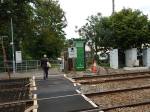
Of all the stations I use regularly, this is the only place where such a system is in use. Unless of course you count the trams at Ampere Road by the Croydon Ikea. A few hundred metres to the west of the station a bridle way and cycle path crosses the railway and Network Rail have built this bridge.


There have been reports like this one in the East Anglian Daily Times, which has a headline of Poll: £1.5m ‘monster’ railway bridge at Thurston is dubbed a ‘total waste of money’
This bridge is an interesting case of what to do where there are gated crossings of railway lines.
I think before being too critical of Network Rail we should bare these points in mind.
1. Suicide
This article on the BBC web site talks of a death at a crossing in the Thurston area. Network Rail get far too many deaths on the railway and it is a sad fact, that stepping in front of a train, is a common method of suicide.
2. The East-West Rail Link
The East-West Rail Link will use this line to get from Ipswich and Felixstowe to Cambridge and Ely. This link will be an electrified 100 mph railway that will run trains between East Anglia and the Midlands and the West. So although the line carries perhaps a couple of trains every hour each way, in perhaps ten years time, this will probably be a few times more. And as the line is pretty straight as the pictures show, the operating speed could be a lot higher.
3, Horses
If you read all the comments about the bridge no-one mentions taking a horse over the railway.
Horses are flight animals and if spooked will run fast away from the perceived danger.
Many horses too, don’t like going under high-voltage cables. Whether it is because they can sense the magnetic field generated by the electricity or they don’t like the whistling sound,I don’t know. But if the crossing is going to be used by horses, it will have to be of the size it has been built.
I’m not sure, but I think this is the only way to get a horse from one side of the railway to the other, unless you go all the way and go under the bridge by Thurston station.
4. Getting The Design Right
This bridge illustrates that getting the design right and satisfying all users and critics who never use the bridge is an almost impossible task.
Aesthetically, I don’t like the bridge, but unless they dig a subway under the railway, there is nothing else that can be done to satisfy all users and critics of the design.
Note that when the railway is upgraded to be part of the East-West Rail Link, Thurston station will have to be rebuilt and I suspect it will have a bridge over the railway, probably with lifts and a price tag well upwards of £2million.
There will be some serious discussions.
The Reality Of The East West Rail Link
Earlier this week, I took pictures of the work going on at Bicester to connect the Chiltern Line to Oxford.
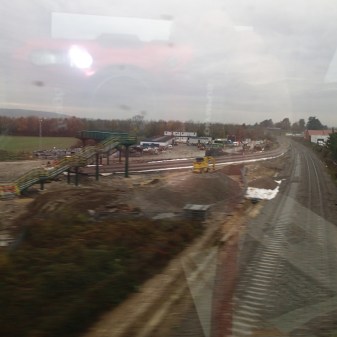
The railway passing underneath the Chiltern Line will become part of the East West Rail Link, which will hopefully link Oxford and Cambridge within the next ten years.
Modern Railways this month has a welcome page to the magazine entitled A Mini Adventure, which describes a promotional trip by Chiltern Railways on the possibly-to-be-reopened Cowley Branch. James Abbott, the Editor, says this.
A railway linking the ‘technology crescent’ – an arc about 60 miles from London stretching from Harwell and Didcot through Oxford and Milton Keynes to Silicon Fen – is well on the way to becoming reality.
He then goes on to say that he can see an East West railway starting at a Reading linked to Heathrow, giving international access for the technology crescent with just one change.
The Bicester Chord Takes Shape
I took the Chiltern Line to Stratford upon Avon today and I was able to get these pictures of the building of the Bicester chord.
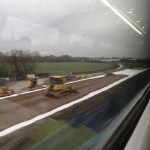

This will allow Chiltern Trains to start services between Oxford and Marylebone sometime in 2015.
The Bicester Chord is the first idea of several to come to fruition and transform railways in the area between Oxford, Banbury and Milton Keynes.
The East West Rail Link will be built and electrified, to link Oxford, Bicester, Milton Keynes, Bedford, Cambridge, Ipswich and Norwich.
The Cowley Branch at Oxford will be opened to passenger traffic.
Marylebone to Birmingham will drop to ninety minutes.
Chiltern Trains will probably want to expand. This is probably just as well, as if HS2 is to be built and Euston rebuilt, someone will have to get the passengers between London and Birmingham.
Will Crossrail Go To Hertfordshire?
Yesterday, it was reported on the BBC that the government is seriously thinking of diverting some Crossrail trains to Hertfordshire possibly terminating them at Tring.
This is an old idea originally proposed by Network Rail and discussed here in Wikipedia. This is what is said.
Network Rail’s July 2011 London & South East Route Utilisation Strategy (RUS) recommended diverting West Coast Main Line (WCML) services from stations between London and Milton Keynes Central away from Euston, to Crossrail via Old Oak Common, to free up capacity at Euston for High Speed 2. This would provide a direct service from the WCML to the West End, Canary Wharf and other key destinations, release London Underground capacity at Euston, make better use of Crossrail’s capacity west of Paddington, and improve access to Heathrow Airport from the North.[113] Under this scheme, all Crossrail trains would continue west of Paddington, instead of some of them terminating there. They would serve Heathrow Airport (10 tph), stations to Maidenhead and Reading (6 tph), and stations to Milton Keynes Central (8 tph).
I think this could turn out to be an excellent change of plan. It certainly won’t add a billion or so to the costs of the project. Tring station would appear to have quite a large number of platforms and the only major infrastructure for the route would appear to be a tunnel at Old Oak Common.
Crossrail as originally designed went to Heathrow and Maidenhead in the West and Shenfield and Abbey Wood in the East. Sensibly in my view, Maidenhead has been changed for Reading in the West, to add a whole new level of connectivity to the West of England and Wales. Connecting to the West Coast Main Line could add similar connectivity to the North West of England, North Wales and Scotland.
So should Crossrail go to Tring or perhaps a more substantial interchange on the West Coast Main Line, which has cross platform interchange to Virgin’s streams of Class 390 Pendolinos to speed North? The excerpt from Wikipedia, I quoted earlier, says eight trains an could go to Milton Keynes.
I estimate that if Crossrail services terminated at Milton Keynes, the trains would get there within a few minutes of an hour from Canary Wharf. That is only twenty minutes more than it will take from Heathrow to Canary Wharf.
But Milton Keynes is more than a New City on the West Coast Main Line, it is an important staging post on the East-West Rail Link from Cambridge and East Anglia to Oxford and the West Country, so making Milton Keynes one of the Crossrail termini and linking it to the North with frequent services, could give whole new areas of the country like East Anglia and the West of England much better train services to the North.
If Milton Keynes was developed as this major hub, this would have other consequences.
- The East-West Rail Link should probably be built as a 200 kph capable railway, so that Oxford to Cambridge services could be well under two hours.
- The East-West Rail Link connects to the Midland Main Line at Bedford and Chiltern Services at Bicester, so should it complete the set by going to Cambridge via Peterborough, where it can interchange with the East Coast Main Line. It is the cheapest possible route of the rail link, but what people who live in places like Oakham will think about it, I do not know.
- HS2 might be being built in the wrong place, as if Milton Keynes becomes this important rail hub, surely it should visit the city.
All I can say, is that extending Crossrail to Hertfordshire and Milton Keynes, will make planners think very hard about connections from the terminus to points to the North, East and West.
 The Anonymous Widower