Could There Be A Tram-Train Between Ipswich And Felixstowe?
I should declare an interest here of my teenage self, who spent some very boring summers in, what was then, the small coastal resort and dormitory town of Felixstowe.
There was only so many places you could cycle and as my school friends were all in London, I used to avoid going to Felixstowe if possible.
I can remember going from London to Felixstowe several times on the train.
I would cycle from our London house in Cockfosters to Liverpool Street station and put my bike in the guard’s van for the trip to Ipswich.
From Ipswich, I would ride the dozen or so miles along the A45 (now the A14) to Felixstowe.
I suspect, that I could have used, the two-car diesel shuttle from Ipswich to Felixstowe, but I never did.
Perhaps, it was because it was not the most frequent of services.
The frequency was certainly a lot less than the current hourly service.
A Tram-Train To Felixstowe
This report on the East West Rail web site is entitled Eastern Section Prospectus and gives full details of their proposals for the Eastern section of the East-West Rail Link.
This is said in the report.
Introduction of a tram-train service on the Felixstowe branch, with doubling between Derby Road and Felixstowe and street running through
Ipswich.
It is also said, that there will be a frequency of four trains per hour (tph) between Ipswich and Felixstowe.
So how feasible is this proposal?
The Proposed Frequency
People travel between Ipswich and Felixstowe for several reasons.
- It is an important dormitory town for Ipswich and increasingly for London,
- The Port of Felixstowe is an important employer.
- There is a large amount of leisure traffic between the two towns.
Currently, much of the travelling between Ipswich and Felixstowe is by car on an increasingly crowded A14.
Four tph seems an eminently sensible frequency.
Why Propose A Tram-Train?
If a train, like a Class 170 train or one of the new Class 755 trains were used for the route, it would mean the following.
- Four tph in the single platform at Felixstowe.
- Four tph in a dedicated platform at Ipwich.
- Four trains would be needed for the service.
- An extra six tph using the route between Westerfield and Ipswich stations.
The stations should be able to cope, but I doubt that the extra trains could be fitted into a busy route with the following services.
- Ipswich and Norwich
- Ipswich and Bury St. Edmunds, Cambridge and Peterborough
- Ipswich and Lowestoft
If you add in the up to forty freight trains per day, that will use the route, something will have to give.
The Route Od The Tram-Train
It would appear that the plan is to replace the train, with a tram-train running on the streets of Ipswich.
This could be a possible route for street running.
- Ipswich Station
- Portman Road
- Ipswich Town Centre
- Ipswich Hospital
It would then join the Ipswich-Felixstowe rail line in the area of Derby Road station or the retail parks on the East of Ipswich.
This Google Map shows Derby Road station and Ipswich Hospital.
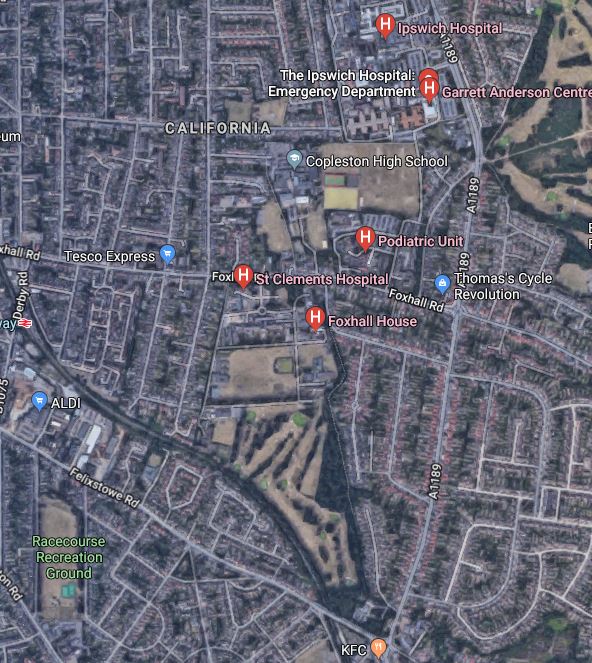
Note.
- Ipswich Hospital is in the top-right of the map.
- Derby Road station is at the left side of the map in the middle.
- The Ipswich-Felkixstowe Line can be seen going South-Easterly across the map to the well-known St. Augustine’s roundabout.
A tram-train would have the following benefits.
- It would link the town centres of Ipswich and Felixstowe.
- It would create a step-free link across Ipswich Town Centre to the all-important hospital.
- Extra stations can be added where they are needed in Ipswich without decreasing capacity on the rail line.
- It would surely encourage more people to use the trains from Ipswich station.
I suspect too, that Class 399 tram-trains could be used as they are in Sheffield and will be on the South Wales Metro.
Between Ipswich And Derby Road Stations
This extract is from the Wikipedia entry for the Felixstowe Branch Line.
The train now enters a section of double track through Derby Road station (6.10 miles (9.82 km) from Ipswich station by train, but only 1.5 miles on the map) where trains can pass.
It is very significant, that going through the houses between the two stations is a route that is shorter by eight-and-a-half miles.
Could it be that the time that would be saved by the shorter route is balanced by the slower progress of on-street running, which means that the current twenty-six minute journey time can be maintained?
Doubling Between Derby Road And Felixstowe
I’ll repeat what is said in the report.
Introduction of a tram-train service on the Felixstowe branch, with doubling between Derby Road and Felixstowe.
Doubling of about a mile of the Felixstowe Branch to the West of Trimley is ongoing and doubling further to the West looks to be fairly easy from my helicopter.
But there is one major problem.
This Google Map shows, where the rail line goes over the Ipswich by-pass.
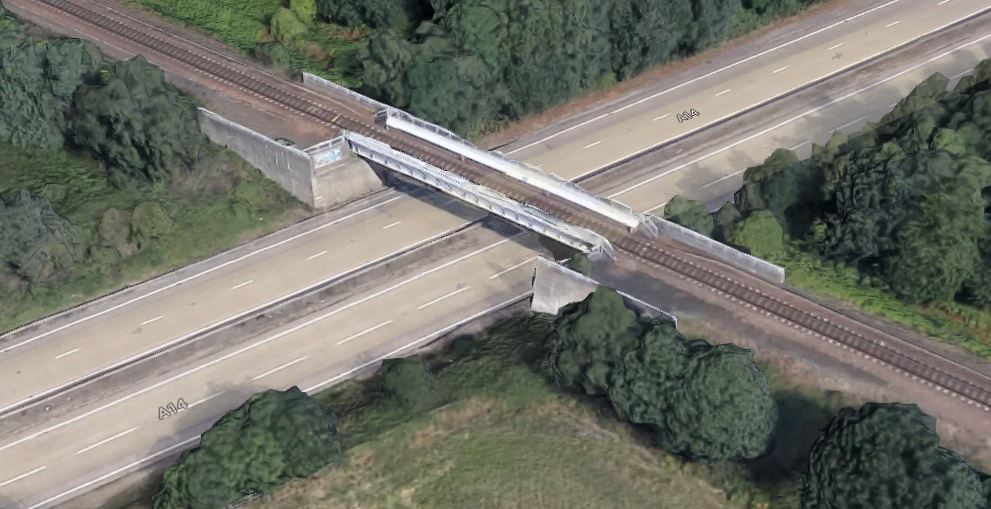
Note that provision has been made for a second track.
So hopefully, it won’t be much more expensive to add a second bridge and track, than to add points either side of the existing bridge.
There would be some extra bridge works between the A14 and Derby Road station, but doubling all the way from Derby Road station to Felixstowe doesn’t look to be the world’s most difficult railway engineering.
Extra Tram-Train Stops Between Ipswich And Felixstowe
There used to be an extra stop at Orwell station. It was little-used and closed in 1959.
Looking at the station, it is now a large private residence and I suspect there is no point in reopening, as there isn’t much housing in the area.
But there could be a case for a station at Futura Park, which is shown in this Google Map.
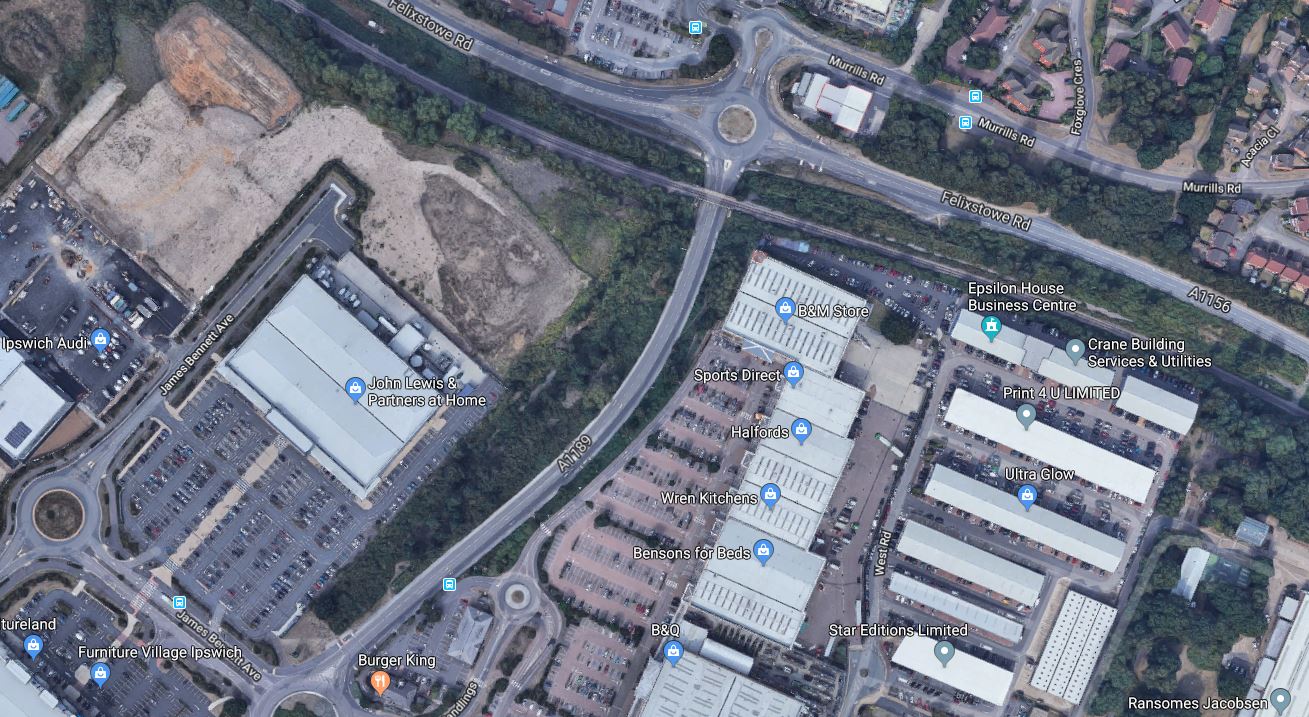
Lots of the usual out-of-town stops are there including a Waitrose and a John Lewis.
The railway runs to the South of the A1156 Felixstowe Road and there is surely the possibility of a station in this area.
There is also the possibility, that the tram-train could join and leave the Felixstowe Branch Line at this point, after and before street running to Ipswich station.
Would The Tram-Trains Go Walkabout In Felixstowe?
Felixstowe used to have two other stations; Felixstowe Pier and Felixstowe Beach. Both are now closed.
- I can remember Felxstowe Beach station, as occasionally in the 1950s, we stayed nearby at the Cavendish Hotel.
- Felixstowe Pier station was towards Landguard Fort and even served steam vessels going to Germany.
Both stations were served by trains reversing at the main station, which is impossible now as the chord has been removed.
This Google Map shows the current rail lines in Felixstowe.
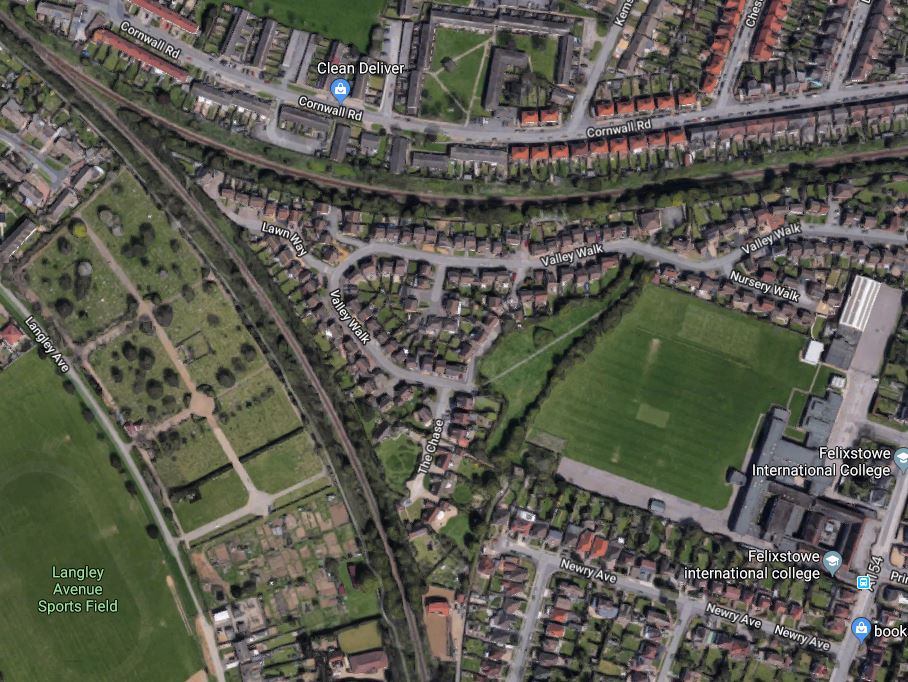
The line to/from Ipswich splits into two in the top-left corner of the map.
- The branch going East goes to Felixstowe station.
- The branch going South used to serve the two other Felixstowe stations and now serves the Port of Felixstowe.
The missing chord is visible to the West of the playing fields of Felixstowe International College.
I would rate reinstatement of the chord as highly unlikely.
- The only reason, the chord would be reinstated, would be if the Port of Felixstowe wanted to have a four tph passenger service.
- The Port wouldn’t want to have all those extra movements on what is a busy and exclusive freight line.
On the other hand, I wouldn’t rule out extension into Felixstowe Town Centre.
This Google Map shows the Town Centre.
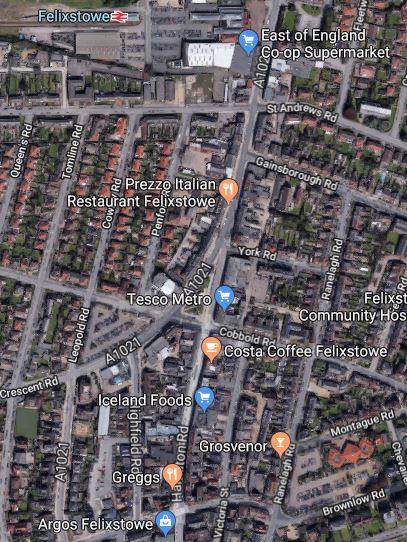
Note.
- The one-platform station is at the top of the map, behind a small Co-op supermarket and the Listed station buildings, which are now a small shopping centre.
- The High Street, which is part -pedestrianised leads down from the station to the top of the cliffs, where Bent Hill leads down to the sea-front.
- Halfway along is a triangular garden, where a local road splits off toward the Southern part of the sea-front and the Port.
- The pattern of retail shopping is changing and Marks and Spencer in the town will be closing soon.
My plan would be as follows.
- Rebuild the Co-op supermarket to allow a single-track tram line to squeeze through to the High Street.
- Trams would then continue down the High Street to the triangular garden.
- A second platform face could be added at Felixstowe station to allow trams to pass and give flexibility.
Done properly, it could improve Felixstowe’s appeal as a leisure destination.
I also think, that as the extension is only short, the current Ipswich to Felixstowe timing could be maintained.
Future Services At Ipswich Station
Listing all the services proposed at Ipswich station gives the following.
- 3 tph – London Liverpool Street and Norwich – Greater Anglia
- 1 tph – Colchester and Peterborough – Greater Anglia – Replaces current Ipswich and Peterborough service.
- 1 tph – Manningtree and Oxford via Cambridge – East West Rail – Replaces current Ipswich and Cambridge service
- 1 tph – Ipswich and Lowestoft – Greater Anglia – Some services extend to London
- 4 tph – ipswich and Felixstowe – Greater Anglia – Proposed tram-train service.
If the Felixstowe tram-train service were to terminate outside the station, as trams tend to do, there would only be a need for one bay platform at Ipswich, that would handle hourly Lowestoft services, that didn’t go to/from London.
Ipswich station would become more of a through station with the following through trains.
- Five tph going between Manningtree and Stowmarket
- Two tph between Manningtree and the proposed A14 Parkway station via Bury St. Edmunds.
This would all save the expense of rebuilding large parts of Ipswich station.
Although, there would be a certain amount of remodelling of the station forecourt to accommodate the tram-trains.
Conclusion
It is a classic application of tram-train technology and I’m sure that a good route can be devised between the two towns.
East West Rail Makes ‘Powerful Case’ For Direct Services From Ipswich And Norwich To Oxford
The title of this post is the same as that of this article on Rail Technology Magazine.
This is the first two paragraphs.
A direct rail link between Ipswich, Norwich and Oxford could unlock £17.5bn for the East Anglia community, according to a case for investment from the East West Rail Consortium (EWRC).
A new report publishing by the consortium outlines the benefits of new East West rail services, including the creation of 120,000 jobs and connecting high-value economies with fast rail links.
This report on the East-West Rail web site is entitled Eastern Section Prospectus and gives full details of their proposals.
Proposed Train Services
The East West Rail Consortium (EWRC) is proposing three phases of train services.
Initial Service Pattern
An hourly direct EWRC service to/from Ipswich, with a good connection at Cambridge to/from Norwich.
The current Ipswich to Cambridge service will be extended from Cambridge to Oxford and Reading.
Intermediate stations between Cambridge and Reading would include.
- Cambridge South for Addenbrookes Hospital
- Sandy
- Bedford
- Milton Keynes
- Bletchley
- Bicester
- Oxford
- Didcot Parkway
Selective journey times would include.
- Ipswich to Bedford – 1 hour 26 minutes
- Ipswich to Milton Keynes – 1 hour 55 minutes
- Ipswich to Oxford – 2 hours 19 minutes
- Ipswich to Reading- 2 hours 43 minutes
At Cambridge, there would be a same- or cross-platform interchange with Greater Anglia’s forthcoming service between Norwich and Stansted Airport, which will replace the current service between Norwich and Cambridge before the end of 2020, when new Class 755 trains will have entered service.
Selective journey times would include.
- Norwich to Bedford – 1 hour 22 minutes
- Norwich to Milton Keynes – 1 hour 51 minutes
- Norwich to Oxford – 2 hours 15 minutes
- Norwich to Reading- 2 hours 40 minutes
There would be a change of train at Cambridge station.
The report says this about infrastructure improvements.
Improved journey times could be provided by undertaking incremental linespeed enhancements between Cambridge and Ipswich/Norwich.
It doesn’t look like there will be too much disruption to train services, whilst the improvements are undertaken.
Interim Service Pattern
An hourly direct EWRC service to/from Norwich will be added to the Ipswich-Cambridge-Oxford-Reading service.
This will obviously mean that there will be two trains per hour (tph) between Cambridge and Oxford/Reading.,
But it will also mean.
- Two tph between Norwich and Bedford/Milton Keynes/Oxford/Reading.
- Two tph between Ipswich and Bedford/Milton Keynes/Oxford/Reading.
One of the Ipswich/Norwich trains will be direct and one will require a change at Cambridge.
I would expect that good connections would be arranged at Norwich, so that Cromer, Great Yarmouth, Lowestoft,and Sheringham had good coinnections to EWR.
Currently, East Anglia has two services to the Midlands/North
- Liverpool and Norwich- 1 tph
- Birmingham and Stansted Airport – 1 tph
These will be changed to the following.
- Liverpool and Norwich
- Birmingham and Stansted Airport
- Liverpool and Stansted Airport
- Birmingham and Norwich
All services would have a frequency of one train every two hours.
There would also be a cross-platform interchange at Peterborough between the two services, thus giving an hourly services on all four routes.
As Greater Anglia are planning to run an hourly Colchester to Peterborough service via Manningtree, Ipswich and Bury St. Edmunds, effectively this gives all these places an hourly service to Liverpool and Birmingham with a change at Peterborough.
The report recommends these infrastructure improvements.
- Additional platform capacity at Cambridge.
- Double-tracking of Trowse Swing Bridge.
- Signalling upgrades between Norwich and Brundall
- Signalling upgrades between between Ely and and Ely North Junction to reduce headways.
- Additional platform capacity at Norwich.
- Improved journey times and improved connections to/from Sheringham.
As with the initial service pattern, the infrastructure works with the exception of the double-tracking of Trowse Swing Bridge don’t seem to be major undertakings.
Long-Term Service Pattern
The long-term service pattern would be as follows.
- The hourly Reading/Oxford service to Ipswich would be extended to Manningtree.
- The hourly Reading/Oxford service to Norwich would be extended to Great Yarmouth.
There must be a good reason for not extending the Ipswich service to Colchester, as the Peterborough and Ipswich service will be extended to this terminal in 2020.
The report says this about infrastructure improvements.
A package of infrastructure enhancements across the region, building on those delivered for the interim phase.
It looks like nothing major will be undertaken.
Smaller Projects
The report details a series of smaller projects, that will be undertaken East of Cambridge. Many of these would be done even if East West Rail were not.
Chippenham Station
The report recommends building a new station at Chippenham Junction, which is to the East of Newmarket, close to the junction of the A11 and the A14 . The station is referred to in the report as A14 Parkway station.
This Google Map shows the location of the proposed station.
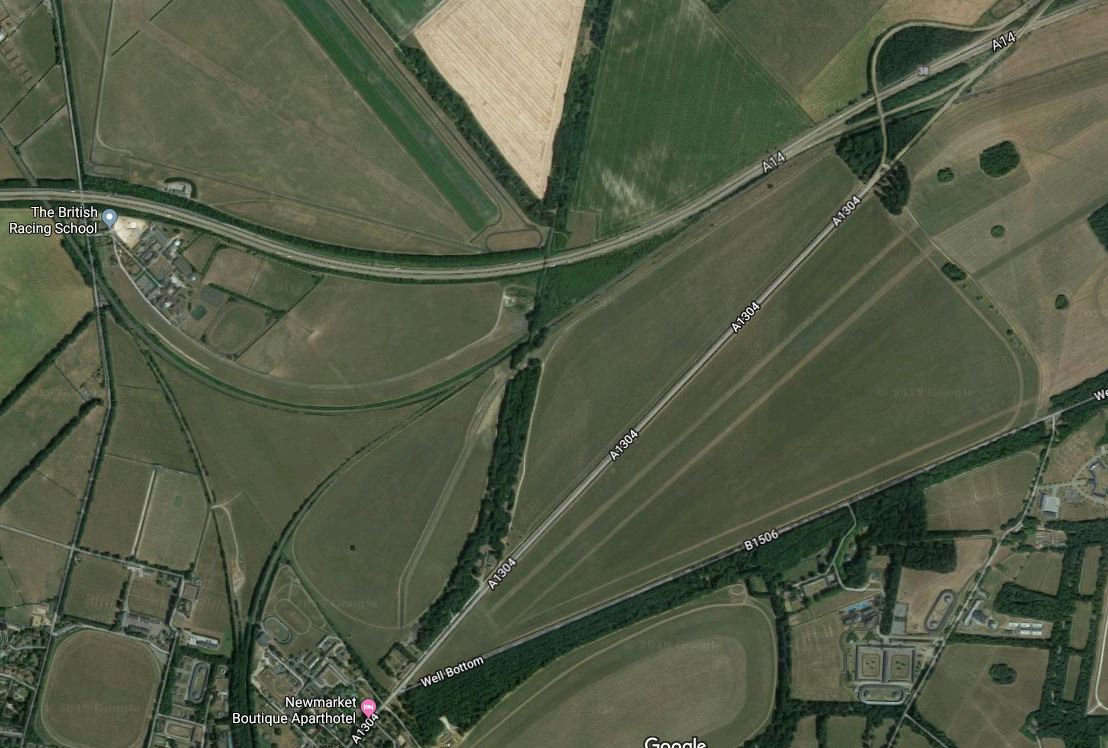
Note.
- The A14 going across the top of the map.
- The junction between the A14 and the A11 in the top-right corner.
- The triangular Chippenham Junction, pointing North to Ely, South to Newmarket and East to Bury St. Edmunds and Ipswich.
Having lived in that area for nearly thirty years, I believe that this is a much-needed station.
- Stations in the area, with the exception of Cambridge North are short of car parking.
- There would be two tph to/from Bury St. Edunds and Ipswich.
- There would be one tph to Cambridge, Cambridge North, Cambridge South , Ely and Peterborough.
I suspect that there could be shuttle trains to provide extra services to Cambridge and Ely.
A shuttle train could run between A14 Parkway, Cambridge South, Ely and back to A14 Parkway, calling at all intermediate stations.
Double-Tracking
The report says that some single-track sections may need to be converted to double-track.
The major section of double-tracking would be between Coldhams Lane and Chippenham Junctions on the Cambridge Branch of the Ipswich-Ely Line.
A new chord would be built at Colhams Lane Junction, so that trains could run between Ely and Bury St. Edmunds via Newmarket.
This Google Map shows the area.
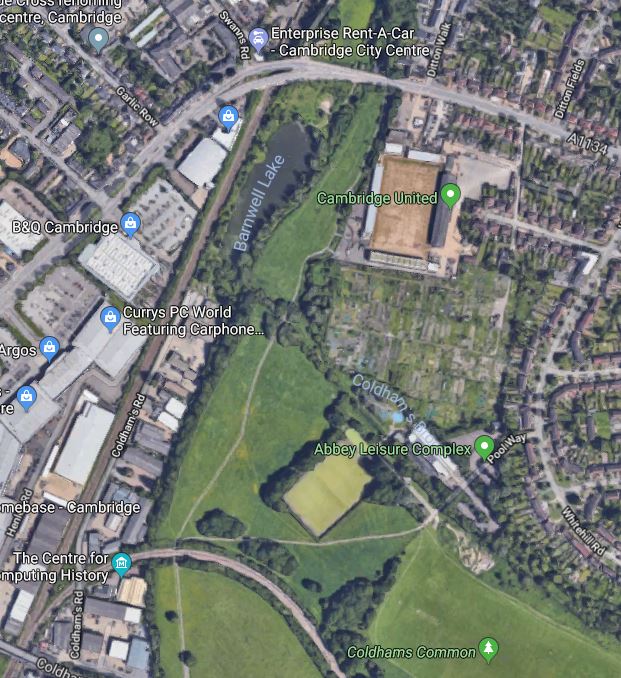
Note.
- The Cambridge to Norwich line running North South at the left of the map.
- The curve of the Cambridge Branch of the Ipswich-Ely Line at the bottom of the map.
- The extensive open space of Coldhams Common.
I have a feeling that building the chord will be a difficult planning process.
Electrification
The report says that there could be some additional electrification.
Ely North Junction
The report recommends that this junction is grade separated.
Ely North Station
The report recommends building a new Ely North station, which would be about one-and-a-half miles from Ely station.
Existing Stations
The report says this about existing stations.
Expansion of Cambridge, Norwich, Reedham, Kings Lynn and Manningtree
stations with remodelling of the station throat layouts.
I don’t think any modifications will be that difficult.
Felixstowe Tram-Train
This was said in the report.
Introduction of a tram-train service on the Felixstowe branch, with doubling between Derby Road and Felixstowe and street running through
Ipswich.
I was rather surprised. But why not?
The tram-train could even go down to the sea-front.
I explore this more in Could There Be A Tram-Train Between Ipswich And Felixstowe?.
Haughley Junction
Thr report recommends that this junction is grade separated.
This is one the most important projects to improve rail services in East Anglia.
Linespeed Increases To 100 mph
Greater Anglia’s fleet of Class 745, Class 755 and Class 720 trains are all 100 mph trains and the Great Eastern Main Line is a 100 mph route, all the way from London to Norwich.
It would seem that to improve services, that where possible linespeeds are increased to 100 mph.
- The Breckland Line between Ely and Norwich, currently has a linespeed of around 75-90 mph and is double-track and fairly straight across flat countryside.
- The Ipswich-Ely Line between Ely and Ipswich, has a linespeed of up to 75 mph, and is mainly double-track and fairly straight across flat countryside.
- The Cambridge Branch of the Ipswich-Ely Line is mainly single track and would probably be more difficult to upgrade.
Knowing the lines and East Anglia well, I suspect that these lines could be substantially given a linespeed of 100 mph.
Stansted Airport Station – Additional Platform
Stansted Airport station needs more capacity and may require the doubling of the tunnel under the runway.
Warren Hill Tunnel
The report recommends that Warren Hill Tunnel at Newmarket is doubled and that from Coldham Lane Junction to Chippenham Junction is also doubled.
This Google Map shows the Western portal of the tunnel.
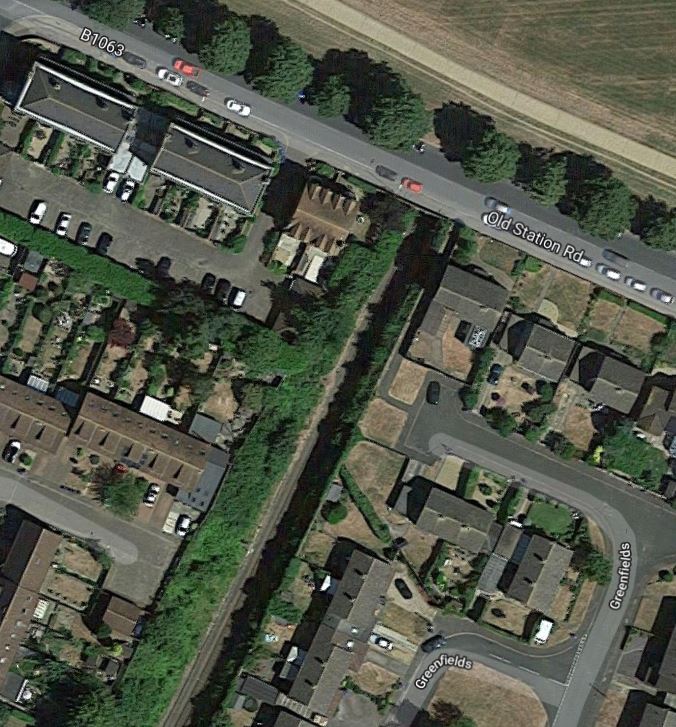
Note.
- The road across the top is Old Station Road.
- The dark shadow at right angles to the road is the cutting leading to the tunnel.
- There seems to be plenty of space to widen the cutting.
And this Google Map shows the Eastern portal of the tunnel.
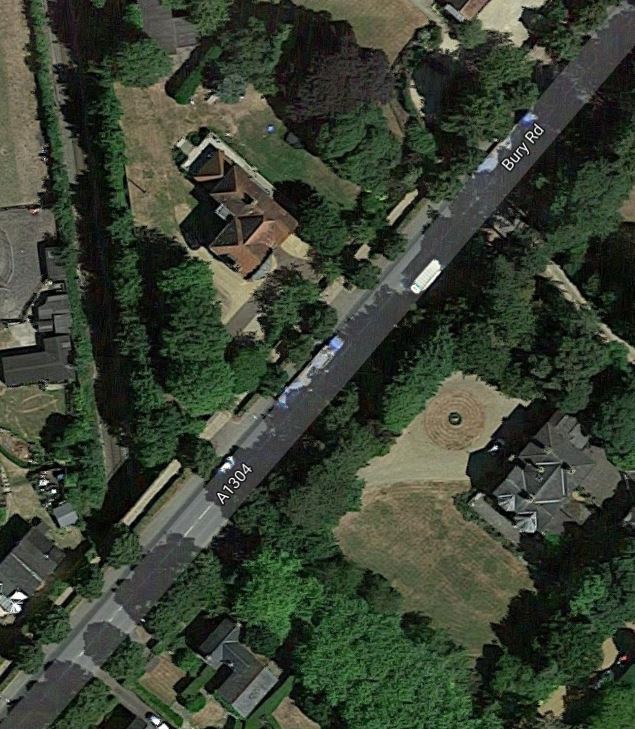
Note.
- The road is the Bury Road.
- The cutting leading to the tunnel portal is in the top left of the picture.
- The actual portal appears to be under the Bury Road.
This page on the Newmarket Local History web site, gives details about railways in Newmarket. The site says that the tunnel is exactly a kilometre in length and built on a curve.
I can see that doing these tunnel works will not be without opposition from the Racing Industry at Newmarket.
I shall talk about this more later.
The Freight Locomotive Of The Future
Before discussing freight, I will describe the freight locomotive of the future.
Rail Operations Group have just ordered ten Class 93 locomotives from Stadler.
- These are a tri-mode locomotive able to use electric, diesel or battery power.
- They will probably be able to haul the heaviest freight train at 100 mph, using electric power.
- They will be slower under diesel power, but they can use battery power for extra grunt.
- They will also find applications in hauling 100 mph passenger trains on partially electrified lines.
Other manufacturers will follow Stadler in developing similar hybrid locomotives, which will haul larger freight trains faster and with less pollution, than the current generation of locomotives.
Freight
Part of the EWRC’s freight plan is to make it easier to get the massive number of freight trains between Felixstowe and the Midlands and the North.
This is an extract from the report.
Note that doubling of Warren Hill Tunnel at Newmarket and redoubling between Coldham Lane Junction and Chippenham Junction is included in the infrastructure requirements.
It is assumed that most freight would operate via Newmarket, with a new north chord at Coldham Lane Junction, rather than pursuing further doubling of the route via Soham.
I indicated , these points earlier.
- ,Building a chord across Coldhams Common will not go down well with the residents of Cambridge.
- The plans for a double-track railway through Newmarket will not go down well with the Racing Industry.
I would also suspect that the logistics of building a second tunnel at Warren Hill, could be a nightmare, given the twenty-four hour nature of horse-racing.
So why have EWRC decided to route most freight trains through Newmarket?
Currently, freight trains going to/from Felixstowe use one of four routes.
- They go via London and cross the city on the crowded North London or Gospel Oak to Barking Lines.
- They go to Peterborough and take a cross-country route to Nuneaton, which is slow and has a notorious level crossing in the centre of Oakham.
- They go to Peterborough and take a diversion route through Lincoln.
- They go to Peterborough and up the East Coast Main Line, which is increasingly crowded.
None of these are perfect routes for freight trains.
Looking into the future, by the late 2020s, the following will have happened.
- An increasing number of freight trains will be running to/from Felixstowe.
- High Speed Two will have opened, which will release paths for freight trains on the electrified West Coast Main Line.
- Hybrid Electric/diesel/battery freight locomotives will be commonplace and hauling most long-distance inter-modal freight trains.
- The East West Rail Link will have opened between the West Coast Main Line and Cambridge.
It appears to me, that there could be a plan to create extra routes for freight trains to/from Felixstowe, using the East West Rail Link.
- Services between Felixstowe and West Coast Main Line destinations like Birmingham, Carlisle, Glasgow, Liverpool and Manchester, will use the East West Rail Link between the West Coast Main Line and Cambridge.
- Services between Felixstowe and Midland Main Line destinations like Derby, Nottingham and Sheffield, will use the East West Rail Link between the Midland Main Line and Cambridge.
- Services between Felixstowe and South Western and Western destinations like Bristol, Southampton and Wales, will use the East West Rail Link between the Great Western Main Line and Cambridge.
Services between Felixstowe and East Coast Main Line destinations like Doncaster, Edinburgh, Leeds and Newcastle will still use the traditional route via Ely and Peterborough.
It seems to me, that as many as two freight trains in every hour in both directions will need to take the route between Felixstowe and the East West Rail Link through Bury St. Edmunds, Newmarket, Cambridge and Cambridge South stations.
This number of freight trains would make it essential, that there is a double-track railway from Chippenham Junction to Cambridge.
The Coldhams Chord also seems to be an important part of the plans of the EWRC.
This is to allow freight trains between Peterborough and Felixstowe to use the upgraded double-track route through Newmarket.
Once on the electrified Fen Line at Coldhams Junction, freight trains with a hybrid locomotive could use the electrification to Ely.
At Ely, the trains would then be able to take the Peterborough-Ely Line to continue on their way.
These points should be noted.
- Currently freight trains between Felixstowe and Peterborough, have to cross the double-track Fen Line at Ely and it could be that operationally it would be easier, if they used the route via Coldhams Lane junction.
- The level crossing at Ely station is being sorted.
- The Fen Line between Cambridge and Ely is an electrified double-track and except at Waterbeach station, it would probably be relatively easy to add additional tracks.
- Cambridge North station appears to have a double-track by-pass line for freight trains.
- For some years, I’ve believed that the thirty miles of the Peterborough-Ely Line should be improved and electrified, as this would give a valuable electrified diversion route, if the East Coast Main Line were to be closed South of Peterborough.
So if a freight train were to be hauled by a hybrid locomotive, it would surely be able to use electrification between Peterborough and Coldhams Lane Junction.
The distance between Coldhams Lane Junction and Haughley Junction, where the electrification from Ipswich ends is forty miles. The terrain is also very undemanding.
I would be very surprised if in a few years, a powerful hybrid locomotive couldn’t haul the heaviest freight train on this route.
Conclusion
The East West Rail Link will have far reaching consequences for Norfolk, Suffolk and North Essex.
- Most towns and cities with perhaps a population of upwards of 30,000 will have a two trains per hour service to Cambridge, Bedford, Milton Keynes, Oxford and Reading.
- Some services will be direct, but many will involve a same- or cross-platform change at a station like Cambridge, Ipswich or Norwich.
- East Anglia will have much better hourly connections to Birmingham, Liverpool, Manchester, Nottingham and Sheffield.
- There will be much improved capacity for freight trains to/from Felixstowe.
I feel very positive about what has been said.
MK-Bedford New Line Mooted
The title of this post, is the same as the title of an article in the April 2018 Edition of Modern Railways.
This is the first paragraph.
A new railway between Milton Keynes and Bedford for the East West Rail project has been suggested as a way of avoiding problems with the Marston Vale Line, where the hourly stopping service and numerous level crossings limit capacity for through regional trains.
Another aim is that the next phase of the project should be completed by the end 2022, which is between a one and two years earlier than the existing target.The Chairman of the East West Rail Company, then said he’d like the the railway to open in 2027.
The article says a new route will be expensive, but innovative ways of doing things could help.
Consider these points about the Marston Vale Line
- The stations need development.
- There are at least thirteen level crossings.
- New houses are being built near some stations.
- The operating speed is just 50 mph.
- Finding a new route at Fenny Stratford, Woburn Sands, Aspley Guise, Ridgmont and Lidlington could be difficult.
- The railway passes under the M1 and the A421, so moving these crossing points could be difficult.
It’s all a complicated design problem.
East West Rail could borrow a trick from the Heathrow Southern Railway, which is planned to run alongside the M25 to get to Heathrow. The new railway could be routed alongside the A421 in the Bedford area.
This Google Map shows the A421 to the South of Bedford.
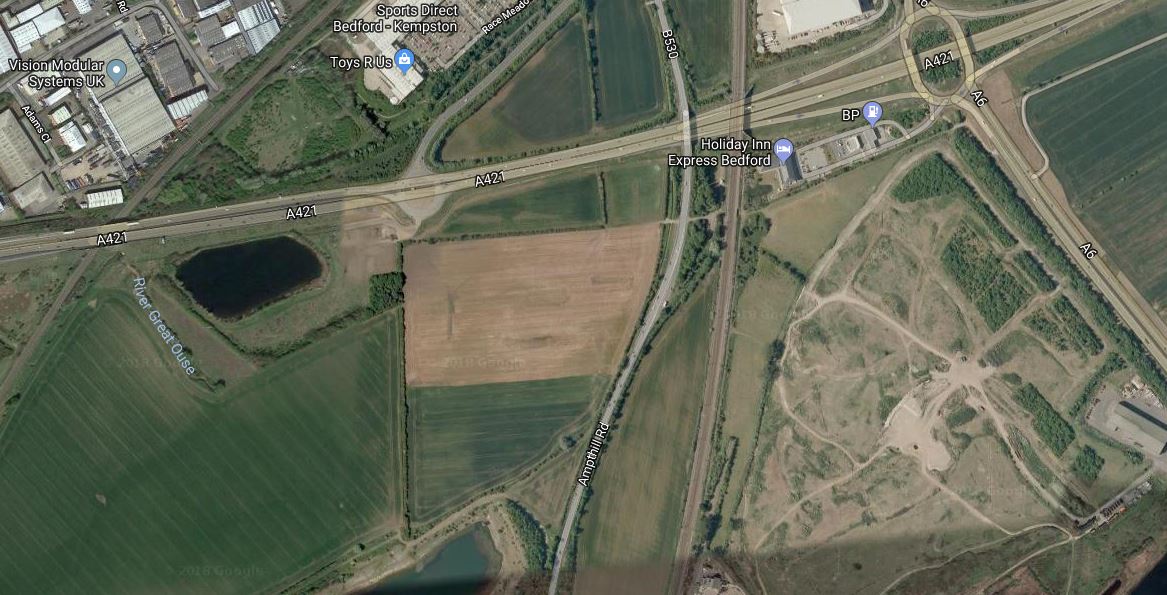
Note.
- The Marston Vale Line goes across the North West corner of the map.
- The Midland Main Line goes across the map in a North-South direction.
- The roundabout at the North East connects the A421 to the A6.
- The building by the roundabout is a hotel.
If the East West Rail Link was routed alongside the by-pass a station could be built where the two lines cross.
- The Midland Main Line and Thameslink would be linked to the East West Rail Link.
- Passengers for Bedford would be able to use the frequent Thameslink service to get to the town.
- A big Park-and-Ride could be built.
- Marston Vale Line services would take the same route as they do now, via Bedford St. Johns station.
If it was desired, chords could be built to enable services on the East West Rail Link to serve Bedford with a reverse in Bedford station.
Oxford has a Parkway station, Milton Keynes has a Milton Keynes South station at Bletchley, Cambridge will probably have a Cambridge South station, so why shouldn’t Bedford have a Bedford South station?
The Pressure For More Rail Electrification
Over the last few days, there have been several articles on the media pushing for more electrification.
This article in Rail Technology Magazine, which is entitled TfGM To Fight Corner For Full TransPennine Electrification.
This article in the Carlisle Times and Star, which is entitled Campaigners Urge Backtrack On Axed Electric Rail Projects.
This article in the Times, which is entitled New Oxford-Cambridge Rail Route Must Rely On Diesel Trains.
This article in the Nottingham Post, which is entitled Strong Condemnation Of Government Plan To Abandon Rail Electrification.
I feel that electric trains are the future, but like members of the current Government, I feel that we need an alternative approach to creating a modern railway network in the UK.
What Do Passengers Want?
Passengers in general want a comprehensive rail service, that is affordable, reliable, fast and frequent and gives them good comfort and service on trains and at their terminal stations.
What Do Train Operating Companies Want?
Train companies need and want to make profits.
Judging by the latest franchise awards to Northern, TransPennine Express, Greater Anglia, South Western Railway and West Midlands Trains, part of their philosophy to achieve this is to buy fleets of new trains to replace old ones, with the following characteristics.
- More carriages and increased capacity.
- Higher speed and performance.
- Power and USB points, wi-fi and 4G connectivity.
- Easier entrance and exit.
- Better facilities for persons of reduced mobility.
- Shorter dwell times at stations.
- Better driver assistance systems.
The best way to pay for these trains and make a profit is to fill them with happy passengers.
So Where Does Electrification Give Advantages?
In summarising what passengers and train companies want, I didn’t mention electrification, although electric trains do give advantages to both groups.
- It must be easy to fit electrical equipment into an electric train.
- Electric trains accelerate faster.
- Electric trains can be fitted with regenerative braking to save energy
Electrification is not needed in all cases as electricity for the train can be provided by diesel or hydrogen-powered generators or some form of onboard energy storage can be used.
Why Are So Many Elecification Schemes In The UK Over Budget And Late?
With my experience of writing Project Management software and talking about it with numerous Project Managers all over the world, I suspect the following about electrifying an existing railway in the UK.
- The drawings and documentation for some of the existing lines which go back well over a hundred years is questionable.
- Politicians put undue pressure to keep costs down and corners are cut.
- The scope of the project changes as it progresses.
- Those against the electrification have lots of routes to delay the project.
- We don’t have enough engineers or qualified personnel to do the work.
- Often work is on constricted sites and the locals get annoyed.
I’m coming to the conclusion, that electrification is one of the most difficult of projects.
I do feel though there is hope for the future judged on what happened at Waterloo during August.
The Future Of Road Transport
We are seeing more and more electric and hybrid vehicles on the roads and this article in the Guardian, says that Britain will ban the sale of all diesel and petrol cars by 2040.
For this to happen, there needs to be a vast improvement in the efficiency and size of energy storage systems.
A few years ago, if you’d fitted solar panels to your house, your neighbours would have laughed at you. Now they don’t as technology has improved the performance of solar panels, just like it will improve energy storage in the next few years.
What Will Improved Energy Storage Mean For Trains?
The first trains with onboard energy storage are starting to appear on the UK’s railways.
Class 800 trains – Intercity Express Programme
This document on the Hitachi Rail web site, which is entitled Development of Class 800/801 High-speed Rolling Stock for UK Intercity Express Programme.
The document provides this schematic of the traction system of a Class 800 train.

Note BC which is described as battery charger.
This is said in the text.
The system can select the appropriate power source from either the main transformer or the GUs. Also, the size and weight of the system were minimized by designing the power supply converter to be able to work with both power sources. To ensure that the Class 800 and 801 are able to adapt to future changes in operating practices, they both have the same traction system and the rolling stock can be operated as either class by simply adding or removing GUs. On the Class 800, which is intended to run on both electrified and non-electrified track, each traction system has its own GU. On the other hand, the Class 801 is designed only for electrified lines and has one or two GUs depending on the length of the trainset (one GU for trainsets of five to nine cars, two GUs for trainsets of 10 to 12 cars). These GUs supply emergency traction power and auxiliary power in the event of a power outage on the catenary, and as an auxiliary power supply on non-electrified lines where the Class 801 is in service and pulled by a locomotive. This allows the Class 801 to operate on lines it would otherwise not be able to use and provides a backup in the event of a catenary power outage or other problem on the ground systems as well as non-electrified routes in loco-hauled mode.
Note that GU refers to Generator Unit, which in these trains are diesel-powered.
This is all very comprehensive, but if you look at how the braking system of the trains work and if it uses regenerative braking, you won’t find anything on the web.
But note how the four traction motors in the diagram are connected to the system. When they are in braking mode, what happens to the electricity?
- It is returned to the overhead wires. Difficult when using GUs on lines without electrification.
- It is passed to resistors on the roof of the train and burnt off as heat.
- It is stored in some form of onboard energy storage, so it can be reused later.
I feel that Hitachi are using Option 3, as it would work in both modes of the train and would save a lot of energy.
Note that in the above extract from the Hitachi document, the company states that the electric Class 801 trains have at least one GU to provide auxiliary and traction power in the event of catenary failure.
It looks like the only difference between the Class 800 and Class 801 trains, is that the Class 800 trains have more GUs.
Could this explain why Hitachi seem to be doing all their testing with Class 800 trains, as the differences between the two trains are minimal?
If the Class 800 works, then the Class 801 will!
Hitachi are also testing the Class 802 trains, but then these are built in Italy, have more powerful engines and bigger fuel tanks.
Bombardier Aventras
Bombardier have been developing battery technology for some years and as I described in Is The Battery Electric Multiple Unit (BEMU) A Big Innovation In Train Design?, I rode in the prototype converted from a Class 379 train in February 2015.
I believe that the Class 345 trains are fitted with onboard energy storage for the following reasons.
- Onboard energy storage is the logical way to handle regenerative braking in tunnels.
- Onboard energy storage means that each train reuses its own braking energy and draws less current from the electrification.
- Onboard energy storage is the only way to move a train to a safe place, when the Russians or North Koreans hack the power suppky.
- Some of the features announced for Aventras, like remote wakeup as I discussed in Do Bombardier Aventras Have Remote Wake-Up?, need onboard energy storage.
- Bombardier have won awards for the technology.
Until Bombardier say otherwise, I’ll assume that Aventras like the Class 345 trains have onboard energy storage.
Overhead Power In Long Tunnels
It should also be noted that the overhead power supply in the Crossrail tunnels is a rail fed with power at both ends, as incidentally is the Severn Tunnel.
Could it be that money could have been saved on the electrification of these tunnels as all electric trains using them; IEPs and Aventras, can handle their own regenerative braking energy?
The Effect Of Large Onboard Energy Storage On Trains and Trams
There is a big difference between adding weight to a pneumatic-tyred vehicle like a car or truck, and adding weight to that of a steel-wheel-on-steel-rail vehicle like a train or tram.
With the former, the rolling resistance is increased, which means more power is needed to move the vehicle, but with the latter, surprisingly, the reverse is true.
This allows locomotives to pull iron ore, coal and stone trains carrying hundreds of tonnes.
So adding a heavy energy storage device under a train may not be as detrimental to performance as you may think.
I suspect Bombardier, Hitachi and others have determined the optimal size of storage device for their trains.
I believe the following, if an appropriately-sized online storage device is fitted to a train.
- It will be able to handle all the regenerative braking energy.
- It will give the train a range of up to fifty kilometres on stored energy.
Without doubt, all trains driven by electricity and having regenerative braking will use onboard energy storage.
This applies even if their main power source is not electricity, but perhaps diesel, hydrogen or extra-strong knicker elastic!
Discontinuous Electrification
Modern trains like Aventras and Hitachi Class 80x trains have another ability.
They can raise and lower their pantographs under GPS control, so that they only connect with the electrification, when it is there.
They can also do it at line speed.
This raises the possibility of discontinuous electrification, where the easy-to-electrify sections have wires and the difficult bits are run using either diesel, hydrogen or onboard storage power.
An example would be between Batley and Morley stations on the Huddersfield Line, between which is the Morley Tunnel.
- The tunnel is four kilometres long and hopefully could be electrified using a conductor rail in the tunnel roof.
- Morley station is hard by the Northern portal of the tunnel.
- The line from Morley to the electrification at Leeds doesn’t appear to have any serious bridges to replace and the double-track line has wide margins.
- Batley, Morley and Cottingley stations are all stations with platforms either side of the track and could probably have the gantries on the platform.
Would it be possible to electrify short sections of line like this and let the trains and the driver decide to use onboard or overhead power?
The TransPennine Route
I will look at the TransPennine route in detail.
Mainly Electrically-Driven Trains
Looking at the various trains on TransPennine routes, we see the following ways of driving the trains and locomotives.
- Class 156 trains – hydraulic
- Class 158 trains – hydraulic
- Class 170 trains – hydraulic
- Class 185 trains – hydraulic
- Class 195 trains – mechanical – six-speed epicyclic
- Class 220 trains – electric
- Class 221 trains – electric
- Class 802 trains – electric – bi-mode
- Class 66 locomotives – electric
- Class 68 locomotives – electric
- Class 88 locomotives – electric – bi-mode version of a Class 68 locomotive.
The last three trains and all the locomotives in this list are electrically driven, where on-board diesel engines generate electricity to power the train.
In addition the Class 802 trains and the Class 88 locomotives are bi-mode and can use electrification to power the trains directly, if it is available.
So a Liverpool to Newcastle service using Class 802 trains or Class 88 locomotives and Mark 5 carriages could use the overhead electrification on the following sections of track.
- From Liverpool to Stalybridge via Manchester Victoria
- Through Leeds
- On the East Coast Main Line
Electrifying between Leeds and the East Coast Main Line would seem to be a lot easier than that between Leeds and Manchester, so I suspect that there is some seriously difficulty that has prevented it being done already, as it would allow Kings Cross to Edinburgh services to stop at Leeds, if that was desired.
Improving The Current Service
Currently Liverpool Lime Street to Newcastle takes three hours and three minutes, with the following sectional times.
- Liverpool to Manchester Victoria – 39 minutes
- Manchester Victoria to Huddersfield – 30 minutes
- Huddersfield to Leeds – 22 minutes
- Leeds to York – 25 minutes
- York to Newcastle – 67 minutes
Some places to save times are apparent.
- Liverpool to Manchester Victoria could be speeded up by a couple of minutes, after the addition of the fourth track at Huyton.
- According to the time table, most dwell times are reasonable, but nine minutes is allowed at Manchester Victoria.
- Manchester Victoria to Stalybridge is being electrified.
- Virgin’s fastest trains take 56 minutes between York and Newcastle, so I would assume that a TransPennine Class 802 train could match this.
- If Leeds to York were to be electrified, I would think that the same percentage decrease in journey time could be expected, which would give a Leeds to York time of 21 minutes.
Could we see the following times on the route?
- Liverpool to Manchester Victoria – 30 minutes
- Manchester Victoria to Huddersfield – 28 minutes
- Huddersfield to Leeds – 22 minutes
- Leeds to York – 21 minutes
- York to Newcastle – 56 minutes
This gives a timing of 157 minutes, which is a saving of twenty-three minutes.
Is The Track Up To It?
Under Timings And Line Speeds in the Wikipedia entry for Liverpool and Manchester Lines, this is said.
As of 2016, the fastest journey times are around half an hour, which is little better than over a century earlier. The fastest recorded run was from Manchester Exchange to Liverpool Lime St in 30 minutes 46 seconds by a 1936 built Jubilee 5707 with 7 coaches. An 1882-built compound steam locomotive was timed on the same route in 38 minutes 18 seconds. Until 1968 trains from Liverpool to Manchester by all 3 routes were scheduled to take 40 minutes and often took less. The southern route via Warrington is now restricted to 85 mph and the northern route via Earlestown to 90 mph, with 75 mph over Chat Moss.
Work is under way to four-track the line between Huyton and Roby which is scheduled for completion in December 2017.
Surely, Twenty-First Century engineering can sort out Stephenson‘s problems of nearly two centuries ago!
If it’s like this between Liverpool and Manchester on a fully-electrified line, what’s it like between Manchester and Leeds?
I believe that modern engineering should be able to create a 100 mph route between Liverpool and Leeds.
Are The Other Trains Slowing The Expresses?
Northern run an assortment of trains between Liverpool and Leeds via Manchester Victoria.
Between Liverpool and Manchester Victoria are all the services timed for and run by 100 mph Class 319 trains, or do some of the assortment of 75 mph trains share the route? If it’s the latter then they will delay the expresses.
Between Manchester Victoria and Hudderfield, I’m sure that slower trains are on the route.
Help is at hand as Northern have ordered fifty-five Class 195 trains, which have a 100 mph capability.
Should Stalybridge To Leeds Be Electrified?
Only when slow trains have been eliminated and the track has been improved to allow 100 mph running between Liverpool and Leeds should we answer this question!
Using rough estimates, I feel we might see the following timings with a Class 802 train.
- Liverpool to Manchester Victoria – 26 minutes
- Manchester Victoria to Huddersfield – 21 minutes
- Huddersfield to Leeds – 16 minutes
- Leeds to York – 21 minutes
- York to Newcastle – 56 minutes
This gives a timing of 140 minutes, which is a saving of forty-three minutes on the current times.
Improving Leeds To Newcastle
The Class 802 trains are stated in Wikipedia as being capable of running at 140 mph with minor modifications.
How many minutes would this take off the journey, if this were to be possible?
Conclusion
There are a lot of things to do before the decision to electrify Stalybridge to Leeds is taken.
- Sort the track for at least 100 mph running.
- Remove all passenger trains not capable of 100 mph from the line.
- Perhaps add some passing loops.
- Electrify Leeds to Colton Junction.
- Remove all level crossings.
- Raise all bridges and other structures, so that electrification is possible.
- Get the planning permission for electrifying the sensitive areas.
Hopefully these actions in themselves would deliver a time of under forty minutes between Manchester and Leeds.
That would be a spoonful of sugar for the passengers and the train operating companies.
Any attempt to electrify without doing all of these actions before the decision to electrify is taken, will result in the sort of mess seen in some of the electrification schemes of the last few years.
The East West Rail Link
I will look at the East West Rail Link in detail.
Linking To Electrified Lines
The East West Rail Link joins or crosses the following electrified lines.
- The Great Western Main Line at Didcot
- The West Coast Main Line at Bletchley
- The Midland Main Line at Bedford
- The East Coast Main Line at Sandy
- The West Anglia Main Line at Cambridge
As connecting the National Grid to electrification is a major cost, if the line were to be electrified, then there are several places to connect at a cheaper cost.
Building For Electrification
The instructions from the Department for Transport seem to have stated the following.
- The line will be double track.
- The line will have an operating speed of at least 100 mph or possibly 125 mph.
- All bridges and structures, will be built to accommodate overhead electrification.
I wonder if the specification suggests preparing the margins of the route, so putting up overhead gantries wouldn’t be a case of digging and hitting important cables or pipes.
Electrification of new lines like the East London Line, Crossrail and the Hitchin Flyover seem to have proceeded much smoother than schemes like the Gospel Oak to Barking Line.
Trains For The East-West Rail Link
The proposed services include.
- Oxford to Bedford
- Bletchley to Bedford
- Oxford to Milton Keynes Central
- Aylesbury to Milton Keynes Central.
I have also seen suggestions that the trains terminate at Reading.
The trains will need the following.
- A 100 mph capability to make good use of the route.
- Ability to use overhead electrification to get to Bedford, Milton Keynes Central and Reading.
- Ability to use diesel to use the Chiltern routes to Aylesbury and Marylebone.
To meet all these requirements, it would appear bi-mode trains like a Class 800 train are needed.
Should The East-West Rail Link Be Electrified?
Consider.
- The trains chosen for the route will be bi-mode and so the line doesn’t need to be electrified.
- Freight trains using the route would be hauled by a diesel locomotive or possibly a bi-mode locomotive like a Class 88 locomotive.
However, if at a future date, all or part of the electrification were to be deemed needed, if the line had been built with electrification in mind, putting up the wires would be a lot easier than on the TransPennine route.
Conclusions
I have come to these conclusions from these two examples.
- The bi-mode route allows a lot of flexibility and means that electrification with all its problems can be done when it is really necessary.
- The bi-mode route, also means that passengers get the benefits of modern, faster and more frequent trains at an earlier date.
- Electrification of a new line is easier than electrifying an old Victorian one.
- All new or reopened lines should be built to allow electrification at a future date.
Don’t underestimate the ingenuity of railway engineers to make a more comprehensive railway powered by electricity possible.
Electrification ‘Very Unlikely’ To Come Back Into EWR Scheme
The title of this post is the same as this article on Rail Technology Magazine.
This is a quote from Andy Free, who is head of engineering of the alliance that is building the East West Rail Link.
The steer from the DfT is that wherever the Alliance is building a new structure it needs to be clear and suitable for electrification, “and we must do nothing that hinders future electrification, but it is not on the short- or medium-term horizon.
Given the developments in bi-mode trains in recent years, I suspect this is a sensible policy.
Electrification is probably cheaper to fit to a train in a nice warm factory in Derby or Newton Aycliffe, than at a remote location in the pouring rain and the howling wind.
In the case of the East West Rail Link, where sections of the route are well defined, as they are existing rail alignments, building the route would involve.
- Raising any over-bridges to be clear of future electrification.
- Building any bridges or flyovers, where the new railway crosses over roads and other railways.
- Preparing the track bed.
- Laying the track.
- Building or rebuilding the stations.
Note I have ignored signalling, as ideally that will be in-cab by radio.
Building the line without electrification must give advantages.
- Network Rail seem to find it impossible to do electrification projects to time and budget.
- Stations without electrification are safer places and easier to design and build.
- There is less visual intrusion for Nimbys to complain about.
- The cost of connecting the electrification to the National Grid is zero.
- There is less copper cable to steal.
In Is A Bi-Mode Aventra A Silly Idea?, I outlined what I believe the ultimate bi-mode train will be like.
A bi-mode Aventra would be a sophisticated train with the following characteristics.
- Electric drive
- Regenerative braking.
- 25 KVAC overhead and 750 VDC third rail capability.
- Automatic pantograph deployment.
- Onboard energy storage.
- Automatic power source selection.
- Diesel or hydrogen power-pack
The first four are probably already in service in the Class 345 train.
A train going from between Reading and Bedford on the East West Rail Link, would charge its energy storage at the terminals and then use this power along the route. If the train detected that the stored energy was running low, the diesel or hydrogen power-pack would cut in and charge the energy storage.
Conclusion
It is my view, that if you are building a new rail line that is not high speed or high frequency, that there is no need to electrify the line, as intelligent bi-mode trains will be able to work the route economically and without the noise, pollution and vibration problems of their diesel engines working all the time.
The Changing Face Of Cambridge
I took these pictures, as my train to Cambridge North station, made a stop at Cambridge station.



There’s certainly been a lot of new building.
Over the years, I’ve seen Cambridge station change from a simple station, where staff had to work hard to juggle terminating and through trains to maintain a decent service into a major rail interchange with the following platforms.
- Two very long through platforms; 1 and 7, capable of taking the longest trains on the UK rail network.
- Platform 1 is actually bi-directional and can be used as two shorter platforms; 1 and 4.
- Two London-facing bay platforms; 2 and 3 capable of taking eight-car trains.
- Two North-facing bay platforms; 5 and 6, capable of taking six-car trains from Ipswich, Norwich, Peterborough and the North.
- A twelve-car platform; 8, that can be used as either a through or a bay platform.
Is there another regional station in the UK with such a comprehensive layout?
Cambridge station and its new sibling a few miles to the North are certainly ready for all the rail developments planned to happen in the next few years.
- Thameslink arrives in 2018
- Greater Anglia’s new trains arrive in 2019.
- The East-West Rail Link could arrive in the mid-2020s.
I would not be surprised if Cambridge created the Trinity by starting the proposed new Cambridge South station at Addenbrooke’s Hospital in the next couple of years.
After all, a third station, will give Cambridge one more station than Oxford.
The Future Of East West Rail
There is an article with this title in Rail Technology Magazine.
This is the opening paragraph.
Shortly before the end of last year, transport secretary Chris Grayling announced unprecedented proposals to create a new and independent East West Rail operation tasked with designing, managing and running services between Oxford and Cambridge.
After the opening of the first section of the route, from Oxford to Bicester and on to Marylebone, which I wrote about in Oxford To Marylebone Opens For Business, things seem to be moving on.
- The Government has announced that the East West Rail Link could be privately financed, built and run.
- This article in Rail Magazine, which is entitled Verster to leave ScotRail for East West Rail, states that Phil Verster from ScotRail will head up the East West Rail Project.
Let’s hope it all means full steam ahead.
Cambridge Thinks About More Stations
This article in the Cambridge News has a headline of Support for re-opening South Cambridgeshire railway station is gathering pace.
It talks mainly about the reopening of Fulbourn station between Newmarket and Cambridge.
This is said.
The Reopen Fulbourn Railway Station group is calling for the station to be reinstated as part of a drive to boost rail connectivity in the area.
Later in the article it says that the Council also wants to open a new station at Addenbrooke’s Hospital and reopen the closed station at Cherry Hinton.
A station at Addenbrooke’s Hospital is pencilled in for the East West Rail Link and the other two stations are on the Ipswich to Cambridge Line.
Wikipedia says this about a previous attempt to reopen the station at Cherry Hinton.
Reopening of the station was proposed by Cambridgeshire County Council in May 2013 as part of an infrastructure plan to deal with projected population growth up to 2050. A proposal to reopen the station had previously been made in 1996 but 70% of residents who responded to a Council questionnaire were against it; in any event, a new station was not considered viable at that time.
There are some cynical comments to the article as well.
But circumstances have changed since 1996.
- Cambridgeshire County Council has more responsibility for this type of spending.
- As I said in Will We Be Seeing More Railway Stations?, it looks like design, technology, new trains and costs are making it easier to make a good case for a new station.
- Greater Anglia will be running new high-performance trains through Fulbourn and Cherry Hinton in a couple of years.
- Network Rail are removing level crossings in East Anglia and there are several in the area, including one at the site of Cherry Hinton station.
The level crossings could be the clincher, as there is a lot of opposition in some places to their removal.
Would Network Rail duck the problems and leave everything as it is?
Levitation Magic
How do you raise a 200 tonne masonry arch bridge by 900 mm, so that you can fit overhead electrification and freight trains with large containers under the bridge?
You used to call in Paul Daniels, but now he’s gone you have to use other forms of magic!
If finesse doesn’t work, you resort to the brute force technique that IK Brunel used to launch the Great Eastern – hydraulic power.
This article on the Freyssinet web site, describes how the bridge was lifted.
For an encore, the engineers then lowered the bridge by 465 mm.
Why raise a bridge like this?
Surely, to use a simple method, like explosives or a large hydraulic breaker and rebuild is a lot easier.
The trouble is it isn’t as this method disturbs the working railway much less and is quicker.
Network Rail also have five hundred bridges like this that need to be raised.
It would certainly make an interesting live stream from the Internet. Perhaps, a fee could be charged to watch for a charity like Cancer Research UK.
Brunel, who played the showman at times, would have approved of that!
Why Grayling’s Proposal For The East-West Rail Link Could Be Right?
I’m not saying it’s right that one company will build the line and then operate it, but I do think it could have advantages.
Track
With the exception of a few short lengths of existing track, most of the construction is a green field site or one where there is just rusty worthless track from decades ago.
This must give opportunities to design a future-proofed route, that in say the 203os or 2040s could run trains much faster, frequent, heavier and longer, than envisaged today.
The route can also be optimised for what is mow believed to be the likely scheduled service.
Stations
This line could have stations optimised for the modern level of working, that the line will.use.
Nothing should be ruled out in station design, if it makes for a more efficient railway.
I would also hope that stations could be modular, so that improvements and new stations could be added by the operator as ttaffic changes.
Get the design right and the company, passengers and staff will benefit.
It would be easier to get the design right, if all stakeholders are in the same team.
Electrification
Parts of the route are electrified and it will have connections to existing electrified lines at Bedford, Cambridge, Milton Keynes, Oxford and Reading.
I believe that there could be considerable savings to be made, by designing the electrification so that it is integrated with the trains bought for the line.
For instance, I believe in a few years time that all new trains will have on-board energy storage, so could this be taken advantage of to perhaps?
- Enable regenerative braking on trains, rather than trackside
- Not put overhead wires in stations.
It could be difficult for freight trains and other electric trains, but there could be scope to simplify the electrification.
Signalling
Go digital to save money.
Operation
I have sat in the cab of a High Speed Train as it went between Edinburgh and Inverness. You see a lot and surely some that drivers see could be safety related.
Surely, if the same company is responsible for both trains and track, reporting and fixing problems must be much more direct.
Conclusion
Good design could really.make the railway cheaper to build and operate.
So if it’s one company, with everybody working to the same objectives, it must benefit that company, if someone has a good idea at any point.
If they have a bad idea, then hopefully it will.be ignored.

