What Next For Class 385 Trains?
Scotrail have ordered a fleet of Class 385 trains, which will be built by Hitachi at Newton Aycliffe in the North-East of England.
If you look at Scotrail’s network, there are a lot of lines, where new trains will be needed in the next decade.
Most of these lines are not electrified, so will the Class 385 train, be available in a version say, that would handle lines like the Borders Railway?
Electrifying all lines will be costly and the Heritage Taliban, may object to overhead gantries marching all over Scotland.
Class 800 And Class 801 Trains
The Class 800 trains are electro-diesel trains with a range depending on the size of the fuel tanks, whereas the Class 801 trains are the pure electric version.
Like the Class 385 trains, they are members of Hitachi’s A-Train family, so I suspect that if asked to supply a bi-mode Class 385 train, that Hitachi know the route to create such a train.
Trains With Batteries
I have written two posts about the Japanese using batteries in electric trains.
- Japanese Trains With Batteries describes how some Tokyo Metro trains have batteries to get them to the next station, in an emergency situation.
- Battery Trains In Japan describes how battery trains are to be used on the OGA Line.
The Japanese technology, doesn’t seem as comprehensive as that I wrote about in Bombardier’s Plug-and-Play Train, but I’m sure that Hitachi must be thinking about trains with batteries,
Conclusion
I am inevitably drawn to the conclusion, that Hitachi will come up with a train, that can run say between Edinburgh and Aberdeen, substantially under its own power, aided by overhead electrification where it exists.
Bourne End Station And Improving The Marlow Branch Line
Bourne End station is an intermediate station on the Marlow Branch Line, where trains reverse on their way between Maidenhead and Marlow stations.
It also is a terminus of trains to and from Paddington station in the Peak.
This Google Map shows the station and its location.
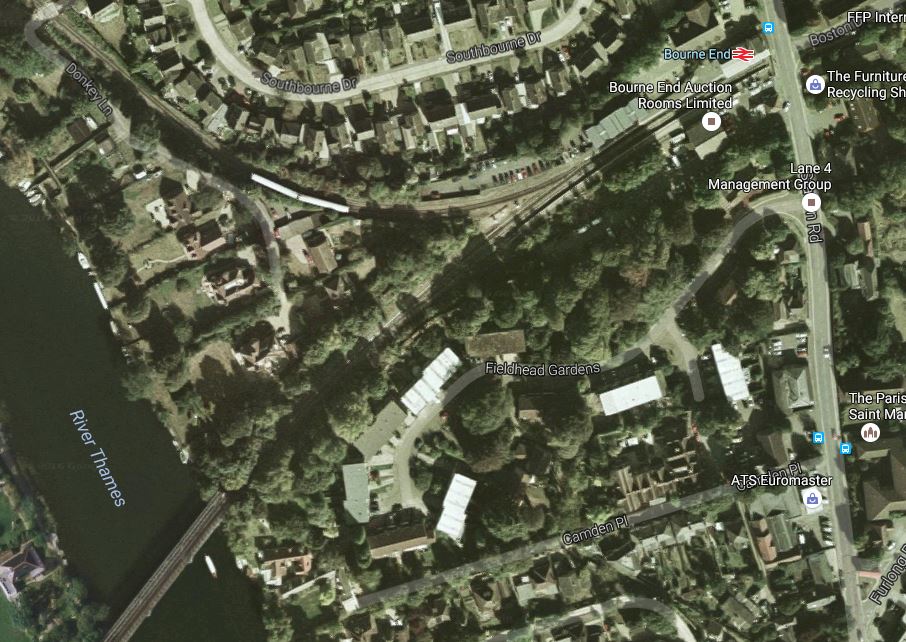
Note.
- The Bourne End Railway Bridge takes the railway over the Thames to and from Maidenhead.
- The two-car Class 165 train on its way to or from Marlow.
- The station has a short Northern platform, where trains reverse and a longer Southern one, that can only be used by trains going to Maidenhead.
- There is a step-free interchange between platforms
- All lines are single-track.
These pictures show the station and the surrounding area.
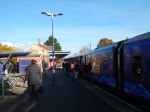


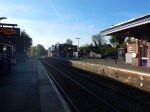
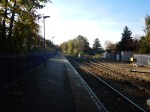


These are some thoughts on various ideas and issues on Bourne End station and the Marlow Branch Line.
Longer Trains To Marlow
Currently, because of the layout of the junction, where trains take the left-hand fork to Maidenhead and the right hand route to Marlow., all trains to Marlow must be only two cars.
I don’t know if modern trains can take sharper curves than the 1990s-built Class 165 trains on the route, but if it was the case, it might be possible to configure the junction to allow the Northern platform to be lengthened to take a longer train.
There are also other features of modern trains like a Class 387 train, that might help.
- Selective door opening.
- Walk-through design.
- 20 metre as opposed to a near-23 metre car-length of the older diesel train.
It would be a tight fit, but I suspect that fitting a three or even four-car train in Bourne End station might be possible, if the passenger traffic needed that capacity.
Passing Loops On The Line
There used to be a passing loop at Cookham station, but this was removed in the 1960s.
This Google Map shows Cookham station.
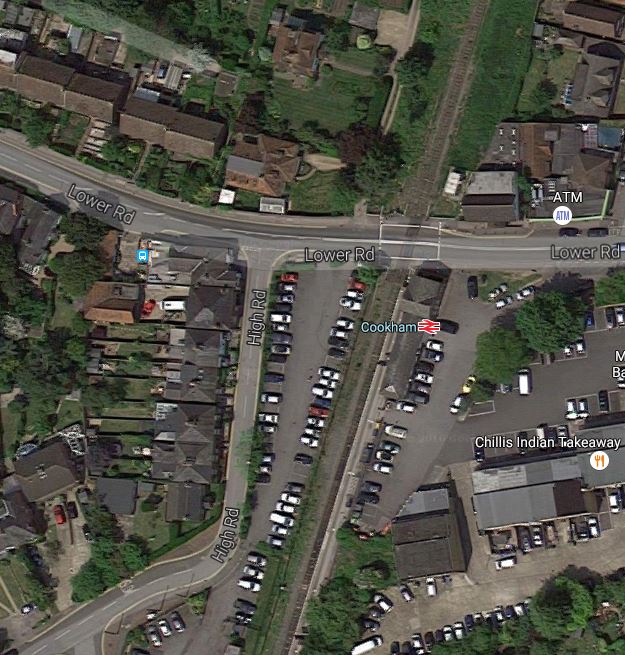
Cookham Station
It is probably one of those things that is possible, but would actually be a difficult project to implement.
- The users of the line wouldn’t accept a long closure.
- The level crossing would add a large degree of complication and opposition.
I suspect that unless there were really pressing reasons, that a passing loop will never be rebuilt at Cookham.
Increased Frequency
In the Peak, the service between Marlow and Maidenhead is effectively two trains per hour (tph). The method is described in Train Services under the Wikipedia entry for the Marlow Branch Line. This is said.
The off-peak service is one train per hour in each direction between Maidenhead and Marlow. During morning and evening peak times a two trains per hour service is achieved by using two trains: one shuttling between Marlow and Bourne End, and another between Bourne End and Maidenhead/London Paddington. This is possible because Bourne End station has two platforms that may be used simultaneously.
I suspect, that some devious train scheduler has a method for improving on this in the Peak and perhaps providing 2 tph in the Off Peak all day.
Certain facts might help.
- It only takes seven minutes to travel between Bourne End and Marlow stations.
- It only takes eleven minutes to travel between Bourne End and Maidenhead stations.
- Track improvements and modern faster trains might improve these times.
- Modern trains probably mean that the driver can change ends in a shorter time.
- Modern trains have various driver assistance systems to help timekeeping.
- . Running two tph as a shuttle shouldn’t be a problem, as it is currently in the Peak.
- Currently, four tph run to both Paddington and Reading from Maidenhead, with extra trains in the Peak.
- Crossrail will add four tph to Paddington and two tph to Reading.
- If all trains are modern, with floor heights compatible with Crossrail’s Class 345 trains and GWR’s Class 387 trains, then all train entry and exit, will just be a step or wheel across.
It probably all adds up to having at least two tph on the branch all day.
One problem that will limit frequency to two tph, is the lack of a passing loop on the line.
Two tph is only attainable, by using Bourne End station as a virtual passing loop, where the trains don’t actually pass. but the passengers do.
I suspect that train arrivals and departures at Bourne End station, are timed, to minimise conflicting passenger movements between platforms.
This is the current times of some movements at Bourne End station in the morning Peak.
- 7:21 – Train arrives from Maidenhead
- 7:24 – Train arrives from Marlow
- 7:27 – Train leaves to Maidenhead
- 7:28 – Train leaves to Marlow
These times give seven minutes for Maidenhead to Marlow passengers to change trains and three minutes for passengers going the other way.
They obviously give plenty of time for the driver to change ends of the train.
If we take the current timings of Maidenhead to Bourne End and Bourne End to Marlow, we get timings for a complete shuttle of two journeys.
- Maidenhead and Bourne End – 6+2*11 +4 = 32 minutes
- Marlow and Bourne End – 4 + 2*7 + 4 = 22 minutes
The extra four minutes has been added as that is how long it takes to reverse the train at Marlow.
So if a minute or two could be shaved on the Maidenhead shuttle, two tph is possible.
Three tph are probably possible between Bourne End and Marlow, but using one train to run three tph between Maidenhead and Bourne End is certainly not possible unless, one or more of the following are done.
- A passing loop is built between Maidenhead and Bourne End.
- A better sequence of trains is used at Bourne End.
- Trains run faster and call in minimum times at intermediate stations.
- Some trains don’t terminate at Maidenhead, but go on to Paddington or another station.
I am left with the conclusion, that with modern trains two tph is possible all day, but with minor adjustments three tph may be possible, especially in the Peaks.
Restoring The Line To High Wycombe
From the images in this post, I think it would be unlikely that the line to High Wycombe would ever be restored.
It would probably need a level crossing and I doubt Network Rail or the locals would like that idea.
I think that the increased frequency of trains between Bourne End and Maidenhead would need a passing loop.
Electrification
It has been planned to electrify Bourne End station and the Marlow Branch Line.
As I said in Is It Bi-Modes And Battery Trains To The Rescue?, nothing has been said by the Rail Minister about any plans for the electrification of the Marlow Branch.
But I did take these pictures at Maidenhead station today.
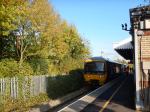
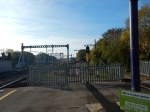
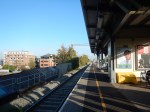
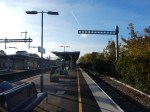
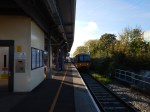
Why would the platform for the Marlow Branch and the first couple of hundred metres of the branch be electrified?
Especially, as there appeared to be no sign of work on the rest of the line between Maindenhead and Bourne End!
Given what I saw and wrote about increased frequencies, I think there are four possibilities.
- The Marlow Branch continues to be run as now..
- It receives traditional electrification later.
- The line is electrified just enough to charge trains with an IPEMU-capability or batteries.
- It has something to do with reversing Crossrail trains.
Option 1 and 2 are possibilities, but Crossrail are reversing trains to the West of the station.
It would also appear that sufficient work is being done for option 3.
Consider.
- There appears to be no work going on to lower the track in the numerous bridges.
- The clearances, are enough for a battery-powered train or IPEMU, which would be those needed for a Class 165 train.
- The line is only just over seven miles long, which would be within battery range.
- The line has at least two level crossings, which can be difficult to electrify.
- Putting overhead wiring on Bourne End Railway Bridge could rightly meet with objections.
Perhaps the best way to run the branch would be to run it almost as two separate services, as it is currently done in the Peak.
- A newer two-car diesel, like say a Class 172 train, runs the shuttle between Marlow and Bourne End.
- A four-car electric multiple unit with an IPEMU-capability, runs the Bourne End to Maidenhead service, under battery power charging at Maidenhead station, using the 200 metres or so of overhead wires.
- The trains are timed to meet at Bourne End, where passengers change between the trains.
- Certain Bourne End to Maidenhead trains could be extended to Paddington, as they are now in the Peak. I think they would take two hours for the round trip.
- In some ways the biggest advantage is that the only new infrastructure, would be the electrification at Maidenhead station, that is currently in progress.
I feel it is all feasible.
Conclusions
On current timings, two tph is very feasible and three tph may be a possibility and a certainty in the Peak.
What benefits would passengers get from this level of service?
- They get a turn-up-and-go service of at least two tph.
- They get newer trains with more capacity.
- Some of the trains would be electric-powered.
And the train operator?
- They get newer trains with more capacity.
- They would only need to allocate a small number of trains to provide the service.
- They get an easy-to-deliver service.
Hopefully, the quality service would attract more passengers and generate profits.
Surely though, Network Rail are the biggest winner, as they would only need to get the infrastructure into tip-top condition, add a small amount of electrification and give it a thorough testing.
Will it happen?
I have no idea, but it certainly looks like something innovative is being assembled.
If whatever Network Rail and GWR are planning, should involve the use of IPEMUs or battery-powered trains and it proved to be a success, then it would open up the possibility of several branch and other lines receiving the same electrification by stealth.
- Barking Riverside Extension
- Didcot Parkway to Oxford
- Felixstowe Branch
- Greenford Branch
- Henley Branch
- Marshlink Line
- Sudbury to Marks Tey and Colchester
- Uckfield Branch
- Windsor Branch
It is certainly easier to electrify a line using modified electric trains with batteries, built in a new clean and warm factory in Derby, rather than by traditional methods, which seem to be Network Rail’s money pit.
Is It Bi-Modes And Battery Trains To The Rescue?
This article in Rail Technology Magazine is entitled Further delays to GWML electrification as schemes deferred indefinitely.
The delayed schemes include.
- Bristol Parkway to Bristol Temple Meads
- Bath Spa to Bristol Temple Meads
- Oxford to Didcot Parkway
- Henley Branch
- Windsor Branch
There is no mention of the Marlow Branch or the Greenford Branch.
The article also quotes the Rail Minister; Paul Maynard, as saying.
Introducing newer trains with more capacity in these areas could be done without costly and disruptive electrification,
Is this a meaningless platitude or is there substance behind it?
A mix of Class 801 electric trains and Class 800 bi-mode electro-diesel trains were originally ordered for GWR.
But this is said in the Wikipedia entry for the Class 800 train.
In July 2016, it was announced that GWR’s intended fleet of Class 801s were to be converted from pure EMUs to bi-mode units. Subsequently these were reclassified as Class 800s.
So will we see bi-mode trains working the Bristol Temple Meads routes, which are numbered 1 and 2 above?
That would certainly allow the Minister to bathe in the glory of a run to Bristol via Bath and back via Bristol Parkway.
Five-car Class 800 trains could also work route 3, thus giving Oxford trains, that would increase capacity and run on electric power between Didcot and Paddington.
But what about the four branch lines; Greenford, Henley, Marlow and Windsor?
Note.
- The Minister used the word newer not new.
- He also said capacity would be greater.
- When I passed the Marlow branch a few weeks ago, it appeared electrification had started.
- All branches are short, with the Marlow Branch the longest at 7.25 miles.
- The Henley Branch has a 50 mph speed limit.
It should also be noted that the Mayflower Line, where the battery train trial was conducted in 2015 is just over eleven miles long.
So would it be possible to fit batteries to the Class 387 trains to fulfil the Minister’s statement?
- The Class 387 trains are very similar to the Class 379 trains used in the trial on the Mayflower Line.
- They are newer with greater capacity, than the current trains on the branch lines.
The answer could be yes! I reported on Rumours Of Battery-Powered Trains in August 2015. At that time Network Rail were calling the trains Independently Powered Electric Multiple Units or IPEMUs.
The possibility also exists that Class 387 trains with batteries could also work the lines between Didcot Parkway and Oxford, Reading and Basingstoke and Reading and Bedwyn.
Network Rail needs to convert a serious loss of face into at least a score-draw!
If the Great Western does use this approach, they’ll only be taking a similar route to the Germans, as I wrote about in German Trains With Batteries.
ScotRail In Trouble
This article on Rail News is entitled Major improvement plan for struggling ScotRail. This is the first paragraph.
The ScotRail Alliance has unveiled a plan to improve performance, after managing director Phil Verster had described the task of upgrading the network while running trains day-to-day as like ‘performing open heart surgery while doing a marathon’.
After my troubles at the weekend on n Northern Rail with overcrowded trains around Blackburn, I wonder if a pattern is emerging.
Consider.
There is a lot of work going on in Scotland to electrify Glasgow to Edinburgh under the EGIP scheme.
There are delays to the electrification.
ScotRail will soon be receiving a a new fleet of Hitachi Class 385 trains.
There has been a union dispute.
Similar patterns are seen across the network, including in the following places.
- Manchester Area
- Northern England
- Southwards from London
- Thames Valley
- Valley Lines In Wales
I do wonder if the announcement of jam, milk and honey in a few years, prompts people to anticipate the new services and the passenger numbers grow, prior to the new services.
All this probably says, is that we should have a long term plan for the railways, which doesn’t get cut back, the next time government has a budget crisis.
Could Electrification Be Removed From The Chingford Branch Line?
This article in Rail Engineer also quotes Jon Shaw of Bombardier on onboard energy storage in the new Aventra trains, like the Class 710 trains that will work the Chingford Branch Line.
As part of these discussions, another need was identified. Aventra will be an electric train, but how would it serve stations set off the electrified network? Would a diesel version be needed as well?
So plans were made for an Aventra that could run away from the wires, using batteries or other forms of energy storage. “We call it an independently powered EMU, but it’s effectively an EMU that you could put the pantograph down and it will run on the energy storage to a point say 50 miles away. There it can recharge by putting the pantograph back up briefly in a terminus before it comes back.
I believe that once the concept of onboard energy storage is accepted, that Network Rail and operators, will question whether there is a need for so much electrification.
In a few years time, all trains, except perhaps a few engineering ones, on the Chingford Branch Line North of St. James station will be new Class 710 trains with the following characteristics.
- Enough onboard energy storage to handle regenerative braking and handle the twenty mile out-and-back trip on the branch.
- By using onboard energy storage, the trains have a remote wake-up facility, as discussed in Do Bombardier Aventras Have Remote Wake-Up?.
- The ability to raise and lower a pantograph quickly.
So would it be possible to remove electrification, North of Clapton Junction.
This map from carto.metro.free.fr shows the area of Coppermill junction, with the Chingford Branch Line shown conveniently in orange.

Coppermill Junction
I will now list the advantages of removing the electrification between Clapton Junction and Chingford.
Maintaining The Overhead Wires
Overhead wires get damaged, vandalised and stolen at a surprisingly high frequency.
Network Rail would love to see the wires come down.
The only objectors would be the thieves, who nick the wires to sell.
The Sidings At Chingford Could Be Without Electrification
As all the trains stored there would have their own onboard energy storage, they would move in and out under their own power.
The Chingford sidings could thus be without electrification.
This would.
- Reduce maintenance costs for the sidings.
- Enable track layouts to be changed without changing the electrification.
- Increase safety levels for everybody working in the sidings.
The only electrification needed at Chingford might be a short stretch of overhead wire to top up trains low on electricity.
All Height Restrictions Could Be Removed At The Highams Park Level Crossing
After the recent accident on the M20, reported in this story on the BBC,, which is entitled M20 motorway shut after lorry crash causes bridge collapse, I don’t think it is wise to underestimate the stupidity of some drivers.
So if there were no overhead wires at the Highams Park level crossing, it might avoid a serious incident.
Easing Station Rebuilding and Building
Wood Street station needs to be rebuilt to make the station step-free and it would be much easier and less disruptive to train services, if there were no overhead wires to get in the way.
If any new stations are added to the line, then the cost of building must be more affordable, if there are no overhead wires to get in the way.
Less Visual and Noise Intrusion
Obviously, removal of overhead wires will reduce the visual intrusion.
But, it will also reduce the noise, as overhead wires are a source of noise from electric trains.
Note too, that as the new trains will use regenerative braking at most times, there will be much less noise from wheel-brakes.
A Safer Railway
There is no doubt, that a railway without electrification is a safer railway, as there is no electricity, except for points and signals.
Conclusion
It would be advantageous for several reasons if electrification could be removed from the Chingford Branch Line.
Related Posts
Improving The Chingford Branch Line
Could Reversing Sidings Be Used On The Chingford Branch Line?
Could The Hall Farm Curve Be Built Without Electrification?
New Stations On The Chingford Branch Line
Rumours Of Curves In Walthamstow
Will Walthamstow Central Station On The Victoria Line Be Expanded?
Improving The Chingford Branch Line
The Chingford Branch Line has a four trains per hour (tph) service between Liverpool Street and Chingford via Hackney Downs and Walthamstow Central stations.
Those that I know who live in the area, have a few simple wishes.
- New trains with wi-fi and other passenger-friendly features.
- More trains to improve services and take the pressure off the Victoria Line.
- A service from Chingford and Walthamstow to Stratford and Crossrail.
- Perhaps some new stations.
- Step-free access at St. James Street and Wood Street stations.
The following sections tackle these wishes in more detail.
New Class 710 Trains
The biggest change to the line will come with the new Class 710 trains in a couple of years time.
Thirty new four-car Class 710 trains will replace the same number of Class 315 and Class 317 trains, that currently work the Cheshunt and Chingford services.
- As the number of trains and their length is the same, the service frequency and capacity will be no worse than at present.
- The trains will be modern and have air-conditioning and all the features that passengers now expect.
- The trains will be fitted with various driver aids to ensure accurate timekeepers.
- Nothing has been said about wi-fi, but most other new Aventras will have free wi-fi fitted, so I suspect it will be fitted or there will be a big argument.
- I am of the belief that all Class 710 trains will be fitted with enough onboard energy storage to handle regenerative braking and short movements not connected to the overhead wires.
- Onboard energy storage would also mean the trains could be fitted with remote wake-up, so that trains stabled overnight at Chingford, can be driver and passenger ready before the driver arrives to start the service in the morning.
It should be noted that London Overground has taken an option for another twenty-four trains. So could some of these trains be added to the fleet on the Chingford Branch to increase capacity and service on the Branch?
The Highams Park Level Crossing
In an ideal world, more services would be provided on the Chingford Branch to Liverpool Street for the following reasons.
- The Victoria Line from Walthamstow Central now has the trains to handle passengers to Central London, but the station doesn’t have the capacity to handle them, due to its cheapskate 1960s design.
- The Chingford Branch has direct access to Crossrail at Liverpool Street whereas the Victoria Line doesn’t connect to London’s new train line.
- The Chingford Branch has direct access to the North London Line at Hackney Downs and the new Class 710 trains, will mean that North London Line services will be increased.
- Crossrail could release extra platform space at Liverpool Street for more London Overground services.
But there is one major problem to increased services on the current Chingford Branch. They must all go through the level crossing at Highams Park Station.
- There is only long detours, if the crossing is closed.
- Extra trains would cause significant traffic congestion.
- Extra trains would mean the crossing would be closed for a large proportion of every hour.
As it is unlikely that the money could be found for a bridge or tunnel at Highams Park, the only thing that can be done, is make sure that all train services be at maximum length, which is probably eight cars.
Obviously, longer trains would help, but in the long term, I’m certain that London Overground would want to run more frequent services between Liverpool Street and Chingford.
I think it is true to say that the train frequency of the Chingford Branch through Highams Park is probably limited by a maximum of eight closures per hour of the Highams Park level crossing, unless the level crossing could be closed or by-passed.
But is maximum use being made of the level crossing closures now?
At present in the Off Peak.
- Trains arrive at Highams Park from Chingford at 14, 29, 44 and 59 minutes past the hour.
- Trains leave Highams Park for Chingford at 08, 23, 38 and 53 minutes past the hour.
I don’t think that this means that a Northbound and a Southbound train can share a single closure of the level crossing. This page on the National Rail web site, shows live departures at Highams Park.
If they could, then that would cut the number of times the crossing closed in the Off Peak by half.
Things that will help, is that the Class 710 trains will have extensive driver aids and probably onboard signalling, so the precise timekeeping that would be required, so two trains shared a level crossing closure, could be a lot easier.
Eight trains per hour in the Off Peak in both direction through Highams Park station is a distinct possibility.
This 8 tph frequency could be continued through the Peak, as it’s probably better than the current timetable.
Eight Trains Per Hour From St. James Street To Chingford
So it looks like that modern Class 710 trains running to a precise timetable could mitigate the problems of the Highams Park Level Crossing and allow eight trains per hour between St. James Street and Chingford.
|As there is no other trains using the branch, except moving empty and some engineering trains to and from the sidings at Chingford, there is probably little to interfere with an 8 tph schedule.
South From St. James Street
South from St. James Street station, the trains go through the Coppermill Junction area and cross the West Anglia Main Line.
The Chingford Branch then joins the line from Tottenham Hale to Hackney Downs, as this map from carto.metro.free.fr shows.
Coppermill Junction
The map shows Coppermill Junction, where the Chingford Branch Line crosses the West Anglia Main Line, that runs North from Liverpool Street to Tottenham Hale, Bishops Stortford, Stansted Airport and Cambridge.
I suspect that there would be a problem fitting another four tph through Hackney Downs station and on to Liverpool Street.
In Rumours Of Curves In Walthamstow, I talked about how two curves would be rebuilt, based on information from an informant with detailed knowledge.
- The Hall Farm Curve would be rebuilt as a bi-directional single-track connection between St. James and Lea Bridge stations.
- The Coppermill Curve would be rebuilt to give a connection between St. James and Tottenham Hale stations.
The Hall Farm Curve is the significant one for passenger services on the Chingford Branch Line, as it would mean that the current service of 4 tph between Chingford and Liverpool Street would be augmented by a second 4 tph between Chingford and Stratford.
- Waltham Forest would get an 8 tph metro service between St. James and Chingford stations.
- There are extensive bus connections at Chingford, Walthamstow Central and Stratford.
- The line has good connections to the Victoria Line, the Jubilee Line, the Central Line and Crossrail.
The only infrastructure needed would be the single-track Hall Farm Curve. If the Class 710 trains were to be fitted with onboard energy storage, this curve would not even need to be electrified.
Conclusion
By using the features of the new Class 710 trains, Chingford can be given four trains per hour to Liverpool Street and 4 trains per hour to Stratford, if a new single-track Hall Farm Curve without electrification is built between St. James and Lea Bridge stations.
Related Posts
Could Electrification Be Removed From The Chingford Branch Line?
Could Reversing Sidings Be Used On The Chingford Branch Line?
Could The Hall Farm Curve Be Built Without Electrification?
Crossrail 2 And The Chingford Branch Line
New Stations On The Chingford Branch Line
Rumours Of Curves In Walthamstow
Will Walthamstow Central Station On The Victoria Line Be Expanded?
Wikipedia – Chingford Branch Line
Comparing An Aventra IPEMU With An Electrostar IPEMU
The Concept Of An IPEMU
This article in Rail Engineer, which is entitled An Exciting New Aventra, quotes Jon Shaw of Bombardier on onboard energy storage.
As part of these discussions, another need was identified. Aventra will be an electric train, but how would it serve stations set off the electrified network? Would a diesel version be needed as well?
So plans were made for an Aventra that could run away from the wires, using batteries or other forms of energy storage. “We call it an independently powered EMU, but it’s effectively an EMU that you could put the pantograph down and it will run on the energy storage to a point say 50 miles away. There it can recharge by putting the pantograph back up briefly in a terminus before it comes back.
I believe that once the concept of onboard energy storage is accepted, that Bombarduier’s engineers have found other ways to use it to the benefit of passengers, operators and Network Rail.
- Regenerative braking energy can be stored on the train and used for a restart or other purposes, rather than just burning it off or returning it to the grid, through complicated transformers.
- Onboard energy can be used to move a train to the next station, if the overhead or third rail power should fail.
- Depots and stabling sidings don’t need to be fully electrified.
- Onboard energy storage enables train features like remote wake up, which I discussed in Do Bombardier Aventras Have Remote Wake-Up?.
- Trains can safely pass over short sections without electrification. Third rail trains can do this with contact shoes at both ends of the train.
Trains with onboard energy probably need to have intelligent current collection, so that pantographs and contact shoes can be intelligently deployed and retracted.
Take the simple example of a passing loop on a single track electrified branch line, which is needed for two trains per hour. The passing loop could be built without electrification and without altering the existing electrification, with just a set of points and appropriate signalling at each end.
- Trains using the existing line and electrification would travel as now.
- Electric trains using the loop would lower the pantograph a safe distance before the loop, go along the passing loop using onboard energy and then once on the main line, raise the pantograph.
This technique could probably be used to simplify building of new stations or adding new platforms to existing ones.
Network Rail are going to love trains with onboard energy storage.
Electrostars and Aventras
Bombadier have shown that onboard energy storage is possible in an Electrostar and there is various articles on the web saying it can be fitted to the new Aventra.
As both Aventras and Electrostars seem to come in four- and five-car versions, I’ll do the calculations for both lengths of trains.
I’ll use these assumptions.
- Electrostar cars weigh 40 tonnes and Aventra cars 32.5 tonnes.
- Each car has 50 passengers weighing an average of 80 kilos.
The various types of IPEMU are shown in the next four sections.
Four-car Electrostar
This would have the following characteristics.
- A mass of 160+16 = 176 tonnes.
- A formation of DMOS+MOS+PTSO+DMOS
- Braking from 100 kph would release 18.9 KWH.
- Braking from 200 kph would release 75.5 KWH.
- Onboard energy storage could be placed in probably the MSO or PTSO cars.
This could be created from a train like a Class 377, Class 378, Class 379 or Class 387 train.
We know that in the demonstration using a Class 379 at Manningtree, that that train could do 18.2 km. on the Mayflower Line, just by the use of battery power.
Five-car Electrostar
This would have the following characteristics.
- A mass of 200+20 = 220 tonnes.
- A formation of DMOS+MOS+PTSO+MOS+DMOS
- Braking from 100 kph would release 23.6 KWH.
- Braking from 200 kph would release 94.3 KWH.
- Onboard energy storage could be placed in probably the MSO or PTSO cars.
Four-car Aventra
This would have the following characteristics.
- A mass of 130+16 = 146 tonnes.
- A formation of DMOS+MOS+PMSO+DMOS
- Braking from 100 kph would release 15.6 KWH.
- Braking from 200 kph would release 62.6 KWH.
- Bombardier have stated that the MOS car is ready for onboard energy storage.
This could be created from a train like a Class 710 train.
Five-car Aventra
This would have the following characteristics.
- A mass of 162.5+20 = 182.5 tonnes.
- A formation of DMOS+MOS+PMSO+MSO+DMOS.
- Braking from 100 kph would release 19.6 KWH.
- Braking from 200 kph would release 78.2 KWH.
The five-car Aventra could have two sets of batteries or onboard energy storage.
Note this about all Aventras.
Bombardier have stated that the MSO car is ready for onboard energy storage, if the customer desires.
The MSO and PMSO cars can be considered a fixed pair of cars handling the electrical power for the train.
Can a PMSO and two MSOs be considered a trio on the five-car Aventra?
Aventras have a lot of motored cars, with lots of traction motor/generators.
The trains can have a remote wake-up feature, that would probably need some form of onboard energy. After all, your smart-phone doesn’t work if the battery is not fitted.
Can I draw any conclusions?
- The Aventra with its pair of electrifical cars has been designed to have onbosrd energy storage.
- The energy that needs to be handled is less with the lighter weight Aventra.
- Stopping from 200 kph releases a lot more energy. Four times more than from 100 kph in fact.
- The energy storage needed for 100 kph stop and restart operation, are within the battery size range of the battery in an electric car like a Nissan Leaf.
- There could be advantages concerning reliability and battery size with the five-car Aventra with its possible two sets of energy storage.
Obviously, the weight of the battery would need to be factored into the calculations, but if say it was a tonne, it would only increase energy figures by less than one percent.
The Definitive IPEMU
I said that two two sets of energy storage in the five-car Aventra could give advantages.
- Each set could be smaller.
- Two sets will be more reliable than one.
- The weight of the storage is shared between two MSO cars.
- The two MSO cars in the five-car Aventra IPEMU would probably be identical.
In the extract from the Rail Engineer article that started this post Jon Shaw of Bombardier is quoted as saying this.
it will run on the energy storage to a point say 50 miles away.
Two sets of onboard storage would obviously help this, with each set needed to keep the train going for 25 miles. This is not the onerous task it could appear. Especially in an Aventra.
- The train is designed to minimise aerodynamic losses.
- The train is designed to minimise the very small rolling losses of steel wheel on steel rail.
- All passenger systems like wi-fi, lighting and air-conditioning are designed to use minimum electricity.
- Driving aids on the train will help the driver to drive in an energy efficient way.
- When the brakes are applied, the energy is recovered and stored in the onboard energy storage.
- The train will stop at a station using much less energy than a conventional train.
But the most important thing, is that the train has been designed from the wheels up as an efficient package.
Conclusions
I believe the following.
- Five cars will be one of the most common lengths for Aventras. Abellio have already ordered eighty-nine.
- The range on energy storage of a five-car Aventra with two sets of energy storage will be at least fifty miles.
- Aventras with an IPEMU-capability will be used to reduce electrification work.
- Aventras with an IPEMU-capability will be used to develop new electrified routes.
- As the IPEMU technology develops, Bombardier will develop a solution, so that later Electostars will be able to store their own braking energy and travel a limited distance away from electrification.
- All train manufacturers will look seriously at energy storage on trains.
If I was asked what would be the ultimate range of a train using this technology, I would say, that trains with an IPEMU-capability will within a few years be running the whole route between Waterloo and Exeter.
I
Would High-Speed Trains With Onboard Energy Storage Enable Environmentally-Friendly High-Speed Lines?
If you stand on the platform at Stratford International station, when a Eurostar Class 373 train comes through, it is a very noisy experience.
For this and other reasons high-speed trains usually have their own fenced-off tracks, well away from centres of population.
High-speed trains like Eurostar tend to have a journey profile, where they accelerate to line speed and then run at this speed, until they stop at the next station.
High speed lines are also designed, so that trains don’t lose energy on gradients and curves for energy efficiency.
I’d love to see an energy use profile for a modern high-speed train like a Class 374 train, as it goes from London to Paris.
Onboard energy storage is rather primitive today, but who’s to know how far the next generation of battery technology will take a train in say ten years time.
Say a high speed train has to go through an area that is highly-sensitive with respect to visual and/or audio intrusion!
If the section was not electrified, which would cut the visual intrusion to just the trains passing through and reduce the pantograph noise to zero, how far would a mix of battery power and the kinetic energy of the train power it until it could get electric power on the other side of the electrification gap?
We could be closer than anybody thinks to the use of batteries on high-speed trains.
The Midland Main Line is being electrified and Ian Walmsley in Modern Railways has speculated that 125 mph Aventras could be used between London and Sheffield. I wrote about this in A High-Speed Train With An IPEMU-Capability.
Could we see sections of the fast lines deliberately built without wires, so that noise is reduced?
Leicester station is a serious bottleneck, so could track be arranged there with two quiet fast lines without wires, through the centre of the city and the station?
It’s an interesting possibility to both reduce the effects on the environment and cut the cost of electrification.
I also think there are other reasons why trains will increasingly have on-board energy storage or in the case of electric locomotives, a small diesel engine.
- A get-to-the-next-station capability for when electric power to the line fails.
- Depots could be without electrification.
- Complicated stations could be electrically-dead.
It is a technology, that will have a large number of positive effects in the coming years.
The New Trains Arriving In East Anglia
This article in the Derby Telegraph is entitled Derby workers on tenterhooks over contract worth BILLIONS. (Note the newspaper’s capitals!)
It states that the new East Anglian Franchise could be announced tomorrow, as it is supposed to be settled in June, and that the order for new trains is between Bombardier and Siemens.
I can’t believe that given the current Euro-turmoil in the country, that Siemens will be given this order.
I think that we can assume that based on London Overgroun’s contract for Class 710 trains, where this is said.
In July 2015 TfL announced that it had placed a £260m order for 45 4-car Bombardier Aventra EMUs
That a new four-car Aventra train will cost around £6million. I would suspect that Siemens Desiro City would probably be around the same price.
So for a billion pounds, you would get around a hundred and thirty trains.
As I said in Could Class 387 Trains Do Norwich In Ninety And Ipswich In Sixty?, one twelve-car Class 387 train, could fulfil the franchise requirement of two fast trains a day on the Great Eastern Main Line in both directions. It might even be possible to deliver it, early in 2017, now that it appears production of Class 387 trains might be able to continue.
The Derby Telegragh article talks about Aventra trains, but unlike Class 387 trains, these would not be available until probably 2019, at the earliest.
But Aventras for the flagship London-Ipswich-Norwich route could be delivered with all or part of this specification.
- Up to twelve-cars.
- Walk-through capability. Thameslink’s Bedford to Brighton serrvice will be like this, so why not?
- A specially-design business- and commuter-friendly interior.
- 125 mph capability to give all services Norwich in Ninety and Ipswich in Sixty.
- A buffet car could be provided.
- An IPEMU capability, so a direct Yarmouth service could be introduced.
Some might mourn the passing of the much-loved and well-used Mark 3 coaches, but the Great Eastern Main Line would have one of the best commuting trains in Europe.
I estimate that six sets would be needed to provide two trains per hour in 90 minutes between Norwich and London.
Currently, they have sixteen sets with eight coaches.
If the trains had an IPEMU-capability, which is possible, but of course hasn’t been announced, these trains could also work Norwich to London via the Breckland Line and the West Anglia Main Line, serving Thetford, Ely, the new Cambridge North, Cambridge and Tottenham Hale. Currently, this route would take just under three hours with a change at Cambridge. What time a 125 mph electric train could manage, is pure speculation, but a time of two and a half is probably possible, with some track improvements on the route.
So could we see the current hourly, Norwich to Cambridge service on this route, serving Cambridge North and extended to London? It would give advantages to passengers, the operator and Network Rail.
- The improved connectivity between Cambridge and Norwich would spread the benefits of the Fenland Powerhouse to Norwich and Norfolk.
- Norfolk would get a third direct route to the capital, after the Great Eastern Main Line and the Fen Line.
- Norwich services would have a same platform interchange to Thameslink at one or possibly both Cambridge stations.
- One of the Northern bay platforms at Cambridge would be used more efficiently, as most Norwich services would be through trains.
- The trains could be identical or very similar to those serving the Great Eastern Main Line.
- The route would be available as a diversionary route between Norwich and London, should the |Great Eastern Main Line be closed.
- There would be no major electrification needed.
To provide an hourly service, I think that three trains will be needed.
The Great Eastern Main Line to Ipswich and the western route to Ely, have platforms long enough for twelve-car trains. North from Ipswich, they can certainly take ten-car trains, as that is the effective length of the current stock.
So will the stock be eight- or twelve-car trains? It could be either, with perhaps some platform lengthening on the western route.
The minimum number of trains would be six for the Great Eastern Main Line and three for the western route. It would probably be prudent to call it ten trains.
I think adding in a bit extra for 125 mph and IPEMU-capabilities and a custom interior, that prices could be of the order of.
- £20million for an eight-car train or £200million for ten.
- £30million for a twelve-car train or £300million for ten.
That’s not billions!
Shorter units of perhaps four-car or eight-car formations with an IPEMU-capability, could run the following routes.
- Ipswich to Cambridge
- Ipswich to Ely and Peterborough.
- Ipswich to Lowestoft, if some form of charging could be provided at Lowestoft.
Four trains of eight-cars for these Ipswich-based routes, would be another £80million.
Still not billions!
This leads me to the conclusion, that a large number of other electric trains in the franchise will be replaced.
- I believe for Norwich in Ninety, all trains north of Colchester need to have a 110 mph-capability or better.
- Some trains are very tired, dated and lack capacity.
- Some could have an IPEMU-capability for working the branch lines that don’t have electrification.
In the present franchise there are the following trains working the Great Eastern Main Line and the West Anglia Main Line
All are of four cars.
If all except the nearly-new Class 379 trains, were replaced with Aventras, that would cost about £950million including the IPEMUs for the branch lines.
I think that if they can develop a sensible way of charging trains at Lowestoft, Sherringham and Yarmouth, this would give the following advantages.
- Every train would be a new or nearly-new electric multiple unit.
- Some trains would have an IPEMU capability to handle lines without electrification.
- Every train would be able to use regenerative braking to save energy.
- There would be a large increase in capacity.
- Most services would be faster and not just Norwich and Ipswich to London.
- New trains into Southend to compete with c2c.
- Trains would be available to serve the new Cambridge North station.
- A possible London to Lowestoft service could be run.
- .Services between Cambridge, Ipswich, Norwich and Peterborough could be increased.
- March to Wisbech could be added to the network.
- Diversionary routes from Ipswich, Norwich and Peterborough to London have been created.
- No new electrification of a substantial nature.
- Some quality diesel trains would be released to other operators.
As I indicated earlier, if it was decided to fulfil the requirements of Norwich in Ninety and Ipswich in Sixty, early in the franchise, this could be done with some Class 387 trains.
If this happens, it will be a substantial improvement on the current service.
East Anglia will have been totally-electrified for passenger services, with all the electrification being done in a new, modern factory in Derby.
I don’t know what will happen, but unless something like this does, I can’t see how Bombardier will get the order for billions of pounds of new trains, as reported in the Derby Telegraph.
Engineering is the science of the possible!
 The Anonymous Widower