Ricardo Develops Advanced Ranger HEX 6×6 Conversion With Hybrid Electric Drivetrain
The title of this post, is the same as that of this press release from Ricardo.
This is the sub-heading.
The new vehicle has been conceived to help improve the sustainability of future defence mobility while retaining the highest performance demanded by the toughest environments
This picture is from the press release.
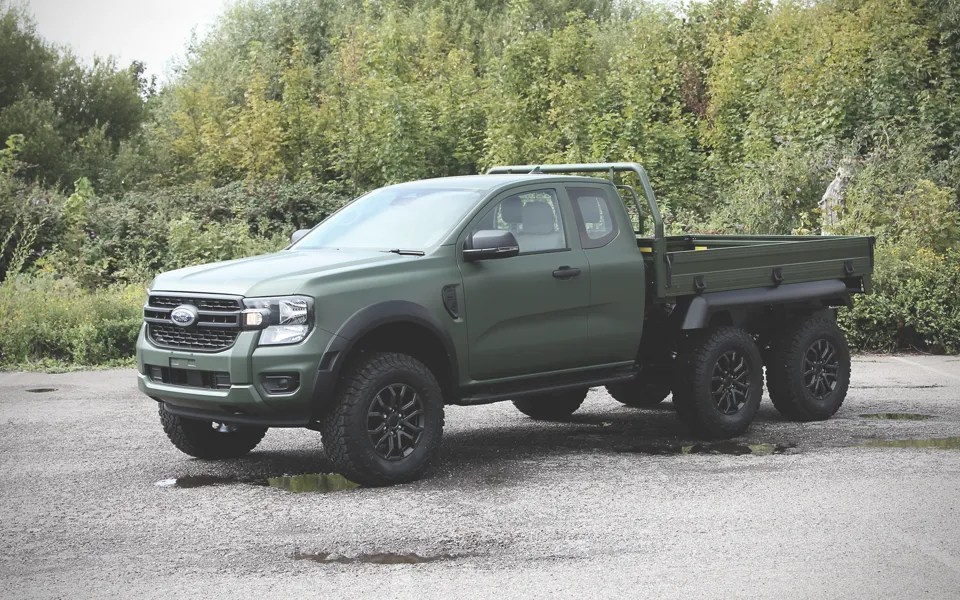
My first thought is that it looks the ultimate technical.
These two paragraphs introduce the vehicle.
Ricardo, a global strategic, environmental, and engineering consulting company, has developed the Ranger HEX, a 6×6 vehicle conversion designed to offer a significant improvement in payload of up to 3,800kg over the harshest of terrains. It comes with a hybrid drivetrain to maintain performance and improve fuel consumption.
This new conversion benefits from Ricardo’s expertise and experience in creating high quality, cost effective special vehicles for defence, security and utility applications. The vehicle will benefit from enhanced levels of capability, robustness and availability.
These three paragraphs describe the design.
The HEX solution differs from conventional conversions as it has been conceived as an overlay bolt-on system that does not require any alteration of the Ford Ranger base vehicle, which is Europe’s number one commercial pick-up platform. This ensures that the base vehicle retains all the robustness and quality of the standard vehicle and allows the system to be removed and re-installed on a different vehicle.
An electric rear drive system has been adopted that uses a production Ford drive unit to provide up to an additional 210kW of power, over and above the class leading 186kW of power from the existing 3.0L V6 diesel engine. The De Dion rear suspension design is not only weight efficient and robust but also provides better wheel control for improved traction and ride. In addition, the De Dion arrangement decouples the suspension and drive systems to allow a range of drive units to be used or deleted for a cost-effective 6×4 variant with maximum payload using an undriven ‘lazy’ axle.
The electric drive is designed as a self-contained through-the-road hybrid system. Braking energy is harvested under deceleration to charge the battery pack. This energy is then used to provide electric torque under acceleration to mitigate the usual drop in performance whist carrying a high payload. A selection of battery capacities are available, depending on customer requirements. All high voltage components are contained within a single integrated enclosure for safety and ease of maintenance and repair.
Note.
- The conversion would appear to bolt on to the standard Ford Ranger base vehicle.
- The vehicle has regenerative braking.
- It has a payload of 3.8 tonnes.
- It appears to have a very sophisticated rear suspension.
- Judging by the colour and the mention of the word defence in the article, I suspect this vehicle has been initially designed for a military application.
- Over 300,000 Rangers were sold worldwide in 2021.
- In the UK, it looks like a Ford Ranger will cost around £30,000 excluding VAT.
In addition I’ve read in this article on Autoweek that, the conversion itself has been designed as an overlay bolt-on modification that requires no alterations to the base vehicle, even preserving its existing warranty.
I have my thoughts.
Applications
The press release talks about high quality, cost effective special vehicles for defence, security and utility applications.
Use your imagination!
Perhaps.
- It is going to be used as the ultimate technical by the Ukrainians.
- A missile manufacturer has a system, that weighs around 3.5 tonnes and needs a launch vehicle.
- The RNLI needs an affordable vehicle to launch lifeboats from the beach.
- It is going to be used as rough terrain ambulance.
- It would make an excellent towing vehicle.
With all the problems in Morocco and Libya at the moment, it has been launched at the right time.
Zero-Carbon Operation
I believe that a zero-carbon version is essential. Especially, as the sub-heading mentions sustainable defence mobility.
The easiest way to achieve this would be to run on HVO or some form of biodiesel.
I suspect between them Ford and Ricardo have enough knowledge to create a hydrogen powered version.
Are There Autonomous Ford Rangers?
Google says, “Yes!”
This article on foresttech is entitled Ford Ranger Goes Fully-Autonomous, where this is said.
An Australian mining group has advanced the future of mobility (in mining at least) with the deployment of a fleet of fully-autonomous Ford Rangers at one of its mines.
Fortescue Metals Group has retrofitted four Rangers at its Christmas Creek mine in Western Australia with autonomous systems created by the company’s Technology and Automation team, to remove the need for fitters to make around 12,000 28-kilometre round trips each year to collect equipment and parts.
Of course, it’s not quite as ground-breaking as it sounds: mining operations don’t need to deal with road rules, pedestrians or many other vehicles, which hugely complicate the matter. Nevertheless, it’s still impressive.
Three applications suggest themselves.
- Delivering supplies in a disaster zone, after an earthquake, flooding,, landslide or volcanic eruption.
- Delivering supplies, including ammunition on a battlefield.
- Moving supplies along a long linear construction site, like a new railway or road.
Note.
In all three applications, six-wheel drive will be important, if ground conditions are bad.
- Could Fortescue Metals Group be behind this project?
- Disasters seem to be getting more common.
- Autonomous battlefield delivery must be safer for personnel.
I suspect there will be agricultural applications of an autonomous vehicle.
£77 Million Investment For UK Heavy Duty And Commercial Vehicle Projects
The title of this post is the same as that of this press release from the Advanced Propulsion Centre.
These are the projects.
Ford to design, develop, and build a fleet of 8 hydrogen fuel cell powered Transit vans, with the latest advances in technology
£8 million awarded by government, matched by industry to a total £16.3 million.
This research project will design and develop a hydrogen fuel cell-powered version of the Ford Transit van, with a Ford Dagenham estate facility re-purposed for upfitting of the vehicle. By bringing the manufacturer, vehicle operator and supply chain businesses together, this project aims to establish a business case for the wider rollout of hydrogen Light Commercial Vehicles.
Project partners include: Ocado, BP, Cygnet Texkimp, Cambustion, Viritech.
Note.
- I suspect Ocado will do the road testing.
- BP will probably supply the hydrogen.
- Cygnet Texkimp are a company based in Northwich and is a leading global provider of fibre handling and converting technology. Have they developed a machine for knitting hydrogen fuel tanks?
- Cambustion‘s Engineering Services team provides powertrain development and testing services to a range of global clients from our Cambridge, UK base.
- Viritech’s web site has a mission statement of Rewiring the DNA of Hydrogen Powertrains.
Ford seem to have assembled a team of all the talents.
Wrightbus to develop a new world-leading zero-emission battery and hydrogen fuel-cell electric, multi-axle vehicles
£6.4 million awarded by government, matched by industry to a total £12.7 million.
This project will produce a new, market-leading platform for battery and fuel cell electric driven buses. Whilst demand is growing for zero-emission vehicles, there are currently few options available for heavy, multi-axle vehicles like large buses.
Project partners include: Queens University Belfast, Grayson Thermal Systems, Hutchinson Engineering, Translink.
Note.
- Grayson Thermal Systems are based in Birmingham and specialise in providing HVAC for vehicles and especially zero-carbon ones.
- Hutchinson Engineering are based in Widnes and invest in state-of-the-art machinery and technology to give our customers the most advanced, cost-effective solutions in design, fabrication and manufacturing.
- Translink provides public transport in Northern Ireland.
It looks like Wrightbus have excellent partners.
ULEMCo creating a zero-emission hydrogen fuel cell range extender for prototype ambulance, fire engine and road sweepers
£3.9 million awarded by government, matched by industry to a total £7.9 million.
This project will develop a hydrogen fuel cell range extender for electric vehicles used for special purposes, such as ambulances, fire engines and street sweepers. The zero-emissions range extender will be based on existing, proven technology from the Toyota Mirai, and demonstrate how zero emissions vehicles can be used in a wide range of specialised and challenging settings.
Project partners include: Altair Engineering, Emergency One, Technical Services Ltd, Oxon Fire & Rescue Services
Note.
- ULEMCo are based in the Liverpool City Region and it is very much in Liverpudlian DNA to repurpose something that works. Hence the use of The Toyota technology.
- Altair Engineering is a multinational engineering and technology company.
- Emergency One is a Scottish manufacturer of fire engines and emergency vehicles.
- Technical Services Ltd, who are based in Cleckheaton, supply thermal management systems and solutions.
- Oxon Fire & Rescue Services will obviously be doing the testing.
In Hydrogen-Powered Ambulance Drives Into Glasgow Ahead Of London Trial, I wrote about a prototype hydrogen-powered ambulance, that was built by ULEMCo and industry partners, that was shown at COP26.
Is this project turning the prototype into a system, that can be manufactured in large volumes?
Bramble Energy developing a hydrogen double-deck bus, using innovative, low-cost fuel cell technology
£6.3 million awarded by government, matched by industry to a total £12.7 million.
This project will demonstrate a fuel cell/battery hybrid powertrain on a double-decker bus. This novel product will be cheaper than the equivalents currently available for large vehicles like buses and uses innovative new electronics and energy recovery technologies.
Project partners include: University of Bath, Equipmake, Aeristech
Note.
- Bramble Energy‘s Printed Circuit Board Fuel Cell (PCBFC™) is a patent protected, revolutionary design which leverages existing manufacturing routes from the printed circuit board industry to offer a cost-effective, scalable hydrogen fuel cell solution.
- Equipmake are based at Snetterton in Norfolk.
- In Equipmake Hybrid To Battery Powered LT11, I describe Equipmake’s conversion of a New Routemaster to battery operation.
- Aeristech are based in Crawley and have developed a range of award-winning compressors for Tier-1, OEMs and other customers.
- Is the compressor needed to pump a mixture of hydrogen and air through the fuel cell?
I have a feeling, that this could be a very revolutionary design.
BorgWarner developing hydrogen combustion systems for heavy-duty commercial transport
£4.9 million awarded by government, matched by industry to a total £9.8 million.
This project aims to speed up the rollout of hydrogen-burning internal combustion engines, as an alternative to diesel. Hydrogen is a clean fuel, producing only water when burned. Project Cavendish will develop new fuel and air management systems, so that existing heavy duty diesel technologies can be repurposed to use hydrogen as fuel.
Project partners include: Mahle, Cambustion, Hartridge
Note.
- BorgWarner is a large American automotive supplier.
- Mahle is a large German automotive supplier.
- Cambustion‘s Engineering Services team provides powertrain development and testing services to a range of global clients from our Cambridge, UK base.
- Since the brand formation in 1930 Hartridge, who are based in Buckingham, has become a world leader in diesel fuel injection test equipment.
- Project Cavendish is obviously named after Henry Cavendish, who discovered hydrogen.
In Ricardo Supports Industry Leaders To Develop Innovative Dedicated Hydrogen Engine, I talk about another project involving BorgWarner. Is Project Cavendish a follow-on from the original project or a new one?
Leyland Trucks scaling up the production of electric trucks through innovations in automation and advanced testing
£2.6 million awarded by government, matched by industry to a total £5.1 million.
By better use of automation and advanced testing, Leyland Trucks aim to increase productivity and step up their production of battery electric trucks. A ‘digital twin’ of the Leyland production line will be set up, meaning any changes can be run in simulation before being rolled out physically.
Project partners include: Expert Tooling, HSSMI
Note.
- Leyland Trucks is one of Britain’s leading manufacturing companies. It is PACCAR’s established centre for light and medium duty truck design, development and manufacture. The company is based in Leyland.
- Expert Technologies are specialists in delivering industrial automation solutions. The company is based in Coventry.
- HSSMI is a sustainable manufacturing consultancy.
As I have done a lot of simulation in my time, I’m very much in favour of digital twins.
JLR leading a consortium research project to develop a high-efficiency and highly integrated 800V inverter designed and built in the UK
£6.3 million awarded by government, matched by industry to a total £12.6 million.
This project will explore and develop technology for inverters – a key component in electric vehicles. As well as developing a best-in-class product, this work will support the growth of a UK supply chain in components for electric vehicles.
Project partners include: University of Bristol, Custom Interconnect Ltd, API Capacitors Ltd
Note.
- JLR is Jaguar Land Rover.
- Custom Interconnect is an advanced electronics manufacturing company, which is based in Andover.
- API Capacitors is the UK’s leading designer and manufacturer of high quality power capacitors for power electronic applications. The company is based in Great Yarmouth.
I suspect this invertor will have several applications.
Conclusion
The grants seem to have been widely spread around the UK.
 The Anonymous Widower