Is This The End Of The Garden Bridge?
This article on the BBC is entitled London’s Garden Bridge project officially abandoned.
Let’s hope so!
The money wasted on the Garden Bridge would have been better spent on improving that much neglected river crossing’ the Waterloo and City Line!
I’d love a Sunday service, but how about a Night Drain?
Good Riddance To The Garden Bridge!
This article on the BBC, is entitled Garden Bridge: London mayor Sadiq Khan withdraws support.
It looks like that’s it for the complete waste of money!
Unless of course, some private individual decides to pay for it. Hopefully, Sadiq Khan, will tell the donor, “Thsnks! But no thanks!”
Is Sadiq Khan Frightened Of Saint Joanna?
This report on the BBC is entitled London Mayor Sadiq Khan backs ‘more accessible’ Garden Bridge plans.
I think the Garden Bridge should be quietly forgotten and the money used to connect Barking Riverside to Thamesmead.
I would have also thought, that the bridge would be the sort of project that few would mourn its passing.
So is Sadiq Khan frightened of Saint Joanna?
Especially, as last year, he didn’t think it was value for money!
An Open Letter To London Mayor Candidates About East London River Crossings
This started as a post on my infrastructure blog, about the Silvertown Tunnel, but now that TfL has launched a consultation about the tunnel, I decided to update it and send it to you.
I am a sixty-eight year-old widower, living alone in Hackney, who has given up driving, so my personal feelings about the Silvertown Tunnel are that it is irrelevant to me, except that it might help some trucks bring goods that I buy on-line or at a local shop.
East London needs more cross-river routes and after recent trips to Birmingham, Nottingham and Germany and reading every word of London’s transport plans for 2050, I feel that whatever is done the Gospel Oak to Barking Line (GOBLin ) must be connected to Abbey Wood.
Over the last few weeks, I’ve made quite a few trips to South East London, including one where I walked along Bazalgette’s sewer between Plumstead and Abbey Wood.
It is a land that London has truly forgotten.
Some transport developments, like the DLR and the East London Line has made a difference, but connections are still not the best.
TfL has talked about a tunnel extending the GOBLin from Barking Riverside to Thamesmead and Abbey Wood.
After a visit to Karlsruhe specifically to see their tram-trains, I now believe that these could be the way to create a universe-class connection across the Thames. Tram-trains like those in Karlsruhe, which are soon to be trialled between Sheffield and Rotherham, could run on the GOBLin and then perhaps do a little loop at Barking Riverside before returning to Gospel Oak.
Note that we’re not talking untried technology here as you can see the tram-trains running on the streets and railway tracks of several German cities. Undoubtedly, if the Germans were extending the GOBlin, they would use tram-trains, as they could serve build several stops with the money needed to build Barking Riverside station. And all the stops, like those on the London Tramlink would be fully step-free.
The loop in Barking Riverside, could extend across the river.
I think that a tunnel under the Thames would be a case of hiding your biggest light under an enormous bushel.
So why not create a high bridge to allow the biggest ships underneath, with a tram track or two, a cycle path and a walking route?
It would have some of the best views in London. Forget the Garden Bridge! This would create a transport link, that those living on both sides of the river could use and enjoy every day to get to work or for leisure reasons. Tourists would come to view London, as they do on large entry bridges in cities like New York and Lisbon.
Effectively, you have a conventional tram connecting Barking, Barking Riverside, Thamesmead and Abbey Wood. At Barking and Abbey Wood, the tram-trains become trains and could go to Gospel Oak and perhaps Meriandian Water, Romford, Upminster or Tilbury in the North and perhaps Woolwich, Lewisham, Dartford or Bluewater in the South.
Everything you would need to create such a link is tried and tested technology or designs that have been implemented in either the UK or Germany over the last few years.
In TfL’s plans for 2050, I found the words Penge and Brockley High Level buried in an Appendix listing places where there could be new transport interchanges.
I believe that an interchange at Penge would link the East London Line to the South Eastern Main Line and trains between Victoria and Orpington. Another interchange at Brockley would link the East London Line to the trains going across South London between Lewisham and Abbey Wood.
Conventional thinking says that these interchanges will be difficult to build, but Birmingham has already created a station that solves the problem at Smethwick Galton Bridge.
As London Overground have the capacity to run twenty four trains every hour each way on the East London Line, these two interchanges would help solve the chronic connectivity to and from South East London. They would also bring more passengers to the East London Line to fill all those trains.
One of the things that the increased number of trains on the East London Line would need is another southern terminal and possibilities include Beckenham Junction or Orpington.
I think it is true to say that there are more possibilities to improve connectivity east of the East London Line, both North and South of the River, than both London’s Mayors have ever dreamed about.
To be fair to both of them, it’s only in recent years that tram-trains have been seriously thought about in the UK, although the Germans have had them for a decade or so.
Get it right and the Silvertown Tunnel would be a very different scheme.
It might even be just be an entry in that large directory of projects that were never started.
How Thameslink Sorts Out London’s Trains
After taking the pictures of the new viaduct at London Bridge yesterday, I thought it would be good to post a map, which showed how it all fits together.
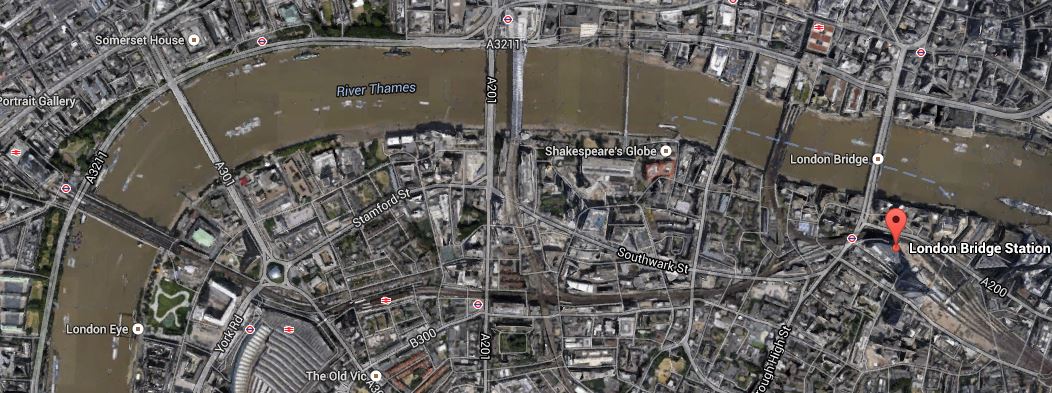
Stations Along The Thames
The picture shows most of the stations along the river that serve the South. And of course the North if they’re connected to Thameslink.
The main stations from left to right (west to east) follow.
Charing Cross is at the far left of the image, where it sits at the end of the Hungerford bridge, by which all trains enter and leave the station. The station is marked by the red British Rail double-arrow symbol, with the London Underground roundel showing the related Embankment tube station.
Waterloo is opposite Charing Cross at the other side of the Thames, although there is no direct rail connection between the stations.
Waterloo East is to the east of Waterloo and this station does have a rail connection to both Charing Cross and London Bridge.
This picture shows the position of the three stations and the rail lines to a larger scale.

Charing Cross, Waterloo and Waterloo East Stations
Note the rail lines going across Hungerford Bridge between Charing Cross and Waterloo East. I’ve never been to Waterloo East or even stopped at it on a train, but you can walk between the two Waterloo stations.
In this image the domed circular roof of the Waterloo IMAX cinema and Nelson’s Column can be clearly seen.
Blackfriars is the next station and its unique position across the river is shown in the middle of the main picture. It is the right one of the pair of bridges and the British Rail symbol indicates the main station entrance on the North Bank of the Rover. This picture shows its position in more detail.
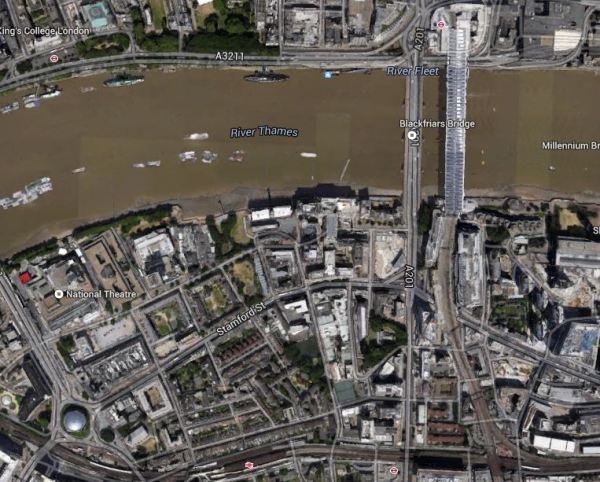
Blackfriars and Thameslink
Note how the Thameslink lines from Blackfriars to the south go in two directions.
One line goes to the East for London Bridge, after joining with the lines from Charing Cross and Waterloo East, at the bottom right of the picture.
The other line goes directly South to Elephant and Castle.
The Temple area is at the top left of this picture, where there is a tube station. London’s new Garden Bridge will between here and the Southbank area, when it is built.
Cannon Street on the North Bank is the next station and like Charing Cross, all trains access the station by a bridge over the Thames.
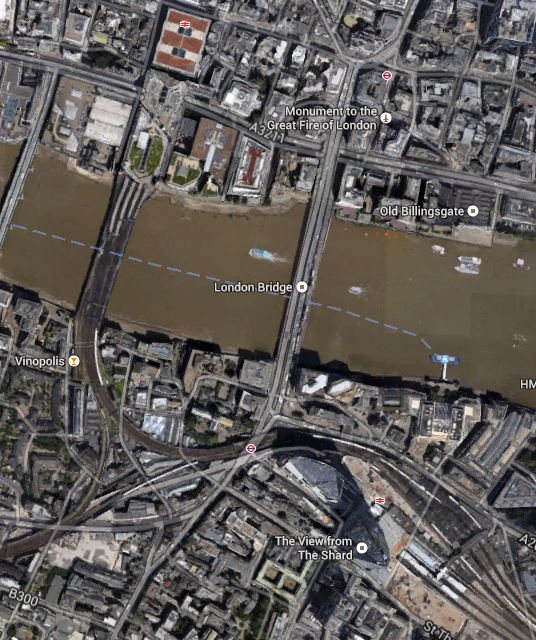
Cannon Street and London Bridge
Note the triangular junction South of the Thames, that gives access to both Charing Cross and London Bridge from Cannon Street.
London Bridge station is shown in more detail in this picture.

London Bridge Detail
The detail would be a lot better, if it wasn’t for the shadow from The Shard, which is visible at the bottom right.
The pattern of the lines to and through London Bridge that will be in operation with the full Thameslink scheme is beginning to emerge.
1. The number of through platforms at London Bridge, for services on Thameslink and to/from Charing Cross and Cannon Street is being increased from six to nine.
2. The extra viaduct over Borough High Street and the Market can be seen.But it doesn’t have any tracks in this image.
3. London Bridge station itself, appears to be a big building site, with trains going through.
Incidentally, I’m not sure of the date of the Google Earth view.
The Thameslink program is vast and will add a hundred stations to the existing network. Wikipedia sums it up like this.
The Thameslink Programme, is a £6 billion project in south-east England to upgrade and expand Thameslink to provide new and longer trains between a wider range of stations to the north and to the south of London without requiring passengers to change trains in London. Work includes platform lengthening, station remodelling, new railway infrastructure, and additional rolling stock.
In this post, I have traced it south of the Thames and shown how it interfaces with the lines into Charing Cross and Cannon Street. If the architects have got the design of London Bridge station right, this alone should unlock a myriad of new routes for all those millions of Londoners and those that come into the City.
A couple of years after the new London Bridge is completed, Crossrail with its connection to Thameslink at Farringdon will open, adding even more travel possibilities.
Some months ago, I wrote a post called A Divided City.
Hopefully, the enlarged Thameslink, will help to cross the great divide of the Thames, that without which London wouldn’t even exist.
 The Anonymous Widower