Keeping Your Wiring Tidy
I have form in this area.
- One of my first jobs was designing and building small pieces of control electronics for industrial plant.
- I built small tuners for a company in Felixstowe.
- Later at ICI, I built instruments for installation on chemical plants.
So I learned from about sixteen, that your wiring always has to be neat and colour-coded.
I also remember at ICI, how Neil Saville developed a computerised design program in the late 1960s, to layout and colour-code the wires in a chemical plant.
So I was drawn to this article in Rail Engineer, which is entitled Safety, sustainability and security polymer cable troughing.
The article is about Trojan Services, based in Hove, who have developed various cable troughs and other products for the rail industry, made out of recycled polypropylene.
The article is very much a must-read, which shows how good design can transform the most mundane of products.
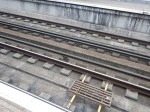

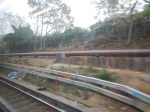
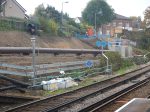
The pictures show some typical cable ducts.
Escalators In Station Design
Over the last few months, I’ve been to three brand-new stations.
- Kirkstall Forge, which I nwrote about in Kirkstall Forge Station
- Lea Bridge, which I wrote about in The People Of London Welcome Lea Bridge Station
- London Bridge, which I wrote about in Details Of The New London Bridge Station
All are well-built stations with step-free access.
But I have to ask, if Kirkstall Forge and Lea Bridge would be better stations with a more favourable financial outlook, if they had escalators instead of stairs to the bridge.
Consider.
- London Transport used escalators extensively before the Second World War and few think that was wrong.
- Escalators must surely attract more paying passengers.
- If escalators are used could we see them paired with inclined lifts. to perhaps create more compact stations.
Quite frankly, Kirkstall Forge and Lea Bridge have boring layouts. I do think, we need more innovative station designs.
In some ways the most interesting station I’ve seen in the last few months is Welwyn Garden City, where the station is on the First Floor of a Shopping Centre. The main escalators and lifts are in the Shopping Centre with individual lifts and stairs to the platforms.
The Composite Platform 1 At Tulse Hill Station
Tulse Hill station is a typical South London station, that has been upgraded several times and probably if money was no object, would be knocked down and rebuilt.
But that would be expensive, so they have replaced Platform 1 with a composite one.
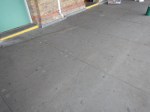
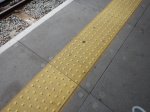
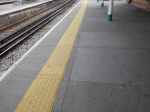

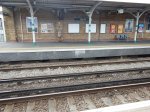
This page from the Dura Composites web site, says more about the installation. Reading about the platforms, the following advantages are mentioned.
- The platform doesn’t suffer from compaction issues.
- The surface is very passenger-friendly, with less likelihood of slips and falls.
- The yellow edge line is build into the platform.
- The stepping distance can be reduced.
- Installation of the platform is faster and needs less line closures.
- There are plans to install LED lights in the these platforms for safety reasons.
Overall the platform has a lower lifetime cost.
This to me is a classic innovation, that makes life easier and better for passengers, train companies and station builders.
My Favourite Gadgets
The pictures show some of my favourite gadgets, many of which can be classed as engineering pornography.
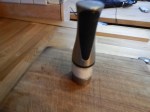
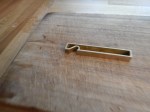
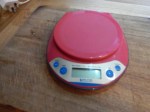

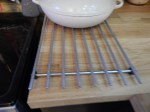



They may seem a rather odd collection, but I like to think the design is good, even if some of the gadgets are just a few pounds.
Step-Free Interchanges In East London
This map from carto.metro.free,fr shows the lines around where I live, which can be best described as a post code of N1.
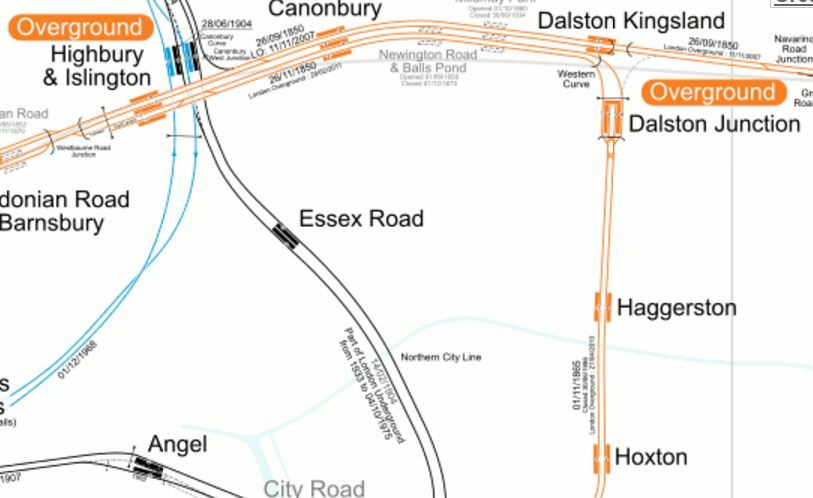
Lines Around N1
I live halfway on the diagonal line between Dalston Kingsland and Essex Road stations. Years ago, there used to be a station at Mildmay Park, between Dalston Kingsland and Csnonbury, which if it still existed would be very useful for me, as it would be about a hundred and fifty metres away.
So my journeys often start from one of the half dozen bus routes, that have stops within fifty metres or so of where I live.
- I’ll take a 38, 30, 56 or 277 to Dalston Kingsland or Dalston Junction stations for the North London Line and East London Line respectively.
- I’ll take a 141 to Manor House station for the Piccadilly Line.
- I’ll take a 38 or 56 bus to Essex Road station for the Northern City Line
- I’ll take a 38 or 56 bus to Angel station for the Northern Line.
- I’ll take a 21 or 141 bus to Moorgate for the Metropolitan and Circle Lines
- I’ll take a 21 or 141 bus to London Bridge for main line trains.
- I’ll take a 21 or 141 bus to Bank for the Central and Waterloo and City Lines
- I’ll take a 56 bus to St. Paul’s for the Central Line
- I’ll take 30 bus to Kings Cross, St. Pancras and Euston for main line trains.
Who said the three most important things when buying a house, are location, location and location?
Strangely, I rarely go directly to Highbury and Islington station, as the station is one of the worst in London for passenger convenience, with long and crowded tunnels and no step-free access to the deep tunnels.
If I need to go North on the Victoria Line, I will sometimes go to Essex Road and then take the Northern City Line for one stop to Highbury and Islington station, where there is a step-free level interchange to the Victoria Line.
There are several of these interchanges in East London, making train and tube travel easier.
Northern City And Victoria Lines At Highbury And Islington Station
This map from carto.metro.free.fr, shows the layout of lines at the station.
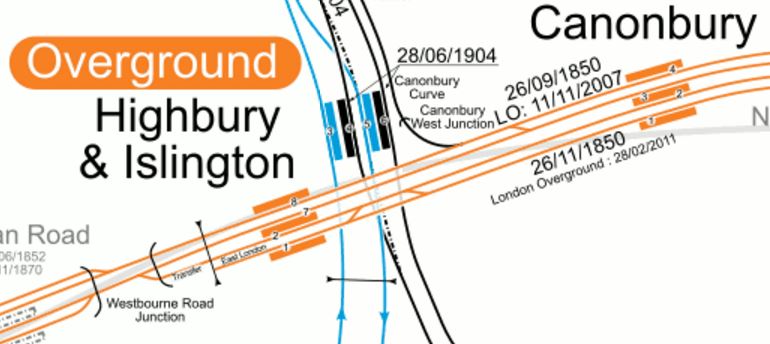
Note how the two Northbound lines and the two Southbound lines of the Victoria and Northern City Lines are paired, so that passengers can just walk through one of several short tunnels that connect the two platforms.
This connection will get more important in the future, as improvements will bring more passengers through the interchange.
- Highbuty and Islington station will be rebuilt, with access to the deep level platforms much improved.
- If traffic said it was needed, the Southbound and Northbound deep-level platforms, which are not far apart might even be connected together and to a second entrance on the other side of Holloway Road.
- The Northern City Line is getting new Class 717 trains, which will give an increase in capacity and I believe that the frequency on the Northern City Line will improve to 6, 8 or even 10 trains per hour (tph), thus making my ducking and diving easier.
- The Northern City Line will connect to Crossrail and for the first time N1 to lots of places, will be one change at Moorgate from the Northern City Line to Crossrail.
- The Victoria Line will increase in frequency to possibly 40 tph and benefit from station improvements at stations like Tottenham Hale, Blackhorse Road and Walthamstow Central.
It should also be noted how the Crossrail connection at Moorgate will help me.
When going to football at Ipswich, I may walk to Essex Road and then get a train to Moorgate, where I will take Crossrail to perhaps Shenfield for a fast train to Ipswich.
But who knows what I’ll do, as there will be several different routes, all of which will have their advantages?
East London Line To North London Line At Highbury And Islington Station
This is only from the East London Line trains arriving from West Croydon in Platform 2 at Highbury and Islington station to Westbound trains on the North London Line in Platform 7.
Although not as powerful as the double interchange at Highbury and Islington station between the Victoria and Northern City Lines, it is typical of well-thought out connections all over the Overground.
Piccadilly And Victoria Lines At Finsbury Park Station
This is a cross-platform interchange, that is heavily used as effectively it gives a simple choice of route through Central London for passengers from the Northern ends of the Piccadilly and Northern Lines. It’s a pity that the interchange between the two lines at Kings Cross St Pancras and Green Park aren’t as simple.
Metropolitan/District And Central Lines At Mile End Station
This picture gives a flavour of the interchange at Mile End station.
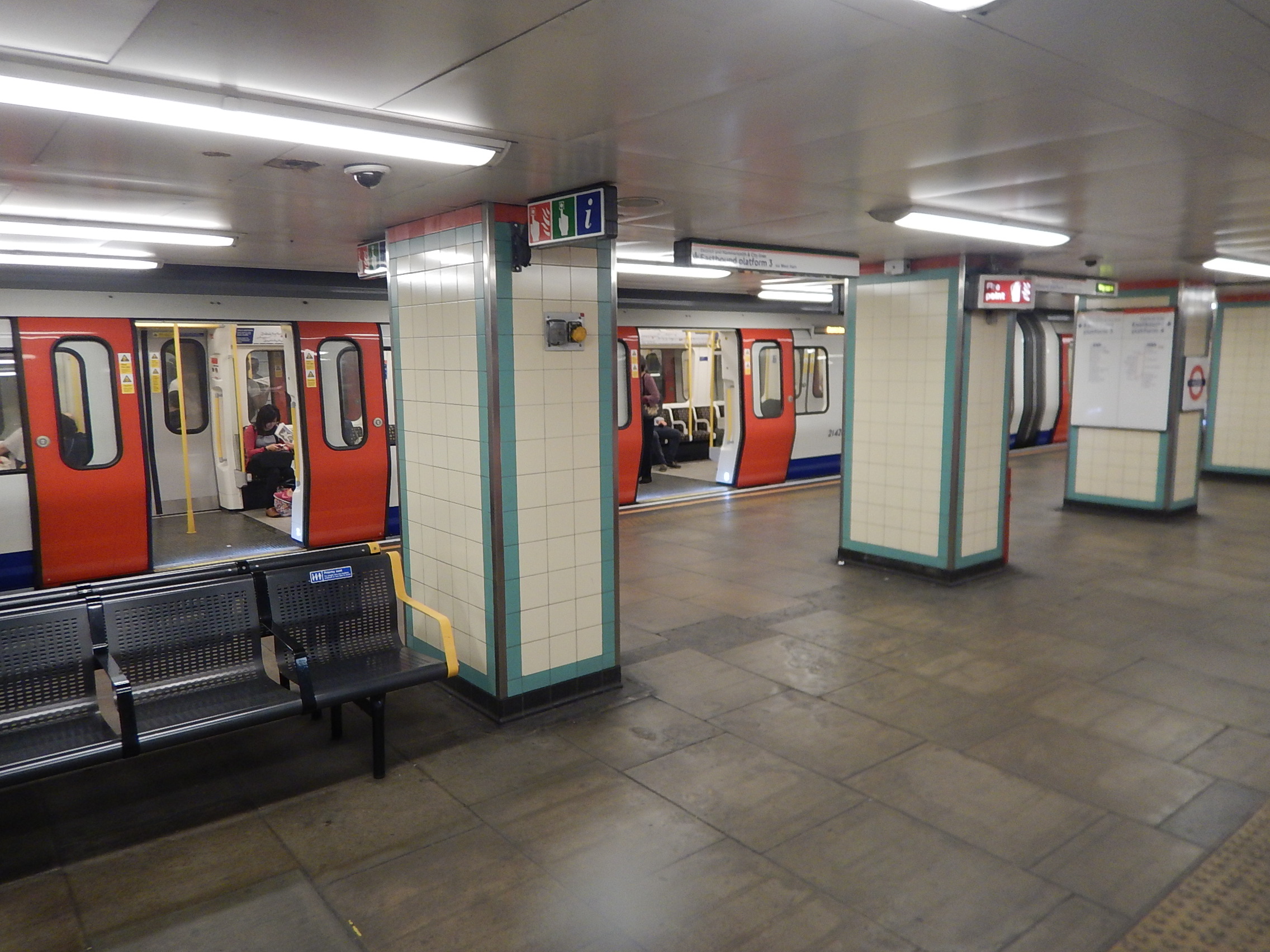
Cross-Platform Interchange At Mile End Station
It is a cross-platform interchange, that I use more and more, to go to the East on the Central Line. I usually arrive on a Metropolitan/District Line train from Whitechapel station, which is just a few stops down the East London Line.
Central Line And Shenfield Metro/Crossrail At Stratford Station
This interchange at Stratford station is going to be an integral part of Crossrail, as it will firmly connect the new line to the Central Line, with advantages to both.
This picture shows the interchange on the Eastbound platform.
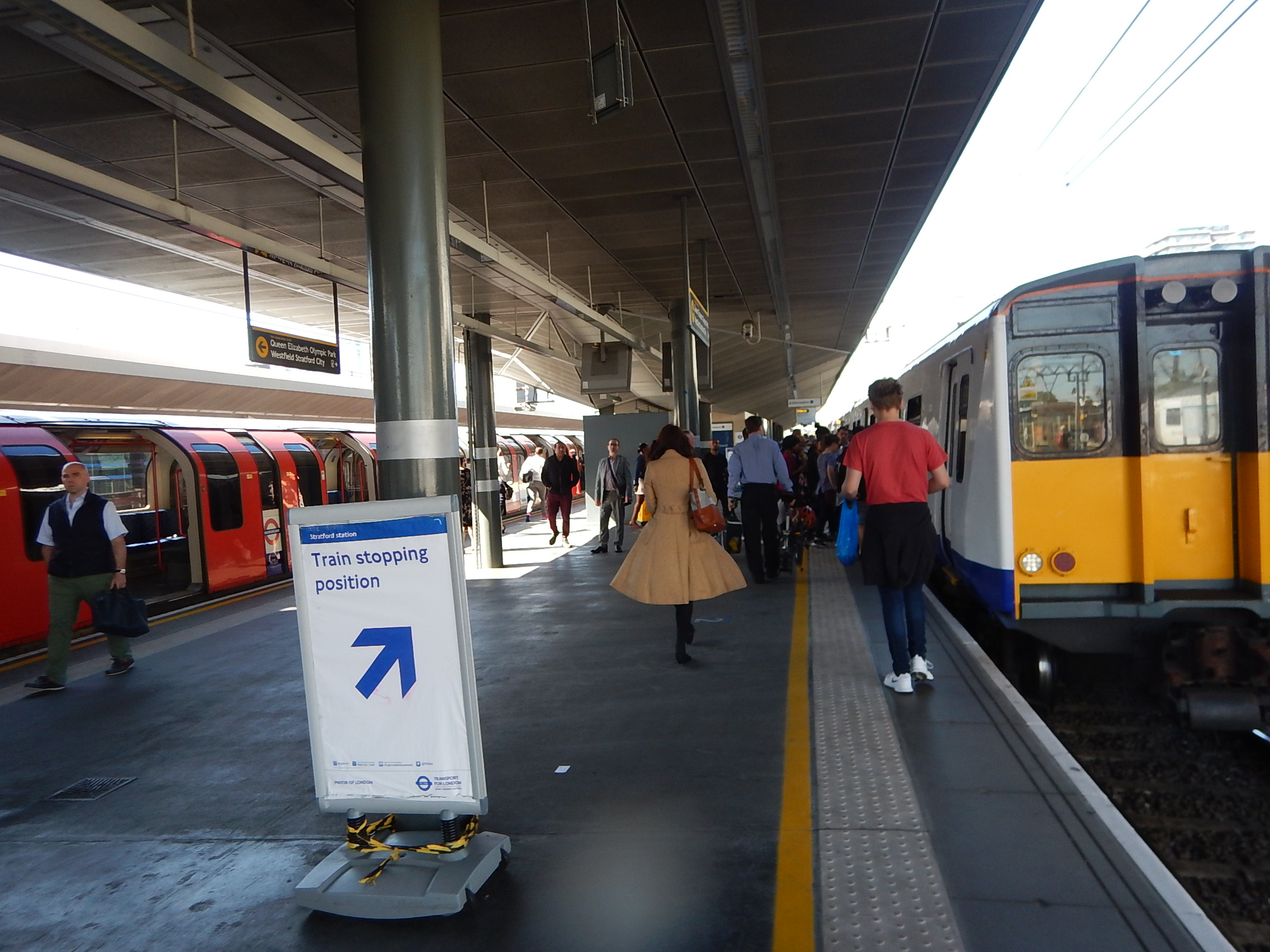
Central Line To Shenfield Metro/Crossrail Interchange
This interchange is certainly well-used and Crossrail will only increase that use.
Why Is This Not Done More Often?
These interchanges seem to work well!
But what always puzzles me, is why this layout is not used more often. And I don’t just mean in London. In all my travels, I can’t remember getting off a train in Europe and just walking across the platform to get a metro or a tram.
I suspect it could be because to get this type of interchange, you need to build some expensive railway infrastructure.
All of the examples I have given concern where a new line is being added to an existing network.
I am surprised that Crossrail doesn’t use a similar interchange anywhere else on its route.
Look at the Crossrail stations I documented in How Are Crossrail’s Eastern Stations Progressing?
In all stations, the Crossrail and fast lines are in pairs, whereas to get Cross-platform interchange between fast and stopping services, probably needs a different layout. That is not the fault of Crossrail, but the way the Great Eastern Main Line was built decades ago.
At the London end of the East Coast Main Line, the two slow lines are on either side of the two fast lines. At Stevenage, they have put two island platforms between the slow and fast lines, so that passengers have a cross-platform interchange between trains.

Stevenage Station
The Google Map clearly shows the layout.
Edinburgh Haymarket Station Gets It Right
Edinburgh Haymarket station is another example of Network Rail’s stations with a wide bridge over the tracks, like Leeds, Derby and most spectacularly Reading. London Bridge will join the club in the next couple of years.
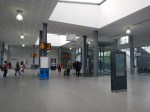
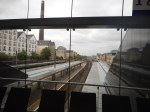

As most trains stop at both Waverley and Haymarket stations in Edinburgh, I think passengers will ask themselves, why they would ever use the truly dreadful Waverley station?
- Access to the trams at Waverley means using endless steps and escalators to get to Princes Street and then an uncovered walk to the tram.
- Trams at Haymarket are just a short level walk outside.
- Taxi drop at Waverley is difficult with more steps. It’s on the level at Haymarket.
- Tickets to Edinburgh allow you to go to either station.
- Coming from the West and needing the tram, will passengers increasingly change at Edinburgh Park station?
Don’t fall into the trap of getting off at Edinburgh Waverley, which now always seems to be called just Edinburgh.
My only reservation about Haymarket is the station’s size.
Is it big enough for an important rugby match at Murrayfield, where the savvy will arrive at Haymarket and take a tram?
And will it be big enough, when the trams are extended, as they surely will be?
Are Sainsburys Winning The Bag War?
Since the five pence charge was introduced for plastic bags in England, there has been very little innovative thinking by shops about how they could use the bags to drag people into their shops.
Summing up the shops I use and the comments of others, I would say this.
- Waitrose – Thin and useless
- Tesco – Thin and useless
- Marks and Spencer – Not too bad!
And then there’s Sainsburys!
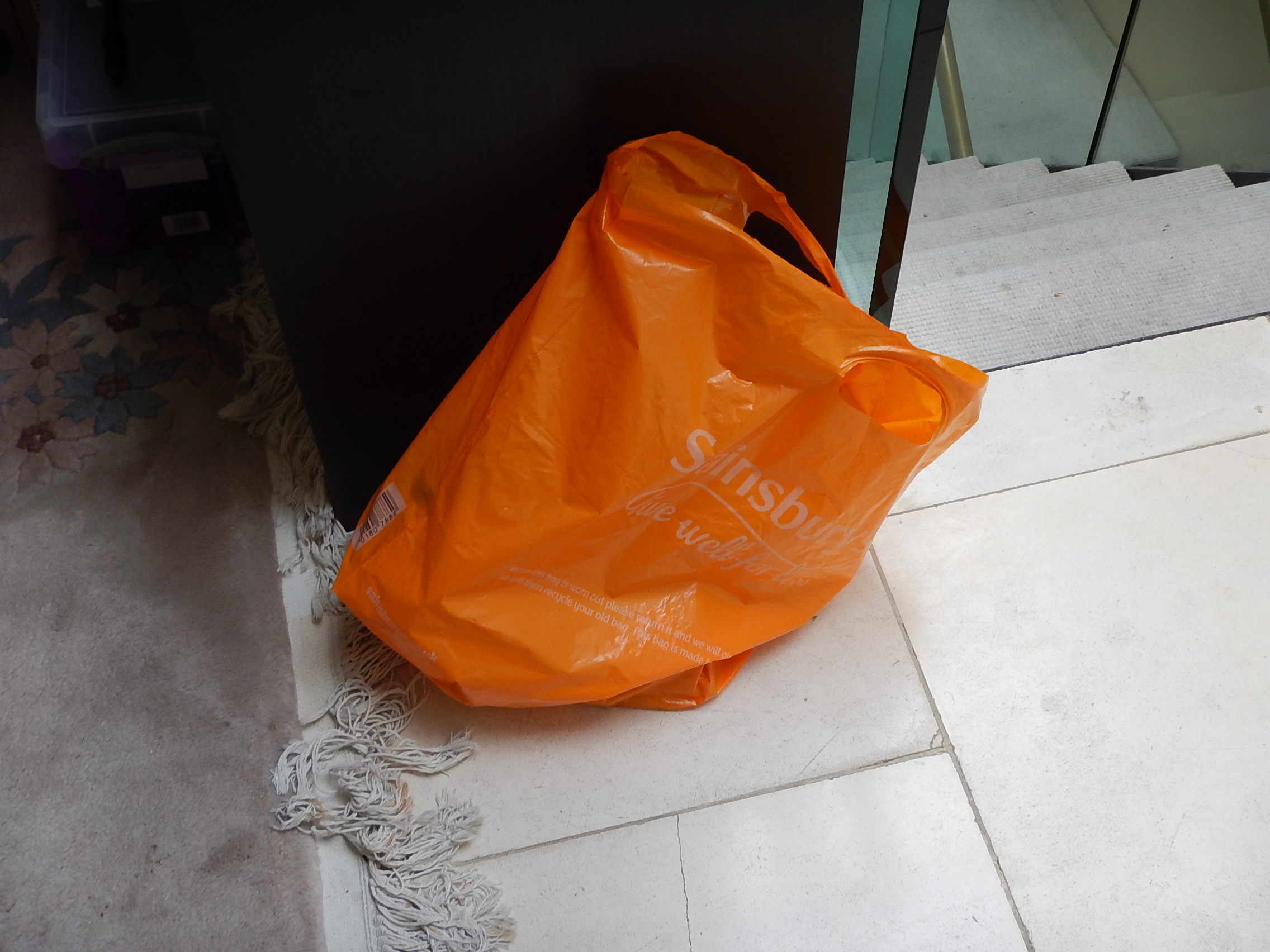
A Reuseable Orange Plastic Bag From Sainsburys
They are surely the best, as you can fold them flat and then into a size to fit in a coat pocket or bag.
The one in the picture is probably six or seven weeks old.
One day last week, I needed a few items to complete my supper like some strawberries and I hadn’t got a bag with me. So I walked past Marks and Spencer and Waitrose to Sainsburys and bought them there together with a 5p. bag.
Do you think that Sainsburys have deliberately made a 5p. bag that lasts to attract shoppers to their stores?
Judging by the number of orange bags, I see on the streets of London, I certainly think Sainsburys have been thinking this one through.
- Orange bags are easy to spot, so you always take one.
- As they’re easy to fold, some might fold them and put them in their pocket or bag after putting the shopping away.
- Seeing lots of orange bags on the street, reminds shoppers to get what they need at Sainsburys.
- Because of the quality of the bag, it makes you think well of Sainsburys and their products.
On the other hand, IKEA deliberately make their blue bags impossible to fold, so you leave them behind, when you go shopping.
Abbey Wood Station – 9th June 2016
I took these pictures at Abbey Wood station.




If you look at the various pictures I have taken over the past months of this station, the station is progressing and the builders seem to be managing to always have a working station amongst all the construction work.
Certain factors have helped in this important aim.
- The previous station was unloved by everyone and had absolutely no architectural merit.
- There are no heritage issues.
- Good design of a temporary step-free pedestrian bridge, that appears to be morphing into a permanent one, has aided passengers.
- There always seems to be cheery staff on hand for lost and puzzled passengers.
- Traffic is heavy in the area, but not unmanageably so.
But I think most importantly, the Crossrail portal is some distance away from the station, keeping the two projects effectively separate.
Compared to some station rebuilds, I’ve encountered in the past, so far it has been a textbook example of good project management.
The Canonbury Cross-Over
The picture shows two London Overground trains at Canonbury station.
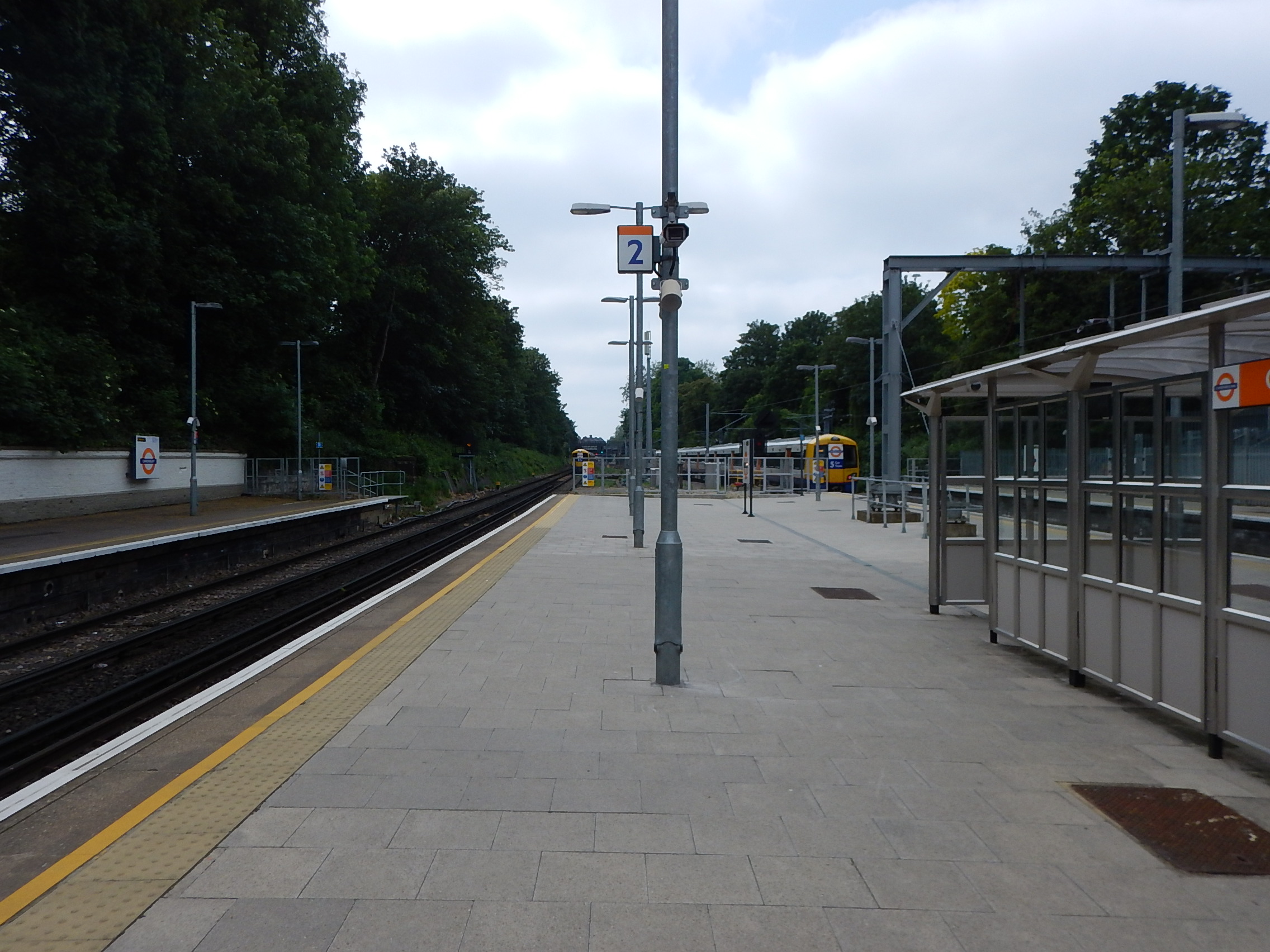
I have just alighted at the station on a train from Willesden Junction, that was going to Stratford along the North London Line and have crossed to the wide centre platform on the footbridge.
The train on the right is going between Stratford and Richmond along the North London Line, in the opposite direction to my journey. The train has just called at the right hand face of this pair of platforms.
The train approaching on the left, is an East London Line train going from Highbury and Islington station to East and South London.
The frequency on the North London Line is about eight trains per hour between Stratford and Willesden and four trains per hour between Willesden and Richmond.
On this section of the East London Line, the frequency is eight trains per hour.
This means that if you are travelling either way along the North London Line and then want to travel on the East London Line, even if you just miss a connection, you have a maximum of about seven minutes to wait.
To ease matters often a North London Line train will call at Canonbury at or just before an East London Line train arrives.
Canonbury is a station with plenty of shelter and a coffee stall, so waiting isn’t the worst of experiences even on a day like today.
The original layout of this station was more complicated and you didn’t need to change trains between Stratford and Dalston Junction, as you do now!
But now, we design stations and track layouts, so that all passengers have an easy and fast journey.
It doesn’t always please everybody, as the direct train a commuter has taken for years, might have been replaced with a faster service, that has a cross-platform change in the middle.
Network Rail have published a report, where they may be reorganising the Cambridge and Peterborough to Ipswich services, by building a new platform at Newmarket.
An hourly Cambridge to Ipswich service would meet an hourly Newmarket to Peterborough service at Newmarket, where passengers between Ipswich and Peterborough would walk across the platform to get the other train to continue their journey.
We shall be seeing this type of train organisation a lot more in the future. But the passenger will get more and better services, whilst the train operator will be using the same number of trains.
Canonbury was one of the first stations, where simple cross-platform interchange was built into the design.
We shall see a lot more innovative station layouts.
Plans For New Rolling Stock To Replace BR DMUs
This is the title of an article on the Rail Magazine. This is said.
Diesel multiple units built in the 1980s by British Rail could be replaced in the next decade, as the Department for Transport believes there are “likely to be significant opportunities” to replace them with modern diesels.
Outlined in the Rolling Stock Perspective: Moving Britain Ahead report published on May 18, this would mean that as well as the Pacers, potentially all Class 150s, ‘153s’, ‘155s’, ‘156s’, ‘158s’ and ‘159s’ could be withdrawn. That would be 1,033 vehicles if all were replaced like-for-like.
The article is based on a Department for Transport document entitled Rolling Stock Perspective. The document says this.
Are self-powered, where required, with such trains meeting the latest emission standards and being built by a range of suppliers. New diesels are being procured as part of the Northern franchise improvements and there are likely to be significant opportunities over the next decade to replace the last remaining diesel multiple units ordered in the BR era with modern diesels that offer much more for passengers, and are designed with manufacturers and TOCs working ever more closely with Network Rail, to reduce the amounts of money needed to be spent to introduce them into service and to allow them to operate reliably and safely.
The report also says.
Good, high quality refurbishment can deliver a passenger experience comparable with new rolling stock.
So is this a feasible plan to remove the 15x trains in their present form from the network?
I will start by summing them up from a passenger perspective.
Class 150
The Class 150 train probably suffers from being too small and inadequate for a lot of the routes it serves. This alone means that they should be replaced, probably with something of at least three cars, as many are on routes, where ambitious train operating companies are endeavouring to grow traffic.
There are only so many elephants you can get in a Mini!
In 2014, I went to St. Ives and wrote St. Erth Station And The St. Ives Branch, where an immaculate Class 150 trundles the few miles along the branch.
This use sums up the class well.
- The two-car train was totally inadequate for the route.
- They can be cleaned up to be adequate for some purposes in their present form.
- Step free and wheelchair access is not very good.
- There is not enough space for bicycles.
- Seats are not the most comfortable.
On short branch lines like the St. Ives Branch, two refurbished units coupled together, might provide the service needed, but would it be better to spend more money on either a refurbished Class 165 train or even a new train?
In A Trip Around Wiltshire, I encountered a Class 150 train. As it was Glastonbury, it was loaded over capacity with heavy baggage. At least a five-car formation of say Class 165s was needed, not a two-car Class 150.
These days the Class 150 trains are mainly used in the North, Wales and the West Country, with some in the Midlands.
I would love to know the train operating companies attitude to these trains.
They may be cheap to lease. But!
- Running costs can’t be much less than say a three-car Class 165 train.
- The difficult train access must mean despair for the disabled and staff.
- Station stops are probably slower than needed, leading to late trains.
- Passengers will be turned away by the bad experience.
- They are not large enough for a lot of their routes.
Some like those in the North and Wales are planned for replacement and hopefully once GWR electrification is sorted and the Class 165 trains are replaced by electric ones, most of the Class 150 trains can go to appropriate retirement in the scrapyard.
Class 153
If anything sums up the cheapskate approach to the railways under successive governments it is the Class 153 train.
In my travels around Europe, I’ve never seen another single car train, excerpt on something like a mountain railway.
They may have a use, but it is certainly not running on the Nuneaton to Coventry Line.
On a lightly-used line they probably wouldn’t be as bad an experience as a Class 150 train, but they certainly wouldn’t be any good to generate traffic.
Class 156
There are 114 two-car Class 156 trains, which are certainly much better than the Class 150 and Class 153 trains.
I’ve certainly ridden some pretty comfortable Class 156 trains.
According to Wikipedia, some are being refurbished. This is said.
38 of the 114 Class 156 sets belong to leasing company Porterbrook, which announced in mid-2011 that they will be substantially refurbished at the time of their C6 overhauls. Seating layouts will be revised to provide priority seating and wheelchair spaces, and new universal toilets are to be installed, as also a passenger information system. Interior doors between vestibule and passenger saloon will be removed, and external door sounders fitted. The trains in question are as follows; 11 leased to East Midlands Trains, 9 toAbellio Greater Anglia and 18 to Northern.
I have a feeling that a lot of this class will be replaced by new or newer trains, simply because they run on the more important lines.
In the North and Scotland, electrification will directly replace some trains and others will be replaced by newer diesel multiple units cascaded from the newly electrified lines.
I believe that refurbishing these trains to a high standard could be possible, and these trains could be ideal for lightly used lines, either working singly or in a four-car formation.
But their top speed of only 75 mph probably means on some of the routes they serve, they cause problems for train operators.
Also, because they have a good range, they might well be a good train to have as cover to help solve the problems of breakdowns and extra capacity for events like Glastonbury.
Class 158 And Class 159
I am considering the Class 158 and Class 159 trains together, as it is rather a moveable feast as to which class the trains belong.
They are slightly younger than the other trains and on some routes like Waterloo to Salisbury and Exeter, they are certainly not a bad experience.
When the Government report said.
Good, high quality refurbishment can deliver a passenger experience comparable with new rolling stock.
They might have had these trains in mind.
I think though, they have qualities that make them suitable for longer routes that have to use diesel traction.
- They are a 90 mph train.
- They have a long range.
- They could have plenty of tables.
- They can accommodate a catering trolley.
- They could be a good route-development train.
- As they are Mark 3.5 coach based, they would certainly scrub up brilliantly.
I think the only problem could be that there are two hundred trains. But seeing the way traffic is developing in the UK, I’m sure that train operating companies could find a use for them.
I have travelled on Class 158 trains on the Settle to Carlisle Line and this is the sort of journey for which the trains are ideal. So what would happen, if routes like this were given a more frequent service with refurbished Class 158/159 trains, that perhaps had the following.
- Good catering.
- Lots of tables.
- Wi-fi
- Lots of luggage and cycle space.
- London Bus-style wheelchair access.
I don’t think the affect on traffic would be negative.
Summing Up The Current Situation
If I look at the numbers of each type of older diesel multiple units we get.
- Class 150 – 137 trains – 133 x two-car and 4 x three-car. – 278 coaches.
- Class 153 – 70 trains – 70 x one-car – 70 coaches.
- Class 156 – 114 trains – 114 x two-car – 228 coaches.
- Class 158/159 – 200 trains – 143 x two car and 57 x three-car – 343 coaches.
Which gives a total of 919 coaches.
On the other hand, I think we can assume the following.
- Great Western Electrification should release a mixture of thirty seven three car and twenty two-car Class 165/166 trains.
- The Class 150 and Class 153 trains could go to a more suitable place.
- The Class 156 trains could possibly be refurbished to a standard to make them a good Class 150 and Class 153 replacement for some routes.
- The Class 158/159 trains could probably be refurbished to the required high standard.
So we’re left with a deficit of about two hundred carriages, without counting good quality trains released from Scottish and Lancashire electrification.
How Could We Bridge The Gap?
At least though we have various trains and solutions available and some have been noted in the last couple of months.
The following sections detail the various solutions.
New Civity Diesel Multiple Units from CAF
Arriva Rail North surprised a lot of people with their order for a mixture of new Civity diesel and electric multiple units from CAF.
I wrote about the order in Arriva Rail North’s New Trains.
The Civity design is modular and this data sheet from CAF describes the Civity range.
Points to note.
- Diesel, electric and bi-mode versions are available.
- It has been designed for standard gauge.
- There is a UK version called Civity UK.
- Top speed is 160 kph, but 200 kph is available.
- The list of interior options is wide.
Reading the data sheet, I get the impression that operators get standard trains with the features they want.
I don’t know the answer, but I suspect that like the Class 378 trains of the London Overground, the Civity trains can be lengthened or shortened, by adding or removing trailer cars between the two driving cars. This concept has worked so well on the Overground, I doubt that a train manufacturer wouldn’t copy it.
Thus you could have four car DMUs on a route like the Calder Valley Line. If and when the line gets electrified, you do a bit of swapping and add two electric driving cars and get four-car EMUs and two-car DMUs.
I believe the flexibility of the design, means that we’ll see more Civity trains in the UK.
New Diesel Multiple Units from Other Manufacturers
I said earlier, that there could be a total need of about two hundred carriages, but this is probably not many, unless you have a proven product ready to be built.
Given that CAF have already sold ninety-eight assorted trains to Arriva Rail North and another twelve 200 kmh-capable trains to TransPennine Express, it would be hard to sell a new design of modern diesel multiple unit into the UK. More Class 172 and Class 185 trains are probably not an option.
Rakes Of Coaches From CAF
Rakes of coaches seem to be making a comeback, as I wrote in Are Train Coaches Making A Comeback In The UK?
Fitted with a suitable and available locomotive at one end and a driving cab at the other, these could be used in some of the difficult and perhaps scenic routes.
Again CAF seem to have got the proven product, which has been sold to Caledonian Sleeper and TransPennine Express.
Have the clever Spanish designed a driving cab with bags of style and panache, for the TPE rakes? It certainly won’t be a driving van trailer knocked up from the parts bin.
One of the advantages of coaches, is that there are a lot of suitable and acceptable locomotives available. Fleet details for the Class 68 locomotive, already show a new order for seven extra units for TransPennine Express.
Anybody, who doesn’t believe that Class 68s and coaches, are a viable option, should be forced to go to Birmingham from London on Chilton and see how good upgraded 1970s-built Mark 3 coaches hauled by a modern diesel locomotive can be.
Rakes Of Refurbished Mark 3 Coaches
If buying new coaches from CAF is a viable order, why didn’t TransPennine Express, do what Chiltern have done and refurbish some of the many Mark 3 coaches.
I think it comes down to these factors.
- Mark 3 coaches need a driving van trailer, so a five-car train is effectively seven units long if you count the locomotive and the DVT.
- Are Mark 3 coaches coming to the end of their lives?
- Is there a shortage of DVTs?
- If CAF build a stylish driving cab in the end coach, the train will have an enormous wow factor!
- The operator can get the interior layout they want.
- Could the cost be not much different between the new and refurbished trains?
In the end the CAF route gives the operator exactly what they want.
The only thing that might happen, is that somebody copies the CAF idea and creates a short rake of Mark 3 coaches, with a driving cab in the last coach. But that is probably a more expensive option.
Chiltern Railways
Chiltern Railways could have a valuable part of play in the replacement of older diesel multiple units.
They currently run some of their Chiltern Main Line services to Birmingham and Oxford using rakes of Mark 3 coaches and Class 68 locomotives.
They currently have the following stock for this.
- 8 Class 68 locomotives
- 31 Mark 3 coaches
- 6 Driving Van Trailers.
Is that enough, given that Oxford will be served later this year?
Probably not! So is Chiltern scratching around searching for coaches and DVTs to create some extra rakes of coaches?
I don’t know, but with the three stations of Bicester Village, Oxford Parkway and Oxford on the new branch, two and three-car multiple units will surely not be big enough.
I would certainly suspect that as Chiltern is an ambitious company, one of their aims is to have all services between London and Oxford and Birmingham, run by modern rakes of coaches hauled by Class 68 locomotives.
These could either be new rakes from CAF or refurbished ones of Mark 3 coaches.
The big side effect would be that Chiltern may be able;e to release some of their modern diesel multiple units.
This probably illustrates why Class 68 and other locomotives pulling rakes of coaches could be very important in improving the quality of diesel multiple units in the UK.
Playing The Joker
There is even a joker in the pack of available locomotives to pull and push the coaches.
The Class 73 locomotive dates from the 1960s, but it has some unique advantages.
- They were built to run all over the Southern Region, including the narrow tunnels of the Hastings Line.
- They can run on third-rail electric lines or on diesel power.
- They seem to be reliable.
- They are capable of 90 mph, which is the same speed as a Class 159 train.
- There are over thirty still available.
- Re-engineering with modern diesel engines is being undertaken, to create a Class 73/9 variant.
- To say they scrub up well is an understatement.
Their latest application is far from their original habitat in the South, as they are now hauling the Caledonian Sleeper trains all over the Highlands, where in some places, the loading gauge is restrictive.
I wouldn’t be surprised to see Class 73/9 locomotives hauling new coaches from Waterloo to Exeter.
- This would mean that new trains could serve Salisbury and Exeter from Waterloo, without extending the electrification from Basingstoke.
- The Class 73 locomotives would use the third-rail electrification at the London end of the route.
- The trains would have the same top speed as the current Class 159 trains.
- The Class 159 trains would be released for refurbishment and cascade to other routes and operators.
But the biggest advantage of this would be that South West Trains or its successor could offer a high-quality alternative service to Exeter and the wider West Country in competition with Great Western Railway’s new Class 802 bi-mode trains.
If anybody had suggested a few years ago, that you might replace a 1990s-built multiple unit with Spanish coaches hauled by a re-engineered 1960s-built locomotive, they’d have been taken away by men in white coats.
But then engineering is the science of the possible!
Battery Trains And IPEMUs
Clare Perry, who is the Rail Minister, says this in Rolling Stock Perspective about battery-powered trains and other similar developments.
Rail is already one of the most environmentally friendly forms of powered travel, but we need to go further. I want to see the industry develop and introduce uk-led innovative solutions such as battery-powered or hybrid trains which will make rail even better for the environment and reduce the industry’s operating costs.
I think we can say, that means that Government will look favourably on good innovative solutions for the replacement of diesel multiple units.
Bombardier are developing the Aventra train and trains will be wired to accept on-board energy storage, just like the demonstrator based on a Class 379 train, that I rode in January 2015.
These are now called IPEMUs or Independently Powered Electric Multiple Units. They would charge their batteries on an electrified main line, then use this power on a branch line or to perhaps bridge a section of line that was not electrified.
As a large number of diesel multiple units are used on branch lines from electrified main lines, IPEMUs could be a direct replacement without any new electrification. Some examples would be.
- Marks Tey to Sudbury
- Ipswich to Felixstowe
- Ipswich to Cambridge/Ely
- Cambridge to Norwich
- Norwich to Yarmouth
- Ely to Peterborough
- Liverpool to Preston via Ormskirk
- Oxted to Uckfield
- Ore to Ashford
Nothing has been said about the ordering and service entry of IPEMUs, but I don’t believe that the technology will be abandoned.
Conclusion
The elimination of the older diesel multiple units or their conversion into modern trains of the highest standard, is not an impossible dream.
But expect some surprises!
 The Anonymous Widower