Rumours Of Curves In Walthamstow
Last night, Lea Bridge station opened without ceremony, as I wrote in The People Of London Welcome Lea Bridge Station.
I got talking to someone, who knows a lot more about what will be happening to the railways in East London, than I do and when I asked about the Hall Farm Curve, they indicated it could be reinstated soon.
This map from carto.metro.Free.fr shows the lines North from Lea Bridge station.

Lines North Of Lea Bridge Station
The Hall Farm Curve connects Lea Bridge and St. James Street stations.
My informant said the curve would probably be only single-track and signalled to allow trains to go both ways.
With my scheduling hat on, I do wonder if the curve would effectively connect spare capacity on the Northern end of the Chingford Branch to some spare capacity between Lea Bridge and Stratford stations. I think it is probably true to say, that North of Coppermill Junction, the West Anglia Main Line needs more capacity, so this sneaky way to Chingford doesn’t impact.
The limiting factor on the number of trains per hour between Chingford and Stratford would probably be platform capacity at the two ends of the route.
My informant also indicated that the Coppermill Curve could be rebuilt to allow trains to go between the West Anglia Main Line and the Chingford Branch Line.
This Google Map shows the area around Chingford station.
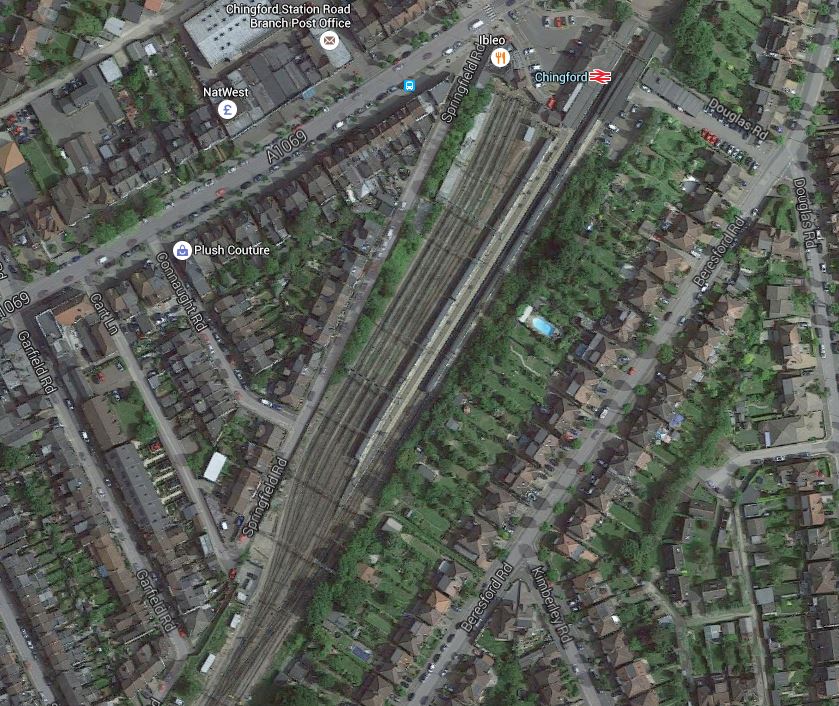
Chingford Station
Note the extensive sidings by the station.
My informant said the main purpose of reinstating a double-track Coppermill Curve, would be to move empty trains to and from Chingford, rather than new passenger services.
But with the design stage of Crossrail 2 well underway, I do wonder, if connecting Chingford station and the related sidings to the West Anglia Main Line, might give Crossrail 2 better options to build the line or provide alternative services, whilst the West Anglia Main Line is rebuilt through the area.
It strikes me that the cost of doing both curves together would be less than only building the Hall Farm Curve and then finding that construction of Crossrail 2 needs the Coppermill Curve.
Related Posts
Improving The Chingford Branch Line
Could Electrification Be Removed From The Chingford Branch Line?
Could Reversing Sidings Be Used On The Chingford Branch Line?
Could The Hall Farm Curve Be Built Without Electrification?
Crossrail 2 And The Chingford Branch Line
New Stations On The Chingford Branch Line
Will Walthamstow Central Station On The Victoria Line Be Expanded?
Work On Lea Bridge Station Has Officially Started
I have found a couple of news reports that Volker Fitzpatrick have now started to build Lea Bridge station.
But both are subscription only, so I suspect they wouldn’t like me to cut and paste them.
There is this press release on the Waltham Forest web site, which has been used by the two reports I found. This is the first paragraph.
Commuters in east London’s Leyton will soon be able to reach two of the capital’s key transport hubs in the time it takes to make a cup of tea. After 30 years of closure, Lea Bridge Station is re-opening to passengers next year, marking the culmination of a 15 year vision for Waltham Forest Council.
A report in the Yellow Advertiser says this about the design of the station.
The new building is to include two new platforms, a new footbridge and lifts, station canopy, ticket vending machines, Oyster readers, waiting shelters, help points and cycle storage.
So I suspect we’ll see a Grand Opening when the timetables change around the end of May.
Let’s hope Volker Fitzpatrick get their skates on!
It would be great, if the reinstatement of the Hall Farm Curve could be approved by the Government, so that passengers can get from Walthamstow and Chingford to Stratford.
Opening the Hall Farm Curve and providing perhaps a half-hourly service between Walthamstow/Chingford area and Lea Bridge/Stratford, would create an easy link for the area to Crossrail. If they used the footbridge and/or lifts at Lea Bridge station, this would give access between the area and up the Lea Valley to Stansted Airport and Cambridge.
The Site Of The Hall Farm Curve
I was travelling north on the Lea Valley Line and just before arrival at Tottenham Hale station, I took these pictures of the site of the Hall Farm Curve.
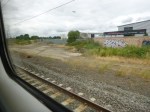
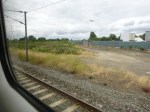

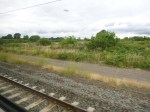
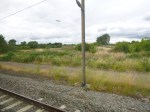
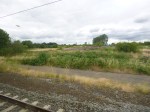
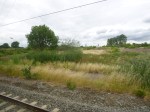

The Class 315 or 317 train in the last picture is a Chingford Branch train on its way to Hackney Downs and Liverpool Street stations.
This Google Map shows the Lea Valley Line from where the Chingford Branch crosses over the top to Lea Bridge station.
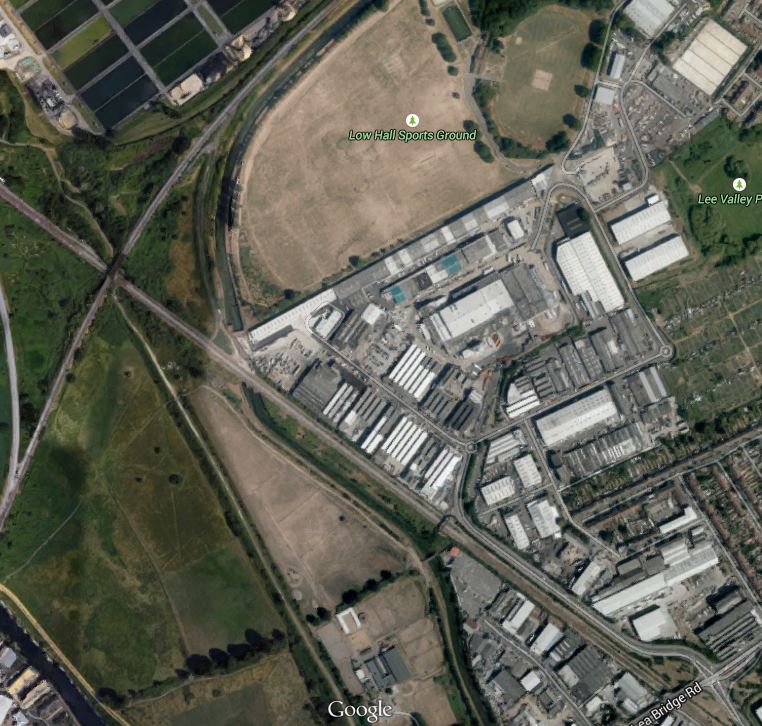
Hall Farm Curve And Lea Bridge Station
The scar of the old Hall Farm Curve connecting the two lines clearly shows.
Note the new Lea Bridge station will be built, where the Lea Valley Line crosses Lea Bridge Road.
What Might Have Been At Walthamstow And Woodford
The World Class Engineering And Penny-Pinching Architecture Of The Victoria Line
The Victoria Line is to reverse one of my favourite phrases, an all knickers and no fur coat Underground line.
Underground and remember, it is a totally below the surface except for the depot at Tottenham Hale, it is superb, with some world class engineering.
1. The original 1967 Stock lasted until 2011 and was a real tribute to its designers and builders.
2. The trains run automatically and the line was the world’s first to do this. I remember reading a document about how it worked in 1969 or so and because of the date the automation was largely controlled by thermionic valves and relays.
3. There was quite a bit of innovative design in the layout of the lines, which included the hump-backed stations, summed up here from Wikipedia.
The line has hump-backed stations to allow trains to store gravitational potential energy as they slow down and release it when they leave a station, providing an energy saving of 5% and making the trains run 9% faster
4. The overall concept has proved to be sound, as the line has a very good safety record.
But they certainly didn’t spend a large amount of time, effort and money on the stations. Again from Wikipedia.
When the Victoria line was built, budget restrictions meant that station infrastructure standards were lower than on older lines and on later extension projects. Examples include narrower than usual platforms and undecorated ceilings at Walthamstow Central, Blackhorse Road and Tottenham Hale, adversely affecting lighting levels. At most stations there is still a concrete staircase between the up and down escalators, where an additional escalator could be installed.
Walthamstow Central, Seven Sisters and Highbury and Islington are still truly dreadful stations.
The Bad Stations Can Only Get Better
Hopefully :-
1. The takeover of the Chingford Line by London Overground and the developments in Walthamstow town centre, will result in substantial improvements to Walthamstow Central.
2. Crossrail 2 and the Overground takeover coupled with development could also improve Seven Sisters.
3. Much needed better disabled access, enhancements to the Northern City line and increased passenger numbers will drive a need for the rebuilding of Highbury and Islington.
4. Other stations like Brixton, Euston and Blackhorse Road will have improvements driven by other new and upgraded lines.
Finally fifty years on, the sins of the 1960s are being eradicated.
The Victoria Line Extension To South Woodford or Woodford
But there are no plans to extend the line to Woodford or South Woodford stations on the Central Line which was part of the original proposals. Again from History on Wikipedia.
It had been intended to build the line beyond Walthamstow Central to Wood Street (Walthamstow), where it would have surfaced to terminate next to the British Rail station. Proposals were also made to extend the line as far north as South Woodford or Woodford, to provide interchange with the Central line. However, in a late decision in 1961 the line was cut back to Walthamstow (Hoe Street) station, renamed Walthamstow Central in 1968.
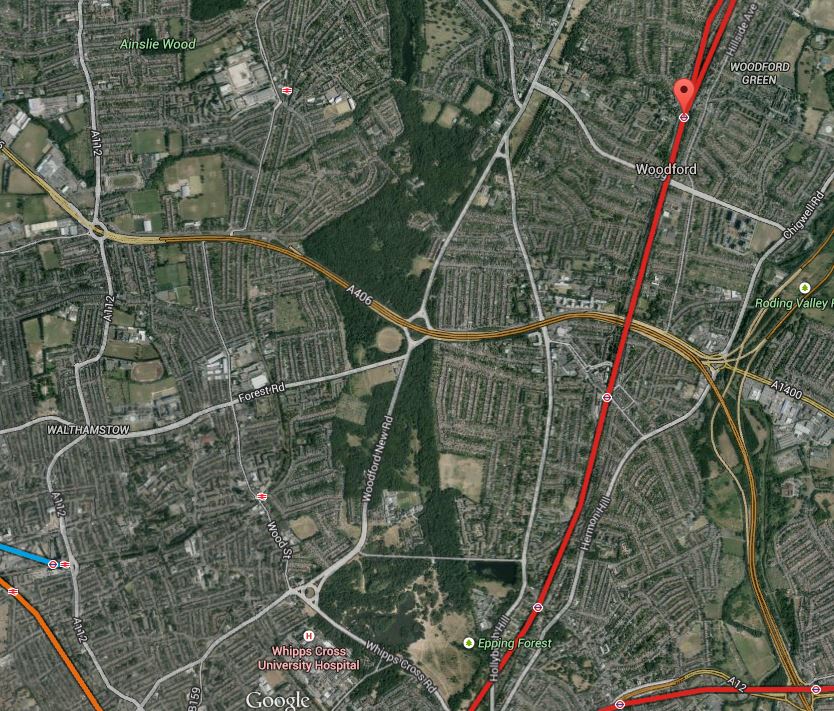
Let’s take a look at the Underground lines in the area. This map from Walthamstow Central to Woodford station is from Google Earth.
Walthamstow Lines
The red line at the right is the Central Line with South Woodford and Snaresbrook stations shown, in addition to Woodford station to the north of the A406.
The orange and light blue at the left being the Gospel Oak to Barking and Victoria Lines, with the two Walthamstow stations; Central and Queens Road.
The Victoria Line was originally planned to surface at Wood Street station, which can be seen to the north of Whipps Cross Hospital and then presumably cut across the southern part of Epping Forest to the Central Line.
I can’t find an article specifically stating why the extension to Woodford was dropped, but I did find this general article on London Reconnections, entitled Why We Do (And Don’t) Extend Tube Lines. This is two paragraphs.
One lesson quickly learnt by the early entrepreneurs who built early tube lines (and by this, as for the duration of the article, we mean the deep level lines) was that the longer the line and the bigger the network, the more profitable it was. To some extent this may seem obvious – a tube line between only two stations is of limited use (although exceptionally the Waterloo and City line manages to perform this role).
As usage tends to tail off at the extremities, it made sense to have the ends only being a small portion of the line. It also made sense to maximise use of resources. Trains sitting in terminal platforms were not in revenue earning service and a lot of the infrastructure – such as power supply – had large initial costs but the add-on cost for these items when extending the line was not that great.
So it’s generally all about economics and probably in the case of the Victoria Line; government money.
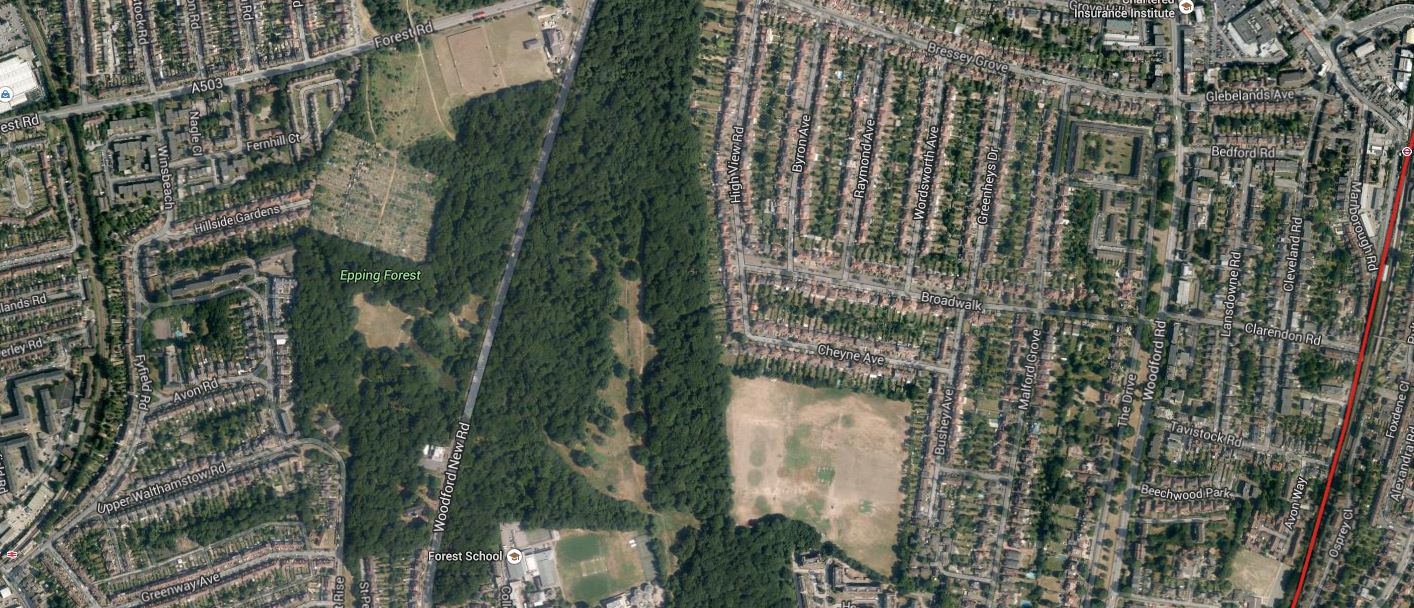
Walthamstow is a large catchment are and it has two routes into Central London and one to the west, two of which will be upgraded in the next few years, so I doubt the Victoria Line will be extended in the near future. This Google Earth image from Wood Street to South Woodford stations, shows the mass of development in between the two lines.
Wood Street To South Woodford
Wood Street station is just visible at the bottom left and South Woodford is at the far right towards the top.
There is also the small matter of putting the line through the green lung that is Epping Forest.
So any extension from Walthamstow Central to the Central Line would probably be in an expensive tunnel.
But there are some other reasons why any extension will not be built as planned in the 1950s.
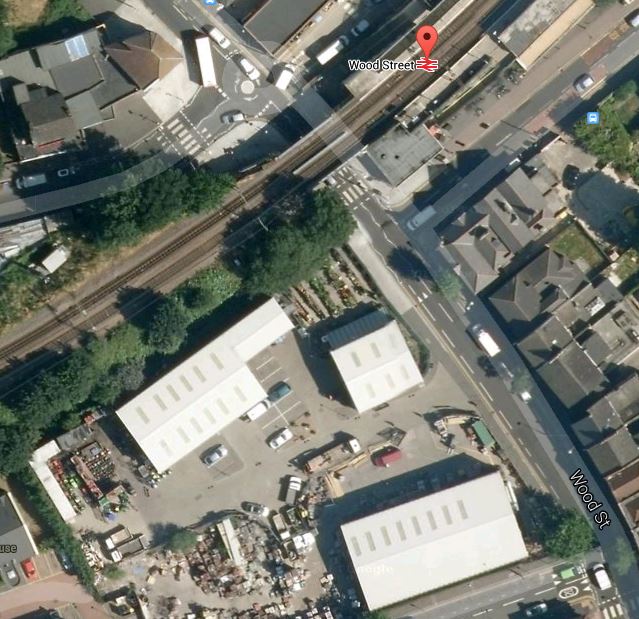
1. There now appears from this Google Earth image to be little space around Wood Street station.
Around Wood Street Station
Although it does look like that some of the buildings around the station were built in recent decades.
This would appear to further rule out a surface route.
2. Walthamstow now has an impressive new bus station, that was built 2005 and is the third busiest in London with twenty-four hour operation.
Buses go all over north east London from the bus station, to places like Wood Green, East Ham, Barnet and Ilford, but there is also a comprehensive local network that covers the area to Chingford and Woodford. This spider map shows all the routes from Walthamstow Central.
3. Crossrail will also have an effect when it opens. How will passengers between Walthamstow and Woodford, get on Crossrail? They have several choices.
What Should Be Done
In my view it would be better to spend money on the following.
1. Adding new routes and extra capacity to the buses in the area, so the in-between passengers will have a choice to go east or west.
2. After May 2015, improving the stations on the Chingford Branch from Hackney Downs to Chingford, with step-free access and better information systems and interchange with the buses in the area.
3. Increasing the frequency of Overground trains to Chingford and possibly running some through to Stratford via the reinstated Hall Farm Curve and the new Lea Bridge station.
4. New trains have been promised and I suspect they’ll arrive in the next few years. However, giving the Class 317 trains a good scrub, some new seat covers and a bit of TLC and they will hold the line in the meantime. On the Chingford branch more services are more important than flash new trains.
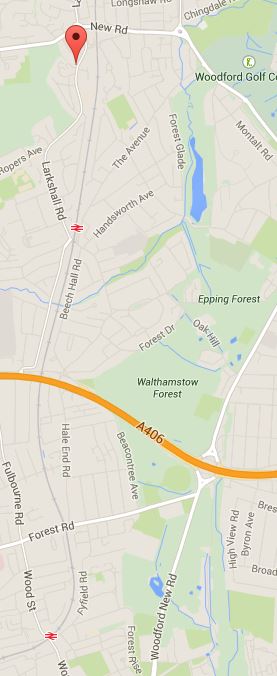
5. In the Future Developments section of the Wikipedia entry for the Chingford Branch, it is said that there may be a station at both Forest Road and Chingford Hatch, either side of Highams Park station. This map shows the area.
Around Highams Park
The red arrow indicates Chingford Hatch, with the two stations shown being Highams Park in the middle and Wood Street at the bottom.
The Effect Of An Expanded Stansted Airport
However, there is one factor that has been ignored, which would change everything.
And that is if Stansted Airport is expanded.
Plans for this sometimes show another rail link direct to London, which is an extension of the Chingford Branch line from Chingford.
Can Any Conclusions Be Drawn?
I can’t see any reason why the Victoria Line would be extended to join the Central Line, unless a second line is built to Stansted Airport or a similar large project was developed in the area, that required a major sort out of lines.
But the major conclusion is that because of developments that are already in place and others that could easily be implemented there are masses of ways to improve public transport in the Walthamstow area, which are proven and a lot more affordable.
I think that in perhaps ten years time, the following will have been done.
1. The Chingford Branch Line will have upgraded stations and a proper interchange to buses and the Victoria Line at Walthamstow Central.
2. The Chingford Branch Line will be running possibly as many as six trains an hour and a proportion will go to Stratford, rather than Liverpool Street.
3. There will be at least two new stations on the Chingford Branch Line.
4. The bus services based on Walthamstow Central bus station will be expanded.
5. New or refurbished trains will be running the service on the Chingford Branch.
I’m not speculating, just applying logic to see what is possible and history from the East and North London Lines after they were taken over by London Overground.
I shall be very surprised if the Victoria Line is extended to Woodford.
I will not be surprised to see house prices in the area rise astronomically, as they have done here in Dalston.
Good railway connections really seem to bring the best or worst out of house prices.
Before Crossrail – The Overground At Stratford
Stratford is the terminus of the North London Line of the Overground. These pictures show the platforms that service the Overground and the Lea Valley Line services that terminate at Stratford.
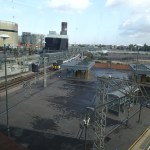
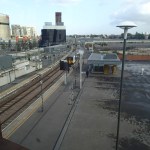
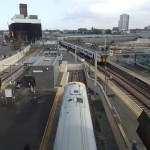
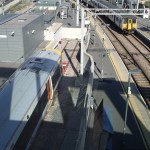
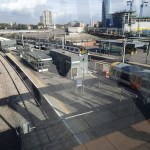
At least the two Overground platforms are long enough to take six car trains, but if services increase will there may be a need for one or more platforms for Overground services.
It would appear though, that the two Lea Valley Lines platforms, on one of which the Class 315 is waiting in the pictures, are not heavily used. And in addition, there is an immense triangular space, which I’m sure for which Network Rail et al. have big plans.
There is actually more potential in the area than appears obvious from these pictures.
Lea Bridge station and possibly the Hall Farm Curve are being reopened, which will link Stratford to Walthamstow and Chingford.
So will this mean services coming along the North London Line and going through Stratford to Chingford. My explorations at Chingford showed it to be a spacious well-connected station with three accessible platforms.
With an Overground spreading out fr0m Stratford, this would mean a lot of changing between the lines, as although they are a few platforms apart, there are lifts for those who need them.
There is going to be a lot of creative arithmetic in this area as London Overground find more and more ways to squeeze gallons out of pint pots.
Before Overground – Walthamstow Central
When the Victoria Line was built in the 1960s, the design budget seemed to run out. Several stations like Euston, Highbury and Islington, Brixton and Finsbury Park, show British rail infrastructure design of the time at its worst.
Wikipedia includes this in its section on the history of the Victoria Line.
It had been intended to build the line beyond Walthamstow Central to Wood Street (Walthamstow), where it would have surfaced to terminate next to the British Rail station. Proposals were also made to extend the line as far as South Woodford or Woodford, to provide interchange with the Central line. However, in a late decision in 1961 the line was cut back to Walthamstow (Hoe Street) station, renamed Walthamstow Central in 1968.
So does this late cutback, explain why Walthamstow Central is another station in this design disaster group?
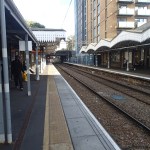
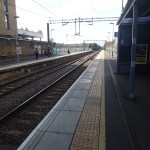
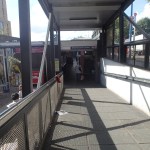

The station has the feel of something designed on the spur of the moment, with a simple subway underneath the Chingford branch to access the Victoria Line platforms. To get between the Chingford branch platforms and the entrance to the Underground station, you need to negotiate a tricky staircase. It’s almost as though London Underground designed the lower half and British Rail did the top.
A station designed today would probably incorporate escalators, lifts and wide straight staircases.
I can’t help thinking that the original plan of connecting the two lines at Wood Street was the correct one.
Wikipedia says this in its description of the station.
The underground station, like many stations on the Victoria line, was never completely finished. White ceiling panels were never fixed to the ceilings above the platforms; instead the steel tunnel segments were painted black and used to support the fixtures and fittings. This has had a detrimental effect on the lighting levels. There is a concrete stairway between the two escalators instead of a third escalator; this caused a hugely disruptive station closure for several weeks in 2004 when both escalators went out of service.
As Walthamstow is going through a building boom in the moment and traffic through the station will only increase, we must accept what’s done is done and we must find a way of correcting the mistakes of the past!
We can do two main things.
1. The interchange routes between the two lines at Walthamstow Central can be made easier by the addition of escalators and/or lifts.
2. We must provide alternative routes that take the pressure off Walthamstow Central. One simple idea would be to reinstate the Hall Farm Curve, which would allow trains to go a reopened Lea Bridge station and the major transport interchange at Stratford, with access to two Underground lines and the DLR.
As with many transport problems in London, I think that in 2018, London’s transport problems will change, with the arrival of the two biggest beasts of all; Crossrail and Thameslink.
1. Crossrail with its stations at Liverpool Street and Stratford will be fed directly by the Lea Valley Lines and pressure should be taken off the Victoria and Central Lines.
2. Thameslink calls at Finsbury Park, so will line be able to act as a bypass for those coming from Walthamstow and Chingford, who need to go to South London.
Hopefully all the changes will be for the better!
Can We Extend Overground Connectivity In North London?
The East London Line has four termini in South London; New Cross, West Croydon, Crystal Palace and Clapham Junction, but only two in the North; Dalston Junction and Highbury and Islington.
In the North the Lea Valley Lines are being added to the system and although these lines meet the North London Line at the Hackney Downs/Central station complex, they are not intimately connected to the core route of the East London Line, as this would need a change of train at Canonbury.
So how could we improve the extend the connectivity?
Hackney Central/Downs
I regularly take the Overground from Stratford to my home. On a wet day, I would take a train to Canonbury from Stratford, walk across the platform to a southbound train and then go one stop to Dalston Junction, from where I would get a bus two stops to my home. On a sunny day, I might change at Hackney Central to a 38 bus or walk from Dalston Kingsland.
But I usually take the Canonbury route, as it has the least amount of walking and if I’ve got a heavy parcel, there is a lift at Dalston Junction.
The two Hackney stations are being connected by a covered high level walk and this would help those changing between the North London Line and Lea Valley and Cambridge services.
But two other things could be done, if the run-down area around the stations is redeveloped.
If you want to get a bus or walk to the Town Hall area, after alighting on the westbound platform at Hackney Central, you have to cross the tracks on a footbridge. An entrance needs to be provided on the south side of the station.
The connection to the buses are better than they were a few years ago, but Downs/Central should have easy access to stops for the high-frequency bus routes that pass through the area.
I have a feeling that they may have spent a lot of money on making the footbridge step-free with lifts and in a few years time, it will be rarely used, as other better routes are developed. A southern entrance would help in this respect.
Crossrail 2 will be the driving force here, as the planners have stated a preference for only having one station in Hackney, to save a billion pounds. Whether this station is Dalston Junction or Hackney Downs/Central doesn’t matter, provided that these two stations are connected by other means. There are already two routes; the North London Line and the high-frequency buses.
For this reason, the access to buses from Hackney Downs/Central must be made as easy as possible. But that doesn’t need to wait for Crossrail 2!
There is a superb opportunity here for a developer to create a real town centre at Hackney Central/Downs, of which everybody can be proud. The original station building is not used, but it is a building worthy of saving as are few other historic buildings in the area.
An Extra Terminal In The North
If the frequency on the core section of the East London Line is increased from 16 tph to 24 tph as is stated in TfL’s plans, there could be a need for another Northern terminus to supplement Dalston Junction and Highbury and Islington, where these trains could turn back.
An extra terminus might ease the overcrowding that is prevalent at Highbury and Islington.
In the original plans for the Overground, there was talk about some East London Line trains going as far as Willesden Junction and terminating there.
With plans for a new super station at Old Oak Common, that could be a possibility. But even New Cross to Old Oak Common would be a journey of about an hour, and there will be faster ways via Crossrail at Whitechapel.
So a terminus for the East London Line at Willesden Junction or Old Oak Common, would be more about inceasing the frequency of trains on the North London Line, by using some of the eight extra trains an hour on the East London Line to provide the extra trains.
There are two other possibilities for extra Northern terminals.
If the Dalston Eastern Curve were to be reopened, then trains could move easily between Hackney Downs/Central and Stratford and the East London Line.
This would mean that Stratford could be an additional terminal and also that some East London Line trains could have an interchange with the Lea Valley Lines.
There is also a curve at Canonbury that connects the North London Line to the East Coast Main Line. It used to be double track, but is only single track now! So could this be used to get to a new Northern terminus?
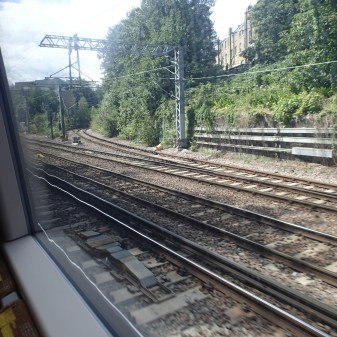
The Canonbury Curve To The East Coast Main Line
It all depends on the passenger flows, which of course TfL has at its fingertips.
We must also take note of passenger behaviour in using cross-city railways.
When Crossrail opens in 2019, all parameters will change, as many who want to use the East London Line to get on the Underground at Highbury and Islington, might get on Crossrail at Whitechapel instead. This passenger will probably go to Oxford Street, by walking to Dalston Junction, before taking the East London Line to Whitechapel for Crossrail. The alternative of taking a bus to Highbury and Islington and then getting the Victoria line, means I have to use a station I avoid as much as possible, due to the excessive walking involved to get to the trains.
The Eastern Curve At Dalston Junction
This seems an easy option to improve connectivity, as it would allow trains to pass easily between Stratford and Hackney Downs/Central and the East London Line. But there are two problems.
It might be a difficult sell to the Dalstonistas and the shopping centre at Dalston Kingsland is being redeveloped, although the Eastern Curve is safeguarded.
It would seem though, that in the next couple of years, there is a chance to make a good fist of sorting out the shops and stations at Dalston.
Tying In The Lea Valley Lines
There has been little or no speculation about how the London Overground will link the Lea Valley Lines to their current lines. London Overground has said that it will deep clean the trains and stations and that new trains are on the way.
They have also got at least three out of station interchanges between the new lines and the current system.
- Walthamstow Central to Walthamstow Queens Road.
- Hackney Downs to Hackney Central, although the way that is going, it will probably become a single station.
- Seven Sisters to South Tottenham
There are also a couple of junctions where useful connectivity already exists.
There is a rail line called the High Meads Loop that goes between the Lee Valley Lines and the North London Line, virtually straight under the old Olympic Village. This is the North London Line End just after Hackney Wick station.
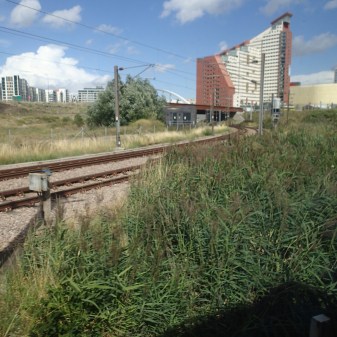
High Meads Loop At Stratford Joins North London Line
And this is the other end on the Lea Valley Line, between Stratford and Tottenham Hale
High Meads Loop At Stratford Joins Lea Valley Line
Incidentally, I don’t think there is a station under all those dwellings.
There is also another junction that links the Lea Valley Line to the Gospel Oak to Barking Line to the East of South Tottenham station.
Perhaps the most interesting proposal though, is to reinstate the Hall Farm Curve in conjunction with the reopening of Lea Bridge station. I travel to Walthamstow Central regularly and the curent timetable of the GreaterAnglia service is a bit threadbare to say the least. So if this curve is reopened, will we see trains linking Walthamstow to Stratford and even to and along the North London Line by way of the link I showed in the pictures to my local station at Dalston.
If the Eastern Curve at Dalston Junction was to be reinstated, then some of those extra trains through the core section of the East London Line could go to Walthamstow and Chingford.
Summing Up
The more I look at the East London Line, the basic concept of a high frequency line through Marc Brunel’s Thames Tunnel, fanning out to several destinations on both sides of the river, was a stroke of genius, which was probably dreamed up in the time-honoured manner of so many other good ideas on the back of serviettes, beer mats or fag packets in a real ale hostelry somewhere.
Who can predict with any certainty what the Overground will look like in 2020, let alone the 2050 target of Transport for London?
The only certainty is that Transport for London will have created another iconic brand to go with Underground and Routemaster.
It could also be argued that London’s three new cross-London lines;Thameslink, Crossrail and East London, are all following a similar design of a central tunnelled core, with a collection of branches at each end.
Certainly the current Thameslink and East London Line have shown that the concept works and if they perform in the next few years, this can only mean that further lines in London and further afield follow a similar pattern. Crossrail is adding more branches and termini and the basic design for the proposed Crossrail 2 appears to have been designed by the use of a photocopier.
From Canary Wharf To Walthamstow Central
On a quick examination, Canary Wharf and Walthamstow Central, are both important transport hubs in their parts of London and probably there is significant commuter traffic between the two stations.
After my trip on the cable car, I took the Jubilee line to Canary Wharf, where I had a coffee.
After looking at some other things, I found I was running a bit late for lunch in Walthamstow.
I suspect the fastest way is usually to take the Jubilee line to Green Park and then change to the Victoria line. Using my mother’s rule on seventeen stations and one change gives 39 minutes. but there was one flaw, the Jerrylee line wasn’t running past Waterloo. At least, I wouldn’t have to walk miles in the tunnels at Green Park.
The obvious choice seemed to be to take a DLR or the Jerrylee line to Stratford and then get a bus. I chose the DLR, as I was nearer, and after a few minutes wait, I was on my way.
It was then that I made the wrong choice. The first bus to arrive was a 257, which treated me to a mystery tour of Leyton and parts of Epping Forest.
When I arrived late at my lunch, I’d taken quite a bit over an hour.
So what does the Tfl Journey Planner say?
It did suggest one all Underground route via London Bridge and Kings Cross, which was fourteen stations and two changes. Or 38 minutes according to my mother!
the others suggested were verging on the exotic, in that they generally involved taking a Central line train to Leyton or Leytonstone and then getting a bus. One even suggested getting off the bus and taking the Overground.
I think all of this illustrates the problem of going north and south in East London, unless you can use the Northern line or the East London line.
Crossrail might improve the journey a bit, as you should be able to reach Bond Street a minute or two quicker. But will the change to the Victoria line, require superhuman stamina?
What might help though, is if the services to Walthamstow are improved, when the Lea Valley lines come under the control of the London Overground. If the Hall Farm Curve is rebuilt, services from Walthamstow to Stratford could be of the order of twelve minutes, giving a time of Canary Wharf to Walthamstow Central of about twenty five minutes.
Tfl have the figures for the traffic, but surely creating a good service between Chingford via Walthamstow to Stratford would relieve the Victoria line, by giving those in Waltham Forest, an alternative route to Central London.
TfL haven’t published any plans for the Lea Valley lines and I’m waiting to see what they propose. If I judge them on the current Overground, it’ll have a few surprises and innovations.
Lea Bridge Station May Be Reopened
Tucked away in the May 2013 edition of Modern Railways, is a statement that Lea Bridge station in Walthamstow may be reopened.
If they do reopen the station and the nearby Hall Farm Curve, this would link the Chingford branch directly to the Lea Valley Lines. Wikipedia says this about the project.
Transport for London ran a study on the feasibility of reopening the curve for 2016 that produced a result with a benefit-cost ratio ranging between 8:1 and 14:1 depending on the length of trains involved. In 2007, the Greater Anglia Route Utilisation Strategy published by Network Rail suggested that construction of the curve could be possible by 2019 or later.
Designs for new services run using the curve have been suggested to reduce journey times between Walthamstow and Stratford or Tottenham Hale to 12 minutes from their current duration of 34 minutes and 43 minutes respectively.
It would appear that house prices in Walthamstow and Chingford should soon be on the rise, if the project goes ahead.
I believe that small projects like this can often give great benefit to passengers and the railways. This one is one of three that have just been proposed. The others are Ilkeston and Pye Corner. They all follow Cambridge Science Park station, which will start construction next year.
 The Anonymous Widower