Tram-Trains To East Midlands Airport
I have a Google Alert looking for tram-trains and it found this article on the Nottingham Post entitled Could tram-trains link Nottingham to East Midlands Airport?
It’s a thought!
The article talks about a proposal to create a link between East Midlands Airport and the Midland Main Line, that would allow tram-trains to connect the airport to cities like Nottingham, Derby and Leicester and the proposed HS2 station at Toton.
This is a Google Map of the area between the Airport and the Midland Main Line.
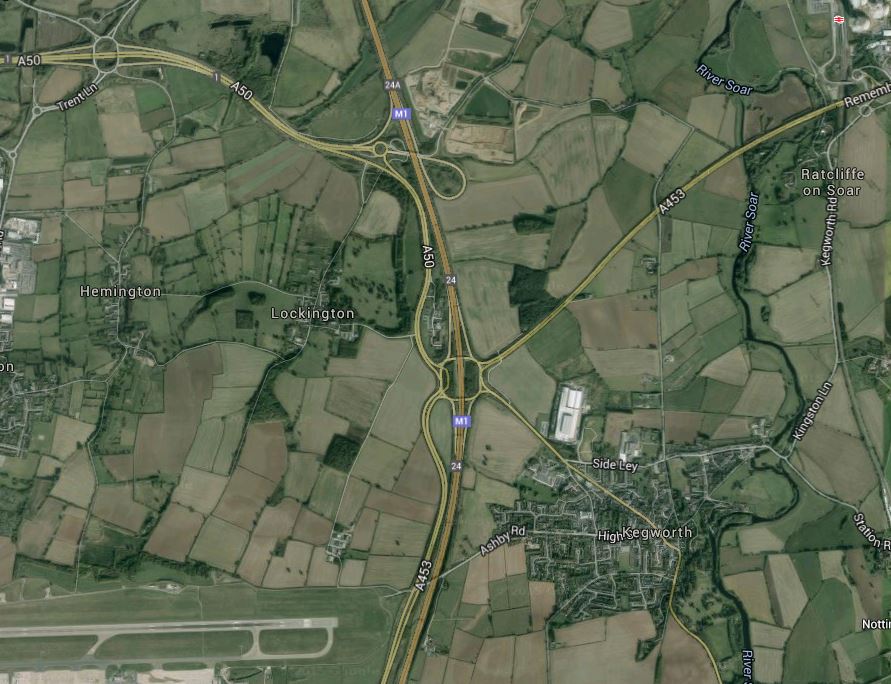
East Midlands Airport, the M1 And The Midland Main Line
East Midlands Parkway station is at the top right of the map.
I think that properly designed this idea could have legs.
A few points.
- Some doubt the South East will ever get a new runway, so improving connections to East Midlands Airport would surely mean more passengers flew from their local airport, rather than a congested Heathrow.
- It would improve links between the major cities and population centres of the East Midlands and they probably need an improved turn-up-and-go four trains per hour service between each.
- There are a number of intermediate stations to the various destinations, which probably need better connections.
- The tram-line would also cross the M1. So would a pick-up/drop-off tram stop ease travel in the area?
- Once the tram-train technology is proven and approved and the Midland Main Line is electrified, I doubt that creating the link would be a difficult planning or engineering project.
I will be very surprised if at some point in the future, some form of light or heavy rail line doesn’t reach East Midlands Airport.
But then I think tram-trains would be best.
Rethinking HS2 And HS3
There is an article on the Rail News web site entitled Sheffield-Leeds HS2 route ‘to be shared with HS3’.
The article bases their article on a document called Rolling Stock Perspective, published by the Department of Transport and comes to the conclusion, that HS2 and HS3 may share tracks between Leeds and Sheffield.
In a post, which I called Whither HS2 and HS3?, I suggested HS2 and HS3 shared tracks between Manchester Interchange (Airport), Manchester and Leeds, and also said that both HS2 and HS3 should serve Leeds and Sheffield. So I might have got it right!
The one thing, I did get right in that post was the last statement.
The one thing we mustn’t do is build HS2 as it is currently designed, as we can do much better than is proposed.
Certainly, it appears that there is a lot of serious thinking going on in the design of HS2 and HS3. Today it was about linking HS2 and HS3, whereas yesterday it was about linking HS1 and HS2.
Who knows what idea will turn up next?
Should We Link HS2 And HS1?
According to this article on the Global Rail News web site, there has been speculation over the weekend in the Press that there will be a direct link between HS1 and HS2.
There are two main reasons why the HS1 and HS2 should be directly linked.
Obviously, in a decade or so, it would be very nice to get on a train in Birmingham and then be in Paris or Brussels without changing trains in under three hours.
Within a decade, the amount of freight going between the Midlands, North and Scotland, and the Channel Tunnel and the ports in the Thames Estuary is going to have grown substantially! So if HS1 was connected to HS2 and the West Coast Main Line by a full-size tunnel, the freight trains could be diverted deep under London. This would free-up the North London and the Gospel Oak to Barking Lines for much-needed passenger services.
A few years ago, digging a full size tunnel between HS1 under Islington to say Old Oak Common would have been an immensely difficult project, but Crossrail and other tunnelling projects around the world have changed all that.
My insight into the minds of those who create these big projects, makes me think, that if HS1 and HS2 are linked directly, it will be used for other purposes.
But above all we must boldly go!
Whither HS2 And HS3?
This morning there is an article in The Independent, which is entitled SNP fury as HS2 finds ‘no business case’ for taking fast train service to Scotland. Here’s the first paragraph.
The £50bn High Speed Two rail link will not be extended to Scotland, as the team behind the project has found there is “no business case” for the undertaking.
There may not be a conventional business case, as some of the reasons for developing a high speed railway up and down the country are emotional or for a country, where none of us will still be alive.
When HS2 is talked about in the media, freight is rarely mentioned outside of specialist magazines and web sites.
Although, HS2 will be built for the biggest freight trains, there are no plans for using it for this purpose at present. But, if the high speed line moves passengers away from the conventional East Coast, West Coast and Midland Main Lines, this will reduce the number of passenger trains and open up more paths for much needed freight trains to drive the economy.
The Electric Spine will take pressure off existing routes to the North and Scotland, but it does nothing to increase capacity north of Warrington and York, where both the East and West Coast Main Lines do not have the capacity of their southern ends. Some extra tracks and easier routes may be possible in places on these two Main Lines, but upgrading them will be difficult and politically sensitive.
The only other way to create more capacity between the North of England and Central Scotland is to electrify the Settle to Carlisle Line and complete and electrify the Waverley Route to Edinburgh.
I also mistrust all forecasts of passenger ridership on the railways. Two examples illustrate how bad they can be.
The estimate for traffic through the Channel Tunnel was very much on the high side and only now are the number of train passengers rising substantially towards that figure.
Locally, to me, the London Overground was started with three-car trains, which just five years later they are now converting to five cars. The original estimate ranks with some of the most spectacularly bad Treasury and Department of Transport predictions.
Add to this the usual mistakes, where they get the number of trains wrong and lumber places with unsuitable, inadequate or poorly designed trains, that are often unique one-offs to fit the budget. This means you can’t easily rustle up some more standard trains. At least with the Overground, Bombardier delivered the Class 378 trains, which can be cut and pasted into new formations and are still in production.
If you want to see an inadequate set of trains look at the Class 185 trains built for Trans Pennine services. Wikipedia has a whole section devoted to Overcrowding and Passenger Feedback. I have this feeling that some of the other trains ordered lately might be disasters, as the dead hand of the Treasury was too much on the decision.
So I can understand, why the SNP are angry that HS2 will not be extended to Scotland. More capacity is needed between England and Scotland for both freight and passengers, and if that is new capacity, it is likely that it would work well and in a reliable way, using standard trains that are just not UK-only specials, bought from the Treasury’s scraps and petty cash.
I do think though that our designs for HS2 are rather dated and don’t take things that are happening or have happened into account.
Crossrail in London has shown that putting a large twin rail tunnel under a major city, is not the problem it once was. Crossrail have also been very innovative in creating stations with the minimum disturbance to existing infrastructure. As an example, the new Whitechapel station for Crossrail has also used a technique called uphill excavation, where you create escalator and lift shafts upwards from the tunnels, rather than traditionally from the surface, which is much more disruptive.
These techniques can revolutionise the construction of HS2.
Take cities like Birmingham, Leeds, Manchester, Newcastle and Sheffield, which have developed and are continually developing extensive local rail, tram and bus networks. So why are we in Birmingham still talking about creating an HS2 station at Curzon Street? Surely, we just dig a very deep pair of HS2 tunnels under the city and then uphill excavate into not only New Street, but Moor Street and Snow Hill as well. The tunnels would be only made as long as necessary, although the underground station could be very large. But it probably wouldn’t be much bigger than the enormous double-ended Liverpool Street/Moorgate station being created for Crossrail.
The great advantage of this method of construction is that you can continue to develop your network of local trains, trams and other transport links, untroubled by the construction of the new station deep below. Anybody, who thinks this is not possible, should spend half-an-hour walking around Whitechapel station, where the Hammersmith and City, District and East London Lines are passing untroubled over the giant hole and through the building site for the new station.
I would have no idea as to the costs of this method of construction, but it surely must be more affordable, than creating a new station or modifying an old one, by traditional methods.
A station in Manchester could probably be created in a similar manner with a giant double-ended station linking into Manchester Piccadilly station at the Southern end and Manchester Victoria station at the Northern. This is a Google Earth image of Manchester city centre between the two main stations.
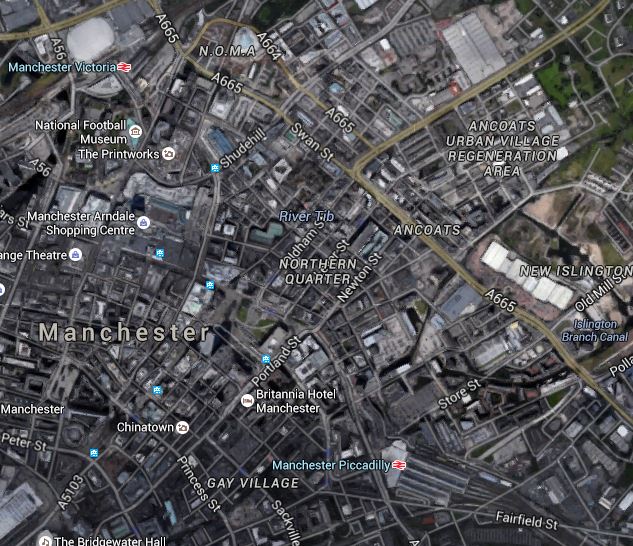
Manchester Piccadily And Victoria
Victoria is at the top and Piccadilly is at the bottom. The distance between the two stations is probably a couple of hundred metres more than between Moorgate and Liverpool Street, so designing a station deep beneath the city centre should be possible with a bit of help from long escalators and perhaps a travalator. If nothing else, it would be a wonderful way to transfer between the two stations in Manchester’s rain. It could also have entrances in places like Piccadilly Gardens
Leeds station could be a number of platforms for the high-speed lines under the current station.
Since HS2 has been proposed and still-born, the Northern Powerhouse and HS3 has arrived.
In my view we should plan HS2 and HS3 together and construct them together, as needs determine and budgets allow.
HS2 would start in London, possibly in an underground station which would be under one of the three stations on the Euston Road; Kings Cross, St. Pancras and Euston. It would probably be under Euston, but wherever it was it would be closely integrated into the Crossrail 2 station, which would be under Euston Road at right angles to the other lines and will serve the three current and the new HS2 stations.
I wouldn’t totally rebuild Euston station for HS2, as the station is so complicated and second-rate in its relationship with the Underground, that creating a decent connection between the current station would be so difficult to do without gumming up London’s transport system for umpteen years.
The approach used at Kings Cross to create the magnificent station we have today should be copied, where the main station was left virtually intact and new Underground entrances and subways were dug and tunnelled out to get the Underground connection working and then build a spacious station to give access to the platforms for the long-distance trains.
I also think that it would be better to build Crossrail 2 first and connect it to the three current stations on Euston Road, then tunnel HS2 accurately into the knitting.
The current Euston station would be kept fully operational throughout the construction of HS2 and only when that line is complete, would Euston station be given the sort of upgrade that has been so successfully done at Kings Cross, St. Pancras, Waterloo and Paddington.
HS2 would go North to a station at Old Oak Common, probably mostly in tunnel and it would then pass stations at Birmingham Interchange (Airport), Birmingham, Crewe, Manchester Interchange (Airport), Manchester and Leeds. I would put the stations in tunnels underneath the current transport hubs.
A branch off the main HS2, north of Birmingham, would go under Nottingham, Sheffield, finally rejoining the main HS2 at Leeds.
And why not balance the network, by having a branch off HS2 south of Birmingham going towards Bristol and Cardiff.
If the alignments were developed correctly, then loops under cities like Stoke might be possible.
HS3 could actually be integrated into HS2. Perhaps it would start under Liverpool Lime Street and then pass under Manchester Interchange, Manchester and Leeds.
From Leeds the HS2 and HS3 would split again, with one branch going North to Newcastle via York and the other going to Hull via Sheffield and Doncaster.
Obviously, this is only a back-of-an-envelop design and properly thought through it could be much better.
But I do feel that HS2 and HS3 will both benefit if they share a route between Manchester Interchange and Leeds, via perhaps Manchester and Huddersfield.
One of the aims of this design is to create a high-speed railway network, with as little demolition and disruption to the workings of our cities as possible.
What happens in Scotland is tricky, as in my view a lot of improvements are mainly Scottish solutions. For instance, as I said, the Waverley Route needs to be rebuilt to a high standard with electrification, Glasgow Crossrail needs to be created and Edinburgh to Glasgow needs to be fully electrified.
But when Newcastle gets a high speed connection to the south, the final piece in the jigsaw of high-speed lines would be to extend HS2 to Edinburgh and Glasgow. Hopefully, by the time that happens, we’ll have learned how to do it in a quick, affordable and non-disruptive way.
The one thing we mustn’t do is build HS2 as it is currently designed, as we can do much better than is proposed.
HS2 And The General Election
In some ways the impact of HS2 on the General Election was more noticeable by its absence. I have only found one serious article in Rail News, that even discusses the subject. This is the first two paragraphs.
Ahead of the general election campaigners against HS2 made much of the opportunity for opponents to vote for parties that wanted the project scrapped. But the final election results suggest HS2 had little impact.
Only UKIP and the Greens put scrapping HS2 as a core issue in their manifestos. And a lone single-issue candidate also campaigned against HS2 in the Westminster North constituency but came bottom of the poll with 63 votes, or just 0.2 per cent of the total cast.
Ukip are a law unto their own, but why are the Greens against HS2?
I do wonder if HS2 is going through a similar popularity as Crossrail, where parts of London were against the building of the rail link in the early days of the project. Now Londoners seem to be getting enthusiastic about their new railway.
From Coventry To Nuneaton
The Coventry To Nuneaton Line is in the process of being upgraded, as this paragraph from Wikipedia details.
The line runs near to the Ricoh Arena football stadium on the northern edge of Coventry. Funding for two new stations, Coventry Arena and Bermuda Park, was approved in December 2011. New plans will also see the number of carriages increased from 1 to 3 and the service upgraded to half hourly, a new platform built at Coventry station and also future extensions of the line to Kenilworth and Leamington Spa.
After coffee with an old friend in Coventry, I decided to hop to Nuneaton using this line , from where I could get a train back to London.







The pictures show the character of the route and some of the building work at the new Coventry Arena station. I caught a glimpse of work at Bermuda Park station, but was unable to get a picture.
There is a third station being built in the area and that is Kenilworth station on the related Coventry to Leamington Line.
I think that the ambitious team that run Chiltern Railways will be looking to at least get a feeder service running from Nuneaton to Leamington, via Coventry and Kenilworth.
If HS2 goes ahead and Euston station is rebuilt, this could be an invaluable route to take pressure off the West Coast Main Line
Are Rail Passengers Enthusiastic About High Speed Rail?
I ask this question, as in some ways it is a continuation of a conversation I had with a fellow First Class passenger, whilst we were waiting for our Manchester train on Saturday in the Lounge at Euston.
He asked if I’d ever flown to Manchester from London. I said no and he said he wouldn’t either, as the trains were good enough. So we were two satisfied Virgin riders.
But we were both travelling on a Saturday and I bought my ticket some weeks ago on-line.
So what if I needed to go urgently to see someone tomorrow, how much would it cost?
Looking on the Virgin web site this morning, I can get a ticket to Manchester from Euston for £67.50, if I leave on the 10:00. The cheapest flight available on British Airways in the morning is £211. But there is one big difference, with Virgin the ticket is a First Class Advance, which includes an unlimited baggage allowance and free drinks and snacks. I’d also get a third off the £67.50 as I have a Senior Railcard.
The conversation was typical of many, I’ve had with savvy passengers on British trains, not always in First Class. Moans include the overcrowding and the quality of on train snacks and drinks. But with most passengers going a distance, there is generally no problems with the price. Obviously, passengers would like to get there quicker, but in the UK in recent years, I’ve never heard anybody complain about the length of the journey, on trips to and from Glasgow, Edinburgh, Cornwall and Wales.
You might get the odd comment, about looking forward to a slight speed-up, but no-one has ever mentioned that they can’t wait for a High Speed train to whisk them to say Edinburgh at 200 mph.
I think that passengers choose a train that meets certain criteria. It must be convenient and comfortable, at a keen price and so long as it is fast enough no-one seems to care. I remember, once being told by a one of First Great Western’s Customer Service Agents, that one of the common question they get asked is “Is the train going to be an InterCity125?”
I must admit, that one of the reasons, I travel on Chiltern to Birmingham, is that the trains are comfortable and spacious, Mark 3 coaches, rather than the cramped Pendelinos. My only problem, is that Euston is easier for me to get to, than Marylebone.
So you pays your money and takes your choice.
Obviously, we’d all like to get there a few minutes sooner and to illustrate this, at Bolton, I had a long chat with a fellow Ipswich fan, who like me was looking forward to the implementation of the Norwich in Ninety improvements.
When HS2 is built to Birmingham, I do wonder if I’ll use it! A lot will depend on the trains, being comfortable and spacious, and I’m not going to pay a silly price to save a few minutes. I’d also be more likely to use the line, if I could just hop on the Overground at one of the Dalston stations and then change across the platforms at say Old Oak Common.
Convenience is everything! Especially, when there is a comfortable, affordable alternative! Which there will be!
If you look at the only high speed link we have, that to Paris and Brussels, through the Channel Tunnel, it obviously meets a lot of passengers’ criteria. But it did take some time to get popular, as I believe it will with HS2.
The interesting thing, will be how successful, the new electrified line to Bristol and South Wales, is in attracting passengers, after it opens hopefully in 2017. There will be new Class 800/801 trains, but I have my doubts, they will be liked as much by passengers as the forty-year-old InterCity125s.
The Great Western Main Line, like the West and East Coast Main Lines, will be a genuine 200 kph plus line, that because of signalling developments will be able to run faster than current services.
All three lines by the end of this decade will share some characteristics.
1. Fast, frequent services in modern trains at speeds up to 140 mph.
2. Services will stop at a convenient intermediate stations, like Crewe, Doncaster, Swindon, Newport and many others.
3. If the current trend continues its upward curve, on-board service will be better.
4. All classes will have free on-board wi-fi.
These services will set a very high bar for services on HS2 to achieve.
The more, I read about HS2, the more I’m convinced that it is needed more on capacity grounds than anything else. And especially, the capacity the line will release for freight! It will certainly find it difficult to offer some of the reasons we use the trains we do today.
So to answer my original question, I think the current answer is no. But in a few years time, there may be a different answer. Unless of course all of the negative publicity about HS2 convinces a government, that it is not worth the trouble.
An Advantage Of Eurostar’s New Trains
I’ve stood on the unwelcoming platforms at Stratford International station waiting to catch a fast train to Kent, as Eurostar’s trains thunder by on their way to Europe.
The current Class 373 trains are not the quietest, to say the least.
This morning, Nicola Shaw, the boss of HS1, said on BBC Breakfast, that the new e320 or Class 374 trains are a lot quieter.
So at least twenty years of development has brought another advantage, to those living along the route.
Hopefully, the trains for HS2 will be even quieter.
Crossrail, HS2 And The Overground Seem To Be Coming Together At Old Oak Common
There has been a report in the Standard, which talks about how Crossrail, HS2 and the Overground could come together at Old Oak Common, which is an area of London ripe for redevelopment.
The report shows this map.
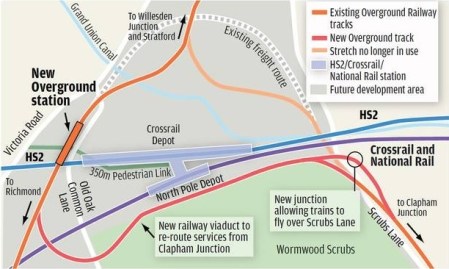
Rail Lines At Old Oak Common
The map is informative and it shows how the West London Line might split from the North London Line at the new Old Oak Common station, rather than at Willesden Junction.
The map though doesn’t show the Dudding Hill Line which joins the North London Line in this area, possibly just south of the new station.
To show the space available in the are, look at this Google Map shoeing the wider area around the proposed station.
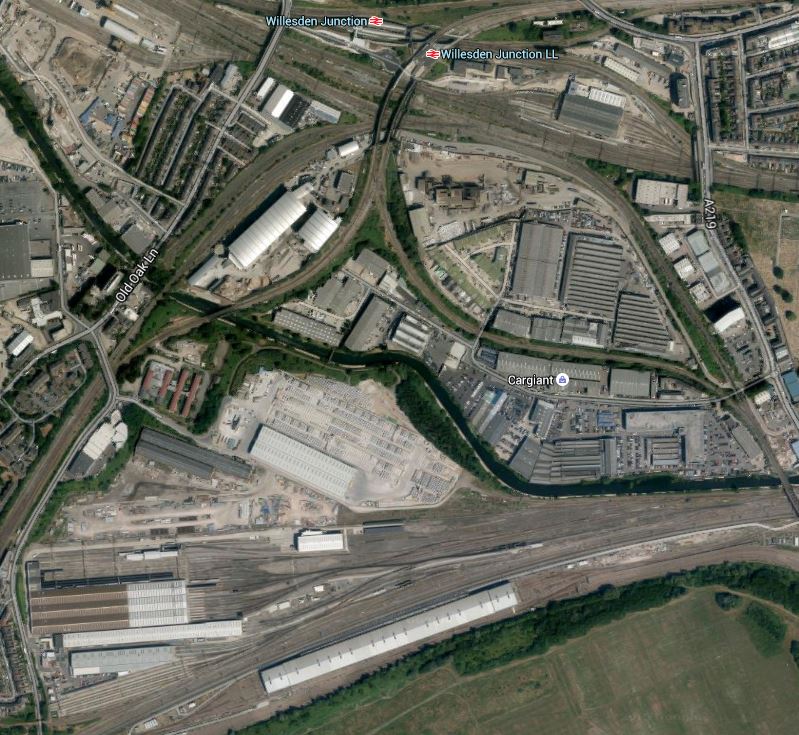
Old Oak Common Area – Downloaded 7th July 2015
There are rail lines everywhere. This second image shows the Southern part of the previous one, along the Great Western Main Line and Crossrail.
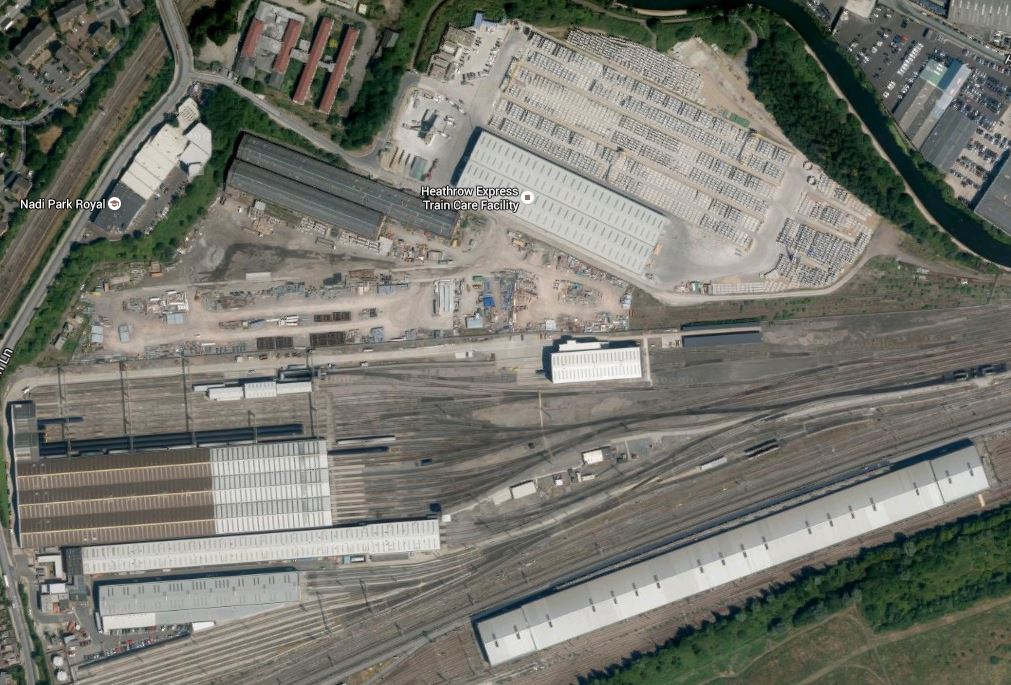
Old Oak Common Detail – Downloaded 7th July 2015
Working upwards from the bottom (South) on this map, you see the following.
1. The long building is the North Pole depot to be used by the new Hitachi Class 800/801 trains, which will be delivered over the next few years.
2. The Great Western Main Line and the future Crossrail tracks.
3. Depots for Heathrow Express and other trains.
4. I think that the large building surrounded by a large amount of grey blobs is the factory that manufactured the tunnel linings for Crossrail.
5. The Grand Union Canal encircles the site.
So could the imaginative minds of the planners at Transport for London have decided to bring the North London Line, an Extended Gospel Oak to Barking Line, Crossrail and HS2 together at the proposed new large development at Old Oak Common? With a little bit more clever design, they might even be able to tie the Central Line into the mix.
I’m all for this personally, as North East London, where I live, will be given a simple route to get to Heathrow and Reading, by just taking the North London Line or the GOBlin to Old Oak Common for Crossrail.
A Vision Of Old Oak Common In The Future
Transport for London’s Transport Plan for 2050 is particularly forceful about what will happen at Old Oak Common.
A key aim beyond this is to integrate Old Oak Common as a Canary Wharf of the future, with around 90,000 jobs and 19,000 homes
They also have a detailed map, showing lines reaching out in all directions, from the junction of Crossrail, HS2 and the Overground. In addition to the links through the Goblin Extension, I’ve traced earlier, there are a possible extension of the West London Line to Balham and a service northwards on the Midland Main Line to somewhere like St. Albans.
So London is getting another hub to complement Stratford and Canary Wharf in the East and Clapham Junction in the South.
 The Anonymous Widower