Some Sense On HS2
There is a report on the BBC, which says that a new station could be built at Old Oak Common to link HS2 and Crossrail. Here’s the first two paragraphs.
Views are being sought on plans for a High Speed 2 and Crossrail station in west London, as part of a scheme it is claimed could create up to 90,000 jobs.
Greater London Authority is consulting residents on the plan for Old Oak, which it says will generate jobs and see thousands of homes built.
I think it’s a good idea and I suspect many others will too, especially, as it will allow the creation of lots of much needed new homes and jobs in the capital.
Other points include.
- This station would take the pressure off Euston as many passengers coming from or going to the North on HS2 would probably prefer to change to Crossrail for the London end of their journey.
- Would less traffic through Euston mean that the need to rebuild Euston station and its dreadful connections to the Underground, could be sensibly delayed?
- If there is less pressure on Euston, the need for Crossrail 2 is probably less.
- It creates a one change connection between the North and Heathrow Airport.
- If a Thames Estuary Airport is built, then I suspect that would be linked to Crossrail, so that is just one change too.
- This plan creates a link between large areas of West London to long distance rail services, especially if the West London and North London lines were to be improved.
But it does show even more that we need some holistic planning, which sorts out London, its railways and airports for the next thirty years or so.
If you look at the area on a map, you will find that the area is served by several railway lines at present including the Great Western Main Line, the West Coast Main Line, the London Overground and even the Central and Bakerloo Lines of the London Underground. There would also appear to be large areas of industrial land, that would probably be ripe for development.
An Impressive Argument For A Thames Estuary Airport
I’ve just read this article in Airport World, which makes an impressive argument for a new four-runway London Airport in the Thames Estuary.
It just strengthens my belief that before we decide on the route of HS2, we must first decide what we are doing to create more runway capacity in the South East.
Putting The Cart Before The Horse
The Standard is reporting tonight, that Lord Mandelson has changed his mind over the building of HS2. Here’s a flavour.
In an extraordinary public U-turn, he confessed the costings were “almost entirely speculative” when Gordon Brown’s Cabinet backed the idea.
Ministers wanted a “bold commitment to modernisation” after the financial crash, he said, and ignored the potential risks of what now looked like “an expensive mistake”.
But then as Gordon Brown didn’t have the financial acumen to run a whelk stall, what do you expect?
I’ve always been slightly cynical about HS2 and feel if it ever gets built, it won’t be as is now envisaged.
But one thought struck me, as I read the article and it gave rise to the title of this post.
My background is in Project Management, which is all about getting things build the right way and in the correct order. Judging by all the arguments about how Heathrow Airport will link in to HS2, it struck me as strange that we are deciding the route of HS2 before we decide if we’re going to build a new airport for London.
Look at any option, with the possible exception of a third runway at Heathrow and we’ll have to revamp the railways around London, to create links to the North.
Strangely in a few years time, when the Midland Main Line is electrified, Sheffield will have the best links to a London airport, of any northern city. I suspect they’ll be running trains from Sheffield to Brighton, which of course will stop at Gatwick.
That just shows how well politicians plan transport networks.
They haven’t really done anything to solve the North-South problems we currently have and what will happen to construction methods in the near future.
HS2 is initially planned to go from London to Birmingham, but that route has one high speed 200 kph line and a convenient slower one. As I found last week, when I went to Birmingham, it’s a good service and a lot of the problems are on their way to being solved. I wonder what amount of traffic, an upgraded and electrified Chiltern Main Line could carry, thus delaying the need for HS2 to Birmingham!
But go North from Birmingham to Manchester, Liverpool and ultimately Scotland and there is a real lack of capacity. Admittedly, Virgin’s lengthened trains and a few new ones will help, but that line will probably be the first part of the West Coast Main Line to get totally overloaded.
So perhaps we should build it from North to South as some have proposed.
A very real problem is the cess-pit at the London end of the line; Euston. It was built on the cheap in the 1960s and needs a complete rebuild. Rebuilding Euston and building HS2 at the same time, would be a recipe for disaster.
And then there’s the problem of freight capacity, which is going to get worse, as some idiot decided to build the UK’s largest container port at London Gateway, in a place which is difficult to get to by rail,as most trains will have to fight their way through London. You could argue that the proposal to run freight trains on the old Grand Central Line by a company called Central Railway, should have been built as a freight spine first.
Building this line, would probably have taken a lot of the freight off the West Coast Main Line, so giving us the extra passenger capacity we need, at least as far as Manchester and Liverpool for a few years.
As with many things in Project Management, you don’t let politicians be involved in the design or choose the order you do something!
I always remember the building of the Lewisham Extension of the Docklands Light Railway. The contractors were told it had to link various holes in the ground and cost under a certain amount. The politicians then stood back and it was delivered on time at an acceptable price. Not like the Jubilee Line Extension, which was built at a similar time and suffered endless interference from politicians.
One of my laws of project management states that the more political or board level interference in a project, the later and more costly the project will be. If however those at the top lay down a feasible specification with rigid time and cost limits, the project will more likely be delivered successfully.
Birmingham Curzon Street Station
Curzon Street station used to be Birmingham’s main station until the 1850s.
I took this picture, as my train arrived in New Street station.
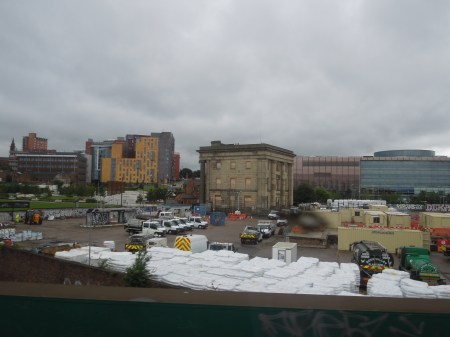
Birmingham Curzon Street Station
If HS2 is built, it will become part of the station for Birmingham. It is after all a Grade 1 Listed Building.
A Decision Day For HS2?
HS2 is a project that I think will never be built.
I was listening to the debate on Radio 5 this morning about George Osborne’s £11. 5billion public pending cuts and one guy phoned in to question, why with the obvious need for cuts, we are going to spend £33billion on HS2.
There is so much opposition to HS2 amongst the Nimbys, that I suspect that at some time parliament will chicken out and vote the project down.
I have never heard so much opposition to a project, in my lifetime. But then the general public doesn’t want new railways, they want new roads on which to drive their gas-guzzlers.
I also think HS2 is probably going about things the wrong way, but as to what the right way is, I do not know.
But we do urgently need the following.
- More capacity on passenger trains from London to Manchester and onwards to Scotland. The case for Birmingham may be less important, especially, if services to Marylebone can be improved.
- More freight capacity through London and to the North, especially after London Gateway becomes fully operational.
- A rebuilt and more efficient Euston station.
The freight capacity cannot be increased without creating a substantial new railway.
It will be interesting to see the way that MPs vote.
Belgians Give Up On Fyra
The Belgian government has pulled out of the Fyra project to run high speed trains between Brussels and Amsterdam. It’s reported here.
This sorry story has a lot of lessons for governments, who try to implement large projects.
Building railway lines and in particular high-speed lines is not difficult, except for the odd local political and environmental problems, as HS1 found in Kent and HS2 is now finding. But the actual line generally works well from an engineering perspective, with the possible exception of the Wenzhou crash in China, where signalling may have been at fault. None of the high speed train crashes in this country, were caused by engineering problems on new lines.
The main problems with Fyra are all about using new unproven trains. No sensible project manager would ever use unproven technology at the heart of a new project. You could argue, that Boeing used an unproven battery system on the Dreamliner. But look what happened there!
The other major problem with Fyra is that they discontinued the traditional services between towns like The Hague and Brussels, thus alienating a lot of their target market.
So when you do a large project, make sure that it fits the aspirations of your customers.
If we look at HS2 to Birmingham, the technology to be used to build the line will be very much proven, as hopefully will be the trains, which will probably be derived from something that is working well in the UK or Europe.
The line too, will be an addition to the current services between the two cities. This in itself removes a lot of risk from this line, as say there is a problem that cuts capacity on HS2, you don’t have only one basket for your eggs. I also believe the competition from such as Chiltern and Virgin trains and their successors, will make sure that HS2 is competitive and reliable. Those two services, will also act as valuable feeder services to HS2, as say you live in Banbury and want to go to Leeds, you’d hop to Moor Street station in Birmingham and then take HS2 to Leeds, when that section of the line is completed.
Is Sir Howard Going To Recommend A Second Runway At Gatwick?
This report in the Standard speculates that Sir Howard Davies report on London airports might be recommending a second runway at Gatwick.
I think this could be a sensible solution, to providing more runway capacity in the South East of England.
I said in this post, that Gatwick’s second runway, if it is built, should be North South. Here’s what I said.
I used to fly a lot and was an avid reader of Flight International. Years ago, an airline pilot proposed building a second runway at Gatwick, by building over the M23 and putting that in a tunnel underneath. The runway would have been North-South, which is an unusual direction for the UK, but would only have been used for take-off in a southerly direction.
He had a point and it shows how if you think radically, you may come up with better solutions.
I still think that this North-South proposal should be seriously examined.
Gatwick also has good rail links to London. My only questions are, are the links as good as they can be and are doing enough to make Farringdon a proper hub with restaurants, hotels and offices? I mused on the latter here!
We need some radical thinking to link the major airports together and also to the Channel Tunnel and HS2.
An Alternative London End To HS2
This plan called Euston Cross, was first aired in the railway press and is a serious alternative to what is currently proposed. it’s described detail in this post in a blog.
I think it should be taken seriously, as it would appear to have a few cost advantages and it would require less demolition at Euston.
As an engineer, who helped to develop the methods and software to build large projects, I believe that we can’t ignore the lessons of the biggest and most intelligent beast in the jungle; Crossrail.
Crossrail is setting new records for tunnelling proficiency, depth under London and project management. But as we experienced in the North Sea Oil industry in the 1970s, today’s big machines are dwarves compared to what will be available in a few years.
So the idea of linking HS2 to HS1 by means of tunnels and an underground station might be easier, than anybody would dare think using today’s technology. It could also go a lot deeper and just as Crossrail is diving under the Underground, it could probably dive deeper still.
The HS2 Eco-Report
The Sunday Times is reporting the Eco-report for HS2 stretched to 50,000 pages and weighs half-a-ton.
Partly this is due to the fact that Parliament needs a hard copy.
Surely though, that in this case to save a large number of trees, they should receive it electronically.
Getting To Huddersfield By Train
Huddersfield is the tenth largest town in England, with a population of 146,000 or so. As I found on my trip yesterday, it has a grand railway station with good connections to Manchester and Leeds, but it doesn’t have any good connections to the South and London. Those that came up by coach and car from Suffolk, weren’t too impressed by the roads to get their either.
I went by changing at Manchester Piccadilly, which at least has a frequent connection to Huddersfield. Going as fast as you can that way it takes a few minutes under three hours, as it does via Leeds. Going via Wakefield can be a bit quicker, but trying via Sheffield say stretches the journey to nearly four hours.
Looking at the various rail lines in the area, there is a line from Huddersfield to Sheffield called the Penistone Line. If someone had a bit of sense, it would seem that this area of Yorkshire could be given better transport links by improving this line so that it provides a better link to the Midland Main Line, when that is electrified to Sheffield. Many countries would electrify the line, but seeing the terrain yesterday and looking at the map, it might not be a cost-effective project.
The current improvements and electrification of the Midland Main Line will probably mean that going via Sheffield to London will be quicker than the other routes in a few years.
And then sometime in the next century HS2 might reach Sheffield Meadowhall station!
You can’t get over the fact, that Huddersfield seems to be a bit of an afterthought in railway planning and it has been like that for many years.
 The Anonymous Widower