Scarborough
I’d never been to Scarborough before so I took the opportunity to visit on my way from York to Hull.
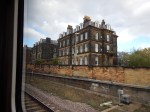
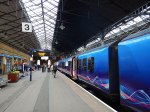







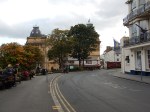


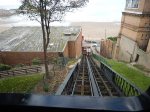
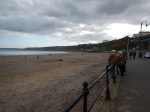
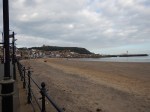
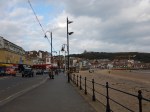
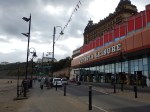
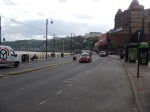
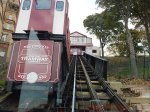



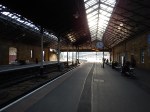
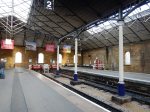

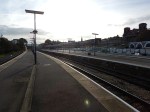
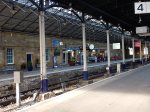

Looking back from a few days away, I think that Scarborough, would be a better place to stay than Hull.
I came to Scarborough station on one a Class 185 train and left in a Class 158 train, so I didn’t have to experience a Pacer. According to Wikipedia the Hull to Scarborough Line is usually worked by the very acceptable Class 158 trains, sometimes coupled to something else for more capacity. This is said.
Services are usually worked by Class 158 DMUs. Summer weekends see services operated by a Class 158 coupled to a Class 153 or extra Class 158 providing a 3/4-car unit for additional capacity. Sundays also see a variety of traction traversing the line to retain crew knowledge; this can include Class 153, Class 150, Class 142 and Class 144.
You do wonder how much traffic this route could generate if it was electrified and run by a new four-car electric train.
It would be very expensive to electrify, as until Hull is electrified, it would be a stand-alone system for about forty miles, that was a long way from any other electrification.
But if some means were to be provided to charge the trains at Scarborough and Hull, I suspect that IPEMUs could provide services between Scarborough and Hull and Scarborough and York with ease, given the easy nature of the lines.
This would also allow the TransPennine services from Scarborough to Manchester and Liverpool to be run by high-speed IPEMUs, which could bridge the electrifdication gap between Leeds and Manchester.
In an ideal world, a service should be provided between Scarborough and Whitby, which if there was an improved service around Scarborough would probably be needed to serve the tourism industry.
That area of East Yorkshire needs to be developed with respect to the leisure and tourism opportunities it offers.
Project Management Says No, But Politicians Say Yes
There is a puzzle over rail electrification all over the country.
Take this article in Rail Technology Magazine entitled NR reopens one of final Manchester-Preston electrification bridges four months late.
The headline says it all and there are problems like this all over the United Kingdom. Some are down to incompetence, some are due to poor ground conditions, some are because new equipment is failing to work and some are just because of a shortage of trained staff.
So we are left with the great dilemma, that why is it that electrification in the North and West is in trouble and Crossrail, which is a much more expensive project is supposedly on time and budget?
In my view it’s like comparing apples with oranges.
Crossrail is a mostly new railway built in virgin ground. Most of the reused bits like the lines to Shenfield, Reading and Heathrow have been rebuilt and electrified in the past. Some things need to be beefed-up and brought up to modern standards, but these tend to be a series of small projects like updating most of the stations or a few big construction projects like building Canary Wharf and the other central stations.
On the other hand electrifying existing lines, of which much of the infrastructure hasn’t been touched for years, is a much more difficult business. Especially when you come across places like the bridges in Bolton, Chat Moss and the Farnworth Tunnel.
How many of us have despaired as the bills have come in as we are doing up an old houise and sworn on our father’s grave, that we’ll never buy another old property? I certainly have and now live in a twelve-year-old house, that although it was badly built is easily fixed.
I have heard engineers say that the Victorians Gerry-built a lot of our railways. That may or may not be true! But certainly, it’s not an easy job to electrify Britain’s railways.
So when I read this article on the BBC entitled Network Rail to restart electrification of train lines, which says this.
The electrification of two railway lines is to be restarted after the projects were halted so a review could be carried out, the government says.
Work on the TransPennine Express Railway – between Manchester and York – and Midland Mainline – from London to Sheffield – was paused in June.
Sir Peter Hendy, Network Rail chairman, said the “temporary pause” had “given us the space to develop a better plan”.
How do I square it with reality?
Obviously, Peter Hendy must be off his trolley, as if you put the wires up for electrification, you’ll have problems.
But at Blackpool and Rugeley, which are two part-completed electrification schemes, where everything appears ready for the wires to go up, I think I saw the germs of the new plan. The sites were all tidy, with no evidence of electrification or the detritus that Network Rail commonly leave behind. All the bridges were finished and where needed platforms seemed to have been extended for the new longer trains. Balfour Beatty have even walked away from the electrification contract at Blackpool.
Other clues have been published in the media.
- Northern Rail split their Liverpool to Blackpool service to at least use electric trains to Preston and diesels thereafter.
- First Great Western were rumoured to be buying battery-powered trains or IPEMUs for their services along the Thames Valley
- Hull Trains are also rumoured to be buying electro-diesel trains.
- But I missed the biggest clue. The only section between Liverpool and Newcastle, that is not electrified is the 34 miles between Leeds and Manchester. This had been announced deliberately as being unpaused. An IPEMU would bridge the gap with ease.
- All the Midland Main Line electrification announced as unpaused can be implemented by IPEMUs.
- A study has been anounced into the creation of a second main line to Brighton, which is an ideal route for running using IPEMUs in prime Tory territory. It would also release a number of modern diesel multiple units for use elsewhere.
- In today’s Sunday Times, there is talk of some of the new Class 801 electric trains being built as Class 800 electro-diesel trains for the Great Western. This doesn’t matter in the long-term, as it just means you remove the diesel engines to convert the 801s to 800s, when the wires are working.
Every day seems to bring more and more clues.
I’m getting more and more convinced that this technology that I rode in Essex in 2014, is going to be the solution. IPEMUs as they are now called have a range of about sixty miles on batteries and if the trains are properly engineered with regenerative braking and intelligent control systems, they might even manage further.
I may be totally wrong, but then I can see no other way that electrification can be delivered, in the desired time-scale, than by going for a mixture of Class 800 electro-diesel and IPEMU trains.
The Class 800 electro-diesel can be summarised as follows.
- Proven Hitachi technology with on-board diesel engines for non-electrified sections.
- Built in Japan and Newton Aycliffe in the North East.
- Ideal for main lines, which are not fully electrified.
- 200-plus kph capability
- Highly automated
- Can be converted to a Class 801 electric train by removing the diesel engines.
The Aventra and the IPEMU-variant can be summarised as follows.
- Proven Bombardier electric train technology coming together in a modern lightweight shape.
- Built in Derby.
- Just under 200 kph capability, if required. Normally probably 160 kph.
- Most Aventra trains can be fitted with batteries to work in IPEMU mode.
- Battery technology has been proven in public trial.
- Range is IPEMU mode is sixty plus miles.
- IPEMU trains have regenerative braking, so they are actually more efficient than many trains.
- Highly automated
The approach does have other advantages.
- Many lines can be served by new electric trains with only minimal upgrading.
- Those who object to unsightly overhead electrification, have nothing to complain about.
- Lines can be electrified as fast as new trains can be delivered, provided there is enough electrified route to charge the IPEMUs.
- Depots don’t need to be fully electrified.
- The approach gets round the shortage of overhead electrification engineers.
- If a line like Gospel Oak to Barking is going to be electrified for other purposes like freight, there could be much less disruption to passenger services.
As an Electrical Engineer, who specialised in control systems, at Liverpool University, I do feel a touch of admiration.
I believe that although it doesn’t look feasibly from a project management basis to electrify lines to the stated time-scale, engineers in Japan and Derby have given the politicians their dream.
I shall be watching every word of George Osborne’s Autumn Statement on Wrdnesday, November the twenty-fifth.
Lewes Station
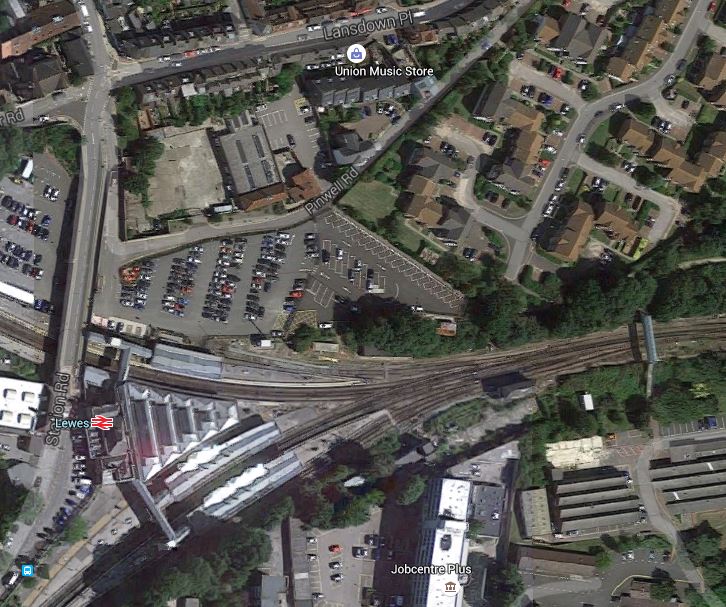
Lewes station has an unusual layout, as this Google Map shows.
Lewes Station
The line going off to the right is the East Coastway Line to Bexhill, Hastings and eventually via the Marshlink Line toAshford.
The top line at the left goes to Plumpton and eventually to London, whilst the bottom one goes to Brighton.
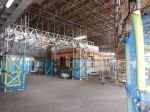
At the moment a great deal of work is going on, as these pictures of the station show.






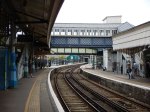
Lewes could end up being a more important station if plans to reopen the Wealden Line to Uckfield come to fruition, to create a second route between London and Brighton. There is a BML2 web site, which is nothing but ambitious, as this map shows.

BML2 Map
I think that the Lewes to Uckfield section might be rebuilt and it would be an ideal place to use IPEMU trains, as they could be used on the whole of the Uckfield Branch of the Oxted Line to replace the current Class 171 diesel trains.
I have a feeling too, that IPEMUs would be ideal to bridge the electrification gap between Ashford and Ore and allow Hastings, Bexhill and Eastbourne to have high-speed services to St. Pamcras. Would these services if they ever start turn back at Eastbourne, Brighton or Lewes?
There is certainly scope for extra services in the area, if only there were more routes to London. In many places along the South Coast, services are hourly, which given the development and other issues in the area, probably isn’t enough.
In my view, half-hourly services are the minimum frequency on any rail-line that is connected to major centres of population, as this effectively, is a turn-up-and-go service. If the Scots feel this is needed on the Borders Railway, then the logic probably applies along the Sussex Coast.
Will The London Overground Aventras Have Energy Storage?
When I wrote Is Liverpool Planning To Invade Manchester By Train?, I enclosed a clip from the October 2015 Edition of Modern Railways about energy storage on the proposed new Liverpool trains.
Merseytravel has indicated that it will be seeking ‘innovative proposals’ from manufacturers, with considerable emphasis being placed on the overall cost of operating the fleet rather than just the basic cost of the trains themselves. Options such as regenerative braking and onboard systems to store energy under braking to be used for acceleration will attract particular interest. The independently-powered EMU (IPEMU or battery train) concept evaluated earlier this year on a modified Class 379 in East Anglia ,might see an application here.
So if energy storage is good for Scousers, surely it would be good for Cockneys! I could add Brummies, Geordies, Mancunians, Bristolians, Glaswegians, Hullensians and lots of others too!
I feel that using the new trains in IPEMU-mode would be a better way to run electric passenger trains on the Gospel Oak to Barking and Dudding Hill Lines, as all the inept disruption of putting up the catenary could be performed in a more relaxed manner.
But are there any other advantages, other than the energy saving and flexibility, if the trains have energy storage or an IPEMU capability?
- This morning, the wires are down on the London Overground at Hampstead, so trains are stopped. An IPEMU could possibly get through to provide a limited service.
- At times, lines are closed for work on the electrification and Rail Replacement Buses have to be used. Would an IPEMU be able to provide a service in some cases, by perhaps using another track? Obviously, safety for the workforce would have to be ensured, but Network Rail is improving its working methods all the time.
- London has two different electrification systems; overhead and third rail. Would an IPEMU allow extra services to be developed, which bridge the two systems?
- Would an IPEMU give advantages in the design, construction and operation of depots, by needing less electrification, as trains could move under their own own power.
- Suppose a terminal station like Chingford needs to be rebuilt or a new station needs to be built, would it cost less to design and build a station, if the station had no electrification?
Even if the current order for Aventra trains for the London Overground isn’t delivered with energy storage and an IPEMU capability, I believe it will become the standard for it to be installed on trains in the near future.
Batteries Or Flywheels?
Hybrid buses and IPEMU trains need some form of energy storage.
Typical systems generally use batteries. Mechanical devices are discussed in this article in Transport Engineer.
Read the article.
Is Liverpool Planning To Invade Manchester By Train?
There is no love lost between the two North-Western cities of Liverpool and Manchester.
I must admit, that I do use the correct feelings towards Manchester, when I’m in Liverpool, as Liverpudlians like it!
In the October 2015 edition of Modern Railways, there is an article about Merseytravel looking for a new fleet of trains for their 750V DC network, which is entitled New Trains For Liverpool. This is said.
Merseytravel has indicated that it will be seeking ‘innovative proposals’ from manufacturers, with considerable emphasis being placed on the overall cost of operating the fleet rather than just the basic cost of the trains themselves. Options such as regenerative braking and onboard systems to store energy under braking to be used for acceleration will attract particular interest. The independently-powered EMU (IPEMU or battery train) concept evaluated earlier this year on a modified Class 379 in East Anglia ,might see an application here.
It does appear on a quick look, that a version of the new Aventra train, which comes with an IPEMU capability as standard might be suitable for Merseyrail, as the size and speed of the current Class 507 and 508 trains, don’t seem to be unusual like some trains of their age.
The trains would need to be dual voltage, so they could work on both electrical systems on Merseyside. But then Bombardier can handle that!
Surely, if the trains were IPEMUs, I can’t believe that Merseyrail would not use their capabilities to provide extra services to new destinations.
Ormskirk to Preston
In my meanderings yesterday, I twice passed the bay platform at Preston, which is the terminus of the Ormskirk Branch. This branch is about twenty miles long and is a monument to the British Rail Crap Design School and is detailed in the line’s History section in Wikipedia. This picture shows how I once changed trains at Ormskirk a couple of years ago.
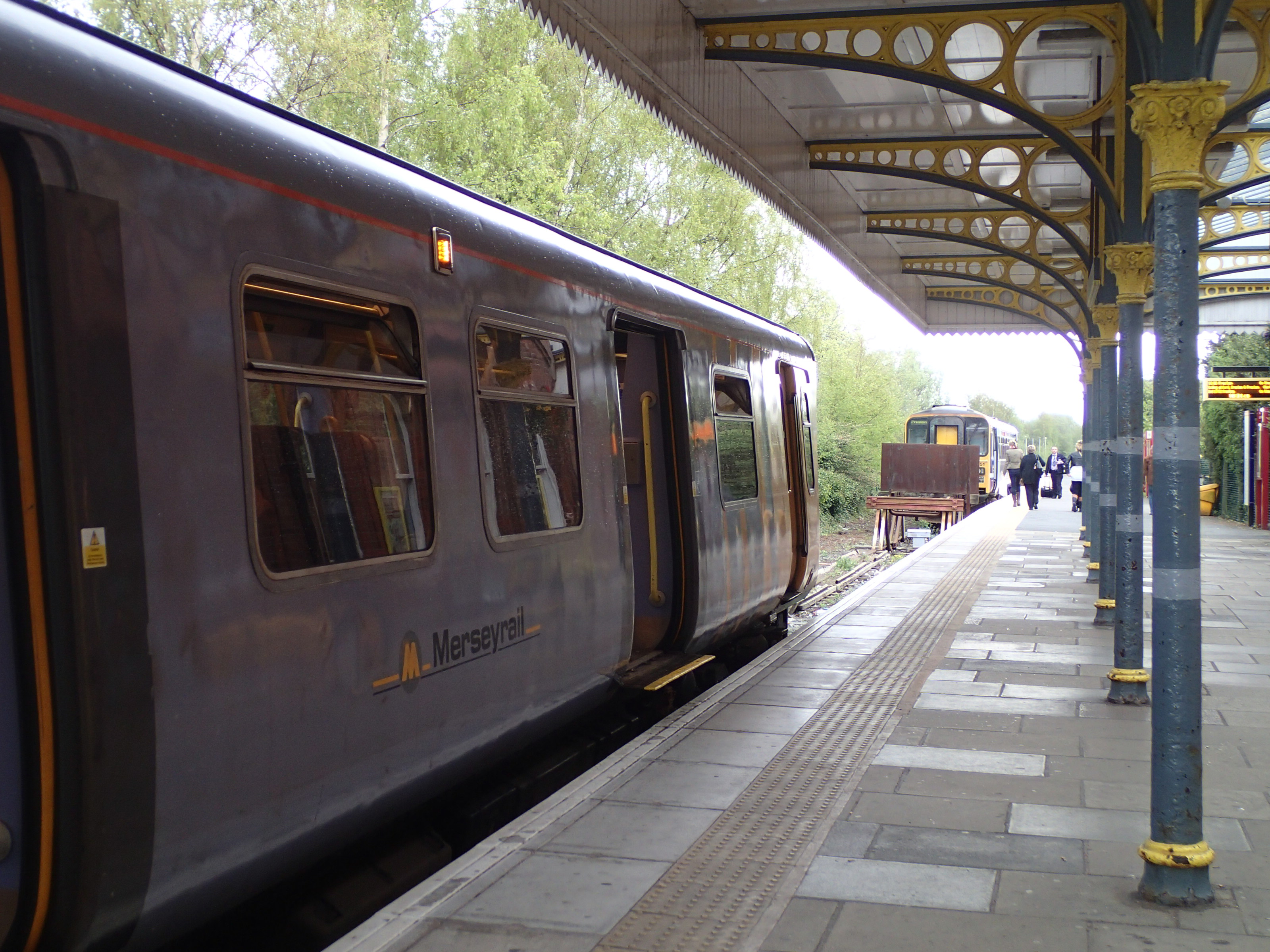
Changing Trains At Ormskirk
Note the barrier between the two trains.
If Merseytravel’s new trains, were IPEMUs, they would be able to provide a continuous Liverpool to Preston service via Ormskirk.
Dual voltage trains would be needed so they could use the different power systems at the two ends of the line.
Kirkby to Wigan, Bolton and Manchester
The British Rail Crap Design School were not satisfied with one bad interchange, but they did the same at Kirkby station, thus cutting the Manchester to Liverpool route via Kirkby in half and necessitating a change of train for anybody going this way.
Just as at Ormskirk, where IPEMUs can extend the Ormskirk branch of the Northern Line to Preston, dual-voltage IPEMUs could be used to create an extension of the Kirkby branch to Wigan, Bolton and Manchester.
IPEMUs would also enable the construction of a new station at Headbolt Lane between Kirkby and Rainsford, which is an aspiration of Merseytravel.
So IPEMUs would enable Liverpool to have another direct service to Manchester for invasion.
New Services to the North
Which services from Ormskirk and Kirkby get developed, would all be down to the traffic statistics.
But the engineering wouldn’t be much, that a competent small station builder couldn’t handle.
I’ve done the change at Ormskirk a couple of times, where in both cases I waited over thirty minutes.
In this modern age, that is as acceptable as piles!
New Services to the South
At its Southern End, the Northern Line joins the City Line at Hunts Cross station., so IPEMUs could travel to Manchester via Warrington Central, if that was what Merseytravel felt they should do.
I do feel that having another terminus like Warrington Central or even Chester might be worthwhile to increase capacity in the tunnel under Liverpool, where trains have to turn back at Liverpool Central.
But IPEMUs would be very helpful in this area, as apart from the line to Crewe, nothing is electrified.
Expanding the Wirral Line
There are various lines that are not electrified that connect to Merseyrail’s Wirral Line. The operation of IPEMUs has been proposed on one line; the Borderlands Line to improve connectivity between Wrexham and Liverpool. In a Proposed Battery Train section in the Wikipedia entry for the Borderlands Line, this is said.
A trial of an overhead-wire and battery powered converted Electrostar train was undertaken in January and February 2015 on the Mayflower Line. The train can travel up to 60 miles on energy stored in the batteries and also recharges the batteries via the overhead-wires when on electrified track, at stations and via brake regeneration. A month later in March 2015, the introduction of battery powered trains was proposed for the Borderlands Line by Network Rail.
The document suggested that consideration had been given to electrification and to running services further into Birkenhead ceasing termination at Bidston for greater connectivity. However these options were expressed as offering low value for money. They proposed that using battery powered rolling stock precluding full electrification of the line, providing a cheaper method of increasing connectivity into the electrified Birkenhead and Liverpool sections of the Wirral Line.
So if Merseytravel decides not to invade Manchester, they can always invade Wales.
Conclusions
I would feel that Merseytravel have got some planned uses for IPEMUs in mind.
I suspect that some of the uses will be rather surprising, but then the concept of an IPEMU does give transport planners a lot of flexibility and a go-anywhere capability.
This document on the Merseytravel web site is their plan of what they would like to do.
There’s certainly a lot of scope for IPEMUs, tram-trains, clever architects and capable construction companies to give Liverpool a world-class local railway network. For a start, they’re looking at stations in all these places.
Anfield
Beechwood
Carr Mill
Chester-Crewe Line
Deeside Industrial Park
Ditton
Edge Lane
Headbolt Lane
Ledsham
Maghull North
Skelmersdale
St James
Tarbock Interchange (or Halewood South)
Town Meadow
Tuebrook
Vauxhall
Warrington West
Woodchurch
That is a large number of stations for only a small part of the UK.
It’s when I read documents like the Merseytravel report, that I think that local areas, should have more control of their transport infrastructure, as local people and their politicians often know the best way to spend the money.
Also when a new station or line is built in an area and most people are in favour, they think of it as their infrastructure and use it!
Meandering Around Lancashire
Yesterday, I went to Ipswich Town’s disastrous match at Blackburn.
I went via Liverpool, as I had at one point intended to get a flight from Liverpool Airport to Poland on the Sunday to start one of my Home Runs.
But circumstances intervened and so I was left with only the first leg of my trip – A First Class ticket to Liverpool.
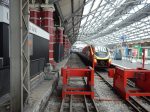
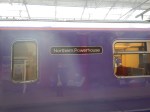
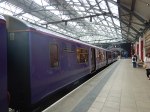
These pictures tell the story of my journey.






Note :-
- Norton Bridge Junction is The Two Hundred Million Pound Railway Project Of Which You’ve Probably Not Heard.
- Where were all the Class 319 trains in Liverpool? Only Northern Powerhouse was sitting forlornly in Platform 1! Normally, there’s half a dozen!
- The New Platform 7 at Liverpool Lime Street has been planned for years. And still nothing is happening.
- Blackburn station had no information on buses.
I’d actually taken six trains during the day.
- A Virgin Pendelino from Euston to Liverpool
- A Northern Rail Class 156 train from Liverpool to Wigan North Western
- A Virgin Pendelino from Wigan North Western to Preston
- A Northern Rail Class 156 train from Preston to Blackburn
- A Northern Rail Class 142 train from Blackburn to Preston
- A Virgin Pendelino from Preston to Euston
The trip up was by a roundabout route, but in some ways it illustrates the problems of trains in the area.
- Liverpool to Preston is fully electrified, but the service is run by diesels, although from Monday, it will be run by Class 319 electric trains on a half-hourly basis.
- As Preston to Blackpool is not electrified, usually the onward journey is a tired diesel.
- Preston to Blackburn and Burnley is not electrified and is generally run by antique Pacers and a few Class 156 trains.
- At the moment due to the Farnworth Tunnel problems, Manchester to Preston is not a journey for the faint-hearted.
Hopefully, it’ll all get better, when the Manchester to Preston via Bolton electrification is complete, but that won’t do anything from Preston to Blackpool, Blackburn and Burnley.
Whoever wins the new Northern Rail franchise is going to be mandated to buy 120 new carriages.
Surely, these should be Aventra IPEMUs and they should be used on these lines from or through Preston.
- Blackpool North to Hazel Grove
- Blackpool South To Colne
- Preston to Barrow
- Preston to Blackpool North
- Preston to Leeds via Blackburn, Bolton, Halifax and Bradford
- Preston to Manchester Victoria via Blackburn, Burnley and the Todmorden Curve.
- Preston To Ormskirk
- Preston to Windermere
They would probably be used on other lines in the area.
- Liverpool to Manchester via Warrington Central
- Manchester to Southport
These services might only need some platform lengthening, adjustments to track and signalling and a small amount of extra electrification.
The longest section that is not electrified is that between Preston and Bradford, which is probably less than sixty miles. If necessary the gap could be shortened by electrifying between Preston and say Rose Hill, where the Colne branch divides.
What surprises me, is that Bombardier haven’t created another demonstrator to prove the concept, just as they did at Manningtree.
Where Does The Borders Railway Go Next?
My Borders correspondent, who lives near Selkirk, says that the Borders Railway has been generally well received. Certainly if you search Google News for Borders Railway, you don’t find many problems or complaints, except one about the singing of the National Anthem for the Queen.
A friend in Edinburgh has just told me, that the trains are too crowded at times. So what’s new? New railways are always crowded, especially if they fulfil a need.
The most common articles on the web, are ones like this one from the Border Telegraph, entitled Next Stop Hawick….
So what will effect this line in the next few years and what do I think will happen?
The Me Too Effect
Now that Galashiels has a reliable half-hourly service to Edinburgh, I suspect that the inhabitants South of Tweedbank, will say that if Galashiels and Tweedbank can have this, why can’t Melrose and Hawick?
Cross Border Co-operation
The Borders area of Scotland and the neighbouring area of England are very similar and probably have the same strengths, problems and needs.
In some ways they are very economically linked now.
- Carlisle is economically tied to the Scottish Borders for shopping and transport links.
- Newcastle is a major airport for the area.
- There is even a rail service between Glasgow and Newcastle, that goes via Kilmarnock, Dumfries, Hexham and the Metro Centre.
- Area rail tickets for North West England include Lockerbie.
- Carlisle and Newcastle are the two major places to catch trains to the South, unless you go North to Edinburgh and Glasgow..
Surely this togetherness should be built on to develop the Borderlands, provided the politicians can be kept out of their way, in their offices in London and Edinburgh.
Increasing Railway Capacity Between England And Scotland
At present, the East Coast Main Line and the West Coast Main Line do not provide enough capacity between England and Scotland, for both passengers and freight.
Tourism And Other Economic Effects
I live in the Dalston area of Hackney, which is an area that has been uplifted by the creation of the London Overground from the rather decrepit railways that used to run through the area.
Unless you have lived through the process, most people will not understand how regular trains, running on a frequency of at least two an hour, can bring economic benefits to an area.
The Borderlands, probably have an economic profile not unlike the areas of East Anglia away from the large towns and cities that I know well.
- Both areas are ringed by a series of large towns and cities
- There is a lot of farming.
- There are a lot of tourism-related businesses of all sizes.
- In the summer, visitors take days out into the areas.
- There is a certain amount of specialist manufacture.
- Housing is being developed for those who have retired, who live and work locally and who commute to major towns and cities nearby.
All of these activities will increase the need for better transport links to the major cities that ring the areas.
The latest East Anglian Rail Franchise will mandate the franchisee to provide much better services all over the area and especially on the branch lines.
I can’t believe that the areas on both sides of the Border would not be worth developing in a similar way to that proposed for East Anglia.
Extending The Borders Railway To Melrose, Hawick And Carlisle
Scottish Borders politicians are all in favour of this extension, as are probably the good citizens of the area. My Borders correspondent and his family certainly appear to be.
Just as I have seen an economic uplift in Hackney because of the London Overground, I think it would be unlikely that the Borders Railway running through Melrose and Hawick, would not increase economic activity in the area.
This extension would certainly happen if Scotland stayed in the United Kingdom, as in some ways, this reopening, would help develop tourism in the wider area of the whole Borderlands, the Lake District and North Yorkshire.
Carlisle is probably the big winner in this activity and becomes a city with important or picturesque railway lines going everywhere.
- The West Coast Main Line, links England to Edinburgh and Glasgow.
- The Glasgow And South Western Line to Glasgow via Dumfries and Kilmarnock
- The Settle and Carlisle Line
- The Cumbrian Coast Line around the Lake District to Barrow and Preston
- The Newcastle and Carlisle Line
- The Borders Railway to Edinburgh
The Borders Railway provides the missing link in the railways of the Borderlands.
So when the Scottish politicians discuss the project, they should take into account, the positive affects a complete line would have on England!
Should The Borders Railway Be Electrified?
This question could legitimately by asked about all the other lines meeting at Carlisle, that are not electrified.
But as Carlisle, Edinburgh, Glasgow, Newcastle , Preston and Skipton are all electrified, I suspect all of the Carlisle lines have enough electrification to be run by modern four-car Aventra IPEMU trains, charging their batteries where overhead power is available and running on batteries as needed.
Some of the lines, including possibly the Borders Railway, are probably ready for Aventra IPEMUs now, with a bit of modification to platforms, track and signalling! Some like probably the Cumbria Coast Line would need some electrification or other means to charge the batteries en route.
So the answer to the electrification question must be yes, if Aventra IPEMUs are used.
But it would create a local railway network, as good as any in Europe, in an environmentally-friendly but totally affordable way.
It would be a showpiece of British technology and an attraction to rail enthusiasts from all over the world.
The network also connects to four World Heritage Sites and the Lake District, Hadrian’s Wall and the major cities of Edinburgh, Glasgow and Newcastle.
Would An Extended Borders Railway Provide Extra Capacity Between England And Scotland?
The Borders Railway has a limited number of paths for trains and when a steam special is run, one of the diesel multiple units has to give up its slot. Read various criticisms on Wikipedia.
My scheduling experience, does suggest to me, that if the line was run by the faster and better accelerating electric trains, including Aventra IPEMUs, that this might create some extra capacity on the line.
Unless the line was fully electrified, it wouldn’t be a route for using the electric trains that run up the East and West Coast Main Lines.
But it would be able to take services run by Aventra IPEMUs or any diesel-hauled passenger or freight trains.
These capacity arguments would also apply to the Glasgow and South Western Line, so with a bit of selective electrification and Aventra IPEMUs, some extra capacity might be squeezed in.
I certainly think that a railway time-tabling expert could certainly find some extra capacity.
But it might be overnight freight trains?
Are There Any Branches To The Borders Railway That Could Be Created?
The original Waverley route had several branches including to Peebles and Hexham.
Midlothian Council have also thought about a branch to Penicuik.
Extra branches are up to the economics and the politicians.
Conclusion
In my view, not to extend the Borders Railway to Carlisle by way of Melrose and Hawick, would be total stupidity.
The problem is that despite being totally in Scotland, extending the Borders Railway to Carlisle, has substantial benefits for England too!
What will Nicola think?
Jumping The Electrification Gap Between Leeds And Manchester
The Battery High Speed Train
An Aventra uses a modern version of the same bogies that are used in the Class 222 trains, which are capable of 200 kph. As the Class 387 train, which is a version of the Electrostar, can travel at 110 mph, I wouldn’t rule out that the more modern Aventra could run at 200 kph or 125 mph. Obviously, this speed would probably only be attainable in places on the East Coast Main Line.
Example times between York and Newcastle include.
- East Coast InterCity 225 – 56 minutes
- East Coast InterCity 125 – 62 minutes
- Transpennine Class 185 – 67 minutes
So if the performance on the line of an Aventra IPEMU was the same as an InterCity 225, then this would knock eleven minutes of the trip to Newcastle
Acceleration on batteries would be the problem, not maintaining a high speed. that had been built up whilst running under the wires.
When jumping the gap in the electrification between Leeds and Manchester, as the train will have been running from either Liverpool or York, I would suspect that it would set out over the Pennines with a full load of electricity.
Manchester To Leeds Electrification Gap
The Manchester to Leeds electrification has now been paused and it is likely that it will not be completed in the next ten years.
The line has its problems as the three-car Class 185 trains, that work the line, are totally inadequate for the route.
There are two major routes between Leeds and Manchester.
- The Huddersfield Line via Dewsbury, Huddersfield and Stalybridge.
- The Calder Valley Line via Bradford Interchange, Halifax, Hebden Bridge, Todmorden and Rochdale.
The shortest distance by rail between Manchester and Leeds is just 43 miles. When I saw this, I didn’t believe it, but it’s all in this article in the Guardian.
So this means that if you want to run an electric train between Liverpool and Manchester to Leeds, York and Newcastle, the Aventra IPEMU would bridge the gap with ease.
The demonstration version of the Aventra IPEMU was a modified Class 379 Train and had a range of sixty miles on batteries.
So even this modified Stansted Express would have been able to bridge the gap on both routes with ease.
A fully engineered production Aventra IPEMU would be unlikely to have a shorter range on batteries.
So Aventra IPEMUs create a fully-electrified TransPennine route from Preston, Liverpool and Manchester in the West to Leeds, York and Newcsastle in the East.
Destinations In The West
These are all current Western destinations for Transpennine Express.
- Barrow – On an unelectrified branch line from an electrified Carnforth.
- Blackpool North – On an unelectrified branch line from an electrified Preston.
- Liverpool – On a direct line from Manchester that is completely electrified
- Liverpool via Warrington – On a direct line from Manchester that is partially electrified.
- Manchester Airport – Electrified from Manchester
- Windermere – On an unelectrified branch line from an electrified Oxenholme.
All could be served by using Aventra IPEMUs.
I suspect it would also be possible to serve Chester.
I’m not sure how Aventra IPEMUs would affect slower services like York to Blackpool North across the Pennines, but I suspect they would be faster than the current diesel multiple units.
With the franchises being reallocated, I suspect that it will be done in such a way, that the trains across the Pennines give a much better service.
Destinations In The East
These are all current Eastern destinations for Transpennine Express.
Cleethorpes – Probably too far, but the Class 185 trains could run the service as they do now!
Hull – Hull is perhaps fifty miles East of the East Coast Main Line and I believe that a solution can be found to do this on an out-and-back basis.
Middlesbrough – This is a few miles from Darlington
Newcastle – Electrified all the way from Leeds
Scarborough – The York to Scarborough Line is forty two miles long and I believe that a solution can be found to do this on an out-and-back basis.
Whether Aventra IPEMUs can do the return trip from the East Coast Main Line on an out-and-back basis to Hull and Scarborough, depends very much on how the range of the trains work out, when the production trains are delivered. I suspect Bombardier know and have either calculated it or proven it on a test rig, but obviously they are keeping it quiet and sticking with the sixty miles total range obtained with the Demonstrator.
If they can’t make it, I suspect that they can provide some form of charging at the Eastern termini.
I do suspect that because of the reorganisation of the two franchises we may see some extra destinations in the East.
Times Across The Pennines
At present times on the major routes are.
Liverpool to Newcastle – 3 hours
Liverpool to Hull – 2 hours 30 minutes with a change at Leeds
As I indicated earlier there is eleven minutes to take off the Newcastle journey and the change at Leeds probably wastes ten minutes on the Hull trip.
Other factors would have an effect.
- The time spent on a stop by the Aventra IPEMU will be less than that of the current Class 185 trains.
- If diesel multiple units on the two TransPennine routes can also be replaced with Aventra IPEMUs, then these trains would be less likely to slow the fastest expresses.
- The Aventra IPEMUs are faster than the current trains.
- Network Rail will probably be able to do some small amount of trackwork to speed trains up in places.
I have no idea what the eventual TransPennine time will be, but it will be a few minutes less than today’s times.
An Open Letter To George Osborne About Teeside
I should say, I have no connection to Teeside, except that I quite like the area.
There is little that can be done about SSI Redcar, other than hope for a miracle, as there is so much steel being produced in the world, that the price will only get lower and the plant will get less and less economic.
I also live in Dalston, which since the arrival of the London Overground five years ago, has very much gone up in the world! And in some ways, like employment, gone up for those at all levels in society.
So I very much feel, that improving a railway and other forms of public transport, can only make an area more attractive for investment, employment, living and leisure.
Teeside has been lobbying for a Metro for years, to link the knit the area together.
There is only one way that this can be provided in the absolutely necesary short time-scale.
The railway line between Newton Aycliffe and Middlebrough should be electrified, as soon as possible. Immediately, this would enable.
- The new trains being produced at Newton Aycliffe by Hitachi, to get to the East Coast Main Line under their own power.
- Direct electric train services between Middlesbrough, Darlington and all points North and South from Edinburgh to London on the East Coast Main Line.
Northern Rail or their successor have been mandated in the new Invitation to Tender for the franchise to provide 120 new carriages to replace the disgusting Pacer trains.
Some of these new carriages should be the IPEMU variant of the new Aventra trains, being produced by Bombardier at Derby, which could by the use of the electrification at Middlesbrough and on the East Coast Main Line and the trains on-board batteries be able to run on the following routes.
- Saltburn to Bishop Auckland via Middlesbrough and the Tees Valley Line
- Hexham to Nunthorpe via the Tyne Valley Line, Newcastle, Sunderland, the Durham Coast Line, Hartlepool and Middlesbrough.
- Middlesbrough to Whitby could be done later.
The faster electric trains would increase capacity, decrease journey times and improve frequencies.
The only construction needed for the new trains, would be a small amount of platform lengthening and adjustments to the track and signalling.
 The Anonymous Widower