Sizewell B Nuclear Plant To Get Life Extension
The title of this post, is the same as that of this article on Energy Live News.
This is the sub-heading.
Power station was slated to close in 2035 but could have its life extended by two decades
These two paragraphs add detail to the story.
EDF and Centrica are preparing to invest around £800 million to keep Sizewell B generating for another 20 years, according to reports.
The Suffolk nuclear plant is currently due to close in 2035 but the companies are in talks with the UK Government over a deal that could extend operations to 2055.
These are also some facts from Wikipedia and other sources.
- Sizewell B was commissioned in 1995.
- It has a capacity of 1.2 GW.
- It provides three percent of the UK’s power.
- According to Google AI, Sizewell B has had an excellent safety record.
- Sizewell A is the only UK nuclear power plant that I have visited and I was very impressed how they managed the annual shutdowns.
Incidentally, according to Google AI, Sizewell A generated electricity for forty years and only had one alarming problem during decommissioning.
How Many Similar Nuclear Plants Are There In The World Like Sizewell B?
I have to ask this question, as when you are running old machines of any type, the more operational examples you have the better.
I asked Google AI and received this answer.
Sizewell B is the UK’s only commercial Pressurized Water Reactor (PWR). Its nuclear core is based on the Westinghouse 4-loop SNUPPS (Standardized Nuclear Unit Power Plant System). While hundreds of PWRs operate worldwide, only two exact global clones share this foundational design, alongside heavily adapted reactors.
The Exact SNUPPS Clones (2 in the world)
Sizewell B’s “nuclear island” is fundamentally based on the SNUPPS model developed in the 1970s.
Only two other plants share this exact base design:
Callaway Nuclear Generating Station (Missouri, USA)
Wolf Creek Generating Station (Kansas, USA)
Note: While Sizewell B utilizes this base architecture, it features significant UK-specific modifications, such as heavily diversified safety systems and an Emergency Boration System.
Similar 4-Loop Westinghouse PWRs
If you are looking at the broader Westinghouse 4-loop PWR family—the wider technological class that Sizewell B belongs to—there are dozens of similar reactors spread across the globe.
These operate in countries like the United States, France, South Korea, and China.
I have been over four PWRs of various makes in the United States and only one gave me any cause for concern.
My training at ICI taught me, that if you have a complicated and possibly dangerous plant or factory, you must keep it tidy, as that lowers the risk of accidents.
This nuclear power plant was the most untidy industrial plant I’d ever seen. Since I visited in the 1980s, it has been decommissioned and demolished.
Would I Be Happy To See Sizewell B Carry On Generating?
Obviously, I’d be guided by the various authorities and information from around the world.
But Sizewell has the Leiston factor. Leiston is the nearest town to the Sizewell site.
This is a paragraph from Leiston’s Wikipedia entry.
Leiston thrived in the late 19th and early 20th centuries as a manufacturing town, dominated by Richard Garrett & Sons, owners of Leiston Works, which boasted the world’s first flow assembly line, for the manufacture of portable steam engines. The firm also made steam tractors and a huge variety of cast and machined metal products, including munitions during both world wars. The works closed in 1981 and the site was reused as a mixture of housing, flats and industrial sites. The Long Shop Museum, showing the history, vehicles and products of the works, remains as a heritage tourist attraction.
Did the engineering heritage of the area contribute to the good safety records of the first two Sizewell nuclear power stations?
I also lived near the nuclear site at Sizewell for thirty years and the feeling of Suffolk people about the power stations is more one of pride, rather than fear.
Suffolk: Sizewell C To Explore ‘Innovative’ Waste Heat Lido
The title of this post, is the same as that, of this article on the East Anglian Daily Times.
This is the sub-heading.
The developers of the new Sizewell C nuclear power station have expressed an interest in an “innovative” plan to use waste heat from the plant to heat a new lido.
And this is the first paragraph.
Creating the outdoor pool was one of a number of ideas contained within the Leiston masterplan – a blueprint for transforming the Suffolk town – and now the Sizewell C company has pledged to explore the proposal with the town council.
This map shows the town of Leiston and the Sizewell power stations site.
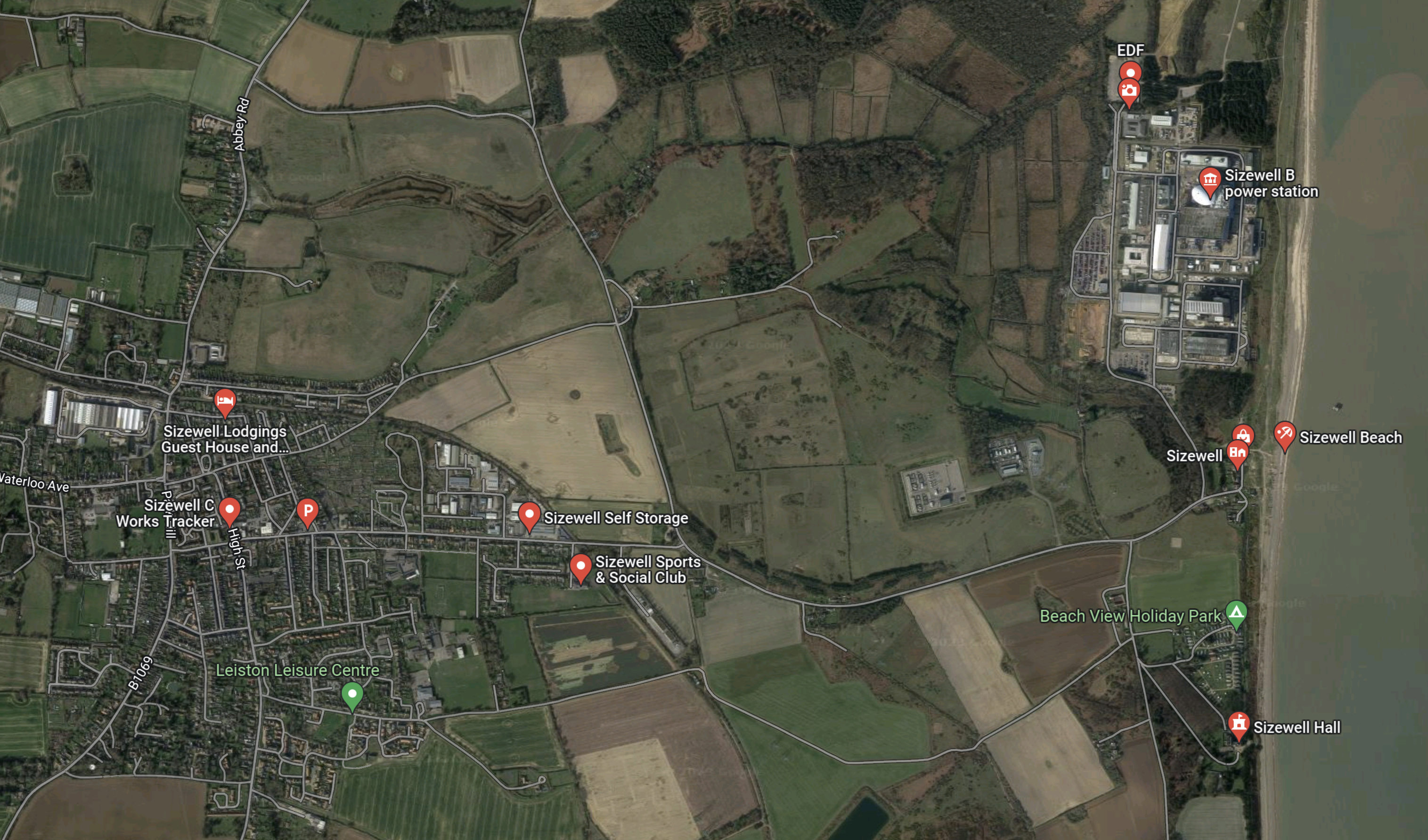
Note.
- Leiston is in the South-West corner.
- The power station site is in the North-East corner.
I have a few thoughts.
Pink Hydrogen
Pink hydrogen is zero-carbon hydrogen produced using nuclear power.
The production of hydrogen is already part of the plans for Freeport East, which I wrote about in Ryze Hydrogen’s Suffolk Freeport Hydrogen Vision Takes Shape.
In that article, I said this.
This would mean that Sizewell’s 6 MW electrolyser could be producing around a thousand tonnes of hydrogen per year or 2.6 tonnes per day.
The more efficient high temperature electrolysis can be used, using some of the waste heat from the nuclear power station. I wrote about this in Westinghouse And Bloom Energy To Team Up For Pink Hydrogen.
I also suspect that it may be more efficient to use seawater to produce the hydrogen.
Could high temperature electrolysis be used at Sizewell?
District Heating
The waste heat can also be used for district heating.
A Train Service To Ipswich
This Google Map shows the railway through Leiston, which is currently used to bring fuel to Sizewell B power station and remove waste.

Note.
- The railway starts in the North-West corner of the map.
- The green dot in that corner marks Leiston cemetery.
- The railway then goes East before turning to the South-East corner of the map.
- In that corner, there are two sidings for loading and unloading the flasks.
Surely, Leiston also needs a new railway station, with at least an hourly service to Saxmundham, Wickham Market, Woodbridge and Ipswich. And possibly even Aldeburgh!
This map from OpenRailwayMap shows the route of the Aldeburgh branch.
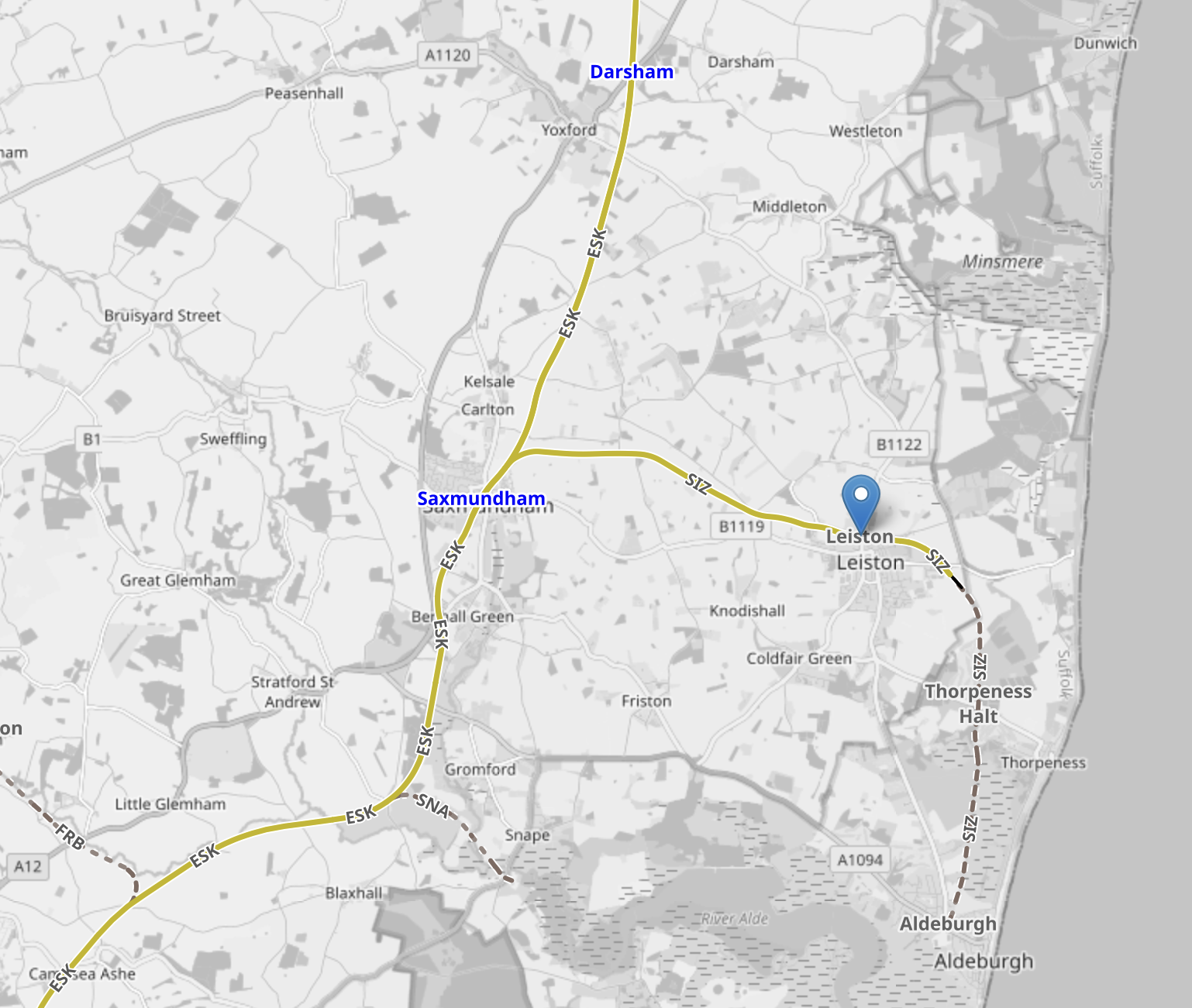
Note.
- The North-South yellow line is the East Suffolk Line.
- Their were three stations; Leiston, Thorpeness Halt and Aldeburgh.
- Leiston station was in the North of the town.
The intact section of the branch is shown in yellow.
There would be no need for any electrification, as Stadler, who built Greater Anglia’s Class 755 trains, are the masters of battery-powered trains and could convert these trains to battery operation. Recently, one of the smaller metro trains, that Stadler are building for Liverpool, ran for nearly 90 miles on battery power alone, which I wrote about in New Merseyrail Train Runs 135km On Battery.
An hourly train service would double the frequency of the train service between Saxmundham and Ipswich.
Does the Leiston masterplan include a train service?
And if it does, does it terminate at a new Aldeburgh station?
Conclusion
Integrating development around a nuclear power station could be a way of levelling up.
It would bring electricity, heat, a rail link and jobs to an area.
Will Rolls-Royce use these benefits to sell one of their SMRs to those living around a site?

