Brown Uses the D-Word
As I drove back home today, I was listening to Prudence’s speech to businessmen.
He then used the D-word – dynamism. I can remember Peter Ryrie using that many times as he tried to dominate student politics in the 1960s at Liverpool University.
I laughed, as we all used to mock Peter for the word.
Sadly though, I’ve found that Peter died in 2007.
Liverpool and Meccano
There are various events, cities, techniques, toys, people and just plain things that has shaped my life.
If I take events, there would be the first Sputnik, Sharpeville, the assassination of President Kennedy, England winning the World Cup in 1966, man landing on the moon for the first time, the Six Day War, the suicide of Jan Palach, the Falklands War, the fall of the Berlin Wall and many others. Perhaps one that will mean more to me in a few years time, was being in Trafalgar Square, when London won the Olympics for 2012.
I will be proud of the London Olympics because London is my city. I was born there and when I’m sad, lonely or just plain bored, I make to the most fabulous city in the world. The London Olympics may be a failure because of circumstances, good or bad, but London will do its best. And that will be better than most, as when you throw London into turmoil, Londoners respond in a unique way. Why unique? Because Londoners are the biggest mongrel race in the world and they can draw from experiences like no other.
I met my wife in Liverpool at the University.
For that and other reasons, to me Liverpool will always be my second city, just as it is the second city of the UK. Glasgow, Manchester and Birmingham may make this claim, but they are lightweights compared to the city of the Beatles. I sometimes ponder how life would be different without the Beatles and it may be a bold claim to say that without them the UK might have been some insignificant island off mainland Europe. But those four did give England and Great Britain a new pride, that had been lacking since the end of the Second World War. I still play their songs virtually every day.
At one time my late wife shared a flat near the Meccano factory in Liverpool.
I had a very large Meccano set, which was very much part of my life until about sixteen when I sold it, because I needed the money. I’d while away the time in my bedroom, building all sorts of machines. Later when I worked for ICI, we’d use bits of Meccano to make instruments work. Do engineers still do that?
So it was with pride and a lot of sadness that I watched James May’s Toy Stories about Meccano. He built a Meccano bridge over the extension to the Leeds and Liverpool Canal. I cried as it was set in my university, the university where I met my wife and was about my favourite toy.
Life is a powerful mixture of emotions.
Leader of the Pack
I had never heard of Ellie Greenwich, but I have heard many of her songs, like Leader of the Pack, Do Wah Diddy Diddy, Kentucky Woman, Chapel of Love and River Deep, Mountain High, to name just a few.
Sadly she has died of a heart attack.
Her songs though gave me a lot of pleasure.
I particularly remember seeing Manfred Mann singing Do Wah Diddy Diddy at Liverpool University.
Thanks for all the memories.
Status Quo at Newmarket
I went to Newmarket Races last night and after racing Status Quo performed.
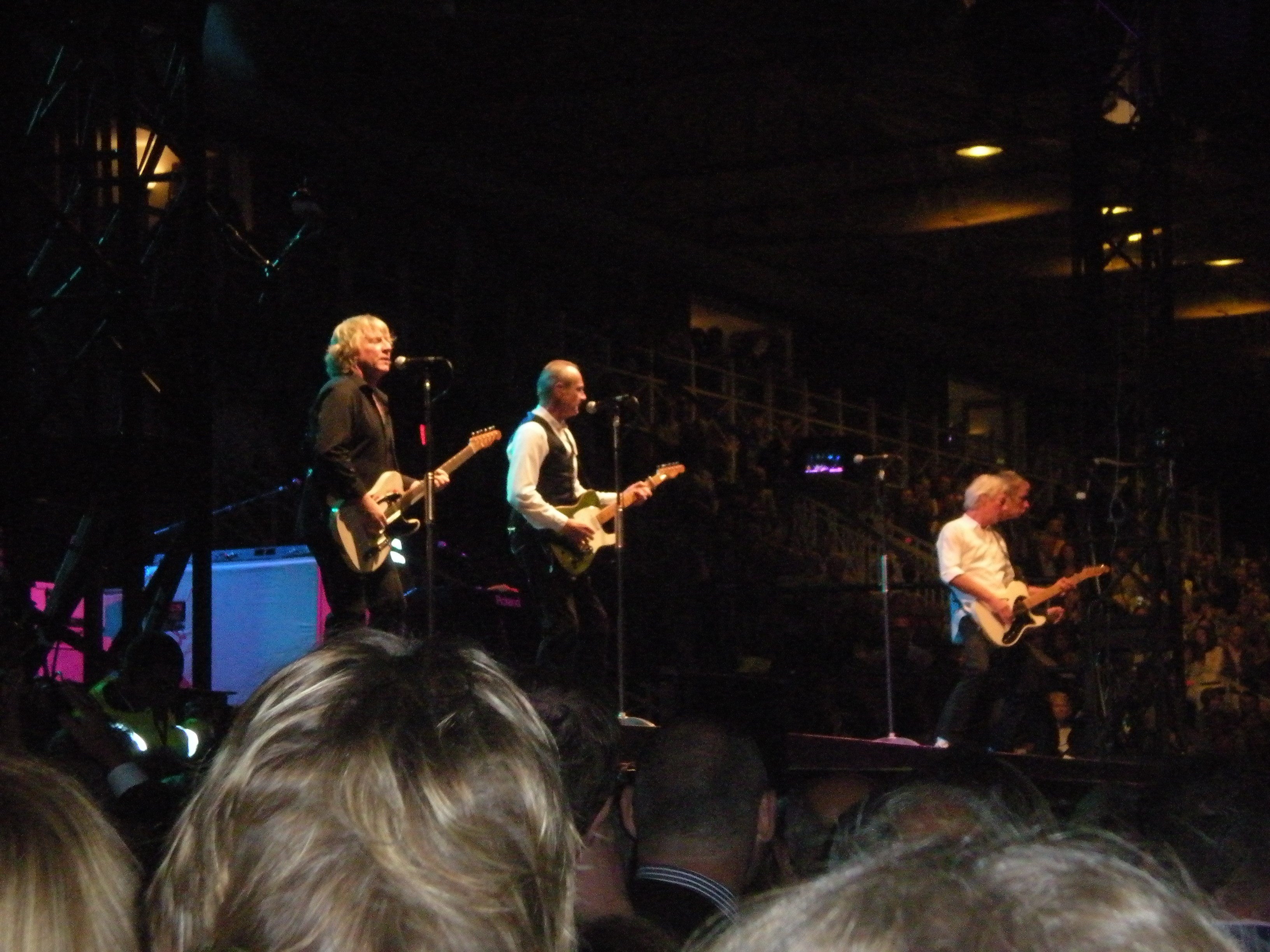
Status Quo at Newmarket
They were very good. Strangely they are not a band that I’ve followed, which was probably because I was at Liverpool University in the 1960s and tended to follow the bands I’d seen there.
It was interesting to note that Francis Rossi and Rick Parfitt got together in 1967. That means that they have been a partnership longer than I was married to my late wife, who I met coincidentally early in the same year.
It’s almost sad for me!
Celebrities
The case of Steven Gerrard is in all the newspapers at the moment. It raises a lot of issues, including the case of celebrities behaving properly.
After all, we’ve had a lot lately, who have got into trouble. Read something like Popbitch and you’ll get all the dirt on many who have overstepped the mark.
I go racing a lot, mainly at Newmarket. You see quite a few people there, who are in the news and they are rarely bothered and I’ve never seen anyone behaving less than impeccably. So perhaps, what happens occasionally and gets in the papers is just an aberration.
One tale I remember, is when we were flying to Greece I think and Susan Hampshire was on the plane. It must have been some time in the 1980s and the plane only had one class. She just said hello to everyone, signed a few autographs and just was extremely pleasant. We all left that plane, saying that she such a nice lady. I’ve had a soft spot for her ever since.
It must have been about 1973 or so, when I travelled to Middlesborough on a train. I had breakfast on the train and sat in a set of four seats in the dining car, with two gentlemen from Evans, who ran the shops for larger ladies, and their guest, Janet Webb. If you remember her from her closing the Morecambe and Wise Show, you will remember that she wasn’t a small lady. She entertained the whole carriage. What a trouper!
I also shared a similar four going to Liverpool on a train with two railway engineers and Virginia Wadeat about the same time. I think she was tired as she slept most of the way. Or was it that we talked about trains all the way up! If I remember, she got off at Crewe to take the train to the tournament at Hoylake. How lives have changed for tennis players since.
These are just three instances, where celebrities have enlightened the everyday lives of others. I could add more.
Is It Art?
There was a discussion as to whether some of the high-profile art in the UK recently, like Anthony Gormley’s Fourth Plinth, is actually art. Perhaps, it is, but perhaps it is not.
In the 1960s, the Engineering Department at Liverpool University bought a set of modern prints. Some wag put a beautifully typed and framed note beside one, which said “We would have liked to buy a painting by this artist, but unfortunately we could afford it. So he was gracious enough to sell us the rag on which he wiped his brushes.”
Seriously though, I went to the University recently to see the Stuart Sutcliffe retrospective. I don’t like modern art generally, but when it is good like some Warhol, I relate to it. Now, the Sutcliffe paintings showed a certain talent. I wonder what would have happened if he hadn’t died at 22.
How I Met My Wife
My wife and I were together for forty years before she died in 2007. I say together, as we were effectively living together for a year before we married in 1968.
How we met was unusual, but before I say how, it is worth adding a little bit of interesting history to this note. At the time, along with many of the other students at Liverpool University, I filled in the forms from Operation Match, which was one of the first computer dating agencies.
Two Harvard students — Jeff Tarr and Vaughan Morrill — came up with the idea for Operation Match, a computer dating service, in the mid-1960’s. But they had some help from a Cornell dropout named Douglas Ginsburg.
Did it work? No! I got some names, but I don’t think I ever even met any of them.
In my second year at the University, I shared one of the world’s worst flats with three other students in Princes Avenue in Liverpool 8. Upstairs lived Mike Davidson, who was the Entertainments Secretary of the Students Union. He was trying to get more students to go to Guild Ball and had the idea of running his own Operation Match.
When I heard of this, I asked if I could have first pick!
And that is how I met my wife.
Interestingly, Douglas Ginsburg seems to have dropped in and is now a senior judge in the United States.
Where are all the Widowers?
After the last post I searched deeper for widowers blogs and information that might help. There would appear to be very little.
Are we all that low on the radar? Or do we just sit and suffer in silence? I have met one widower, who has decided to enjoy himself with large numbers of young ladies, but I think that he is rather in the minority.
There is I think little research into widowhood and even less where widowers are concerned. One researcher at my old university of Liverpool, does research the subject, but when you consider how many are bereaved in this world, the number involved in this subject is very small.
Surely decent research on identifying the problems and suggesting solutions, might be a very affordable way of improving society.
But it still doesn’t answer the question as to why so few widowers are posting on the web.
Posting helps me! So I suspect it would help others.
Memories of Polythene
My first job on leaving Liverpool University was at ICI Mond Division in Runcorn. I actually worked in Research at Runcorn Heath and like the company itself, I think where I worked no longer exists. Or should I say I couldn’t find it when I returned to the area last year.
The process for making polythene, or more correctly polyethylene, was discovered by ICI at Northwich.
The first industrially practical polyethylene synthesis was discovered (again by accident) in 1933 by Eric Fawcett and Reginald Gibson at the ICI works in Northwich, England. Upon applying extremely high pressure (several hundred atmospheres) to a mixture of ethylene and benzaldehyde they again produced a white, waxy, material. Because the reaction had been initiated by trace oxygen contamination in their apparatus the experiment was, at first, difficult to reproduce. It was not until 1935 that another ICI chemist, Michael Perrin, developed this accident into a reproducible high-pressure synthesis for polyethylene that became the basis for industrial LDPE production beginning in 1939.
For some months in my brief period at Runcorn, I shared an office with L. H. (Bert) Cross, who told me quite a bit of the history of how polythene was made. He would confirm the statement in Wikipedia that it was created by accident, as the researchers were experimenting with high pressures on ethylene gas.
Bert was an infra-red expert and he had analysed the spectrum of the compound to confirm what it was and ascertain his properties. I won’t put all of the story in, as even now many years on, I don’t want to destroy confidences. But let’s say that he found some interesting properties of polythene.
I’m not sure if it was Bert who told me, but at first they had no idea of what to do with their new product. It was very expensive and suggestions that it could be used to stiffen wax candles were probably quickly discounted.
In the end it was Radar, that used polythene because of its unique insulation properties. Even today, you’ll still find polythene as the insulation in the high-frequency cable that connects your television to the aerial.
Later I went on to work at ICI Plastics Division, but strangely I never worked on polythene, its production or properties again.
World Heritage Sites in the UK
Pontcysyllte is the latest UK World Heritage Site and brings the total to 28. The government web site doesn’t include this latest one, but gives a list of all.
I’ve visited about half and would like to visit all.
But one is St. Kilda, so I doubt I’ll get there!
My favourite is Liverpool, as I went to University there and met my wife in the city.
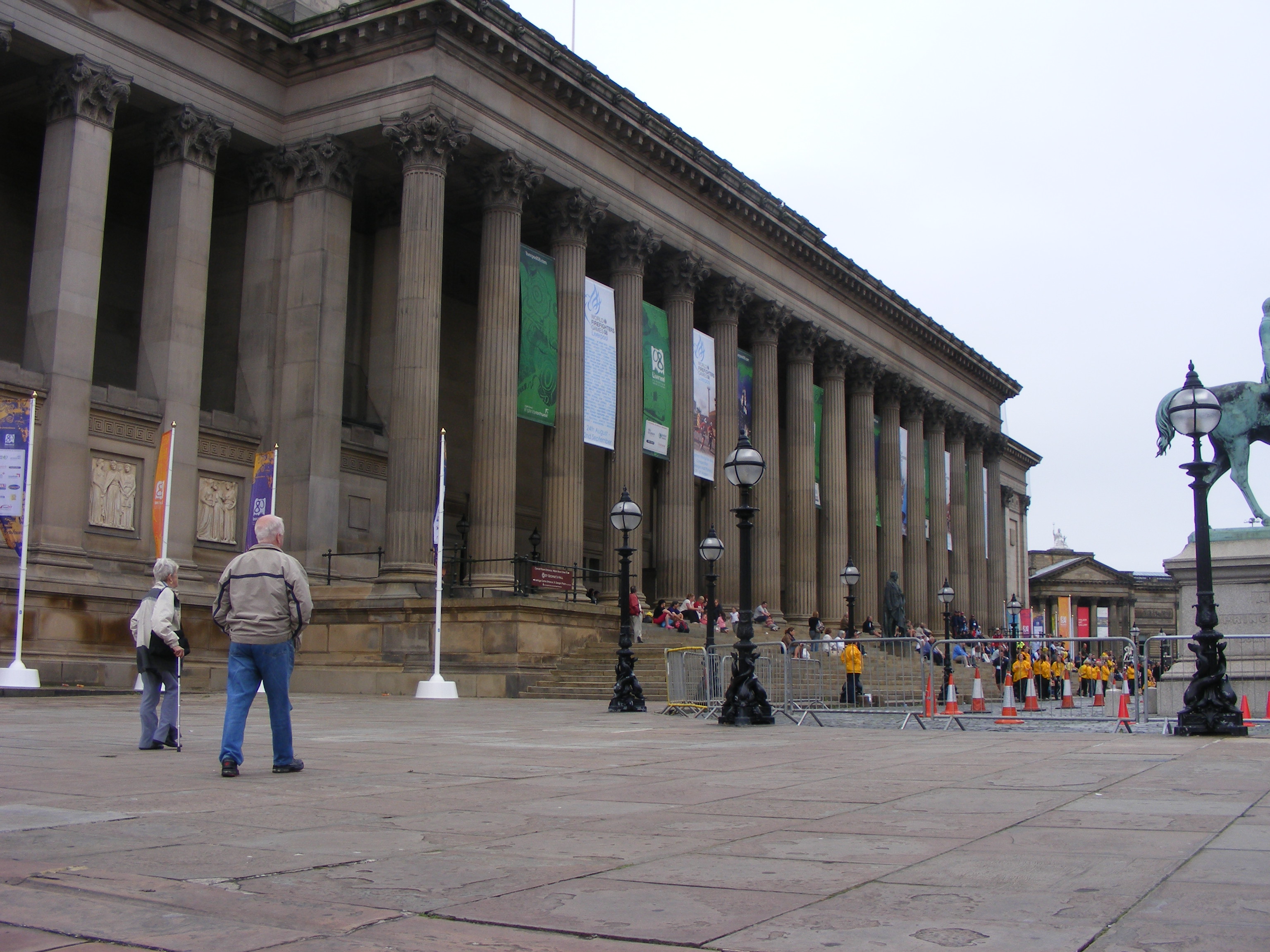
St. Georges Hall, Liverpool
 The Anonymous Widower