This report from the Thurrock Gazette tells how London Gateway is making a big effort to recruit more women. Here’s an extract, which explains the title of this post.
One of these is former beautician Nicki Allabush from Stanford-le-Hope, who has been a terminal operative for 18 months.
“I absolutely love the challenge that this job offers,” she said. “I thought, if men can do it, women can too.”
Note that the paper didn’t bother mention Ms. Allabush’s age, something that many papers find essential information.
Let’s hope this campaign is as successful as the one by the London Underground to recruit more female train drivers, by placing an advert in Cosmopolitan.
August 5, 2014
Posted by AnonW |
News | Employment, London Gateway |
Leave a comment
It may seem strange that freight has such a large affect on the Gospel Oak and Barking Line, which is essentially a passenger railway across North London.
But at the Barking end of the line there could be very good connections to London Gateway and the other end has good connections to the main routes to the north. So a container unloaded at the port, which is destined for say the large distribution centre at Daventry, could go on a train up the Goblin to the West Coast Main Line. Other large distribution centres are planned or being constructed, like the one at Radlett, so we will see more trains from the London Gateway taking this route as the port gets larger.
In a few years time, the line will be carrying a lot of freight trains, many of which will be hauled through at night. At least the line is being electrified, so the noisy thuds of the dreadful Class 66 locomotives will hopefully be replaced by smooth electric power.
If a new Thames Tunnel is built between Barking and Thamesmead, this will be a game changer, if it is a tunnel that is capable of taking the biggest freight trains. It should probably be built to the loading gauge of the Channel Tunnel, so allowing any train capable of using the Channel Tunnel to be able to use the new link.
London Gateway is one of the few ports capable of handling the new breed of ultra large container ships. Obviously, this will generate more freight train traffic for the UK out of London Gateway, but will some of these containers be destined for Europe? At present there is a route to get them onto HS1 for the Channel Tunnel, but a new Thames Tunnel might give opportunities for these trains to go along the North Bank of the Thames and then through the tunnel to pick up the North Kent Line for HS1. The advantage is that it avoids sending trains through the crowded North London rail system. Obviously freight going from Europe to London Gateway for onward shipping, could be routed in the reverse direction.
Increasingly, over the last few years there has been a significant stirring of the practice of sending freight trains through the Channel Tunnel. Car components and perishable fruit, are just two of the cargoes seeing an increase.
We will see a large increase in future with exports such as complete cars going both ways on special trains. Although, it’s a common site in Europe, large trains of new vehicles are rarely seen here.
All of these flows will probably be best routed through the new Thames Tunnel and over the upgraded Goblin.
We shouldn’t forget that the main reason for a rail tunnel between Barking Riverside to Thamesmead is to vitalise the housing developments in the east of London, as I outlined in A Divided City.
But could the Goblin Extension be used for extra passenger trains given that it would link HS2 at Old Oak Common to HS1 at Ebbsfleet via the North Kent Line.
During the day there probably aren’t enough paths for an intensive service from the North via HS2 to link with HS1. And anyway, is the demand there for direct trains between say Paris and Manchester or Cologne and Leeds?
But it would allow overnight sleeper services, which might be a better proposition.
On the other hand to run a regular service from Old Oak Common to Ebbsfleet might be worthwhile, especially if it stopped regularly in between, at say Abbey Wood, Barking, Walthamstow and West Hampstead.
August 5, 2014
Posted by AnonW |
Transport/Travel | Class 66 Locomotive, Freight, Goblin Extension, High Speed Two, London Gateway, Tunnels |
2 Comments
Level crossings are generally a danger on railways. In East Anglia and Essex, there are a number that should have been removed years ago.
Buit surely the one described in this article from the Thurrock Gazette, must surely be the most dangerous of them all. What makes this one even more dangerous is that there is no alternative route, and sometimes emergency vehicles get stuck, waiting for a train.
When the London Gateway Port, is fully open, there will be regular mile-long freight trains passing this crossing.
I found out about this crossing on the BBC London News tonight. When I saw the report, I was surprised that no-one in authority had ordered Network Rail to do something about it.
I thought the level crossing in Lincoln was a disgrace, but this one is much more dangerous.
51.545613
-0.075794
December 28, 2013
Posted by AnonW |
Transport/Travel | Essex, Level Crossing, London Gateway, Trains |
1 Comment
This article from the Echo asks if road links to the new London Gateway port are good enough. Here’s the first two paragraphs.
One of the first businessmen to import goods through the DP World superport says he had to use the new rail line because the roads are not good enough.
David Mawer, director of Hillebrand Group, which imported the first container of wine through the superport, said it was a good job London Gateway has added a second rail line to take cargo to London
I don’t live in the area around the port, but the figure quoted of 8,000 lorries a day going in and out of port, when it’s fully operational, seems to me, a recipe for gridlock in South Essex and East London.
Although, David Mawer, seems to be pleased with the rail line to the port, it strikes me that there isn’t enough capacity on the crowded routes through North London. The Gospel Oak to Barking line is being electrified, but will this be enough to allow the lines to cope.
At present I doubt it, but then only time will tell!
51.545613
-0.075794
November 14, 2013
Posted by AnonW |
Transport/Travel | Freight, Gospel Oak And Barking Line, London Gateway, North London Line, Trains |
Leave a comment
With London Gateway receiving its first ship in November, the war of words between the port and its rivals is hotting up.
There’s a report here from the Daily Telegraph, which says that Felixstowe will be a cheaper port to use. But it was produced by the port’s owners, so we should probably add a shovel of sea salt.
As a man of Suffolk, who has seen Felixstowe rise from a small dock to the giant port it is today, London Gateway should probably look at the lessons of history, where Suffolk has a proud record of taking on invaders. Boadicea’s descendents will give London Gateway a very strong and probably dirty fight.
london Gateway makes a lot about having the land for a large logistics park by the port, but then you’ve still got to get the containers to the market and can London’s roads, the M25 and the railways cope with getting the boxes away? The Gospel Oak to Barking line may be being electrified, but will the residents of North London put up with container trains at all hours? Felixstowe is at the end of the line and electrifying the line to Peterborough and beyond, with a certain amount of double-tracking would help that port cut costs further.
We live in interesting times!
August 12, 2013
Posted by AnonW |
World | Felixstowe, Freight, London Gateway, Trains |
Leave a comment
C occasionally used to make appearances in the County Court at Grays, which is part of Thurrock. She used to say it wasn’t the best part of Essex and I’ve heard people say there is only one near-World Class buildimg in the town, and that is the disused State cinema.
But today, it has been announced that the station at Stanford-le-Hope is getting a big makeover, courtesy of London Gateway. It’s all here in the Thurrock Gazette.
May 2, 2013
Posted by AnonW |
News | Essex, London Gateway, Stations |
Leave a comment
There are reports this morning about the new cranes arriving for the new container port at London Gateway. The arrival is reported here in the Daily Telegraph.
I will be following the development of this port with interest, as I suspect that getting it into operation will not be all plain sailing. My biggest worries concern the road and rail links to get freight containers to and from the port. After all the freight train route through London on the North London and Gospel Oak to Barking lines are not the easiest places to move heavy freight trains, especially as the local residents don’t like Class 66 locomotives at all hours of the night.
March 2, 2013
Posted by AnonW |
Transport/Travel | Class 66 Locomotive, Construction, Freight, Gospel Oak And Barking Line, London Gateway, North London Line, Ship |
Leave a comment
I have hinted in my ramblings around the North London and Gospel Oak to Barking lines, that London has a rail freight problem, which mainly concerns getting large numbers of long heavy freight trains, to and from London Gateway and the Haven Ports in the east and the West Coast and Great Western Main lines in the north and west.
Without repeating what London Reconnections have done, I would suggest, that before you pontificate down the pub, you read their three part analysis.
Part 1: Reshaping the Network
Part 2:The Freight Must Flow
Part 3: A Quart Into A Pint Pot
The title of part 3 sums up the problem so well.
At the present, all I can see that more and more freight traffic is going to pass through London.
For my own part, I would never buy any house, that was anywhere need the North London or Gospel Oak to Barking lines, as the noise problem is going to get horrific.
The following should also be done as soon as possible.
There should be electrification of the Felixstowe to Nuneaton rail line , so that freight trains from the Haven Ports to the Midlands and the North don’t have to go via London. This would have the benefit of opening up paths on the Great Eastern Main line and also making services from East Anglia to the Midlands electric-hauled.
The Gospel Oak to Barking line should be electrified. There are always good environmental reasons for electrification, but here the main reason is that replacing noisy diesel engines with quieter electric ones will reduce the noise substantially.
But these will only be stop gap measures and surely in around 2020, the problem of getting the freight through is going to get worse.
Something radical will need to be done.
September 24, 2012
Posted by AnonW |
Transport/Travel | Freight, Gospel Oak And Barking Line, London, London Gateway, North London Line, Trains |
3 Comments
The North London Line of the London Overground is not only a passenger route, but a main freight artery.
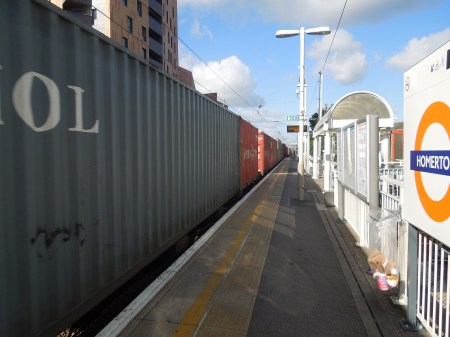
Why Are These Containers On the London Overground?
As I waited at Homerton station today, this long train of boxes passed through.
Many of these trains are going to and from the Port of Felixstowe and the West Coast Main line. As the North London line, is the only electrified route between the Great Eastern Main line and the West Coast Main line, there is virtually nowhere else the trains can go.
The main new route will be a more direct line from Felixstowe to Nuneaton. But this route is not complete yet and there are no plans to electrify it, so it may need an engine change or two. It also requires reversing at Ipswich, due to the nature of the track layout, where the Felixstowe branch joins the main line.
There is also an alternative route via the Gospel Oak and Barking line of the London Overground. This takes four freight trains an hour and by-passes eight stations on the North London line. But unlike the North London line, it is not electrified.
This problem is going to get worse when London Gateway, a new port on the Thames east of London starts operating in late 2013. Trains to and from London Gateway will probably feed in directly to the Gospel Oak and Barking line, via the London, Tilbury and Southend Railway.
As to the size and number of trains, read this press release from DB Schenker, who will be handling the rail traffic. Here’s an extract.
The agreement will see DB Schenker Rail introduce at least four rail freight services a day (four in, four out), subject to volumes, and will serve a range of inland terminals including potential new UK locations. Additional rail freight services will be introduced in the future.
DB Schenker Rail will also pursue the development of rail freight services from London Gateway to mainland Europe using the Channel Tunnel.
Something most certainly needs to be done! In the meantime, I certainly wouldn’t buy a house that backed on to either the North London or Gospel Oak to Barking Lines.
September 18, 2012
Posted by AnonW |
Transport/Travel | Felixstowe, Freight, Gospel Oak And Barking Line, London Gateway, London Overground, North London Line, Trains |
Leave a comment
The Sunday Times is saying today, that it would be quicker to build a completely new airport in the Thames Estuary, than to add a third runway to Heathrow.
I’m not sure, but I do know that project planning engineers always have ways of building things faster, if they look at a problem in depth.
If we look at Chek Lap Kok Airport in Hong Kong, that was effectively built in eight years. That is a massive airport and involved a similar type of construction to say building an island in the Thames Estuary with two terminals and four runways. Admittedly Hong Kong didn’t have to deal with our planning system.
But hopefully, there will be less planning problems with putting an airport in the middle of the estuary, as several have proposed, like this guy.
To get another estimate on the minimum construction period, look at the London Gateway port. They estimate a construction period of about 10-15 years.
The Sunday Times says that a report has said, that the Thames Estuary airport would take 14 years to build and a new runway at Heathrow would take twelve.
Given that the third runway at Heathrow doesn’t solve any of the other airport problems like moving traffic away from London and good passenger access from a lot of the UK, it would appear that this report bangs a big nail in the third runway at Heathrow’s coffin.
There are several things that all of these plans ignore.
The first is flood protection for London. The Thames Barrier should give protection until 2060-70, but it would need to be supplemented or replaced in the future. An estuary airport could be designed to eventually incorporate another flood barrier.
The M25 is not the best designed of roads with a real pinch point at the Dartford Crossing. Every estuary airport proposal incorporates road and rail links to both Kent and Essex, which would add a lot more capacity between the Channel Tunnel and the Midlands and North.
So a properly built estuary airport would probably take longer to build than they have planned at present.
On the other hand, none of the estuary airport proposals seem to pay much attention to the handover from Heathrow. Would it be on a one-night basis as the changes in Hong Kong or Paris or would it be on a gradual basis, as the airport was completed?
This is where the project planners come in.
I suspect that the optimal would be somewhat different to any of the proposals.
Remember that Brits are rather an inventive nation and a cussed lot to boot, so the obvious solutions wouldn’t happen. There would be so much inertia to keep Heathrow, as moving it would effectively change the working lives of millions of people.
So perhaps the most cost-effective solution would be to build the road and rail links from Kent to Essex and create the island for the airport in the first phase. These would improve transport links from the UK to the Continent and take a lot of pressure off the roads in the south-east of England.
The road and rail links would also join the massive port and logistics centre at London Gateway directly to the Continent and probably to the North and Midlands as well. At present, it’s assumed they can fit the trains on the tracks through London, that are shared with the London Overground. Fat chance, that’ll work well!
I’ve not done any calculations and I am just kite-flying, but I’d like to see this planned and costed.
Once proper road and rail links are there, they would make the building of the new airport a lot easier. It might even be started as a cargo airport, if that is where the most urgent need is, as it is ideally suited for that because of its position.
Only when the traffic requirements become known, will we build the airport.
One things that strikes me, is that most pushing extra airport capacity in the South-East have vested interests.
As an example, airlines see railways as competition. Could this explain why the UK’s rail link to the Continent was designed not to annoy them? A rational design might have driven the High Speed link to the Channel Tunnel right under London with stops at Stratford, Kings Cross/St. Pancras/Euston, Paddington and Heathrow. But that would have annoyed the airlines. And probably the French as well, who would want passengers in North East France to use Charles de Gaulle rather than Heathrow.
The French will probably fight an estuary airport with a vengeance.
I actually think that in the end, we’ll stick with what we’ve got! Although, I do think that a road and rail liknk across the Thames estuary will be built. Let’s face it, the Dutch would have done it years ago, if only to protect London from flooding.
September 2, 2012
Posted by AnonW |
Transport/Travel | Flying, Heathrow Airport, London Gateway, London Overground, Project Management |
Leave a comment