Is Everything A Short-Term Fix At Willesden Junction?
In posts yesterday, I highlighted the problems with platform/train gaps and the dreadful interchange at the North London Line platforms at Willesden Junction station.
But is all the work done to lengthen the platforms for five-car trains just a short-term measure, which doesn’t address these problems at all?
Obviously, work has to be done on the low-level platforms and as they don’t have too many problems, except for the step up and down into Bakerloo Line trains, it will make the low-level station a good one with step-free access, a cafe and toilets.
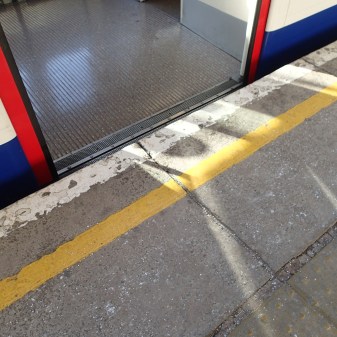
The Tube/Overground Mismatch
But upstairs, I can’t help feeling that solving the problems are virtually impossible, without a complete rebuild of the station. But look at this map of the proposed layout of the lines at Old Oak Common.
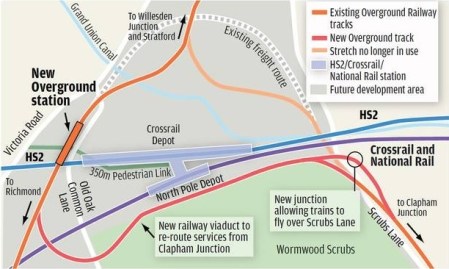
Rail Lines At Old Oak Common
This would link HS2 and Crossrail to the North and West London Lines at a new station at Old Oak Common.
So if the Old Oak Common area is developed with a new station, would this have a knock-on effect at Willesden Junction? This could ich mean that the station had to be changed substantially or possibly was no longer needed.
The big problem is what to do with the interchange between the North London Line and the Bakerloo and Watford DC Lines.
There have been plans for the Bakerloo Line to take over the Watford DC Line north of Harrow and Wealdstone. This would mean diverting the North London Line via Queen’s Park and Primrose Hill.
This would fit in well with the combined North/West London Line station at Old Oak Common. On the other hand, it would mean a few station closures and stations between Queen’s Park and South Hampstead would leave their links to Euston.
Old Oak Common station is still very much at the planning stage and if the ideas get firmed up to a mega-interchange, it should make it easier to sort out the North London Line and the Watford DC Line.
There is also the question of how the Croxley Rail Link will affect ridership on the Watford DC Line. The fastest jouneys to Euston Square from Watford Underground station, are now about 45 minutes, whereas the DC Line takes 52 minutes from Watford High Street. However by going one-stop the wrong way to Watford Junction station, you can do it in 35 minutes. As London Midland runs several trains an hour into Euston in about twenty minutes, this might be a preferred option.
If Crossrail goes up the West Coast Main Line, as is also being proposed, then the trains would surely stop at Harrow and Wealdstone and Watford Junction.
Transport for London have a lot of deep thinking to do.
More Platform Action At Willesden Junction
In a previous post, I talked about work on the Southbound platforms at Willesden Junction. Here’s some more pictures.
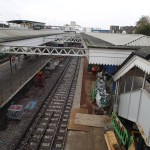
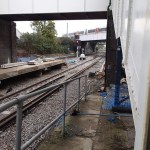
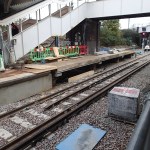
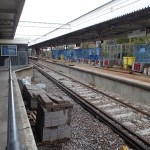
The low-level platforms to and from Watford are in better state than those on the North London Line.
The Dreadful Change At Willesden Junction
No sane person with movement issues, like a wheelchair, a baby in a buggy,a heavy parcel or just plain old age, would change between the North London Line and the Watford DC or Bakerloo Lines at Willesden Junction.
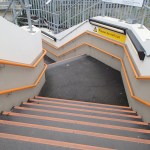
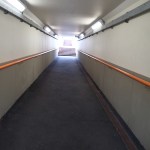
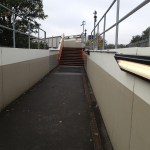


As a lot of the walkways are uncovered, you certainly wouldn’t do it in the rain.
Platform Action At Willesden Junction Station
As I came back from Watford, I had a choice of going all the way to Euston or changing onto the North London Line at Willesden Junction.
In the end I chose to do the latter, as I needed the toilet and I know that Willesden has one of the few toilets on the Overground. As ever it was clean and welcoming.
I couldn’t hope noticing though that there seemed to be substantial work in progress on the platform faces on the line through the station.
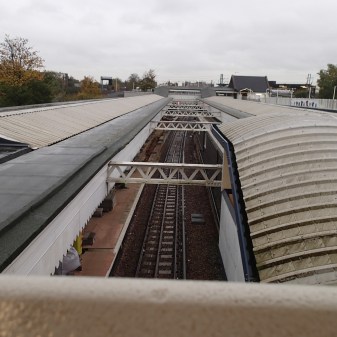
Platform Action At Willesden Junction Station
Normally, the platform extension work for the five-car trains is much less than this. Checking on Wikipedia, this is said.
In October 2014 the DC line was closed temporarily between Wembley Central and Queens Park reportedly to allow platform 2 to be extended further west as a through platform.
Platform 2 is on the left in the picture.
So it would appear that the Overground/Bakerloo lines to the South are getting an extra platform. Looking at the Google Map view of the area shows the layout.
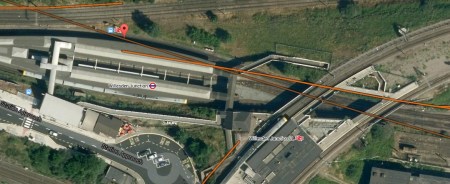
Note the three platforms for the Bakerloo and Watford DC Lines at the left and the two North London Line platforms at the right. Just above these is the double-track link to the West Coast Main Line.
Could it be that London Overground are just making sure that all the work they are doing to make the Overground ready for five-car trains, they are future proofing as much as they can? This section in Wikipedia talks of a reorganisation of the Bakerloo Line and the Overground DC Line to Watford, so with all the uncertainty and variability around Old Oak Common, this is probably a good approach.
I think the only certainty is that anybody using the Overground or Bakerloo Line through Willesden Junction in ten years time will find the station very different, with probably more connections and longer and more frequent trains.
Before Overground – Emerson Park
A Charming Step-Free Station – Rating 9/10
This was definitely a case of saving the best to last.
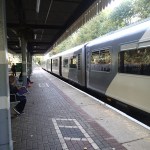
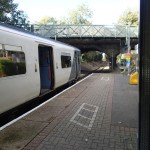

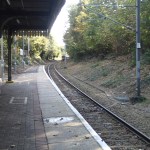
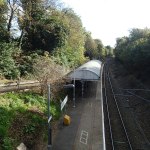
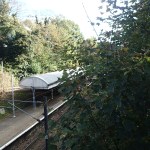
London Overground will love doing up this station, as all they’ve got to do is add paint, new signage and perhaps erect a little shed for the staff they promise will be on duty between the first and last trains.
The station has a rural feel and is on what could be described as a village High Street with a selection of shops and businesses. I walked a couple of hundred metres to a busy cafe and had a very pleasant cup of tea.
A Clean Train From Romford To Upminster
The last time, I travelled on the Romford to Upminster line, the train was a rather tired Class 315. Today’s train was a much smarter Class 317.
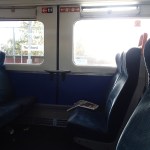
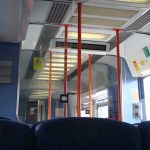
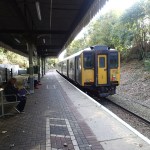
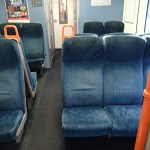
Perhaps someone from London Overground, bagged this one for when they takeover the service in May 2015. It certainly had lots of orange, but I think it might have been an old Stansted Express unit.
The Clapham Kiss – Where East Meets West
I took these two pictures, as I went from Shepherds Bush to Dalston Junction stations this afternoon on the London Overground.
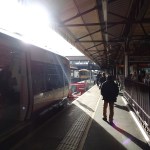
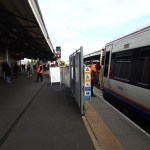
Normally, I’d take a northbound train at Shepherds Bush direct to Highbury and Islington or Canonbury, where I would use the footbridge to crossover to get on a train for Dalston Junction. The reason I like to end up in Dalston Junction station, is that there are lots of buses down the Balls Pond Road to my house and they mean, I don’t have to cross any roads.
But at Shepherds Bush, this would have meant waiting nearly ten minutes for a northbound train, so I took the first train to Clapham Junction. A factor that influenced my choice was that to change between the two trains, is just a short walk up the platform.
I spoke to the driver, who was very pleased, as they don’t always meet as precisely as this, although that is what’s intended.
But the whole layout at Clapham Junction shows that a little bit of innovative thinking can often make things better for all concerned.
Buying Cheap Tickets If You Have A Freedom Pass
I talked about the Overground’s clever ticket machines in August and now for a lot of trips outside of London, I buy my ticket at an Overground station, as I get a better price than on-line and one that is only matched in a Ticket Office. There is no hassle, little wait and I don’t have to write down that impossible-to-remember eight character code.
Yesterday I went to Twyford from London and back for just £5.55.
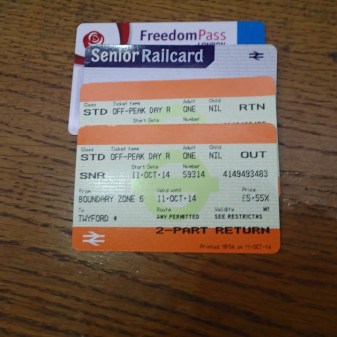
Tickets And Passes For Twyford
Or should I say the Zone 6 Boundary, which is the limit of my Freedom Pass.
Today it was Shenfield for £3.95.
These new ticket machines that give you best value, should be rolled out everywhere.
Missing Infrastructure In East London
As I write up all the stations that will transfer to Crossrail in May 2015, certain much smaller pieces in the jigsaw of the train services appear to be possibly missing.
1. Shoreditch High Street on the Central Line
Shoreditch High Street station is one of the larger, busier and most impressive stations on the Overground. It is also well-placed between London’s high-tech district of Silicon Roundabout and the City. But the Central Line runs underneath the station and some are pushing for an interchange between the Central and East London Lines. Wikipedia has a section on the plans, which says wait until Crossrail is working.
I suspect that this won’t happen quickly and only will if London’s politicians and passengers want the connection. Passenger flows will probably decide the issue.
2. A Station Under The Olympic Village
The Olympic Village, which is now being converted into housing, sits on top of a double-tracked and electrified chord that links the North London Line and the Lea Valley Line between Stratford and Tottenham Hale.
I can’t find any plans for a station on this line and it is assumed that residents of the village will happily walk to the other nearby stations.
Have the planners missed a trick here?
3. The Dalston Eastern Curve
Transport for London have plans to run twenty-four trains per hour through the East London Line.
If this is going to happen, I can’t see how without connecting the line to that to Stratford, the trains can be found places to serve.
It won’t be the most difficult job engineering-wise, but it will probably be the most difficult task politically.
Before Crossrail – The Overground And Lea Valley Platforms At Stratford
After yesterday’s exploration from the bridge across Stratford station, I just had to get down on and see it from the ground.
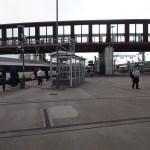
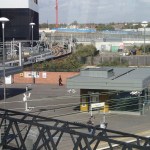
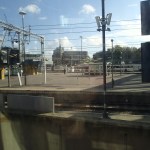
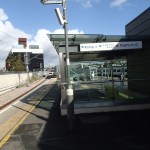
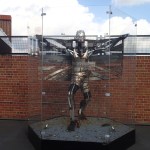
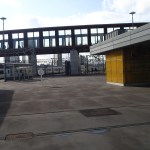
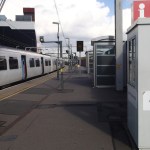

There are two Overground terminal platforms, numbered 1 and 2, at the Eastfield side of the station, with the two long Lea Valley Lines platforms, numbered 12 and 11, curving around them. A driver told me that the only trains that used the platform on the Overground side, 12, in normal circumstances, was the last arrival of the day and the first departure of the next morning. So it would appear that except when there are diversions or trouble, these platforms are seriously under-used.
As the pictures show they are well-appointed and even have a piece of expensive art-work in the large triangular area between platforms 10 and 11, which could probably only be nicked by the use of one of those Russian very heavy lift helicopters.
Whilst I was there, a Norwich-bound train stopped at platform 10. I suspect there are very few transfer passengers between platform 10 and 11, although you might decide to use the walk-across if you were going from say Stansted Airport to East Anglia.
But it does seem to me, that there could be some more efficient way to provide the current services or perhaps to add some extra ones to the station.
 The Anonymous Widower