National Grid Pioneers UK-First Trial Of 3D Printed Technology For Low-Carbon Substations
The title of this post, is the same as that of this press release from National Grid.
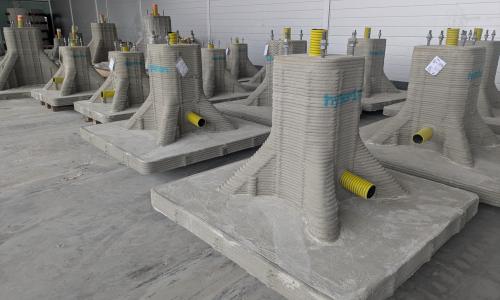
These three bullet points act as sub-headings.
- Collaboration with Hyperion Robotics and the University of Sheffield will trial low-carbon 3D-printed concrete foundations including at National Grid’s Deeside Centre for Innovation in North Wales
- Innovation could reduce waste, carbon emissions and costs to consumers of network construction
- If rolled out across National Grid substations the technology could save up to 705 tons of concrete and 323 tons of CO2 and deliver £1.7 million in consumer savings versus traditional methods over a 10-year period
These two paragraphs give more details.
National Grid is working with Hyperion Robotics and the University of Sheffield on a UK-first trial to manufacture, install and test 3D-printed substation foundations, which have the potential to reduce construction-driven carbon emissions and reduce costs to consumers of network construction. This is part of National Grid’s commitment to leverage innovation to future-proof the network.
If the project is successful and the technology is rolled out across all National Grid substations, it is estimated it could save up to 705 tons of concrete and 323 tons of CO2 over a 10-year period, and deliver £1.7 million in consumer savings versus traditional methods.
The foundation design will deliver significant savings across the entire value chain.
- 70% reduction in concrete usage
- 80% less soil displacement
- 65% decrease in embodied carbon emissions
- 70% weight reduction compared to typical foundations
- 50% reduction in site operative hours, streamlining production
The foundations will be designed and produced in Finland by Hyperion Robotics, and tested at full-scale by the University of Sheffield. Further field testing will then be carried out at National Grid’s state-of-the-art testing facility, the Deeside Centre for Innovation in North Wales, later in 2025.
Conclusion
I like this technology and I suspect there are many other applications of 3D Concrete Printing.
National Grid Goes Carbon-Free With Hydrogen-Powered Substation Trial
The title of this post, is the same as that of this press release from National Grid.
These are the main bullet points.
- Hydrogen powered unit (HPU) quietly provided carbon-free electricity to National Grid’s Deeside Centre for Innovation
- Only emission is water
- HPUs could save an estimated 500,000 kg of carbon across all National Grid substation sites
I am an Electrical Engineer and I had never realised that all those electricity substations around the country need a backup electricity generator.
These four paragraphs describe the trial and the generator used.
A GeoPura 250kW hydrogen power unit (HPU) contained within a transportable shipping container measuring 7.2 m by 2.5 m was installed at DCI and produced the energy to power low-voltage equipment needed for National Grid’s innovation testing projects and site operations. The trial tested the capabilities and feasibility of HPUs as direct replacements for backup diesel generators across more than 250 National Grid substation sites, the data will now be analysed and shared later this year.
National Grid currently use diesel generators alongside batteries to provide backup power to a substation for key activities such as cooling fans, pumps, and lighting, enabling it to continue to perform its crucial role in the electricity transmission system.
These backup generators are rarely used and have less than a 1% chance of operating per year, however, on the rare occasion that backup power is required, changing from diesel to low-carbon emission alternatives have the potential to reduce carbon intensity by 90%* and save over 500,000 kg of carbon emissions.
The HPU at Deeside has power capabilities of up to 100 kW in continuous operation mode and up to 250 kW for 45 minutes and uses 100% green hydrogen. The unit is quieter and the hydrogen cannisters used to fuel the generators can be safely stored on site.
I have some thoughts.
Deeside Centre For Innovation
The Deeside Centre for Innovation (DCI), a state-of-the-art testing facility hosting a 400 kV modified substation, designed as a unique environment for development and trial of innovative technologies and practices.
I think there’s something rather cunning about the DCI, as it means that anybody with a good idea will probably approach National Grid for help with the testing.
Visit Deeside Centre for Innovation for more information.
GeoPura
GeoPura has a totally zero-emissions answer to how we’re going to generate, store and distribute the vast amount of energy required to decarbonise our global economies. Or so their web site says!
This page on GeoPura’s web site, gives several case studies of how they work.
They would appear to provide zero-carbon power in widespread locations for Winterwatch, Springwatch etc. for the BBC.
University Of Manchester And National Grid Team Up To Develop SF6-Free Retrofill Solution For Electricity Network
The title of this post, is the same as that of this press release from National Grid.
This is the introductory paragraph.
National Grid and the University of Manchester are to collaborate on a four-year project to develop a full-scale demonstrator at the Deeside Centre for Innovation, designed to test at scale how the UK can retrofill sulphur hexafluoride (SF6) across its network of high-voltage equipment.
Note.
- Sulphur hexafluoride (SF6) is a gas commonly used in the power industry to provide electrical insulation and arc interruption.
- Eighty percent of sulphur hexafluoride is used in the electricity industry.
- According to Wikipedia, sulphur hexafluoride has several important applications, including a medical one in eye surgery.
- But sulphur hexafluoride is a is a potent greenhouse gas with a global warming potential that is 25,200 times greater than CO2.
It certainly looks to be a good idea to see if the sulphur hexafluoride can be eliminated from electrical equipment and other uses, that may release the gas into the atmosphere.
These paragraphs from the press release outline the project.
The £1.9m project will see experts at Manchester help determine how National Grid can develop a retrofill solution to replace SF6 with an environmentally friendlier alternative without having to replace or otherwise modify the existing equipment.
This solution – to be demonstrated at National Grid’s test facility the Deeside Centre for Innovation – will mean National Grid can avoid the environmental impact and cost of replacing equipment otherwise fit for many more years’ service.
It is not the first time National Grid and the University of Manchester have teamed up on a project exploring SF6 alternatives – a previous initiative which concluded in 2020 is now up for an IET Engineering & Technology magazine innovation award for ‘Best Innovation in Net Zero and Sustainability’.
The press release also says this about the Deeside Centre for Innovation.
National Grid’s Deeside Centre for Innovation in North Wales is the first of its kind in Europe, where electricity network assets can be tested under real life conditions, 24 hours a day, seven days a week.
It certainly seems that National Grid and Manchester University are on top of the problem and have the resources to achieve success in the project.
The Russian Attack On Ukraine
You may wonder what this has got to do with improving transformers and switchgear in Manchester and Wales.
Recently, the Russians have been targeting the Ukrainian electricity network. Are Ukrainian transformers and switchgear insulated with sulphur hexafluoride and if they are how of this potent global warming gas has been released into the atmosphere?
 The Anonymous Widower