Should We Add the Lea Valley Lines to the Overground?
There are effectively three surburban Lea Valley lines.
- Liverpool Street to Enfield
- Liverpool Street to Chingford
- Liverpool Street to Cheshunt via Southbury
Some count the line through Tottenham Hale as another Lea Valley Line, but I prefer to think of that as part of the West Anglia Main Line to Bishops Stortford and Cambridge.
I know the lines quite well and they are not in the best of health with stations that need investment, disabled access and to be incorporated into the Oyster fare network.
You might say it is just like the North London Line of a few years ago!
Except there is one major difference. The trains may be old, but they are in a much better state than the travelling urinals of the old North London Line.
The lines are also not badly connected to both the London Underground and the Overground.
- Seven Sisters and Walthamstow Central are shared stations serving both the Lea Valley Lines and the Victoria line.
- A footpath is planned to connect Walthamstow Central with Walthamstow Queen’s Road on the Overground.
- Hackey Downs used to be connected to Hackey Central on the Overground by means of a path at track level. This interchange could give the Overground a quick way to get to the city as an alternative to walking from Shoreditch High Street on the East London Line.
The more I look at this, the more I like it!
The lines are already built for eight car trains and frequencies approaching ten trains per hour. All they need is punters to fill them and that is where the expertise of the Overground comes in. They certainly have a track record of doing it on the current lines.
Transport for London also have good project management expertise, as they showed at the Dalston Curve, where the project was under budget and early. They also know about making stations disabled-friendly.
So I think we should go for it!
Is The London Overground a Success?
The three most important lines of the London Overground are now well established. I like it and I use the system several times a week. Admittedly, I have a station at the end of my road, but it is still about a kilometre away. The trains are comfortable, clean and I’ve only been late once.
But do others feel the same way as I do?
So I typed “London Overground success” into Google to see what I got.
I found this article, which is sub-titled, Tangerine Dreams. Here’s a flavour.
That the London Overground has been a success is difficult to deny. Whilst it has certainly had its share of delays and difficulties (such as with the rollout of the 378s), its current performance and satisfaction figures accurately portray the step change in service that has happened on the NLL and elsewhere since the Operator effectively made its debut in 2007. In a city where other Operators such as South Eastern are increasingly feeling the heat from passengers over the level of service they provide, London Overground’s performance also serves to highlight that there are effective ways to address the challenges that London’s railway infrastructure brings.
The rest of the article should be read and it is generally positive about London’s newest railway.
Politician’s of all colours will claim that the success is all down to them. In my view, given how the Overground built on successful ideas, rather than try revolutrionary new ones, I would say you’d have to be really stupid to make the project fail and be an unloved railway.
For a transport project to be successful, you have to locate it so that it takes people where they want to go. The Overground does this well, although you could argue it needs more links to the Underground, as Highbury and Islington, Whitechapel and Richmond aren’t really enough. But West Hampstead will come and possibly there will be others if the politicians decide to invest in success.
One factor that helps, is it is the least claustrophobic and most photogenic of London’s railways, with the possible exception of the DLR. I would recommend both the DLR and the Overground to visitors who want to get a different perspective of London.
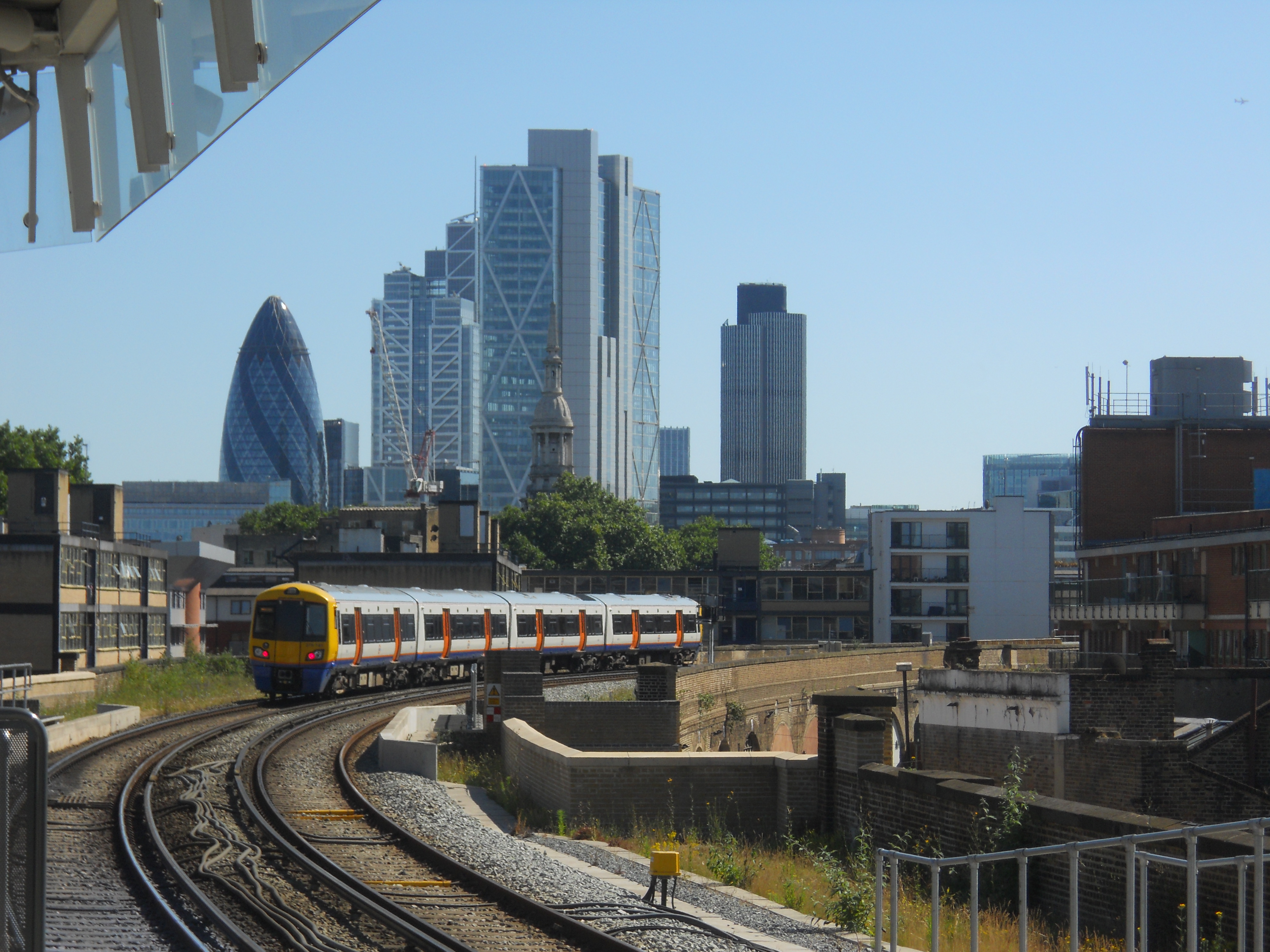
Overground Train on the Embankment South of Hoxton Station
I’ve used this picture before to show how different the Overground is. This view even ended up in Modern Railways to illuastrate an article about links between the City and transport projects.
I think the next question is can we build on this success?
Another Non-Jobsworth
I had dinner with my son at Carluccio’s in Upper Street and we walked back to Highbury and Islington station to get our trains home.
I was intendimg to take the North London Line to Dalston Junction for a bus home and as I walked down the stairs to the platform, I noticed that the train doors were closed. But the driver waved me to open the doors and get on!
He was on time at Dalston Junction despite waiting for me.
Interchange at Stratford
Yesterday I took a friend down the North London line to take a train to her home in Ipswich. The interchange there is now very good and it is just down one set of steps, a short walk and a climb up between trains. Both climbs can be avoided by lifts, if you have limited mobility or heavy luggage.
The only problem is that the proper Ipswich trains have non-sliding doors and this is a slight problem for some with less than perfect hands. It’s exacerbated by the fact that no-one gets out of an Ipswich train at Stratford, so these trains need to have a better door mechanism, when they are refurbished next time.
Stratford is going to be a major interchange during and after the Olympics. If say I was travelling from Ipswich to say Oxford Circus on the Central line, then now it is better to change at Stratford rather than Liverpool Street. Other journeys may also be better with a change at Stratford. For example.
- Ipswich to Gatwick, by changing to the Jubilee at Stratford for London Bridge.
- N**wich to Southampton, by changing to the Jubilee at Stratford for Waterloo.
The interchanges are much better than using the Underground or buses in central London.
You can make a list of places, that are directly connected to Stratford, but not to Liverpool Street.
- London Bridge, Charing Cross and Waterloo
- Canary Wharf, Greenwich and the O2.
- Camden Town, Kentish Town, Hampstead and the Heath.
When Thameslink is completed at London Bridge, many more places will be easier to get to, after a short trip from Stratford.
Chiltern are also threatening to connect at West Hampstead to the North London line, so this would mean East Anglia or Essex to Birmingham or Oxford would be a simpler journey in new trains all the way.
And then in 2016 or thereabouts there’s CrossRail.
Where Have All The Jobsworths Gone?
I’ve had a friend staying for the last few days and I accompanied her to Stratford to get her train back to Ipswich this morning on the North London Line. Changing from the North London Line to the main line at Stratford is particularly easy, as the platforms are virtually next to each other. And there are lifts, if you aren’t so good on your pins.
My friend had bought her tickets on the TrainLine, which is a company, I only use as a last resort, as I know the system and can often get a better deal elsewhere. Her tickets were actually to Ipswich via Colchester and I know that ticket inspectors can take non-compliance with rules seriously. So when the first train came, which was going to Colchester and then on to Ipswich, she took it. But to be fair to National Express East Anglia, the inspector on the train accepted her ticket without question.
Then when I got home, I found that my recycling had been collected. Nothing special about that, except perhaps that they’d done it an hour or so earlier than normal. But they had replaced one of my recycling bins with a brand new one, which they had clearly numbered.
So sometimes people do use a bit of initiative to do their jobs better! And of course make things more pleasant for their customers and clients.
There was slight downside this morning. A guy was cleaning the train between Stratford and Hackney Wick. In trying to remove one of the disposable newspapers, he inadvertantly touched someone. The guy mouthed him off in no uncertain terms.
Do We Mislead Tourists?
I travelled to London Bridge today and on the train I met a couple of ladies from New Zealand, who were trying to get to the Churchill War Rooms in Whitehall. But their hotel had told them to go to London Bridge to see something similar by the London Dungeon. I put them on a Jubilee Line train to Westminster.
I also met an Australian tourist and her family going to the London Dungeon. I suppose they had kids, but at least I was able to point out Borough Market and Sothwark Cathedral. Let’s hope that when London Bridge Quarter gets finished, they put up some decent information.
At least though I saw this outside the Globe Theatre a few street’s away.
I have a simple tourism rule. I don’t pay to go into anything, unless it’s National or special interest museum. I’ve never been to Madam Tussauds, the London Dungeon or any of the other places in London setup to relieve tourists of their money. These places are not an asset to London, just as others of a similar ilk aren’t in Paris, Amsterdam and New York.
Many of the best tourist sites in London are free and all some require are a London Travelcard or Oystercard. Here’s my favourite top ten.
- The front at the top of any London double deck bus. Favourites include a 24 from Victoria to Hampstead and the two heritage routes (9 and 15). I like to play bus roulette and get on the first that turns up.
- The British Museum. It’s worth going in, just to see the roof and have a nice coffee. Special exhibitions are extra, but the main museum is free, althougth they do like the occassional donation. When it’s not too busy, you can handle some of the exhibits. I’ve seen little girls, and big ones for that matter, in Roman necklaces.
- The Olympic Park. But go before June 2012, as I suspect you’ll find views will be shut off for security before the Olympics.
- The Imperal War Museum.
- The Kensington Museums; Science, Natural History and V & A. There’s even a good Carluccio’s nearby.
- The Victoria and Albert Embankments. At low tide, look for the beach at Tower Bridge.
- The North and East London Lines on the London Overground. They connect lots of small, good museums, Hampstead Heath, Kew Gardens and Crystal Palace. There is also a superb panorama of London in several places.
- The Docklands Light Railway. Take it from Bank to Canary Wharf and on to the Thames Barrier.
- St. Pancras Station. Even the French think it’s the best railway station in the world. It may not be by next year, as King’s Cross may outshine its neighbour.
- Green, Victoria and St. James’s Parks.
- The Regent’s and all the other canals that take you from Islington to Stratford and Docklands.
I suspect this list will grow.
I did like this bike though.

Mobile Low Carbon Tourist Office
Is this the first mobile low carbon tourist office?
Is This The End of Train Building In The UK?
Does the loss of 1,400 jobs at the Bombardier factory in Derby mean the end of train building in Derby?
After all Alsthom has gone from Washwood Heath and the only light on the horizon is the news that Hitachi might be assembling the IEP in the North East. I say might be, as I have my doubts that the IEP will ever be built in it’s proposed bi-mode form, where an electric train hauls a diesel engine around the country for the places where there are no overhead wires. But then the IEP was always a creation of civil servants to avoid electrification, rather than a sound engineering proposal.
So what new trains do we need?
It would seem that at last we have got the message that every other country in the world got years ago and that is that trains should be powered by overhead wires carrying electricity. London to Bristol, Cardiff and Swansea now appears to be on track for completion in the next few years. It would also appear that Network Rail are developing a system to install the overhead wires using effectively a series of three factory trains. Wikipedia says this.
In an effort to minimise disruption during the electrification works, Network Rail is developing new “factory engineering trains” to facilitate the process of installing overhead lines. There will be three types of trains: the first train will be used to install pylons, followed by a train to hang the wires and finally there will be a train which will check the installation. The system is expected to be able to install 1.5 kilometres of electrification in one eight hour shift.
Why wasn’t this developed years ago, as it doesn’t seem to be the most difficult of technology to develop, especially, if you have lots of electrification to do? There is only one answer, politicians and civil servants like to do things on the cheap!
If the engneers get this right, then we should at last see a rolling program of electrification with the Midland Main line an obvious candidate.
So all of this will mean we will need more electric trains. And ones that go fast too! Wouldn’t it be a good idea if we had a unified fleet that could be run London to Swansea, London to Sheffield and London to Newcastle and Edinburgh, as surely economies of scale would mean cheaper trains, even if there are a lot of them. There is a precedent here in that the InterCity 125 ran on the same lines when it was built and because it was such a good and updatable design it still does.
We could almost be in a virtuous circle here, in that say the Great Western and Great Northern routes prove to be a great success, then there will be a clamour for more electrification, because it cuts carbon emissions and the customers like it. We might even see lines like Chester Holyhead electrified to improve connections to Ireland and Edinburgh to Aberdeen to improve links to the far north of Scotland.
Small pieces of fill in electrification will also open up possibilities. As a simple example, when I went from Liverpool to Edinburgh a few weeks ago, I went by two diesel trains, but the fill-in Network Rail are scheduled to do in that area, may mean that in a few years, it could be a new electric train.
So there will be a need for a lot of high speed electric trains, which at present will be satisfied by Hitachi and built in the North East. But it will only be an assembley job at best, with all design in Japan.
The next large batch of trains are the Thameslink and CrossRail trains for London. The first order has gone to Siemens and any sane person would use the same trains for both lines.
Other than that there are not too many orders in the pipeline.
There will be a need for more electric trains for the Liverpool, Blackpool, Wigan and Manchester services when they are electrified.
There is also a need to replace all of the ageing diesel trains, such as Pacers, all over the UK.
So looking at it sensibly, the fast electric trains will probably be built by Hitachi and the commuter electric trains will be built by Siemens.
There is just a significant number of scraps left.
One thing we’re good at though in this country is train refurbishment. We have to be as it’s the only way we can keep the railways running. But over the last year, I’ve had some memorable journeys in forty year old InterCity 125, where the standard of passenger comfort is up there with the best new trains.
So for example as the new trains arrive for Thameslink, there will be a large number of old ones that can be refurbished for the newly electrified services in the North West. If you doubt that refurbished trains are any good, just travel from London to Swansea and back in a day as I did.
Some respected commentators have argued that if you put good trains on old lines and improve the infrastructure, you create traffic and because people change from cars to trains, you cut carbon emmissions.
I’ll use two examples.
Cambridge to Ipswich was a Cinderella line with crap rolling stock and a frustrating timetable. It was given a modest improvement with some more comfortable hand-me-down trains and a better schedule and the investment was rewarded by an increase in passengers. They’ve even seen fit to put three-car trains on the line at busy times.
Where I live now, two lines, the North London line and the East London line have been upgraded and given new trains. The positive affects have been well documented and show that a not outlandish level of investment can bring a very high rate of return.
So it would appear that tactical investment can be positive.
Another scheme that is being brought forward is the improvement of the Ipswich to Lowestoft line, by putting in a passing loop at Beccles. This would mean an hourly service would be possible.
These last three schemes all use Bombardier trains, which are powered by electricity or diesel as appropriate.
Just as Ipswich to Lowestoft is showing improvement in passemger numbers, I don’t think it takes much thinking to know that there are many other lines in the UK, that could benefit from improvement.
A lot of the cross-country lines are very much overcrowded, but how many civil servants ever travel by train from say Ipswich to Birmingham? If they did they’d go from Ipswich to London and then get a Virgin train to Birmingham.
But if these lines are to be improved and the dreaded Pacers replaced, then we need more modern two, three and four coach trains. And Bombardier has the designs that work and they are available virtually off the shelf!
So perhaps we won’t see large numbers built, as after all the main UK fleet of trains is one of the newest in Europe, but we will see quite a few small orders for services that are not high speed or high density. But who’s to say that these won’t go to a cheap Chinese manufacturer as obviously a trip to Shanghai is more exciting that one to Derby.
We won’t see too many exports either, as our loading guage is so much smaller that to deliver trains even to Europe is a logistical nightmare.
So where does our future lie in the manufacture of trains?
We will probably make the high speed trains we need, but as I indicated above, will we really make any more than we need with extras for export?
One of our strengths is in the technology that goes on trains, as I indicated in this post. But then we have always been good at niche markets and in some ways there is more money in the design than the actual manufacture.
We are also very good at train rebuilding and you can argue that this has been one of the great successes of the last few decades.
So we will still be building trains, but the industry will be very different.
Is The Cause of High Unemployment Our Housing and Transport Policies?
There was a program on BBC Radio 5 this morning about unemployment. It was the usual left versus right battle, which has been fought so many times to a non-conclusion, that the program got boring, so I went shopping at Upper Street.
I have lived in several houses and flats in my life and in some ways, where I am now suits me best. Visitors like it too and they feel it is absolutely right for me.
So what is this house like. It’s a three bed-roomed house with two en-suite bathrooms and one that isn’t. It’s modern and it’s built upside down, with two bedrooms, a bathroom and the garage on the ground floor and a seven-metre square living area, kitchen and a bedroom on the first floor. It has a lot of chocolate-coloured steel and big glass windows. Unfortunately, it was built by Jerry. It doesn’t have a garden, but it does have two patios front and back.
In some ways the nearest to it in feel, was our flat in Cromwell Tower, in the Barbican, where we raised our three sons for the first few years of their lives. There we had three bedrooms, a large living room, kitchen, an underground car park and superb views across to St. Paul’s.
My house is however not the sort of house that most people aspire to or in fact that many can afford.
So many prefer one of Pete Seeger ‘s Little Boxes on a new estate somewhere in the countryside with space for two cars. After all, these sort of estates don’t get inhabitated by the riff-raff do they? They are also as eco-friendly as Obama’s Beast.
I have now come to the conclusion that I don’t like to live in the countryside. It is all so sterile, unfriendly and full of lots of little cliques. After the loss of C and my son, not one person in the village came to see me. After all I was a loser wasn’t I, especially as I had a stroke? There’s a great belief too, that widows might decide to walk off with your partner! It was a real relief to escape on a train to somewhere, where something actually happened. But there was no public transport, so simple things like getting any food meant a taxi or scounging a lift.
I also should say I hated living in Cockfosters as a child. There the problem was that there were no children of my own age and most of my school friends lived some distance away. Only when I was old enough to work in my father’s print works and ride my bike all over the area did I feel liberated.
How I live now, is surprisingly similar to how C and I used to live with the boys in the Barbican and St. John’s Wood before that. Except of course that I am now alone and do the things like food shopping, that C used to do. But then when I wander round Chapel Market, it’s like going back to the early seventies and she’s still guiding me.
It’s a friendly and a mixed area, with some good shops, four pubs that know their gluten-free within walking distance, several gardens and superb public transport links. The people are friendly too and I’m starting to add to my circle of friends. In this sort of mixed area, you also develop passing acquaintances with people, who you say hello to as you pass. In the countryside, it’s a bit difficult to talk to someone about their basset hound as I did today, when the dog is in the back of a 4×4 passing at speed.
So the sort of mixed area where I live is not to most people’s taste, but in my view, if we want to decrease unemployment and create worthwhile jobs, then this sort of area can do it’s bit. Another mixed area, I know well is the centre of Cambridge and it could be argued that that mixing helps with the development of ideas.
How many good ideas have been hatched in pubs or coffee shops? Sterile country villages might have an award winning gastro-pub, but the only ideas that come out of places like that, are things like better ways to cook asparagus.
One of the complaints in all the villages I’ve lived was the lack of any staff locally. This was mainly because, those same people didn’t want any affordable housing built, that might spoil their view and lower the tone of the place. I have a lovely lady, who sorts my house out, once a week and she was fairly easy to find. Incidentally she comes on a bus from the other side of Dalston JUnction station. so just at a selfish level, good public transport helps people to get to their jobs. In those much admired villages, there is no public transport, so everybody has to drive, so those that can’t afford their own car, often can’t get a decent job. But then a lot of those that live in villages don’t want more public transport, because of all the noise and inconvenience of passing a bus in a large 4×4. But they have their own cars anyway!
To illustrate what I say further, I will take the Suffolk town of Haverhill, which has large numbers of little boxes, which asre being added too at a fast rate. There are jobs in the town, but many require a car to get to, as the town isn’t the most cycle-friendly and the public transport is limited. Haverhill is also a sensible commute to Cambridge, where there are far better-paid and more worthwhile jobs, but the only way to do it, is to use a bus or car. There used to be a railway, but that was axed in the Beeching cuts. Axing it actually wasn’t the problem, but building over the right-of-way was, as that railway, which is needed to provide a link etween Sudbury and Cambridge, could have been reinstated. In Scotland, they have been reinstating railways like Airdrie to Bathgate with some degree of success.
If I was in charge of eployment policy in this country, I would reinstate railways like Sudbury to Cambridge, as they not only create employment, but allow people to get better jobs. Recently, the line from Ipswich to Cambridge has been updated with better and bigger trains and the investment has led to a large increase in passenger numbers.
Where I live, we also have the example of the recently-rebuilt North and East London Lines of the London Overground, which are now used and liked by everybody. In fact, so much so, that frequencies are being increased.
I have also read and heard stories how the new lines have decreased unemployment, just by enabling people to move more easily from where they live to where the jobs are.
I think too, we concentrate on unemployment and rightly so, but in many cases better transport links will enable people to move up the employment ladder. This is just as important, as not only does it create a need to replace the person who’s left, but if people earn more, they tend to spend more and that helps to create jobs.
Northumberland Park Station
I made a mistake to get off the 341 bus and take the train from Northumberland Park station.
It might better be called No Rthumberland Park, as it had no staff, no timetables on the wall, no train information indicators and no trains for an hour. I actually had to phone rail information on 08457484950 to find out when the next train would arrive. There was though a betting shop on the corner and one of London’s last level crossings inside the M25.
Eventually, a train did turn up and I went all the way to Stratford for interest, rather than a quick journey. I then took the North London line and a bus home. If I’d stayed on the 341 bus, I’d have been home thirty minutes earlier. I will travel from Tottenham Hale to Stratford again, as it gives good views of the Olympic site, HS1 and the train sheds for Eurostar and the fast trains to Kent from St. Pancras.
Through the Olympic Park on the Greenway
From the Top of the Morning, I had two choices. I could either walk to Hackney Wick station on the North London line, or try to find the Greenway that continued through the Olympic Park to Pudding Mill Lane on the Docklands Light Railway.
I chose the latter more in hope than expectation, as I felt that building or security considerations on the Olympic Park might mean the Greenway would be closed.
About a hundred metres south of the pub, I found this welcoming sign.

Entry to the Greenway
So I’d made the right choice.
Incidentally, the Greenway is built on top of the eastern end of the Northern Outfall Sewer, which was built in the mid-1800’s by Joseph Bazalgette, to take London’s sewage to the works at Beckton.
The Greenway gives good views of the Olympic stadium of which this is typical.
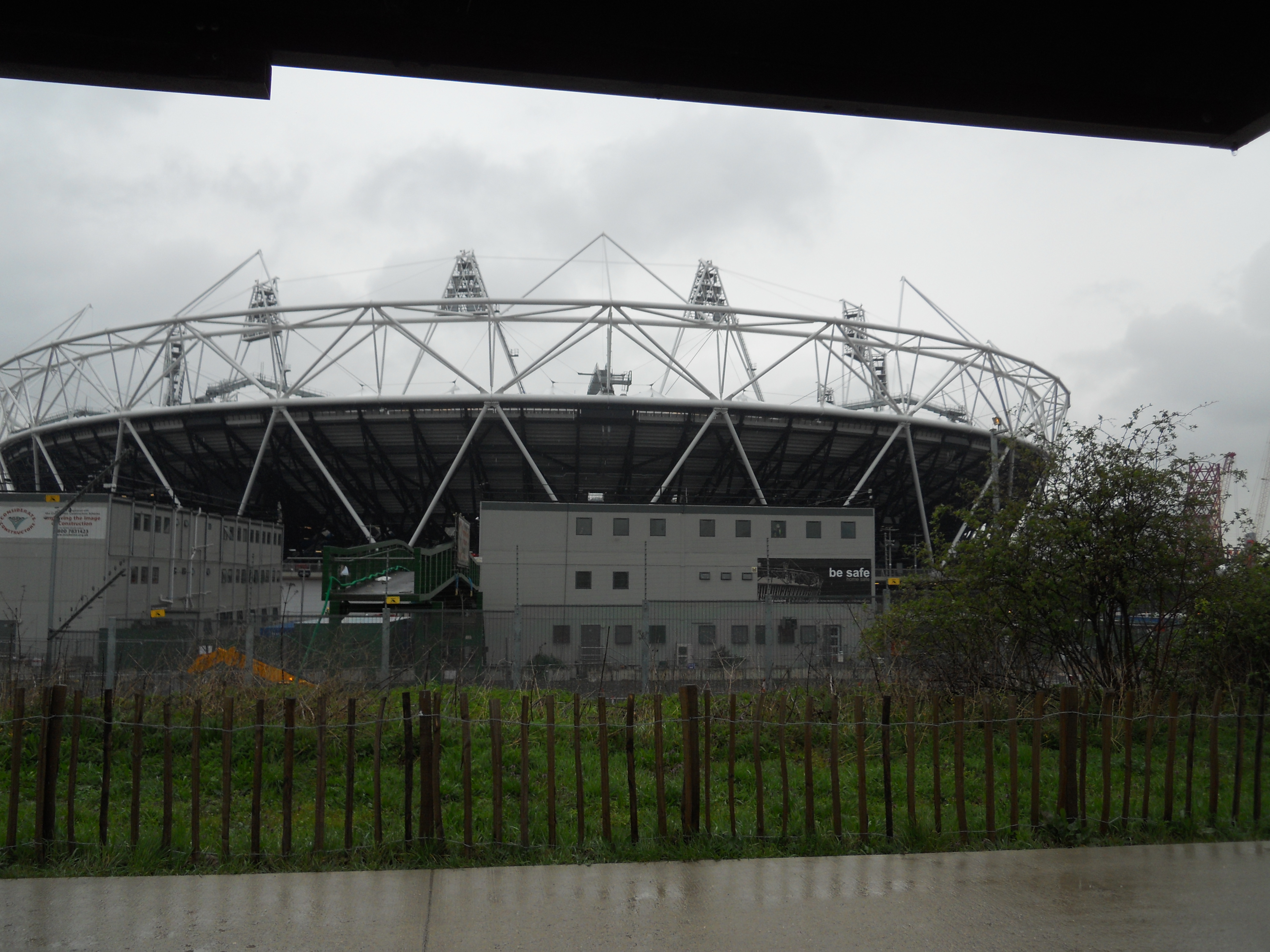
The London Olympic Stadium
Obviously, landscaping and a few other things need to be done, but it is now virtually complete.
You can also see the ArcelorMittal Orbit and the Aquatics Centre.
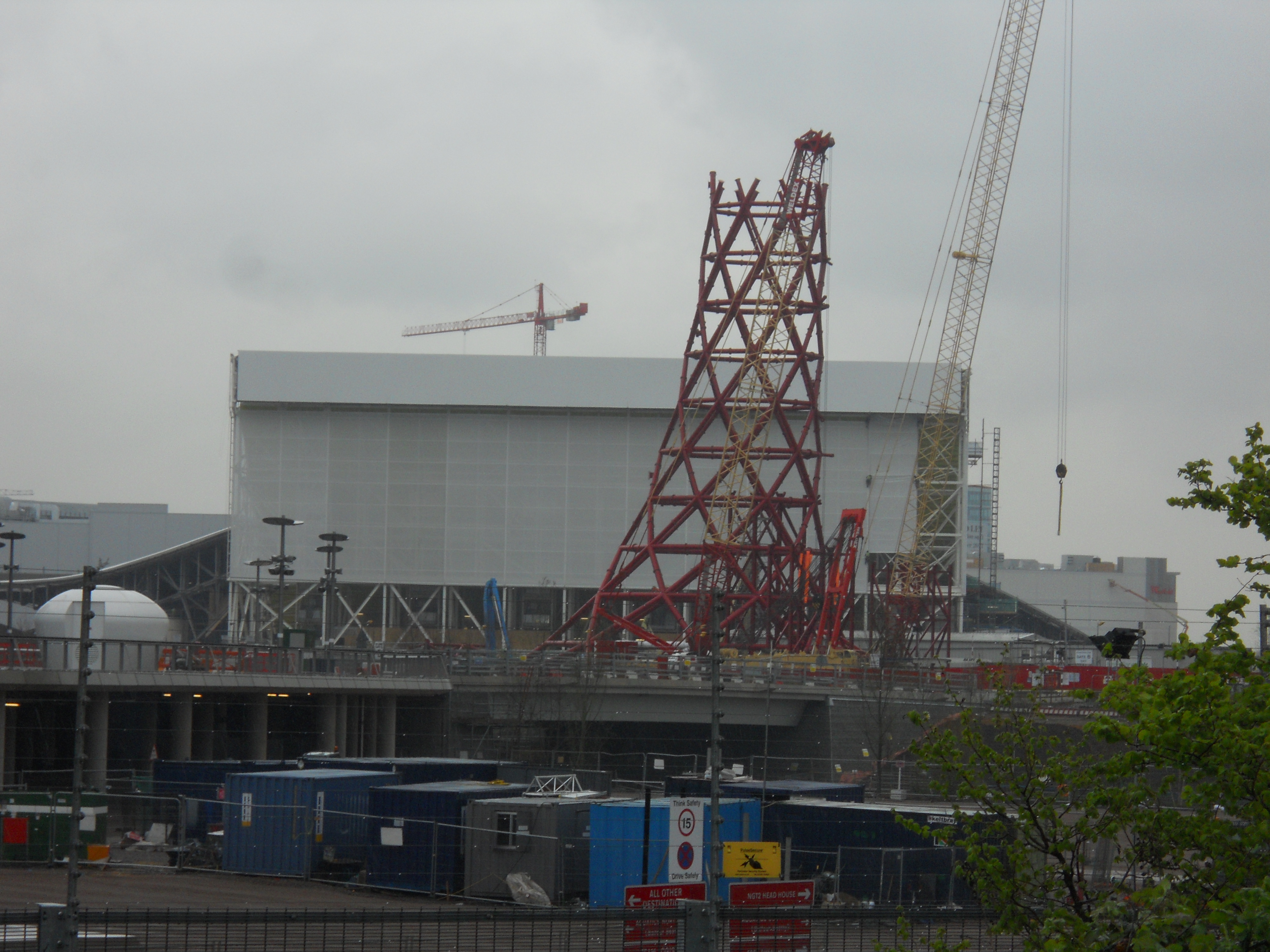
ArcelorMittal Orbit and the Aquatics Centre
The Orbit structure has aroused controversy, but seeing it close to, I found it rather fascinating. You can also see all of the bits lined up like groups of acrobats ready to climb into position in the tower.
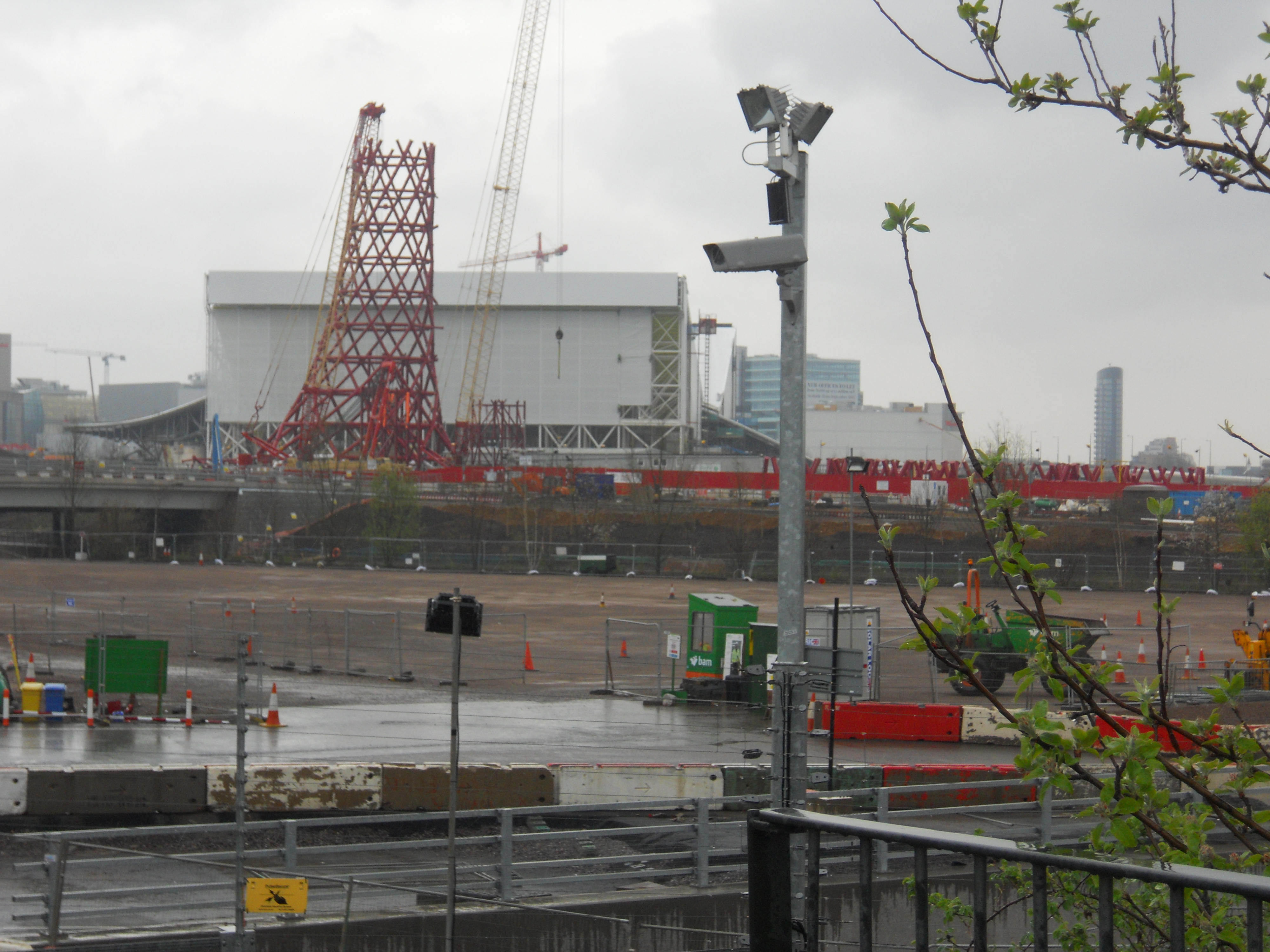
I’m Ready to Ascend!
I suspect that like the Eiffel Tower has for Paris, it might end up as an icon of East London after the Games.
The one think you can’t say about it, is that it is boring! The only things that should be boring are some machine tools and tunnelling machines.
One thing that has been got right is the information for visitors, as this picture shows.
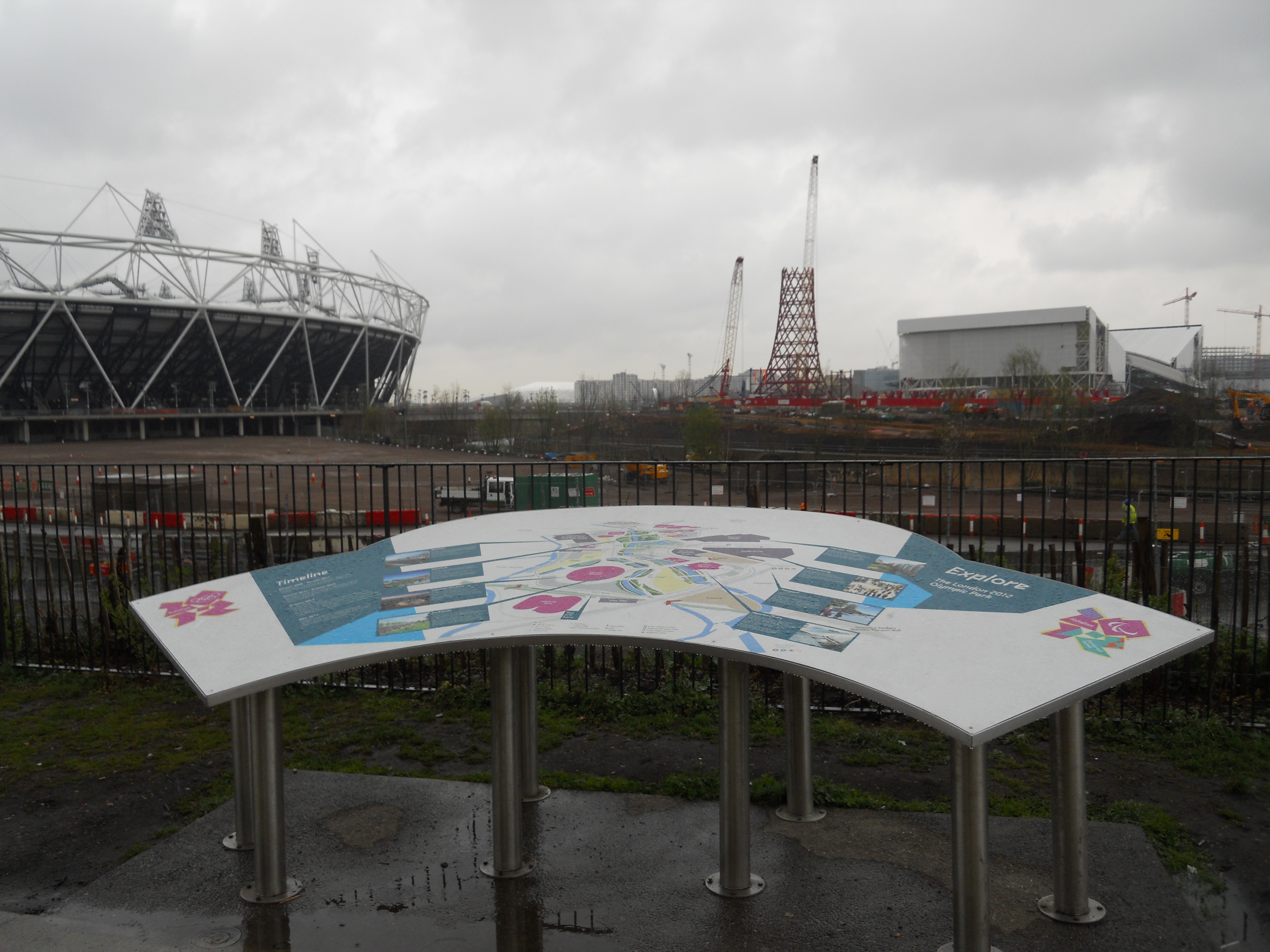
Olympic Park Panorama and Information
Do you think that the far-sighted Joseph Bazalgette had realised that his enormous sewer would one day be used as a grandstand for a construction project, of which I’m sure he would have proud? Obviously not, but with so many things he did, he got them absolutely right. And right for possibly a thousand years!
No walk is complete without a cup of something and at the south end of the portion of the Greenway that crosses the Olympic Park, there is this cafe and viewing point called ViewTube.

The ViewTube, Olympic Park, London
I had a good cappucino and a rest before walking on to Pudding Mill Lane and the DLR, where I took this final picture.

The Olympic Park from Pudding Mill Lane, DLR Station
All in all, this walk took about two hours including refreshments. On a good day, it should easily be possible to do it in the same time from the Angel at Islington to the ViewTube cafe.
But I suspect it’ll get busy!
 The Anonymous Widower