Expanding The Robin Hood Line
The Robin Hood Line, runs between Nottingham and Worksop. It had been closed to passenger trains in the 1960s and reopened to passengers in the 1990s. I used to use it regularly to see a client in Mansfield in the years soon after it opened.
In my investigations into Ilkeston station, the Robin Hood Line kept cropping up and especially talk of a branch from the line to Ollerton.
Search Google News for Robin Hood Line and articles with titles like Chancellor backs Robin Hood line passenger plans are found in the Mansfield and Ashfield Chad. This is the start to the article.
The Chancellor George Osborne, has confirmed his backing for plans to open a passenger service on the Robin Hood line, from Shirebrook to Ollerton, including passenger stations at Ollerton and Edwinstowe.
Other Government figures like David Cameron and Patrick McLoughlin and important local councillors are also quoted saying similar things.
What is not said is that the line will serve the CentreParcs Sherwood Forest and that the rail line needed is currently fully maintained for driver training. This Google Map shows the area.
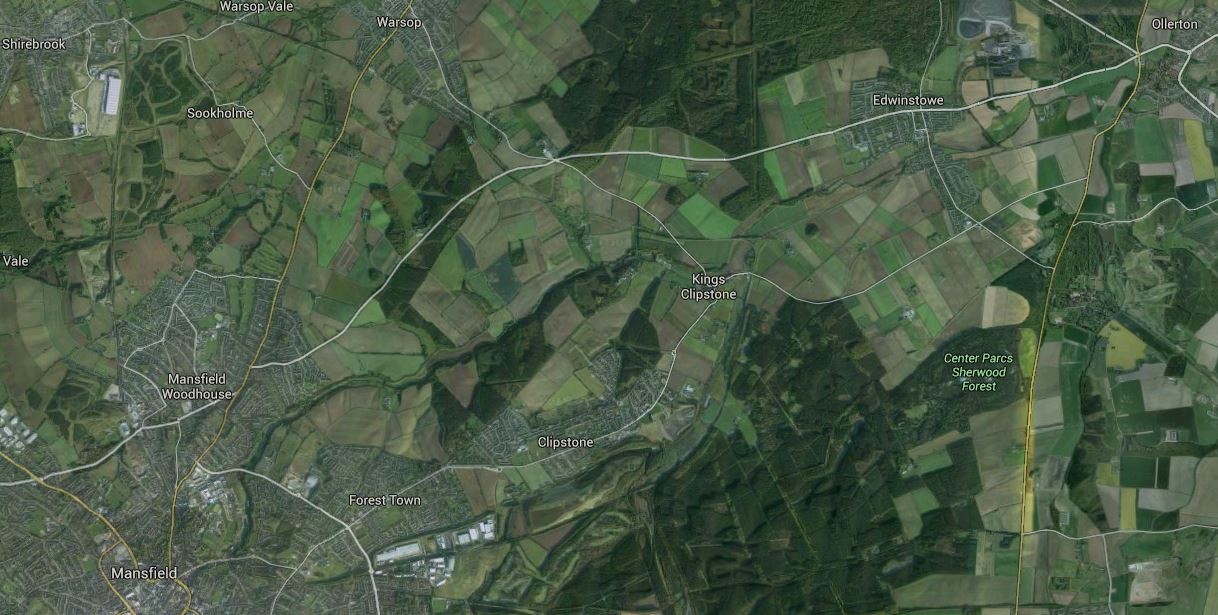
Proposed Ollerton Branch
The branch turns off from the Robin Hood Line just North of Shirebrook station in the top left hand corner of the map and then makes it way to Ollerton by way of the South of Warsop and Edwinstowe and North of the CentreParcs Sherwood Forest .
The line probably illustrates the only environmentally-friendly use for coal, which is to keep rail lines open and in good condition, until we can find a better use for them.
There is an interesting section called Branch Lines in the Wikipedia entry for Shirebrook station. This is said.
Two branch lines are plainly visible veering off north of the bridge at the north end of Shirebrook station.
The double tracks branching off eastwards (i.e. to the right as viewed from the station) to the side of the signalbox joined the LD&ECR’s one-time main line to Lincoln, next stop Warsop. The branch only ever carried a regular passenger service for a few years in Edwardian times. It did, however, carry Summer holiday trains such as the Summer Saturdays Radford to Skegness in at least 1963. The branch’s main purpose was always freight traffic, with coal being overwhelmingly dominant.
In 2013 the line gives access to Thoresby Colliery and to the High Marnham Test Track.
There is some hope of reopening the line as a branch off the Robin Hood Line and reopening Warsop, Edwinstowe and Ollerton stations, providing an hourly service to Mansfield and Nottingham.
This Google Map shows Shirebrook station and the railway lines around it.
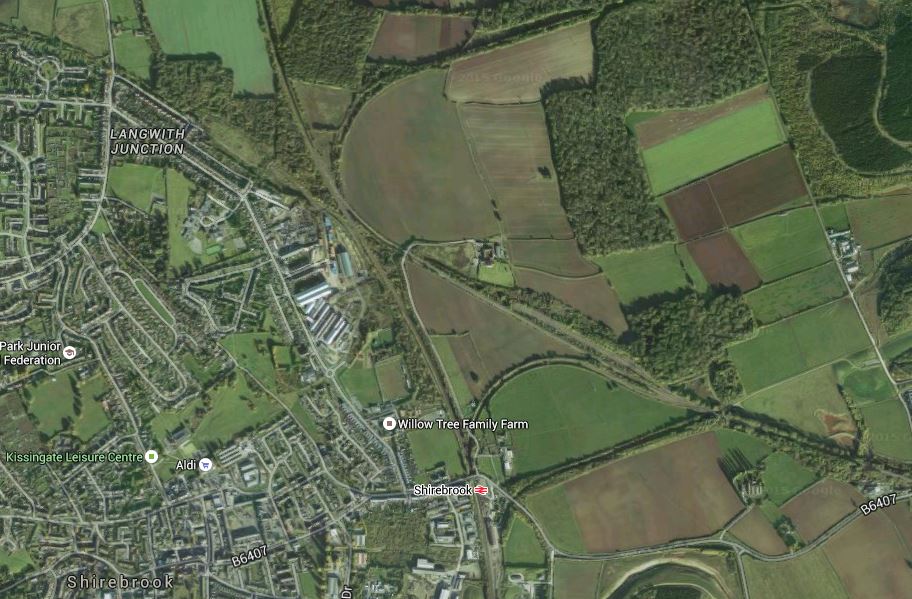
Shirebrook Station
The junction of the Ollerton branch would appear to allow access to trains from or to either Nottingham and Mansfield in the South and Worksop in the North
So there could be three stations; Warsop, Edwinstowe and Ollerton on a double-track branch.
From Ollerton To Lincoln
Interestingly, after Ollerton the line goes all the way to Lincoln. But I doubt that it would ever be part of the plans for passenger trains in the area.
But who knows?
The area between Chesterfield, Mansfield and Nottingham is not very well connected to Derby.
If you want to go from Mansfield or Kirkby-in-Ashfield on the Robin Hood Line to Derby, you always have to change at Nottingham, with sometimes an extra change at East Midlands Parkway.
The Erewash Valley Line runs North-South a few miles to the West of the Robin Hood Line.
Despite being partially in Derbyshire, getting from stations like Alfreton, Langley Mill and the soon-to-be-opened Ilkeston stations to Derby, you have to change at either Nottingham or Chesterfield.
Look at this Google Map of the area
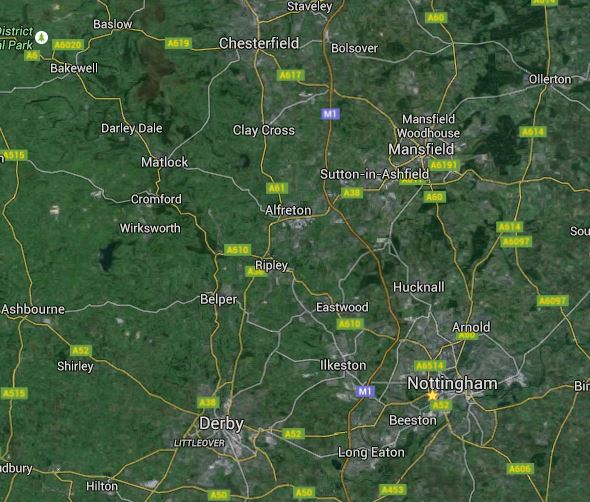
Between Derby, Nottingham, Mansfield And Chesterfield
There must be a better way of getting to Derby, than by changing trains in Nottingham or Chesterfield.
But what?
There are four main North-South routes in the area.
- The Robin Hood Line between Nottingham and Worksop
- The Erewash Valley Line between Long Eaton and Chesterfield
- The Midland Main Line between Derby and Chesterfield
- The M1 Motorway
What seems to be missing is high-capacity East-West routes for both rail and road.
The Erewash Valley Line goes South to Long Eaton, which has several trains per hour direct to Derby, so this could be the key to getting to Derby.
In a Notes on Current Station section on the Wikipedia entry for Long Eaton station, this is said.
It is planned that both platforms will be extended by up to 10 metres by no later than 2012.
It is anticipated that developments along the Erewash line will result in changes for Long Eaton station. A plan drawn up in 2011 recommended a new Derby to Mansfield service via new stations at Breaston & Draycott, Long Eaton West (renamed from Long Eaton), Long Eaton Central, Stapleford & Sandiacre, Ilkeston, Eastwood & Langley Mill (renamed from Langley Mill), Selston & Somercotes and then to Pinxton via new trackbed connecting with the Mansfield line from Nottingham at Kirkby in Ashfield.
It strikes me that work at Long Eaton, the several new stations and improvements north of Langley Mill would enable direct services from Alfreton, Ilkeston and Langley Mill to both Derby and Mansfield. This service would also improve services from stations stations North of Mansfield to Derby.
A trackbed from Langley Mill to Kirkby in Ashfield is shown on Google Maps.

Langley Mill to Kirkby-in-Ashfield
Alfreton is the station at the top left and Kirkby-in-Ashfield is at the top right. The Erewash Valley Line from Langley Mill, enters at the bottom and splits with one branch going to Alfreton and the other going East to cross the M1 and join the Robin Hood Line south of Kirkby-in-Ashfield.
On an Ordnance Survey map, dated 2009, the railway is shown as a multiple track line, probably serving collieries and open cast coalfields.
It all sounds very feasible too! Especially, as the Erewash Valley is an area of high unemployment, low car ownership and a dependence on public transport.
The Future Of Railways In North Nottingham And South Yorkshire
Look at any map of the area between Nottingham and Derby in the South to Sheffield, Doncaster and Barnsley in the North and you will see rail lines criss-crossing everywhere. Many are now disused and show up as green scars on the landscape.
Also on the maps, you will see quite a few large power stations. Most were originally coal-fired and merry-go-round trains transported the coal from the mines to the power stations.
So most of the rail lines in the area, were built to take the coal away from the mines to where it was needed. Passengers were almost an afterthought. The railway companies even built the Great Northern Great Eastern Joint Line from Doncaster to East Anglia to take coal to where it could profitably be used.
After the Second World War, the railways contracted and cut passenger services. As an example, the Robin Hood Line closed in the 1960s.
The passenger services were suffering because of car ownership, so most were withdrawn, except on the main routes. Mansfield before the Robin Hood Line reopened, was one of the largest towns in England without a rail station, an honour now held by Ilkeston a few miles away.
In recent years, coal use has in my view rightly declined. Everybody knows the poor environmental record of coal, with its creation of CO2 and other pollutants. On the other hand, I have met people whose fathers worked in the mines and the general advice they received is don’t go underground!
So as the need to move coal by rail has declined, many of these railway lines have ceased to carry much freight traffic and have fallen into disuse.
But some are coal’s last legacy, in that until comparatively recently, they were still used to get coal to the power stations. Like the line from Shirebrook to Ollerton, they are in good condition and only need stations to bring them back into use as passenger lines. Just as the Robin Hood Line was reused twenty years ago!
Because these lines serves the coalfields and the mines, they also serve the mining communities and the small towns, that need improved public transport links.
Network Rail’s plans seem to be going some way to be addressing some of the problems in the area.
I don’t think that the reopening of the Ollerton Branch and the connection between the vErewash Valley and Robin Hood Lines, will be the last lines to reopen in the area.
Ilkeston Station In A Few Years Time
I am not putting a time-scale on this, as there are so many possibilities in the mix.
I think we can assume that at some point, there will be a new station, that will look substantially like this visualisation.
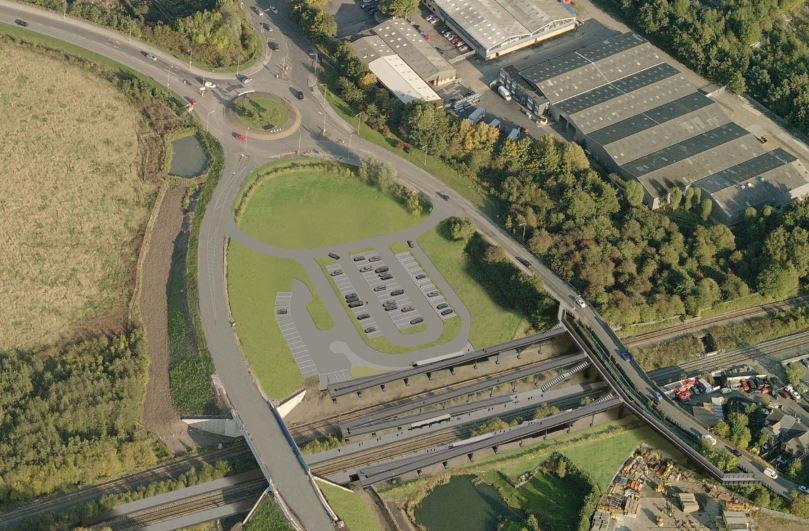
Ilkeston Station Visualisation
The Wikipedia entry for Ilkeston station says that the station is expected to open in August 2016. I think this may be challenging, but there is one factor that makes building a station here easier. It would appear that there will not be any substantial new track, so other than the station, there should not be a great deal of work to do, before trains can provide a service at the station.
There was also a substantial amount of engineering work done to the line through Ilkeston and Langley Mill in Summer 2007.
The Initial Train Service
I had intended to check whether trains between Nottingham and Leeds that call at Langley Mill, actually pass through the Ilkeston station site, when I visited Ilkeston. But as the weather was so bad and I was sitting on the other side of the train, I didn’t see anything.
I shall certainly be going to Nottingham on October 24th, so if I don’t get the information by then, I can take a detour.
If the trains that go through Langley Mill can stop at Ilkeston, the station would not have to wait long before the timetables were adjusted, so that they called. According to Wikipedia, this is the services at Langley Mill.
Northern Rail run an hourly service between Nottingham and Leeds that stops at Langley Mill. This service started from the December 2008 timetable change.
East Midlands Trains operate a few services per day from Langley Mill southbound to Nottingham and beyond (usually Norwich) and northbound to Sheffield (usually continuing to Liverpool Lime Street).
Some East Midlands Trains Mainline services from London St Pancras to Sheffield / Leeds call here, but generally interchange with London services should be made at Nottingham.
Incidentally a typical Nottingham to Leeds service stops at Langley Mill, Alfreton, Chesterfield, Dronfield, Sheffield, Meadowhall, Barnsley and Wakefield Kirkgate.
So will the new station at Ilkeston get a similar service? I think that the service will be at least as good as that to Langley Mill.
After all the timetable change of 2008 was implemented, when it was quite likely that a station would be built at Ilkeston, so I would assume timings make allowance for a possible stop at Ilkeston
In fact of the two stations, if either gets preference for services, it is more likely to be Ilkeston, as unless Langley Mill is upgraded it is a very basic station according to Network Rail.
One of the usual problems, when starting a service is finding the trains to run it. This delayed the opening of the Todmorden Curve by several months.
But in the case of services at Ilkeston, it’s mainly a process adjusting schedules so that passing trains, stop at the station.
Problems On The Midland Main Line Through Derby
It’s an ill wind, that blows nobody any good!
Ilkeston station is actually on the Erewash Valley Line, which runs from Long Eaton to south of Chesterfield joining the Midland Main Line at both ends.
In the Future section for the Erewash Valley Line on Wikipedia, this is said.
Network Rail as part of a £250 million investment in the regions railways has proposed improvements to the junctions at each end, resignalling throughout, and a new East Midlands Control Centre.
As well as renewing the signalling, three junctions at Trowell, Ironville and Codnor Park will be redesigned and rebuilt. Since the existing Midland Main Line from Derby through the Derwent Valley has a number of tunnels and cuttings which are listed buildings and it is a World Heritage Area, it seems that the Erewash line is ripe for expansion.
So it looks like Ilkeston could be on a by-pass of the Midland Main Line.
Electrification
The Midland Main Line is scheduled to be electrified and the services on the line could be provided by Class 800 and Class 801 trains,
I just wonder if Class 800 electro-diesel trains were run through Derby and Class 801 electric trains were run on the Erewash Valley Line, this might get round the problem of the heritage lobby objecting to electrifying through the World Heritage Area of the Derwent Valley, with its Grade 2 Listed tunnels and cuttings.
Derby would still get new trains. It would just be that the faster electrified ones ran up the Erewash Valley Line.
Would these trains call selectively at Long Eaton, Alfreton and Ilkeston?
Services To Derby
Ilkeston is in Derbyshire, so I expect there will be pressure to have a direct service to Derby.
At present, if you want to go between Langley Mill and Derby, you have to change at either Nottingham or Chesterfield.
I suspect that when Ilkeston station opens the route between Ilkeston and Derby will be as tortuous as it is now from Langley Mill.
Look at this Google Map of the area.
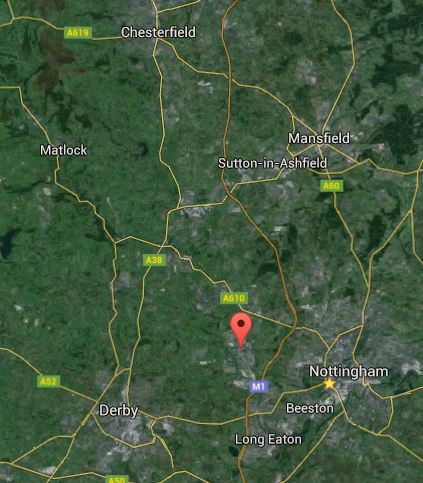
Around Ilkeston
Ilkeston is indicated by the red arrow.
There must be a better way, than changing trains in Nottingham or Chesterfield.
But what?
The Erewash Valley Line goes South to Long Eaton, which has several trains per hour direct to Derby, so this could be the key to getting to Derby.
In a Notes on Current Station section on the Wikipedia entry for Long Eaton station, this is said.
The usable length of the station platforms is shorter than the express trains which stop here, so passengers arriving from London, Derby or Sheffield will usually have to get off from the front four carriages. Elderly passengers or those with pushchairs, heavy luggage or bicycles wishing to alight at Loughborough should take particular care to board the correct portion of the train. Cycles may have to be stored in vestibules away from the cycle lockers depending on the orientation of the train.
It is planned that both platforms will be extended by up to 10 metres by no later than 2012.
It is anticipated that developments along the Erewash line will result in changes for Long Eaton station. A plan drawn up in 2011 recommended a new Derby to Mansfield service via new stations at Breaston & Draycott, Long Eaton West (renamed from Long Eaton), Long Eaton Central, Stapleford & Sandiacre, Ilkeston, Eastwood & Langley Mill (renamed from Langley Mill), Selston & Somercotes and then to Pinxton via new trackbed connecting with the Mansfield line from Nottingham at Kirkby in Ashfield.
It strikes me that work at Long Eaton, the several new stations and improvements north of Langley Mill would enable direct services from Ilkeston to both Derby and Mansfield. A trackbed from Langley Mill to Kirkby in Ashfield is shown on Google Maps.
Langley Mill to Kirkby-in-Ashfield
Alfreton is the station at the top left and Kirkby-in-Ashfield is at the top right. The Erewash Valley Line from Langley Mill, enters at the bottom and splits with one branch going to Alfretonand the other going East to cross the M1 and join the Robin Hood Line south of Kirkby-in-Ashfield.
On an Ordnance Survey map, dated 2009, the railway is shown as a multiple track line, probably serving collieries and open cast coalfields.
It all sounds very feasible too! Especially, as the Erewash Valley is an area of high unemployment, low car ownership and a dependence on public transport.
IPEMU Trains For Ilkeston?
If the Erewash Valley Line is electrified, so that Class 801 can run fast from London to Chesterfield and Sheffield, one option for the local services is to use Aventra IPEMU trains, which will be built in Derby.
IPEMU stands for Independently Powered Electric Multiple Unit. These trains have all the features of the standard four-car electric multiple unit, but they have an on-board battery that is charged when running from the overhead line and gives them a range of about sixty miles, when the wires run out.
So chargeing the battery on the Erewash Valley Line, they could reach Derby, Mansfield and Nottingham.
If Nottingham and Derby weren’t electrified until a later phase, then Class 800 electro-diesel trains could work the routes to London, until full electrification were to be completed.
Watch what happens about IPEMU trains.
Rumours have appeared in Modern Railways that orders for trains powered by the technology are imminent.
Tram-Trains For Ilkeston?
In my view the Nottingham Express Transit will get overcrowded in a few years and the capacity of the system will have to be increased.
One way to increase capacity would be to run tram-trains to destinations away from the city on the heavy rail lines. Once in the city centre they transfer to the tram lines and run as trams to suitable destinations, thus increasing the number of trams running on the various lines.
So tram-trains could say run between Ilkeston and say the Old Market Square or the Queens Medical Centre and then on to one of the terminals.
It all sounds rather fanciful, but go to Karlsruhe or Kassel and see the tram-trains in action.
Ilkeston To HS2
Tram-trains, IPEMU or standard trains from Ilkeston and other places to the North could link quite a few places to the proposed East Midlands Hub station at Toton.
Conclusion
The more I look at the future of Ilkeston station, the more I realise that constructing the new station is just petty cash in the big scheme of things around rail and tram expansion in the East Midlands.
A lot of money has been spent in sorting Nottingham station and expanding the Nottingham Express Transit and a lot more will be spent in improving and electrifying the Midland Main Line and the Erewash Valley Line. The latter will be equipped with several new stations and probably new trains of some sort.
Nottingham To Ilkeston And Back
Ilkeston is a town without a railway station and this is said in Wikpedia about the town and its railway links.
Ilkeston has not had a railway station since 1967, despite its substantial population and the fact that the Midland Main Line (formerly part of the Midland Railway, later the LMS) skirts the eastern edge of the town. Due to recent rail reopenings in similarly-sized towns it is now, by some definitions, the largest town in Britain with no station.
So I had to go to the nearest station at Langley Mill and hopefully, I could organise a taxi. I took these pictures on the journey.

After trying three taxi numbers at Langley Mill and all saying they couldn’t help, I got a bus to Heanor from where I got another bus to Ilkeston. To be fair to the buses, I’ve travelled on much worse services elsewhere in the UK. Cambridge to Haverhill for a start. And I was not issued with a dreaded ticket.
After my meeting, I decide to take the easy route back, so I got an express bus into Nottingham and then use the Nottingham Express Transit to get to the station.
I don’t think that in the twenty-first century, where we’re supposed to use green public transport, that this is the best we can do to get in a reasonable time from Nottingham to Ilkeston.
A related question, is, Is it easier to get to Ilkeston by taking a train to Derby and getting the bus from there?
Tram-Trains To East Midlands Airport
I have a Google Alert looking for tram-trains and it found this article on the Nottingham Post entitled Could tram-trains link Nottingham to East Midlands Airport?
It’s a thought!
The article talks about a proposal to create a link between East Midlands Airport and the Midland Main Line, that would allow tram-trains to connect the airport to cities like Nottingham, Derby and Leicester and the proposed HS2 station at Toton.
This is a Google Map of the area between the Airport and the Midland Main Line.
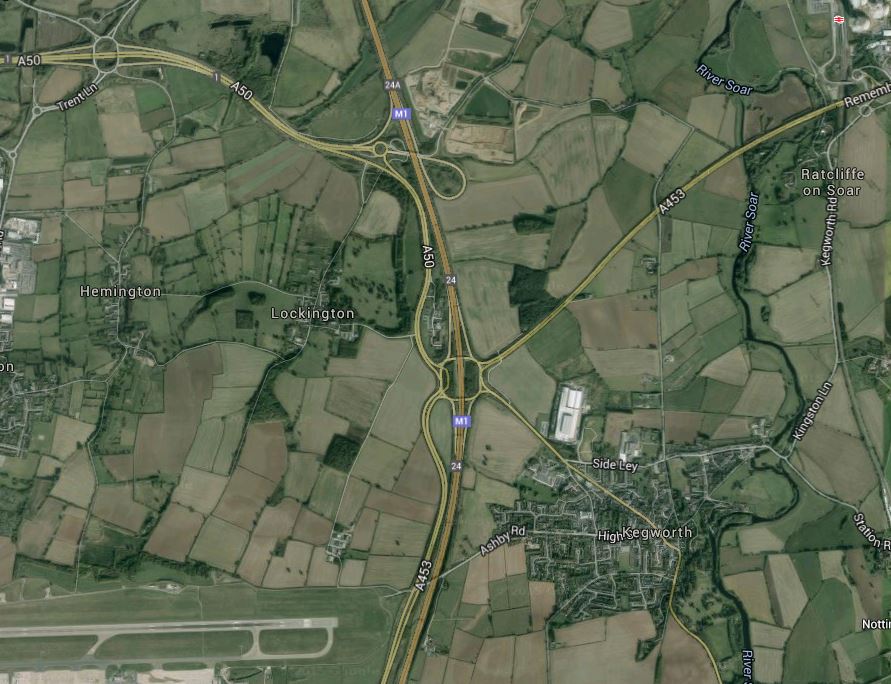
East Midlands Airport, the M1 And The Midland Main Line
East Midlands Parkway station is at the top right of the map.
I think that properly designed this idea could have legs.
A few points.
- Some doubt the South East will ever get a new runway, so improving connections to East Midlands Airport would surely mean more passengers flew from their local airport, rather than a congested Heathrow.
- It would improve links between the major cities and population centres of the East Midlands and they probably need an improved turn-up-and-go four trains per hour service between each.
- There are a number of intermediate stations to the various destinations, which probably need better connections.
- The tram-line would also cross the M1. So would a pick-up/drop-off tram stop ease travel in the area?
- Once the tram-train technology is proven and approved and the Midland Main Line is electrified, I doubt that creating the link would be a difficult planning or engineering project.
I will be very surprised if at some point in the future, some form of light or heavy rail line doesn’t reach East Midlands Airport.
But then I think tram-trains would be best.
Phase Two Of The Nottingham Express Transit Opens Today
The Nottingham Express Transit is in my view one of our better tram systems.
As a regular user of tram systems in the UK and Europe and a Londoner, I actually think that the London Tramlink is the best, but that is because of the ticketing, which is based on the London contactless system and I just touch-in and go. Both Nottingham and Croydon systems are low-floor systems.
Nottingham Express Transit (NET) has also proved to be reasonably commercially successful. Wikipedia says this.
The new line proved successful, leading to an increase of public transport use for the Nottingham urban area of 8% in the five years to 2008, together with a less than 1% growth in road traffic, compared to the national average of around 4%. Nottingham has exceeded the most optimistic predictions, carrying 9.7 million people in 2005. This bolsters the case for the construction of new lines.
In my view other than the non-contactless ticketing, NET major problems are that it is not big enough, doesn’t connect properly to the rail station and doesn’t serve the two football and the major cricket grounds at Trent Bridge, which are all clustered together a twenty-minute walk south of the rail station.
The size problem is being rectified today with opening of Phase 2 of the system. According to this article on Global Rail News, it is happening today.
I think that this could turn out to be a significant day in the history of modern tramways in the UK, as if it proves out to be a successful extension to a proven system, it will be a wonderful advert for trams and light-rail in general.
It is just a pity, that the tram system still doesn’t serve the three sports grounds. Nottingham County Cricket Club, does at least say this about using trams to get to the ground on this page of its web site.
The nearest tram stop, Station Street, is a 20 minute walk from the ground, and anyone travelling from outside the city can take advantage of NET’s free park and ride facilities.?As an added incentive to take the tram, NET will be running a £2 return ticket for all match and season ticket holders.
Nottingham Forest give no information on how to use the tram, although Notts County would seem to run a similar scheme to the cricket.
This Google Map shows the layout of the station, the River Trent and the three sports grounds.

Nottingham Station, The River Trent And Sports Grounds
Note the bridge at the left hand side of the map over the River Trent. This is the Wilford Toll Bridge, which the NET uses to cross the river.
I suspect though that many meetings about transport in Nottingham have concluded that crossing the River Trent is the biggest transport problem in the area.
When I used to drive to Nottingham from Suffolk to either see a client or watch football or racing, getting away from the city to the East was always difficult, as the river always seemed to get in the way.
The simplistic solution to solve the sports ground problem of running a tram route over Trent Bridge or Lady Bay Bridge, which are the two bridges near the grounds would probably be the sort of measure that would be terribly unpopular with motorists.
I have searched for stories about a possible new crossing across the Trent to the East of Nottingham and there is certainly a lot of studies and speculation. This report in the Nottingham Post talks about a fourth road crossing and this one in the same paper talks about a foot and cycle crossing.
My feelings are that this is a classic problem, that should be sorted locally by a local Nottingham-wide Mayor or Transport Commissioner, responsible to a lkocal electorate.
If the extension to the NET are successful and take traffic off the roads, this might give impetus to expand the tram to the east and south-east of the city coupled with a new route to get cars and trucks over the river. This is a Google Map of the East of Nottingham.
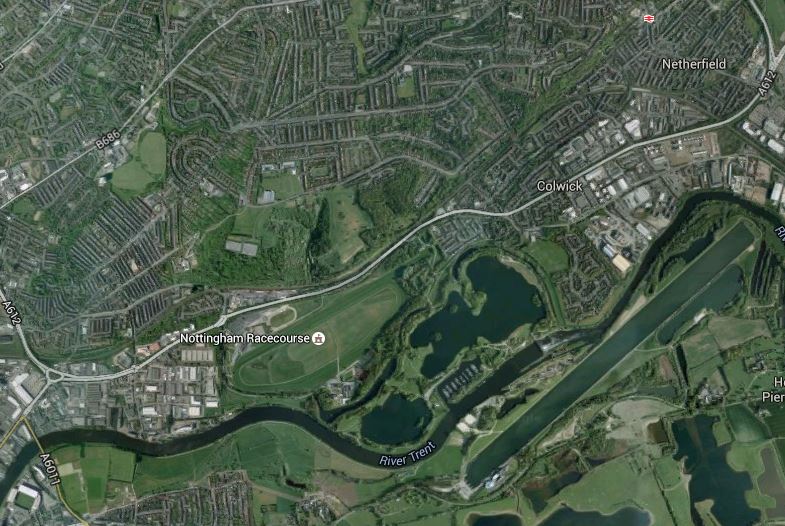
East Nottingham
Note Lady Bay Bridge and the City Ground in the bottom left-hand corner and the Holme Pierrepoint National Watersports Centre to the right. I bet the Watersports Centre would love a tram from the centre of Nottingham.
Also in this map in the top right hand corner is Carlton station on the Nottingham to Lincoln rail line. After what I’ve seen in Germany, this line would be one, they’d not hesitate to use for tram-trains. Little modification except for electrification would be needed outside of the city. At Nottingham station, the tram-trains would become trams and use the tram network to get to their final destination. I hope that Nottingham’s great and good visit their twin city of Karlsruhe and see how tram-trains working on the Karlsruhe model combine trams and trains in the city.
One thing that would make connecting tram-trains to the new tram stop at Nottingham station is that Nottingham station is not on a cramped site and a lot of the land surrounding the station is surface-level car parking.
I can envisage tram-trains arriving at Nottingham station from places like Grantham, Mansfield and Newark and then transferring to the NET tracks to go north or south from the station. You could even run tram-trains to Sheffield, so that the two tram systems are connected.
Compared to similar lines around Liverpool, Birmingham, Leeds and Cardiff, the frequencies on all these rail branches out of Nottingham are not high enough. Nottingham to Sheffield, as an example is only twice an hour, when four should be a minimum for cities of this size.
I suspect that Nottingham is watching the result of Sheffield’s tram-train trial to Rotherham with interest.
One way or other the Nottingham Express Transit will be key to solving the transport problems in Nottingham.
Why Is It Not Planned To Take The Nottingham Tram To Trent Bridge?
From my limited knowledge of Nottingham, I find the Nottingham tram, a bit of a conundrum, in the way it doesn’t serve the football and cricket grounds.
England has four major cities; Manchester, Sheffield, Newcastle and Nottingham, that use tram or light rail to move passengers around the city. In addition, Birmingham, Liverpool and Bristol have heavy rail networks that do a similar job.
Most major sports ground and arenas in larger cities are located on these networks. In fact, some clubs have the tram stop or train station named to connect it to the stadium or club.
There is Arsenal, Upton Park and White Hart Lane in London, St. James in Newcastle, Hawthorns in Birmingham and Hillsborough in Sheffield.
Nottingham has three stadia in the Trent Bridge area of the city; Trent Bridge cricket ground, Forest’s City Ground and County’s Meadow Lane, but surprisingly the Nottingham tram doesn’t go or isn’t even planned to go to the area.
However this lack of connection to the City Ground, didn’t stop the tram advertising in the stadium.
I am totally surprised that Nottingham are spending all these millions on constructing a tram system, that doesn’t go near the area, where a lot of visitors to the city want to go.
Today for instance, after arriving from London, I took the tram up the hill to a restaurant I like in King Street. After my lunch, it would have been so easy to walk to the tram line and then get a tram to the ground! I’d have also probably taken a tram back to the station. So instead of probably a day ticket for £3.70, I bought just one single ticket at £2.20.
And did a lot of walking!
A Street For Coeliacs In Nottingham
On Saturday, the fourteen of December, I went Nottingham to see Ipswich play.
As I often do in the city, I had a meal in French Living in King Street, as they know their gluten-free well.
They have now expanded to include a creperie that does gluten-free and King Street, where they are, now has two chain restaurants, which are safe for coeliacs.
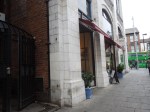
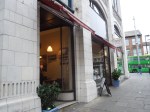


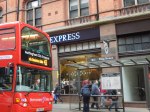
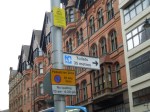
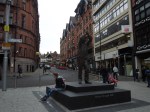
So if you want gluten-free food in Nottingham, head to King Street.
I took the tram up the hill from the station. and then it was a short walk.
It will be interesting to see if other restaurants opening in the area, will also do gluten-free offerings.
Stefan From The Atos Trio
The trip to Leicester on the train, was enlivened by this guy.

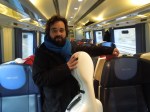
He is a member of the Atos Trio and was going to perform at a concert in Nottingham.
Sometimes, you see small women struggling with enormous double-bases on the Underground. Do they wish they’d chosen to play the violin or the piccolo?
Nottingham’s Pedestrian Unfriendly Streets
This picture is typical of many I could have taken walking between Nottingham station and the two football grounds and the cricket ground.
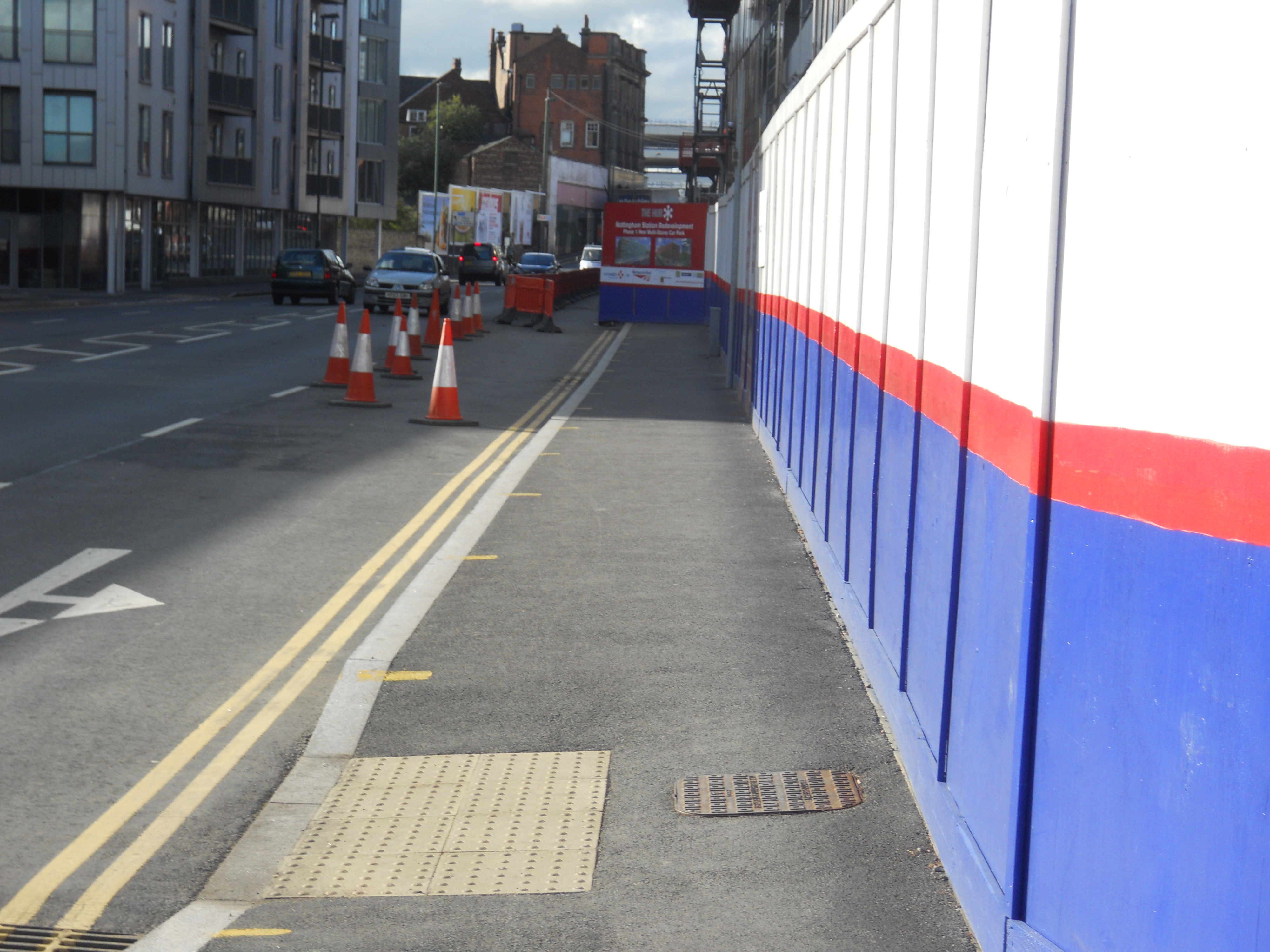
A Typical Nottingham Pedestrian Route
It would appear that little has been done to create a safe walking route to and from the city centre for pedestrians. I couldn’t find a bus either.
When I got to the station, I asked a policeman as to his views on walking to the grounds. I won’t repeat his answer here.
To be fair, there is a map in the station. But it doesn’t show the football and cricket grounds in the list of important places!
Let’s hope when they finish the development of the station and the trams, that it will make the journey easier!
Or they could perhaps use the Nottingham Canal as a walking route, as it goes roughly the right way.
Today’s Nottingham Card
friend has asked me to give him some pointers to the races at Nottingham today.
Here are my quick thoughts.
Race 1 – Neytiki as it’s got the most attractive jockey! She’s a coeliac too! Avoid Brand Bob as the horse has a bad draw. The horse is also owned by someone I know!
A general point is that it’s probably worth watching Richard Hughes mount in the first, but a PlacePot using all his mounts would be a good idea, as he’s closing in on the jockey’s championship.
I can’t say I can guarantee these selections, but my father’s ability to pick winners improved after he’d had a stroke.
Race 2 – Ittirad as trainer Michael Jarvis and jocky Philip Robinson are often dangerous in this sort of race.
Race 3 – Academy and Charles Camoin.
Race 4 – If Hayley wins the first, back Ace of Spies here. Make My Dream is probably worth looking at.
Race 5 – Be patriotic and back the Queen’s horse – Starshine. Seriously though it looks like a horse that gets a distance and few except the Queen run those.
Race 6 – Spinning is napped and should go close and Naddwah is my pick. But don’t underestimate Compton Blue because of Richard Hughes going for the championship.
Race 7 – Point North and Colour Scheme.
Race 8 – Kenyan Cat as trainer a great and honest guy and horse just missed a hat trick.
 The Anonymous Widower