A Walk Around The Ordsall Chord
I took this walk around the Ordsall Curve.
I’d taken one of Manchestewr’s free city centre buses and a walk to the Spinningfields area.
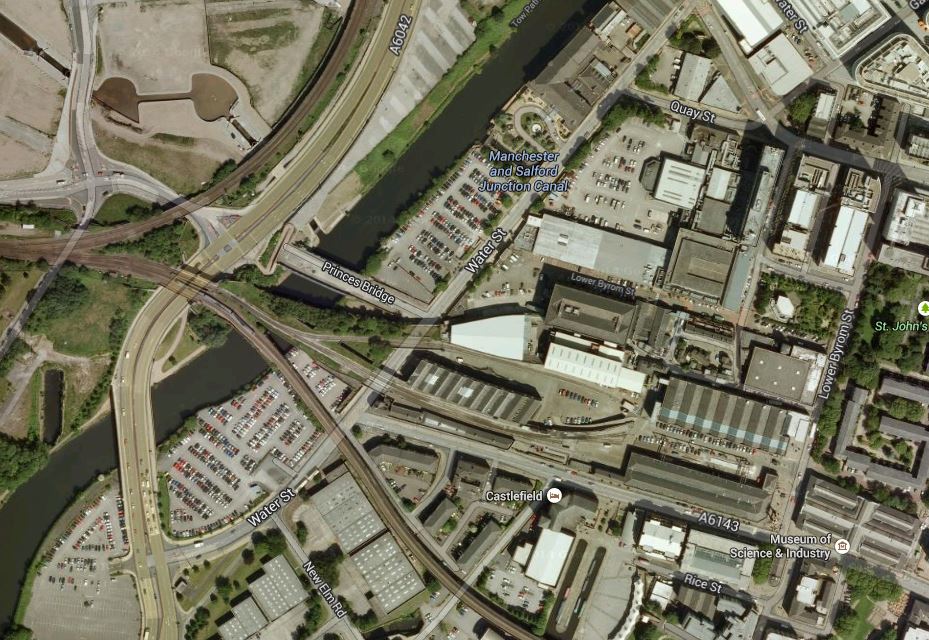
This Google Map shows the layout of lines in the area.
The Area Of The Ordsall Chord
Walking North-East to South-West along Water Street, the bridges in order are as follows.
- The Prince’s Bridge is a disused road bridge, noticeable because of its zig-zag construction, which will be demolished. There’s more on the bridge on this page on Manchester History.
- Then there is the single-track line, that the Museum of Science and Industry used to run their replica locomotive.
- The Windsor Link Railway which connect Salford Crescent and Deansgate stations, appears to share a wide bridge with the line to the museum.
- The last bridge is the direct historic line between Liverpool Lime Street and Manchester Piccadilly.
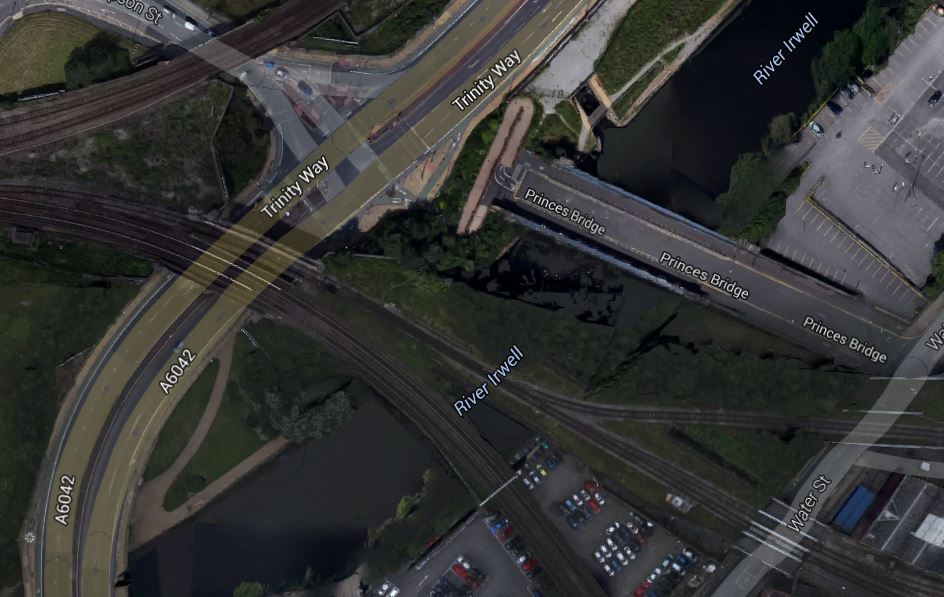
This Google Map shows the lines as they cross the Irwell in detail.
Across The Irwell
Note in the North-West corner of the map, the line between Salford Crescent and Manchester Victoria stations via Salford Central can be seen.
The Ordsall Chord will run in a North-South direction between this line and the line to Manchester Piccadilly.
Under Proposal in the Wikipedia entry for the chord, this is said.
The Ordsall Chord would preserve connectivity between the relocated East-West services and the city’s existing main rail interchange at Manchester Piccadilly. It would also improve rail access to Manchester Airport, which at present cannot be reached easily from Victoria. Without the chord, such operations would require for trains to be run on and then reversed back at Salford Crescent.
The would enable services such as.
- Huddersfield, Leeds and York to Manchester Airport.
- Leeds to Crewe without a change or a reverse in Manchester.
- Huddersfield to London without a change.
It will also enable services on the Northern branches out of Manchester to be connected to those going South, with stops at both Victoria and Piccadilly in Manchester. This will mean that passengers needing to cross Manchester will probably be able to change trains once, rather than use the tram. it should also mean that both major Manchester stations will be able to use their capacity better, as trains will go through Manchester rather than terminate in the city.
No-one could argue that building the chord is simple, although released images show it to be dramatic.

An Artists Impression Of The Ordsall Chord
Note.
- In the image, you can see the historic Liverpool to Manchester Line behind the bridge.
- Deansgate and Manchester Piccadilly stations are to the left with Salford Central and Manchester Victoria to the right.
After walking past the bridges, I crossed the river and followed Trinity Way virtually all the way to Salford Central station.
As I walked, I took these pictures.




















The one thing that surprised me about this visit, was that propgress in the short time, they’ve had since all the legals were settled, seems to have been purposeful.
From Salford Central station, I was able to get a train to Preston, where I stayed the night.
Will It Be All Systems Go For The Ordsall Curve?
This article in Rail Technology Magazine is entitled Court of Appeal dismisses Ordsall Chord legal challenge and it talks about Mark Whitby’s fight to stop the Ordsall Chord being built.
This is said.
A legal appeal following the dismissal of a challenge to the process for granting permission for the Ordsall Chord has been dismissed.
The Court of Appeal today upheld a ruling to dismiss a challenge from Mark Whitby, former president of the Institution of Civil Engineers.
The Court dismissed all three appeals made by Whitby against the decision of Lang J in the Mrs Justice Beverley Lang: two statutory challenges of the Transport and Works Act order and of the Listed Building Consent, and a judicial review of the planning permission. The Court of Appeal will hand down its judgement early in the new term, after Easter.
I hope this is the end of it, and work can proceed on the much-needed new infrastructure.
But I suppose there’s always the Supreme and European Courts!
I am a Londoner and one thing puzzles me about this case. If say in London, there was an argument about such a piece of infrastructure, those making the fuss would be local people, as they are in Chelsea and Wimbledon over Crossrail 2. In all the reports on the Ordsall Chord, the councils, politicians and the media seem to be in favour and only one lone person is against.
This article in Building gives an insight into Mark Whitby.
The Saga Of The Ordsall Chord Goes Into Extra Time
If there is one railway project that sums up one of the worst problems often faced by rail planners in this country it is the endless saga of the Ordsall Chord. Wikipedia describes the chord and the reason for building it in this paragraph.
The Ordsall Chord is a proposed short railway line in the Ordsall area of Greater Manchester. It will link Manchester Piccadilly and Manchester Victoria and it is expected to increase capacity in the region and reduce journey times into and through Manchester.
Sadly, the endless fights, that this worthy aim, which would be to the good of millions of rail travellers, could have been avoided if history was different.
The Picc-Vic Tunnel was one of three major tunnels under Northern cities to improve rail services. The other two in Liverpool and Newcastle were built, but Manchester’s solution was cancelled by that very bad friend of trains in the North; Harold Wilson.
And then, the Ordsall Chord was proposed as an alternative to the tunnel. Wikipedia says this.
The chord was first proposed in the late 1970s. Parliamentary powers for its construction were received in 1979, but the project was cancelled. Network Rail revived the proposal in 2010 as part of its Manchester Northern Hub proposal. Funding for its construction was announced in the 2011 United Kingdom budget. It is scheduled to be completed by December 2016, and will cost around £85 million to construct.
So the proposal has been around a long time and since 2011, there has been the money to build it.
In A Single Objector Holds Up The Ordsall Chord, I expressed my despair at the delay and said this.
I will not judge this case one way or the other, but one of the reasons for bad economic progress in the North is poor and outdated rail infrastructure. So surely, it would have been better to have got this argument out of the way a couple of years ago.
I do wonder in this country, how many projects don’t ever get started because organisations like Network Rail feel it is better not to have a fight and leave the inadequate status quo alone.
So now according to this article in Rail Magazine, which is entitled Whitby issues new challenge to Ordsall Chord, the original objector is taking his challenge to a higher court. This is said in the article.
That High Court ruling also refused Whitby the right to appeal. However, Whitby has appealed this refusal, and on January 11 the Court of Appeal granted Leave to Appeal. Thus the former President of the Institution of Civil Engineers is set to launch his third attempt to derail the Ordsall Chord project, on a date to be set later this year. “The grounds of appeal raise important points and have real prospects of success,” the Court of Appeal said.
Comments from Council leaders in the area are less than pleased.
In another article in Manchester Confidential, there is this user comment.
If Mark Whitby is so right why did he lose the Judicial Review? The judge who heard the hearing Mrs Justice Lang who is no pushover in these matters. Ruled that the Public Enquiry was legally flawless and agreed with the planning inspector that the common good over ruled the objections to the Chord.
I don’t think its about historic buildings more Mr. Whitby’s dented big ego because his route was rejected.
Hopefully if he loses he should be made to pick up the bill for all the public money he’s wasted.
I think a lot of people feel that way about Mark Whitby.
What worries me is that if the Court of Appeal turns down the appeal, will the case go to the Supreme Court and then an appropriate European one.
The only winners in this sad saga are the lawyers.
But there are millions all over the North, who just want to get about their business, who are very big losers.
And that doesn’t count, all taxpayers from Lands End to John O’Groats, who are eventually footing the bill, for one man’s stubbornness.
A Single Objector Holds Up The Ordsall Curve
This article from the Manchester Evening News entitled Ordsall Chord delay: Town hall chief blasts single objector holding up £85m Piccadilly-Victoria rail link, is a superb example of how external factors contribute to delays in not getting vital rail and road infrastructure built and increase the costs, when they do get built.
I will not judge this case one way or the other, but one of the reasons for bad economic progress in the North is poor and outdated rail infrastructure. So surely, it would have been better to have got this argument out of the way a couple of years ago.
I do wonder in this country, how many projects don’t ever get started because organisations like Network Rail feel it is better not to have a fight and leave the inadequate status quo alone.
Manchester Now! Is Glasgow Next?
Look at most large English, Scottish and Welsh cities and there is usually at least one line through the city so that trains can pass from one side of the city to the other. Look at these examples.
1. London is upgrading the main North-South Thameslink route and building another East-West one.
2. Birmingham, Cardiff, Edinburgh, Leeds, Newcastle, Nottingham, Reading and Sheffield all have lines that fan out on either side.
3. Liverpool Lime Street is effectively a terminus on the coast, but a North-South line in the city connects stations in the North with others in the South.
When lines connect across a city, this means you don’t have so many terminal platforms in the centre of that city. As an example look at Brighton and Bedford, which have been connected for decades by Thameslink through London. There are several Central London stations where the train calls, so passengers have a lot of journey options. But there are no terminal platforms in Central London used by Thameslink.
Only two major cities don’t have a connection like this.
1. Manchester has two unconnected stations; Piccadilly and Victoria, with the former generally dealing with Southern services and Victoria dealing with the North and East.
2. Glasgow is the same with Queen Street dealing with the North and East and Central dealing with the South and West.
But with the announcement today of the final go-ahead for the Ordsall Curve in Manchester, as reported in this piece on the BBC, Manchester is finally getting the cross-city link it should have got with the building of the Picc-Vic tunnel. This plan was abandoned in 1977.
Will Crossrail Glasgow be announced before the election? I doubt it, as Alex Salmond would label it an English bribe.
But it is desperately needed!
The Proposed Ordsall Chord
The Ordsall Chord is going to allow trains to call at both Manchester Piccadilly and Victoria stations as they pass through the city. This map from Network Rail shows the layout of rail lines in Manchester and the position of the proposed Ordsall Chord.

Rail Lines Around The Ordsall Chord
There is also this image from Google Earth.
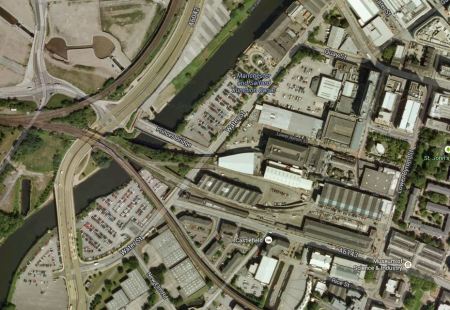
The Area Of The Ordsall Chord
The two lines that will be connected meet at the left or West of this image. The Ordsall Chord will make a triangle with the existing lines and will connect the line going to the top of the picture towards Victoria, with the one going to the bottom towards Piccadilly.
The project is not without controversy. A lot of the arguments are laid out in this article in the Manchester Evening News. This is said.
Ministers have been asked to step in over fears a new £85m bridge will sever the world’s oldest train station from the rail network. Bosses at Network Rail are consulting on plans to build the new bridge over the River Irwell in Castlefield to link Victoria and Piccadilly stations for the first time.
I’m all for looking after historic sites, but in some cases economic necessity will mean, that things have to be done that can’t please everybody.
It would appear that the chord has not been approved yet.
So does this mean that the completion of the Northern Hub is going to be delayed?
Electrification Of Manchester To Preston Via Bolton
My trip to Bolton today, beautifully illustrated that the Manchester to Preston line needs to be electrified and the Ordsall Chord needs to be built. This chord would allow trains to serve both Manchester Piccadilly and Victoria stations as they pass through the city.
Trains do run directly between Piccadilly and Horwich Parkway, but going to the match, I did want to take some pictures in Manchester, so I walked to Victoria and got the train from there. Hopefully, when the scheme is fully implemented, all of the stations served by the line will get better connections at Piccadilly to and from the South.
Wikipedia says this about services between Horwich Parkway and Manchester
Northern Rail: there is a half-hourly service Monday to Saturdays northbound to Preston, with hourly extensions to Blackpool North and southbound to Bolton, with trains running alternately to Manchester Piccadilly or Manchester Victoria. An hourly service continues onwards to Stockport and Hazel Grove.
Trans-Pennine Express: one train per hour calls in each direction throughout the day, northbound to Blackpool North and southbound to Manchester Airport.
I think after the Ordsall Chord is built, it is reasonable to assume that a good proportion of the services will call at both Manchester stations. Certainly, it has been stated that Manchester Airport services will do this.
The train I got to the match from Victoria was one of Northern Rail’s better elderly diesel units, but coming back I was in one of TransPennine’s modern Class 185 trains.
After electrification of the line, I suspect there’ll be a bit of a reallocation of routes between the two train companies and most services on the line will be run by refurbished Class 319 trains. These are four carriages to a trainset and they can also be run in eight and twelve coach formations, so they can run services based on the newly-electrified lines in a very flexible manner, suited to the traffic.
I personally think that the train service between Manchester and Blackpool is totally inadequate at just a couple of rather pedestrian trains per hour.
As electrification is likely to bring a raising of speed limits and a larger pool of bigger and much better rolling stock, I would think that in a few years time, the Manchester-Blackpool service will bear no relation to the terrible one it is today.
At present it is not just the Manchester-Liverpool and Manchester-Preston-Routes that are being electrified. In their description of the electrification in this report, Network Rail show this map.
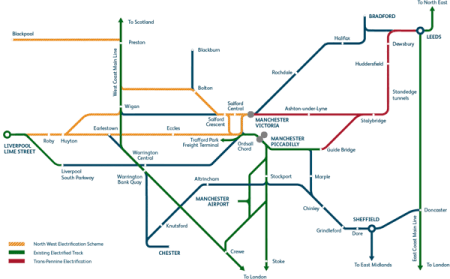
Northern Electrification Map
Note how Wigan-Liverpool via Huyton, Manchester Victoria-Leeds via Huddersfield and Guide Bridge-Stalybridge are also shown as going to be electrified. As is the Windermere Branch Line, which is not shown on this map. All are costed and funded, but there have been a few engineering problems, meaning that the Manchester to Liverpool services didn’t start when they should have done. The problems are reported in the Liverpool Echo.
Network Rail has admitted the long-awaited launch of electric train services between Lime Street and Manchester Victoria and Manchester Airport will now be postponed until next year, possibly as late as February.
The serious delay has been blamed on “unexpected ground conditions and technical issues” encountered while installing the overhead catenary wires on the 184-year-old former Liverpool & Manchester Railway mainline, said Network Rail.
This will only be the start of the revolution.
As there are 86 Class 319 trainsets, that are to be split between the North and the Great Western Main Line, I’m sure that enough sets can be found to run a good service between the following destinations, when the current electrification plans are complete.
- Liverpool-Blackpool
- Liverpool-Lancaster, Carlisle and Scotland
- Liverpool-Leeds/Newcastle via Manchester Victoria
- Manchester-Blackpool
- Preston-Windermere
Services from Liverpool, that go North up the West Coast Main Line, don’t run at present, except to Preston and Blackpool. But if the lines are all electric, subject to the paths being found, I think that one of the operators will run direct services between Liverpool and Glasgow. Failing that Liverpool to Blackpool services will probably be timed to connect with services to both Scotland and the South at Preston. Or perhaps some of the First TransPennine services between Scotland and Manchester , could divide and connect at Preston. But whatever happens travel between Liverpool and Scotland will be a lot easier.
Once electrification gets to Leeds, this will enable services from Manchester and Liverpool to go all the way to Newcastle, opening up more possibilities for new services.
I don’t believe that this will be the end of the development of electric services in the North.
The Class 319 trains currently ply between Bedford and Brighton, which by road is about 120 miles. So they should be capable of serving the slightly shorter distance between Liverpool and Hull. It would seem they are capable of travelling across the North of England reliably. As they are 100 mph electric trains, they certainly wouldn’t be slower on the route than the current Class 185 trains and probably only slightly slower than the new Class 350 trains, that First TransPennine use on Manchester-Scotland services.
In a few months time, electric services between Liverpool and Manchester will commence, probably followed about two years later by electric services from Liverpool and Manchester to Preston and Blackpool.
If the North like their refurbished trains running on electrified lines, it will be hard to resist the pressure to put in more electrification.
If Network Rail can get its act together on electrification, I think that by 2022, the number of electrified lines in the North will be greater than currently planned.
The route from Manchester to Sheffield by the Hope Valley Line will probably be a priority, as when the Midland Main Line from Sheffield to Doncaster, Nottingham and London is electrified in 2020, it will open up all sorts of routes like Liverpool and Manchester to Nottingham and the East Midlands.
If Hull to Leeds and Doncaster is electrified, then this opens up the possibility of electric Liverpool and Manchester to Hull services via Leeds. The BBC has this report about ministers backing the electrification.
The government has backed plans to electrify the Hull to Selby rail line.
Transport Secretary Patrick McLoughlin said he was making £2.5m available to take the project to the next stage
First Hull Trains is planning to spend £94m electrifying 70 miles (112km) of track to improve connections with the wider rail network.
Work is already under way to electrify the line from Manchester to Leeds, York and Selby and is due to be completed by December 2018.
This one will happen, as First Hull Trains wouldn’t spend £94million of their own money, if they didn’t think they’d make a decent return. They are probably trying to get their hands on some of the InterCity225s that will be made redundant by the new Class 800/801 trains.
It is almost if a hundred miles per hour railway across the country is fighting its way to birth by stealth, aided by some refurbished over twenty-years old British Rail rolling stock.
An interesting aside is what will happen to the thirty one InterCity225s. I have heard a rumour that some will be cascaded to the Greater Anglia Main Line to run London to Ipswich and Norwich services currently run by Class 90 locomotives hauling Mark 3 coaches.
I haven’t travelled in an InterCity225 for some months, but the last time I did on a short trip to Peterborough, they did not appear to my untrained eye to be scrapyard fodder yet.
As they are genuine 200 kph high speed trains, could we see them providing fast services from Liverpool to Newcastle and Hull in under two hours? Politicians and comedians may well have poked fun at British Rail for years, but now that we have a UK cash flow shortage, who are stepping up to the plate to help out our impoverished railways? A whole series of British Rail trains like the InterCity 225s and Class 319. No-one should forget the refurbished Class 315, Class 317 and InterCity125s, which will fill other gaps in the bad planning of our railways in theThatcher, Blair and Brown decades.
The only problem with the InterCity225s, is that they may be too long for some of the stations across the Pennines. But solving that is in the grand scheme of things a relatively minor problem for good engineers, architects and construction teams. Also, as they get replaced will some end up on the West Coast Main Line providing direct services to Blackpool?
Once the basic spine across the country is complete and running high-capacity services fast electric services between Blackpool, Liverpool and Manchester, in the West and Leeds, Hull and Newcastle in the East, two things will happen.
Politicians will press Network Rail to create a genuine high speed railway or HS3, across the country, as they love high profile projects, by which they will be remembered.
But more importantly, all of those connecting lines across the North will be prime candidates foe electrification, so they can be home to some more Class 319s.
HS3 will eventually be created, but only when the new electrified service is in need of more capacity.
I think that the electrification in the North is an unstoppable series of projects, that will only finish, when all lines are electrified.
Talking to people on the trains to Bolton yesterday, I don’t think the passengers know how their lives will change, when what is certainly going to be implemented happens.
One very extensive traveller, I met on the train between Manchester Victoria and Horwich Parkway, didn’t realise that the new electric trains in a couple of years would be larger units that the current diesels. He also had travelled on Thameslink to his daughter in South London and actually thought the current trains on that route were pretty good. He hadn’t realised that these would be running after a basic refurbishment all around Manchester.
And then on the trip back to Piccadilly, I met two young ladies, who were coming all the way from Eskdale to see the Who in Manchester. They didn’t kow that the branch to Windermere is going to be upgraded and said that it would have made their journey today a lot easier.
The rail industry in the North needs to spread the word. I have a feeling that the Class 319s, when they start operating in a few months between Liverpool and Manchester will start the process.
Expanding The Manchester Metrolink
In my view the Manchester Metrolink has not grown as fast as it should have done. A good proportion of the system opened in the early 1990s and nothing really seemed to open until the last few years.
For a lot of that twenty year gap, the government was one that you’d think would be sympathetic to expanding public transport in areas, where they could count on the vote. Perhaps, though Blair and Brown were more interested in war abroad than looking after the North!
There have been various plans to extend the Metrolink to places like Middleton, Salford, Stalybridge, Stockport and Trafford Park, but strangely not Bolton. Only the extension to Trafford Park has been funded.
Now I don’t know Manchester politics, but I do feel that if there had been a Manchester mayor for say the last ten years, I suspect with someone batting for Manchester, some of these extensions would have been progressed. Now that one should be there in 2017, hopefully progress will be quicker.
On this post there are comments about the non-extension of the tram from East Didsbury to Stockport.
So can this line be easily built, as it seems to me, as someone who only knows the area from the 1960s and a good map, that it would be of benefit to a lot of people?
Also if the Metrolink went to Stockport rail station, it would surely give an alternative Manchester station for those living on the tram network, just as Watford, Stratford, Ealing Broadway, Wimbledon and others do for the London Underground/Overground. Travellers should be given the choice of as many different routes as possible.
So I looked up how this line would get from East Didsbury to Stockport and found this article, which describes a route as proposed in 2004.
Reading the article, the route seems to be rather complicated and expensive, as it crosses the River Mersey several times and it doesn’t go to the rail station.
So perhaps if Stockport, is ever linked to the Metrolink, it will use a different route.
It all illustrates that extending the Metrolink isn’t as easy as it might first appear. I hope Manchester has got some good transport planners, who know the city well.
As an aside here, it is worth thinking about how the Northern Hub and in particular, the Ordsall Curve linking Manchester Piccadilly and Victoria, will indirectly affect the Metrolink. There could be at least four trains per hour both ways between the two stations and six going towards Bolton and Preston according to Wikipedia. So as some of these services will go south towards Stockport and the Airport, Manchester will probably see a high-frequency service between Piccadilly, Victoria, Bolton, Stockport, Salford and other places in the Greater Manchester area. The trains will all be electric and probably something like the ex-Thameslink Class 319. These trains will extend journeys all round the area to Blackpool, Huddersfield, Leeds, Liverpool, Preston, Warrington and Wigan. With not a lot more electrification, places like Blackburn, Burnley, Sheffield and Southport could be brought into an electrified network, where high-capacity trains run at least four times an hour on all routes.
One thing that would need to be done is improve the interchange between the Metrolink and some of the central Manchester rail stations. Victoria is showing glimpses of being superb, Piccadilly needs to be a much shorter walk and perhaps Salford Crescent needs to be linked to the tram.
I don’t drive and suspect will never do so again, but one thing that always worries me about city transport systems is, are there enough Park-and-Ride spaces and especially close to the motorways? I know London lacks badly in this area and suffers because of it. So how does Manchester stack up?
By the end of this decade, Manchester could be getting the transport system it needs and deserves.
Did Manchester Railways Ever Have A Plot?
What are the two odd ones out of these British cities?
Birmingham, Bristol, Cardiff, Derby, Edinburgh, Glasgow, Leeds, Liverpool, Manchester, Newcastle, Nottingham and Sheffield
It’s actually, Glasgow and Manchester, as they are only cities other than London with two main stations. The pedantic could argue that Birmingham has more than one, but New Street is very much larger than the others.
Glasgow’s two station; Central and Queen Street, split their services geographically, but at least they could be connected by Crossrail Glasgow, which is summed up like this.
The proposed Crossrail initiative involves electrifying and reopening the City Union Line for regular passenger use in conjunction with new filler sections of track which will connect the North Clyde, Ayrshire, and Kilmarnock and East Kilbride suburban routes together, therefore allowing through running of services through the centre of Glasgow in a North-South axis.
The scheme never saw fruition however. Will any Glaswegian tell me why, as on paper it looks sensible?
Manchester has a similar problem with two stations at Piccadilly and Victoria. If I’m going to say Burnley or Blackburn, as I often have and want to have lunch at Carluccio’s in Piccadilly, I find I have to traipse across Manchester, usually in the rain, to get the train out of Victoria.
There was a plan in the 1970s for the Picc-Vicc Tunnel, but like the Crossrail Glasgow it has been cancelled.
So now the Ordsall Chord is being built to allow trains to cross Manchester city centre.
It may work well in the end, but it has a touch of the old answer of “I wouldn’t start from here!” to the question of how to get to X.
The proof of the pudding will be in the eating, but it doesn’t seem to be a concept that can catch the imagination of the public, like some public transport schemes do.
 The Anonymous Widower