What Will Oxford Think Of This
Over the last couple of years, certain interest groups in Oxford have not been very pleased with the plans of Network Rail, Chiltern Rail and Great Western Railway to give the city an improved rail connection.
I wrote about this opposition in Network Rail’s Problem In Oxford.
So I was surprised to see this article on the BBC web site, which is entitled Oxford station design competition winners revealed. This is said.
Three competition ideas have been picked to help secure funding for a £125m revamp of Oxford railway station.
Six architects submitted designs to a contest launched in December by the city and county councils.
A proposal featuring a rooftop restaurant by firm AHR was chosen by a panel of judges and scored 70% in a public vote.
This is an image from the article of the winning design.

New Oxford Station Design
I agree with the panel and the general public.
But is it too good to be wasted on Oxford?
Electrification Of The East West Rail Link
East West Rail has this question about electrification in the FAQ.
Q: Will East West Rail be electrified and if so, when?
A: It is expected that the Western Section of the East West Rail link will include electrification of the line between Bedford and Oxford.
Bletchley to Oxford is expected to be completed first during the 2014-2019 railway funding period.
Bedford to Bletchley will follow, probably in the next railway funding period 2019-2024, as part of the wider work done to electrify the Midland Main Line to Corby, Nottingham and Sheffield.
The Office of Rail Regulation has confirmed funding in principle for the electrification. The exact amount of funding and scope is expected to be determined by the ORR by March 2015 following detailed development between NR, DfT and the train operators.
I will take this as a qualified yes or it would be desireable.
Bletchley to Oxford electrification is stated as being done first and if that timetable is met, it would be likely to be completed before services start on these routes.
- Oxford to Milton Keynes
- Milton Keynes to London via Aylesbury.
As both Oxford and Milton Keynes are currently or will be electrified by then, the services between the old and new cities could be performed by a 100 mph EMU, like a Class 387 train, which could then continue to Reading if required.
But there are no plans to electrify any of the London to Aylesbury Line. To complicate matters Chiltern Railways have a shortage of suitable diesel trains.
So although the line might be ready in 2019 or so, there would appear to be no chance of Chiltern Trains running between London and Milton Keynes.
Unless!
Wikipedia gives the length of the passenger section from London to Aylesbury Parkway as about thiry nine miles.
So this probably means that the line could be run by Class 387 IPEMU trains, if there was some electrification in Marylebone station to charge the trains before they travelled North.
It is an interesting possibility.
Especially, as an electrified Marylebone, would probably allow the same trains to run services to electrified stations at Bicester Village, Oxford Parkway and Oxford.
Oxford Or Oxford Parkway Station?
I ask this question, as the new Oxford Parkway station opens on the twenty-sixth of this month.
I have just looked at the times and it would appear that the half-hourly services between Marylebone and Oxford Parkway, will take about an hour.
The current service between Paddington and Oxford station isn’t a consistent service, with some services taking forty minutes and other direct services taking an hour longer.
So for the next few months, until Chiltern Railways hopefully arrive in Oxford station in Sprint 2016, it’ll very much be a question of personal convenience and preference.
First Great Western’s Pragmatic Large And Little Solution To The Problems Of Great Western Electrification
The electrification of the Great Western Main Line from West of Airport Junction to Bristol, Cardiff and Swansea is proving to be a difficult project to deliver.
This article on the BBC web site talks about the problems and starts with these paragraphs.
Electrifying the Great Western line is “a top priority”, the transport secretary has said, as he announces a rethink of a £38bn programme to overhaul Britain’s railways.
Patrick McLoughlin said Network Rail’s five-year plan was being “reset” as it was “costing more and taking longer”.
In an ideal world, the whole of the Great Western Main Line and its branches to places like Worcester, Gloucester, Cheltenham, Exeter,Plymouth and Penzance would be electrified.
But it was never intended to electrify the major branches and for a time InterCity 125 diesel trains will be used on these lines.
Then in February 2014, the sea wall at Dalwish was breached in a storm and much of the track and Dawlish station was washed away. Although the line was rebuilt in a few months, it is only recently that the sea wall and the walk alongside the railway has been reinstated.
The force of the storm probably put an end to thoughts for many years of fully electrifying the line from Exeter to Plymouth and Penzance
The Large Class 800 Electro-Diesel Train
The trains that will work the Great Western Main Line to Bristol and Cardiff are the Hitachi Super Express, which comes in two variants.
The two trains are very similar, but the Class 800 has on-board diesel engines to generate electricity. Wikipedia says this.
The Class 800 units will be electro-diesel multiple units, able to draw power from electrified overhead lines where available and power themselves via underfloor diesel generators outside of the electrified network. The train specification requires that this changeover can occur at line speed. The trains are able to be converted to electric only operation by removal of the diesel engines
Current plans are for 21 9-car Class 801 and 36 5-car Class 800 to replace 60 InterCity 125.
With no prospect of electrification to Devon and Cornwall and because of the nature of the line with gradients, First Great Western have taken the pragmatic decision to order twenty-nine more trains, which will effectively be a variant of the Class 800, but with uprated diesel-engines and larger fuel tanks. It’s reported in this article in the Railway Gazette International.
So the total fleet will eventually be 47 9-car trains and 39 5-car trains of all new variants to replace 60 2+7 InterCity 125 and 5 5 car Class 180 trains.
So it would appear that about 490 x 23 metre cars will be replaced by 618 x 26 metre cars. On a crude calculation that is just over a forty percent increase in capacity, with a sixteen percent increase in the number of trains.
When everything is delivered towards the end of this decade, First Great Western would seem to have available a substantial increase in capacity, with a large proportion of the fleet having a go-anywhere capability because they are electro-diesel trains.
So it looks like some of these trains will be used to extend the network, as well as increase the frequency to Devon and Cornwall.
But there will be no need to need for any extra electrification. Although of course if there were, this would only be to the advantage of the electro-diesel trains, which would run on electric power for longer.
The Little Class 387 IPEMU
If the rumours about the Class 387 trains for First Great Western in this month’s Modern Railways are true, then some or all of the eight trains on order will be IPEMUs, with an on-board battery to power the train for up to sixty miles.
Modern Railways said this about their use.
Delivery as IPEMUs would allow EMUs to make use of as much wiring as is available (and batteries beyond) while electrification pushes ahead under the delayed scheme, and in the longer term would allow units to run on sections not yet authorised for electrification, such as Newbury to Bedwyn. The use of IPEMUs might also hasten the cascade of Class 16x units to the west of the franchise.
As Newbury to Bedwyn is probably less than twenty miles, a Class 387 IPEMU could easily do the trip out and back on a battery, charged whilst running from Paddington.
There is also a small problem highlighted in a section entitled Review after May 2015 general election in an article on Wikipedia describing the Great Western electrification.
This has led to speculation that the GW electrification scheme (although it remains “top priority”) could be cut back. On 27 May 2015, the website of Theresa May, MP for Maidenhead, contained the following: “… a recent report stated that it would not be ‘technically feasible’ for electrification to go ahead on the Marlow branch, raising questions about the future of the Henley branch as well”
The Marlow and Henley branches are 7.25 and 4.5 miles long respectively and mainly run a shuttle service to the main line with occasional services to Paddington.
So would it be more cost-effective to use a Class 387 IPEMU on these branches, as there would be no need to electrify the lines?
If a Class 387 IPEMU was good enough for these branches, what about the other branches on the Great Western Main Line to Greenford and Windsor and Eton Central?
The only work that would need to be done on these branches to accept the 4-car Class 387 IPEMU would be some platform lengthening and electrifying any bay platforms they use on the main line.
There may be other places on the Great Western Main Line, where electrification can be omitted by the use of the Class 387 IPEMU.
Class 387 IPEMU Or Aventra IPEMU?
This question has to be asked.
The Class 387 train on which the Class 387 IPEMU will be based is a member of the Electrostar family of trains, that have been produced by Bombardier since 1999,
The Electrostar is being superseded by the new Aventra family and the first orders have been placed for Crossrail and the London Overground.
The improvements in the Aventra design are summed up here in Wikipedia. This is said.
The multiple units have been designed to be lighter, more efficient, and have increased reliability. They will have lightweight all-welded bodies, wide gangways and doors to shorten boarding times in stations, and ERTMS. The design incorporates FlexxEco bogies which have been used in service on Voyagers, Meridians and newerTurbostars.
The design features a gangway design that allows maximum use of the interior space and ease of movement throughout the train.
As the Aventra is a new train, that has been designed since the successful IPEMU trial with a Class 379 in 2014, I do wonder if it has been designed with the ability to be fitted with an on-board battery to make it an Aventra IPEMU! In this article on Global Rail News this is said.
AVENTRA can run on both 25kV AC and 750V DC power – the high-efficiency transformers being another area where a heavier component was chosen because, in the long term, it’s cheaper to run. Pairs of cars will run off a common power bus with a converter on one car powering both. The other car can be fitted with power storage devices such as super-capacitors or Lithium-Iron batteries if required. The intention is that every car will be powered although trailer cars will be available.
So every Aventra can be converted to an Aventra IPEMU! And as that article was written in 2011, it increasingly looks like the IPEMU trial was a test of one of the new systems for an Aventra.
It would surely be a big advantage to a train operator running a fleet of Aventras, if they could add and remove battery packs as their schedules required.
But surely, because of the fact that an Aventra is lighter and more efficient than a Class 387, I wouldn’t be surprised that the range of an Aventra IPEMU is greater than the sixty miles quoted for the prototype.
Every extra mile, that the train can complete on batteries would open up new routes.
I suspect too that the Aventra IPEMU will have more customer appeal than a Class 387 IPEMU.
No-one will believe that a train running on batteries could possibly be a viable proposition, so at least if it looks like one of the new Crossrail Class 345 trains, passengers would at least think the train was modern.
So I wouldn’t be surprised if the order for Class 387 IPEMU was delivered as Aventra IPEMUs.
Oxford
To say that Oxford station has had planning problems in the last few years would be a massive understatement. I talked about them in Network Rail’s Problems In Oxford.
According to this article on the BBC, planning permission has at last been given to extend platforms at the station, so that Chiltern Trains can run services to the city.
But there is no mention of a new platform on the South side of the station, as is mentioned in Future Expansion in the station’s Wikipedia entry.
Or any mention of electrification either!
So will Network Rail postpone the new platform and the electrification to Oxford?
If they do, then First Great Western can serve the city by Class 800 trains going along the Cotswold Line to and from Evesham and Worcester.
First Great Western could also still use the current Class 165/6 trains, but they would like to cascade them to other places on their network.
Now here’s a thing!
Didcot to Oxford is probably less than thirty miles, so once Didcot is electrified, Oxford could be easily reached by an IPEMU.
If this happened Oxford would get new 110 mph 4-car electric trains to replace 90 mph 2-car and 3-car diesel trains.
The electrification needed for the East-West Rail Link would be done later, when Oxford decided to join the twentieth century.
Rolling Stock Cascade
At present First Great Western has a fleet of diesel multiple units that work the Thames Valley Services.
- Sixteen 3-car Class 165 trains
- Twenty 2-car Class 165 trains
- Twenty-one 3-car Class 166 trains
These will be replaced by twenty-one 4-car Class 365 trains from Great Northern and twenty-nine 4-car Class 387 trains cascaded from Thameslink as the new Class 700 trains arrive.
Another order for eight 4-car Class 387 trains has been placed and it is this order that Modern Railways said could be for IPEMUs.
In terms of carriages 151 diesel carriages are being replaced by 232 electric ones.
According to this document on the ATOC web site, this will happen to the Class 165 and Class 166 trains.
Some will be displaced by electrification (and the resulting cascade) on Great Western. One option is that they remain in service, to accommodate growth and to provide a cascade of Class 15x vehicles, subject to necessary modifications and PRM-TSI.
So it looks like they will be used to replace the outdated Class 15x trains.
Cardiff to Portsmouth
Cardiff to Portsmouth is a route run by First Great Western. When I went from East London To Yeovil By The Long Way, I used a First Great Western Class 158 train from Fratton to Salisbury. I said this in the related post about the journey.
I think this journey shows up our trains in a reasonable light. The journey times are slow not because of slow trains, but because of the frequent stops and complicated route. The journey took three hours seventeen minutes from Littlehampton to Yeovil, but there was only thirty-three minutes wasted in connections.
Although some trains date from the 1980s, there wasn’t anything as bad as the dreaded Pacers that inhabit the North. The services were pretty well-used and except for the short leg from Littlehampton to Fratton, there was a catering trolley on all trains.
I do think though, that perhaps this journey might be better done in something like a 4-car Class 800. Although, there isn’t much electrification to make use of until you get to Bristol, once you’ve left Southampton.
An IPEMU wouldn’t be much help, as it’s a long way between Cardiff and Portsmouth.
So is there a need for a 4-car Class 800 train, optimised for long cross-country routes, where there is not much electrification or high-speed running?
Conclusion
The Large and Little approach by First Great Western seems to be a pragmatic way around the problems of the Great Western electrification.
The new Class 800 trains and their closely-related siblings will enable services to be expanded at the extremities of their network, without any need for full electrification.
If all or some of that future order for eight Class 387 trains, was for the IPEMU variant or were even Aventras, so long as electrification reached Newbury and Didcot, new Class 387 IPEMUs could run to Marlow, Henley, Windsor, Oxford and Bedwyn.
One side effect would be the release of Class 165/6 trains, currently used on the routes out of Paddington and the branch lines, for other services on their network.
Not Much Going On At Oxford Station
Oxford station is being upgraded in two ways.
A New Southern Platform
According to this section on Further Expansion in Wikipedia, a new Southern platform is to be created on the Long Stay car park to the South of the station. This is said.
The new platform was to have been brought into use during 2011.
When I last looked this morning, we are now in 2015.
Project Evergreen 3
Chiltern Railways are implementing Project Evergreen 3 to bring services from Marylebone to Oxford. Wikipedia says that this is being done at Oxford station.
The scheme also includes two new platforms at Oxford station, to be built on the site of the disused parcels depot. The new platforms would initially be five carriages in length, but provision will be made for them to be extended southwards to eight carriages.
All this should be done by 2016. This article on Modern Railways gives more details about the proposed Chiltern service.
So when I arrived at Oxford station, I expected it to be a hive of activity. These are the pictures I took.

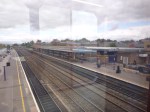

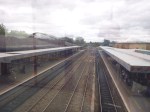

There isn’t even a man in an orange suit trying to look busy! Although the platforms were!
Perhaps this is how Oxford would like to welcome visitors? Hoping perhaps they might stay away!
I think one of the toughest jobs in the world must be a Project Manager in Network Rail. Passengers are rightly complaining that stations are cramped and need building or rebuilding and sometimes it’s impossible to get anything done for whatever reason. Then you have politicians on all sides complaining and saying it’s a total disgrace!
Hopefully Sir Peter Hendy and his new broom will go in to projects like Oxford station with all guns blazing and tell a few home truths.
I’m sure, if Oxford doesn’t want an updated station, then there are some nice projects in Birmingham, where the money would be appreciated.
Network Rail’s Problems In Oxford
Oxford is going to be a big rail hub with over the next few years the following projects being completed or at least underway.
1. Chiltern Railways from Oxford Parkway to Oxford station. Services to Oxford Parkway station will start on October 26th 2015, with services to Oxford city centre starting in spring 2016. I’ll believe the last part of that, when a Chiltern Railways train takes me to Oxford. When I visited in March 2015, little seemed to be happening at Oxford station in preparation for the arrival of this service.
2. Oxford station to be substantially upgraded with more platforms and possibly two island platforms for through trains. Again in March 2015, little seemed to be happening.
3. Chiltern Railways from Oxford station to the Science Park on the Cowley branch.
4. Electrification between Didcot and Oxford.
5. The creation of the East-West Rail Link
But according to the August 2015 of Modern Railways, they are having severe problems in the area North of the station, which I explored in a walk in March 2015. This is said.
On top of that, there is a hint of exasperation with the local authorities about the glacial pace of the planning process: it took two and a half years to get approval for a pedestrian crossing to replace a footbridge for Chiltern’s mew line to the city centre, because allotment holders used to wheeling barrows of compost across the line were complaining about the new up-and-down route they would have to take over the bridge. New railway staff accomodation in Oxford is mired in similar planning mud.
Cambridge have upgraded their railways in recent years, and although they have had delays on the new Cambridge North station, there doesn’t seem to have been the same planning mud.
The question has to be asked if the good burghers of Oxford would prefer that money was spent on improving transport infrastructure in more welcoming places. The writer obviously feels strongly as he goes on to say this.
While not wishing to stand in the way of democracy , Network Rail is pointing out that there is a window of opportunity for modernising the route to Oxford that could be lost unless local authorities embrace it wholeheatedly. With NR’s spending plans under pressure, there is a danger that Oxford will be put in the “too difficult” pigeonhole and the caravan will move on. Then it would really be back to the 1970s, with changing at Didcot becoming the best option to reach Paddington at some times of day.
I had a friend who lived in Oxford and he used to say that the Council liked to keep cars out of the City. Perhaps, it is more fundamental than that, and the Council would prefer to keep everybody out of the city, so they can continue to lead their cloistered lives, untroubled by the Twentieth Century, let alone the twenty-first.
Do the same people, who blame Network Rail for their well-documented problems, like these at Oxford and those at Manchester, fully support the improvements in the first place or do they really want money to be spent on their own pet projects?
We certainly need a planning system that allows people to air their views and protest, but also one that takes more account of the good of the majority after all contra-arguments have been rejected.
Oxford Station And Chiltern Trains
In a couple of years Chiltern Trains will go between London Marylebone and Oxford stations around the Bicester Chord. Wikipedia says this about how Oxford station will be expanded to accept the extra services.
The scheme also includes two new platforms at Oxford station, to be built on the site of the disused parcels depot. The new platforms would initially be five carriages in length, but provision will be made for them to be extended southwards to eight carriages.
These pictures show the Parcels Office.

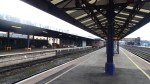
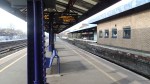

I would suspect that any southward extension would use the car park.The Parcels Office is clearly shown in this Google Earth image of the station.

Oxford Station
Note the two coach train in Platform 3, by the Parcels Office, with the white flat roof on the northern end of the station.
Oxford Station
Oxford station shares a lot of similarities and problems with the station at Cambridge.
Both were badly designed when they were built and although Cambridge now has new platforms and a lot of rebuilding, Oxford is still in need of expansion.
These pictures show the current station at Oxford.


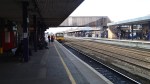
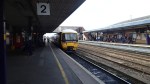
Oxford though has one problem that is nowhere near as bad at Cambridge; freight trains.
All of the issues at Oxford are set out in this document on the City of Oxford web site. It pays particular attention to the following.
1. East West Rail Link
2. Noise and Vibration in the area.
3. Freight Lengthening Project that will allow longer freight trains to go through the station, which has been completed.
4. Electrification
It doesn’t deal with new platforms at Oxford station for both Chiltern Railways and First Great Western.
The work for Chiltern Railways is shown in this post, whereas that for FGW is probabably more extensive and is described in this section in Wikipedia.
Oxford station will be a very different and busier station in the next few years.
3.
A Walk From Oxford Station
At Oxford station, I took a walk in a loop by the water and then along the railway, before crossing it on a bridge and returning along the Oxford Canal to the station.
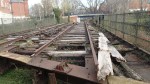
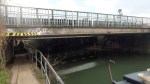




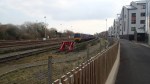









It is a good walk, but it does need a few maps and fingerposts. This Google Earth image shows where I walked.
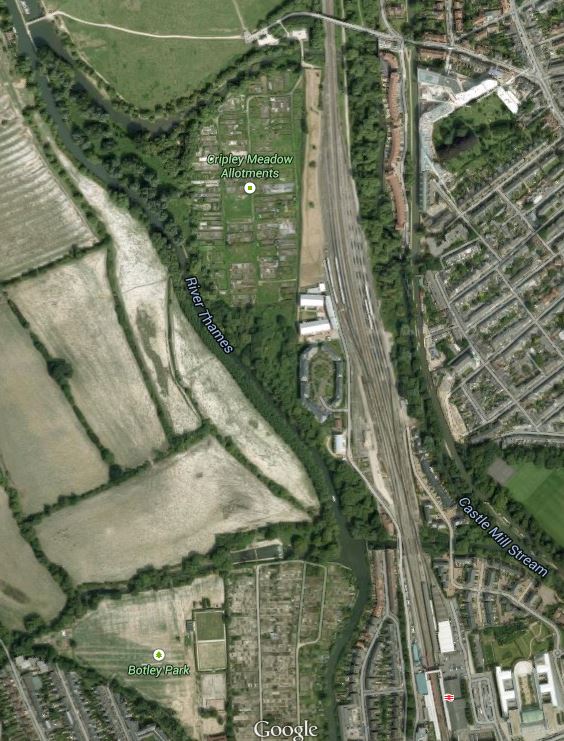
North Of Oxford Station
Note the bridge at the top and the station at the bottom.
I only took about an hour to do the walk and my main aim was to investigate the railway north of Oxford station, but Oxford station would certainly be a good place to start a walk either into the city or along the Thames or the Oxford Canal.
One thing that the walk showed me, was how much railway land there is in the area and with all the developments in services to the station, I’m sure it will be put to good use.
In some of the pictures you can see the Castle Mill development, which was nominated for the 2013 Carbuncle Cup.
From the railway side it looks fine, but I suspect from the river it grates in some peoples’ minds.
There is a noise debate rumbling on about the railway, which hopefully electrification will kill. But there will still be quite a few Class 66 hauled freight trains going through.
 The Anonymous Widower