Around Portsmouth Historic Dockyard
These pictures are a few general ones of Portsmouth Historic Dockyard.
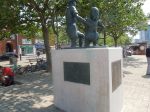


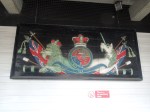

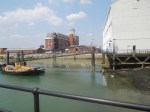


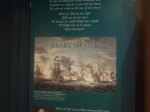
Note the cheese and ham toastie. It was a surprise in the Georgian Tea Rooms. They also had jacket potatoes.
You Can’t Miss Portsmouth Historic Dockyard
I went to Portsmouth yesterday to look at the Historic Dockyard and in particular to see the Mary Rose.
I took the train from Waterloo to Portsmouth Harbour station and when you walk out of the station, you can’t exactly miss the dockyard.
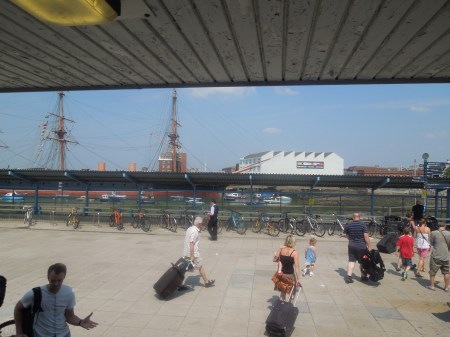
You Can’t Miss Portsmouth Historic Dockyard
The ship is HMS Warrior.
I do have a couple of issues with South West Trains though.
I travelled First Glass and on trains like Virgin, East Coast and Greater Anglia, you get complimentary drinks. But not on South West Trains.
The Class 444 trains, seem to have an absence of litter bins in First Class. Perhaps First Class passengers throw everything on the floor.
The station also seems to have a lack of any sort of map. Not that I needed one, as I could see my destination from the station entrance.
Two Capital Ships In The Pool Of London
I then moved upriver to the Pool of London, where HMS Edinburgh had moored alongside HMS Belfast.


The Royal Navy is present in London for the celebrations of the seventieth anniversary of the Battle of the Atlantic. There’s more about the celebrations here on the Royal Navy website.
HMS Illustrious At Greenwich
I took these pictures of HMS Illustrious at Greenwich.


Apparently, she is going to be preserved for the nation, as is reported here.
Guns And Alcohol Don’t Mix
If ever there was a story that proves that guns and alcohol don’t mix it is this one of the tragic death of Royal Navy officer; Ian Molyneux.
When my youngest son was doing some training to see if he wanted to join the Guards, he forgot to take his boots. So I drove them down to Pirbright and gave them in at the gate. The sentry was a bit strange and actually pointed his weapon at me. I didn’t think anything of it at the time, but he too could have been drinking. I do know that I was distinctly uneasy at his behaviour and made a rather quick getaway.
The last time, I came across a sentry with a weapon, was when I went over HMS Liverpool. But I didn’t feel any unease at all, as the sentry was female and she handled it impeccably.
The Old Royal Naval College At Greenwich
The Painted Hall in the Old Royal Naval College is being restored. So I went and took some pictures.





In a few weeks time, they will be allowing you to get close to the work. I shall go again.
Drunken US Sailors
There has been some entertaining correspondence in the letters pages of The Times lately about alcohol on ships in the US Navy.
Some years ago, I worked briefly with an American engineer, who’d been an officer on a US Navy nuclear submarine. He told the hilarious tale of how they visited Portsmouth in the 1960s. They needed to be resupplied and asked for cases of fresh orange juice. This was not in the Royal Navy stores at the time, so they sent them bottles of beer instead. The only problem was where to hide the beer and according to the tale, much was kept in the torpedo tubes.
A good time was had by all concerned.
Another tale I heard from a former US Navy officer, was when they were working with the Royal Navy, or any other one with a sensible alcohol policy, face-to-face meetings generally didn’t take place on the US ships.
Nelson’s Link To Hawke
Edward Hawke was an admiral in the Royal Navy and is best known for his defeating of the French at the Battle of Quiberon Bay in 1759, which probably ended any chance of a French invasion of Great Britain. Quiberon Bay was one of those naval battles like the defeat of the Spanish Armada, Trafalgar and Taranto, that have defined our history.
I had lunch with a friend yesterday and the subject of a artist called Edward Hawke Locker came up. He was called Edward Hawke, as his father, William Locker, was a protege of Admiral Hawke, who served with him in the Seven Years War. The Wikipedia entry for William says this.
Locker then moved to command the frigate HMS Thames, on the home station. He was her captain from 1770 until 1773. In 1777 he took command of HMS Lowestoffe, sailing her to the West Indies. During this period, one of his lieutenants was the newly promoted Horatio Nelson. Nelson, then barely nineteen, served with Locker for fifteen months. His experiences with Locker, and Locker’s teachings had a lasting effect on Nelson.
Twenty years later, on 9 February 1799, Nelson wrote to his old captain: “I have been your scholar; it is you who taught me to board a Frenchman by your conduct when in the Experiment; it is you who always told me ‘Lay a Frenchman close and you will beat him;’ and my only merit in my profession is being a good scholar. Our friendship will never end but with my life, but you have always been too partial to me.”
Note that Lowestoft is spelt how the locals tend to pronounce it. The article also goes on to elaborate on the connection between Locker and Nelson.
If there is a moral in this, it is that you should make sure you learn the lessons of history.
 The Anonymous Widower