A Trip To Gainsborough
I wrote about Gainsborough in A Town With Two Stations And Infrequent Rail Services, so when I was in Sheffield, I had to go and have a look at the town.
From Sheffield To Gainsborough Central
I left Sheffield on the 08:09 train to Cleethorpes and arrived at Gainsborough Central on time at 09:01.
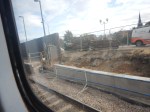
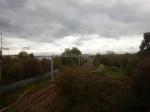
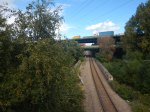
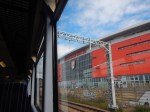
I took these pictures on the way.
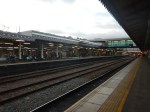
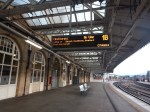

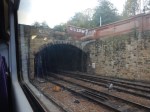



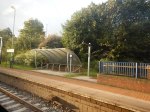

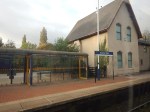
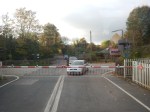


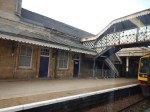



Note.
- The route is double-track.
- The terrain is flat with no tunnel,
- There are seven intermediate stations and several level crossings.
- There is an interchange at Worksop station with the Robin Hood Line to Nottingham.
- There is an interchange at Retford station with the East Coast Main Line.
Our Class 144 train handled the route with ease at a steady sixty mph or so.
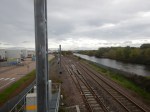
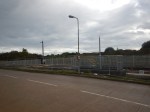
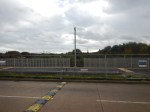
Gainsborough Central Station
Gainsborough Central station only has a train service on a Saturday.

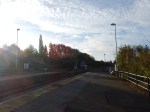
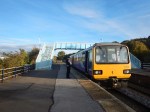
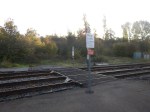

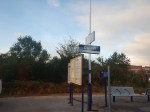
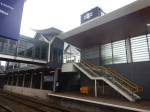
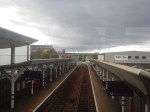
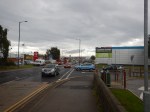
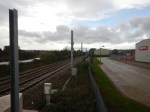
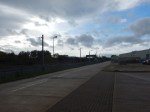
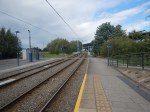
As the pictures show, the facilities are basic. Although there is plenty of parking.
Gainsborough Central station illustrates the the problems of providing step-free access at some stations.
Consider.
- With modern trains or trams, all the tools are there to enable anybody to board and leave the train easily.
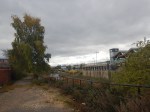
- At present, someone in a wheelchair or pushing a buggy would just use the crossing shown in picture four.
- The three services a week, probably don’t attract many passengers.
- How many passengers have used the bridge recently?
This is a station, that cries out for a well-designed solution to ensure safety.
Marshall’s Yard
Marshall’s Yard is a Shopping Centre by Gainsborough Central station.


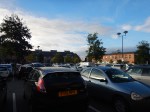
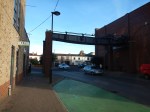

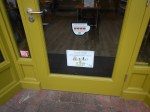
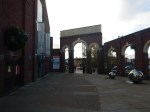

The Shopping Centre is a comprehensive one, with a wide range of shops and a few cafes and restaurants.
- I bought an excellent gluten-free breakfast at Root
- I was surprised to see an M & S food store.
- There were several middle-range specialist chain stores.
It was certainly busy.
It strikes me, that a more frequent train service to the station might be in the interest of everyone.
Walking Between Gainsborough Central And Lea Road Stations
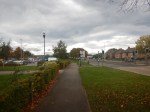
It took me about half-an-hour and I took these pictures as I walked.
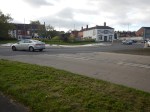
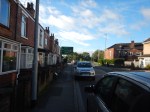


I would have taken more, but I was walking directly into the sun and couldn’t see much!
Gainsborough Lea Road Station
Gainsborough Lea Road station is an unusual station, as these pictures show.
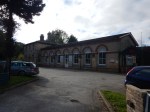
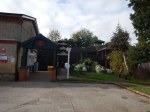
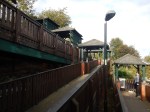
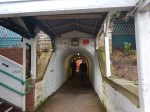


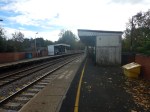
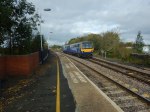
I would assume British Rail asked the local agricultural building manufacturer to design and build the wooden disabled ramp on the Lincoln-bound platform.
A couple of years ago I was coming down from Edinburgh to London in an Inter-City 125, when because of engineering works, we were diverted through Gainsborough Lea Road station.
From Gainsborough Lea Road To Sheffield
The two routes from Gainsborough to Sheffield join between Gainsborough and Retford and these are pictures of the return journey.




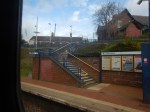
I timed this journey, so that I would arrive in Sheffield, to get to Bramall Lane in good time, for the Ipswich match. There were a lot of football supporters on the train, as Rotherham were also at home and the poor old Pacer was creaking at the seams.
It certainly proved to me, that the trains working between Lincoln and Sheffield are totally inadequate for the task.
Improving The Service Between Sheffield And Lincolnshire
The service between Sheffield and Lincolnshire needs improvement.
New Trains
New trains on the services are desperately needed and I will be interested to see in a couple of years, what trains are running the services.
The football crowds on the Saturday, showed that a two-car train is sometimes inadequate.
I suspect that Northern will run new Class 195 trains on the Sheffield to Lincoln route.
- These are 100 mph trains, as opposed to the 75 mph of the Class 144 trains.
- I suspect the trains will have wi-fi and power sockets.
- Three-car units are on order.
They should be a great improvement.
Improved Stations
The stations are rather variable, with some like Retford and Worksop of a high quality, but others a bit more suspect.
Is there also a need for extra stations to serve new developments?
Extra Services
The current times from Sheffield are as follows.
- Worksop – 30 minutes
- Retford – 41 minutes
- Gainsborough Lea Road – 56 minutes
It is reasonable to assume that the Class 195 trains will better these times by a few minutes.
Consider.
- The passenger demand will probably be higher, close to Sheffield.
- Worksop station has a turnback facility.
- It is likely, that a Class 1895 train could go from Sheffield to Worksop and back, within an hour.
I, therefore feel that an extra service from Sheffield to Worksop may well be possible.
Tram-Train To Worksop
In Class 399 Tram-Trains In Service, I discussed the Class 399 trains that are now running in Sheffield.
The performance of the Class 399 tram-trains is such, that they could be able to achieve the one hour time for a complete journey to Worksop.
If a suitable route from the Supertram at Sheffield to Worksop could be identified and electrified, I don’t see why Sheffield’s new Class 399 tram-train couldn’t run to Worksop.
This Google Map shows where the Sheffield to Workshop rtoute passes alongside the Supertram Depot.
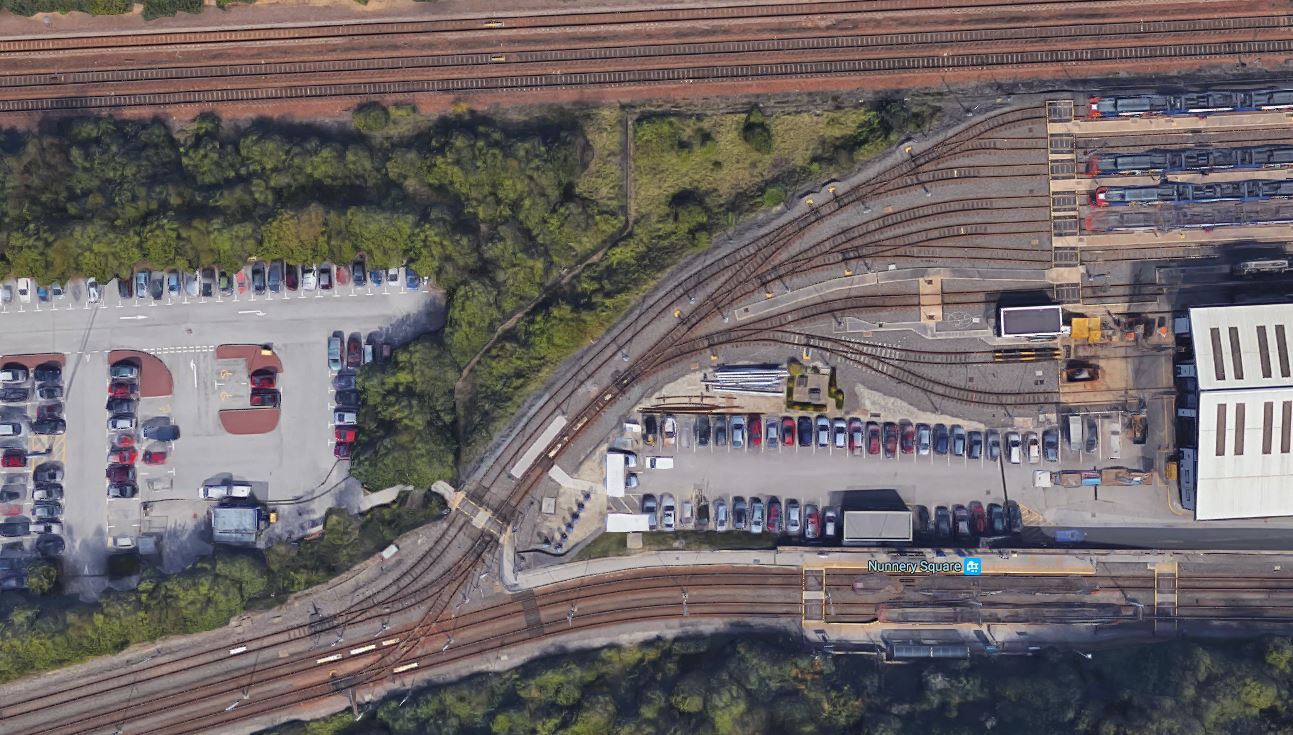
Note.
- The Sheffield to Workshop route is the two tracks at the top of the map.
- The Meadowhall Branch of the Supertram is the two tracks at the bottom of the map.
- The Nunnery Depot is in between.
I believe it would be possible to arrange a connecting pair of track, so that tram trains could go between the two routes.
Use Of Hybrid Tram Trains
I have assumed that the tram-train route will need to be electrified, but this isn’t necessary.
Chemnitz or Karl Marz Stadt as the East Germans renamed it. also runs Stadler Citylink tram-trains, which are similar to the Class 399 tram-trains.
But the tram-trains in Chemnitz are different in that instead of being dual-voltage like Sheffield and Karlsruhe, they have a diesel-generator to power them away from the 750 VDC overhead wires.
This data sheet gives a few details of the Chemnitz Hybrid tram-train. The data sheet doesn’t specify the power of the diesel powerpack, but the much heavier Class 769 train uses two rail-proven MAN diesel engines of 390 kW each.
Conclusion
The service between Sheffield and Lincolnshire needs to be improved.
This could be done traditionally using Class 195 trains or creating a tram-train extension.
Progress On The Sheffield-Rotherham Tram-Train – October 13th 2017
It is only a couple of weeks since I wrote Progress On The Sheffield-Rotherham Tram-Train and progress seems to have accelerated in that time.
The Class 399 tram-trains are now running between Cathedral and Herdings Park, as I reported in Class 399 Tram-Trains In Service.
Progress On The Tinsley Chord
I took these pictures at Tinsley Chord, where the track connects theMeadowhall branch of the Supertram to the freight line to Rotherham.
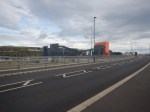
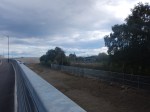
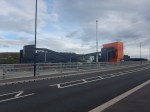
There isn’t really much to see, as trees obscure any good view from the road.
This Google Map shows the area.
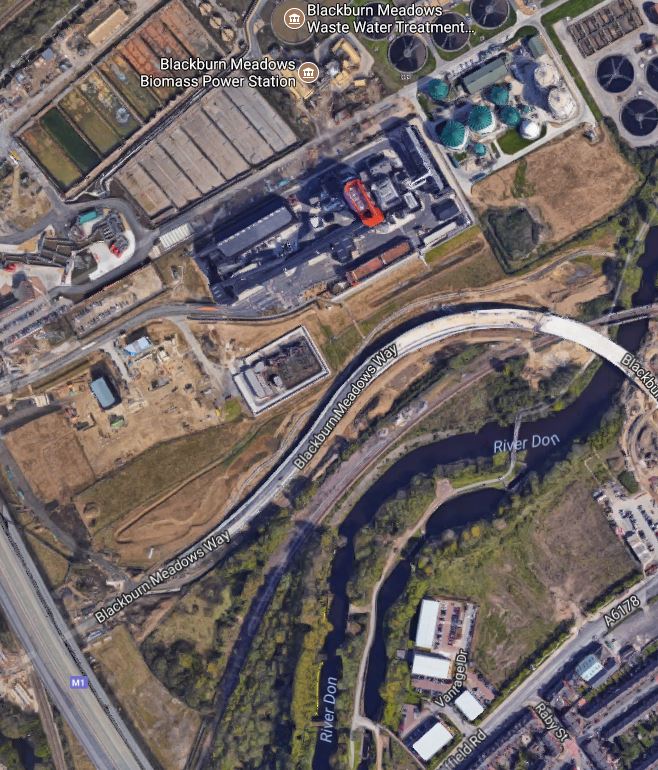
Note.
- The Tinsley Viaduct carrying the M1 cutting across the bottom-left corner of the map.
- Blackburn Meadows, with the Water Treatment Plant and Biomass Power Station, at the North of the map.
- The Blackburn Meadows Way linking into Meadowhall.
- The freight line to Rotherham runs to the outh of this road.
- The Supertram running along the West side of the motorway.
The Tinsley Chord, that links the tram and freight lines is hidden under the viaduct.
I did get some more pictures later.

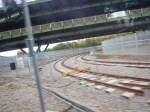
The Tinsley Chord appears to be double-track, where it will join the existing tram line.
The Wires Are Going Up
These pictures show that the wires are going up between the freight line and Rotherham Central station.
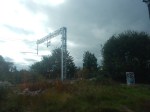

The gantries seem much more main line than tram.
But the Class 399 tram-trains, won’t care if they contain 750 VDC or 25 KVAC. Changing the volts is a lot easier than changing the catenary.
Rotherham Station
These pictures show the current state of Rptherham Central station.


Note.
- The wires are going up.
- The low-level platform extensions need to be completed.
- Trains will use the high end of the platforms and tram-trains the low end.
Karlsruhe have much worse platform height problems, as they have two generations of tram-trains and German trains that need low platforms to cope with.
Walking To The Parkgate Shopping
I thought about using a taxi, but in the end, I walked to the Parkgate Shopping, as the weather was sunny.


I did manage to get an idea of the distance in a thirty minute walk.
Parkgate Shopping
Parkgate Shopping is the sort of shopping centre I rarely visit.
I am a guerrilla shopper, who decides what he needs and then chooses where to go and buy it. Being a coeliac, food shopping usually requires a couple of shops. One of these must be a Marks and Spencer, as their gluten-free staples like bread, biscuits, beer and muesli are better than most.
These days, I don’t drive, but a couple of doctors have told me, they reckon I could get my licence back.It’s just that not having a car, removes a whole chunk of hassle from your life. I don’t want it back!
I also often create shopping with a visit to either a friend, a restaurant, a museum or perhaps even a dentist.
I’ll often plan my day, so I come home via somewhere like the Angel, Moorgate, Eastfield or King Cross, where I pick up my supper.
Parkgate might be a place to go if it fitted my target requirements and I lived locally.
But it would need decent public transport like Meadowhall down the riad.
The Tram Stop At Parkgate Shopping
These pictures show the railway that passes Parkgate Shopping and the tram-train stop being built.



The stop needs finishing and a route to the stops would need to be created.
But it looks like the designers have developed a simple one platform stop capable of handling the required three trains an hour.
Conclusion
The project appears to be coming towards the end.
There are several things that need to be completed.
- The catenary.
- The connection of the tracks at the Tinsley Chord.
- Rotherham Central station pltforms
- Parkgate Shopping tram stop.
Then it would need to be tested.
If I have a question about the project, I wonder how they managed to be so late and over budget, as IS reported in this article in the Guardian, which is entitled Sheffield to Rotherham Tram-Train Is Five Times Over Budget, Says NAO.
My gut instinct tells me, that there are a few problems with this project, that would have been avoided by a little bit more thought before it started.
But I think it’ll come out alright on the end.
Progress On The Sheffield-Rotherham Tram-Train
I took these pictures in Sheffield and Rotherham, whilst trying to take pictures of Class 399 tram-trains.

Note.
- The heavy-weight gantries for the electrification, which I suspect would support 25 KVAC electrification.
- It appears simple bi-level platforms are being built at Rotherham Central station.
- Could a stop being put at the New York stadium?
It certainly doesn’t seem to be an expensive system.
Single Or Double Track Electrified At 25 KVAC
The heavy rail route which is both single and double-track is electrified using standard 25 KVAC electrification.
Simple Voltage Changeover
In Karlsruhe, a ceramic rod is used to connect the overhead wires of different voltages. The pantograph of the tram-train runs on this rod, as the vehicle passes between the two voltages.
The different voltages would be handled automatically on the tram-train.
Kinetic energy or a battery will take the tram-train over the very short dead section.
I didn’t see it, but I suspect a similar system is used on the Tinsley Chord in Sheffield, where the two voltage systems meet.
The advantage of this simple system, is that voltage changeover can be completely automatic, with the driver only monitoring the changeover.
Simple Bi-Level Platform Extensions
This technique is used in Karlsruhe, where they have myriad problems due to various classes of tram-trains and conventional trains.
Modern construction methods will certainly help here.
How Did Network Rail Manage To Spend So Much Money?
The only feasible positive explanation is that this tram-train trial is being very comprehensive and covers all possible UK operations.
- The tram-trains are tested on 25 KVAC at Rotherham.
- Single and double-track.
- The tram-trains are tested on 750 VDC all over Sheffield.
- The tram-trains are tested on sharp curves and climbing hills on the Sheffield Supertram network.
- The voltage changeover is thoroughly tested on the Tinsley Chord.
- Platform designs get a rigorous test.
If the tram-train passes these tests and the regulators and operators like it, it’ll be passed for the UK network.
Is The Rotherham Trial A Tram-Train Or A Train-Tram?
When going from Sheffield to Rotherham, the Class 399 train, starts as a tram and changes to a train on the Tinsley Chord.
But when going from Rotherham to Sheffield, the vehicle starts as a train and changes to a tram.
So I suppose it’s both and it changes over where the voltage changes on the Tinsley Chord.
But just as in the Rotherham trial, provided there is an overhead wire with an acceptable voltage, the Class 399 tram-trains can run on any track, be it for trams or trains.
On What Routes Could A Class 399 Train Run?
There are several possibilities.
Extending An Existing Tram Network On A Heavy Rail Line
The tram-train runs normally on a standard tram line and then the route is extended on a heavy rail line, which is electrified with 25 KVAC overhead wires.
This is what is being done at Rotherham.
More possibilities exist in Sheffield and probably on other systems like Birmingham, Blackpool, Edinburgh, Manchester and Nottingham.
Creating A Tram Link Across A Town Or City
Suppose a town or city has two electrified stations on opposite sides. Perhaps one handles trains from the West and the other handles trains from the East.
If a tram route can be created between the two stations, which is connected to the lines at the station, then tram-trains can run across the town or city.
This has been done in Karlsruhe and other European cities, but I doubt we’ll see a cross-city link like this in the UK for a decade or two.
Creating A Tram Link Between Two Electrified Lines
This is similar to the previous application, except that the tram route might be in a rural area.
One possibility might be from Cambridge to Marks Tey along a rebuilt Stour Valley Railway.
Running A Branch On A Heavy Rail Line As A Tram
Creating a branch line to tram standards should be cheaper than creating it to heavy rail standards.
The proposed Glasgow Airport Tram-Train could be built this way, by building a tram track from the Inverclyde Line to the Airport.
The branch would have the following characteristics.
- Segregated single-track from the Inverclyde Line
- 750 VDC overhead electrification.
- Low floor tram-trains.
- Simple stations.
The tram-trains could run as normal electric trains from Glasgow Central station to West of Paisley St. James station, where they would take to the branch line and run as trams to the Airport.
As the performance of a Class 399 tram-train is not much slower than the current Class 314 trains that work some services on the Inverclyde Line, I feel that fitting the tram-train service into the service pattern on the line would be possible.
I estimate that a round trip from Glasgow Central to the Airport could be done within an hour, which would mean that to provide an adequate four tram-trains per hour, would require four vehicles.
Two other airports could be served in this way; Leeds and Liverpool
- Leeds Airport would require electrifying as far as Horsforth station, where a tram track would lead to the Airport.
- I suspect that the tram-trains could not only connect Leeds to the Airport, but Bradford as well.
- Liverpool Airport from Liverpool Lime Street services would change to a tram at Liverpool South Parkway station.
I think we’ll be seeing tram-trains used for services like these.
Consider these points.
- A suitable station on the electrified network is needed as a terminus.
- A suitable junction must be possible between the branch and the electrified network.
- Any number of stops could be built on the branch.
- Simple tram-style 750 VDC overhead wires can be used, which would be less visually intrusive.
Some schemes will be simple like perhaps the Slough to Windsor and Eton Line and others would be more complicated.
Conclusion
In a year or so’s time, we’ll know if tram-trains are another method of expanding and improving the UK’s rail network.
Is There Progress At Last On The Sheffield Tram-Train?
Coming through Sheffield, I took these pictures of the Tram-Train Project.

Some of the chord to connect the trams to the freight line is visible and the Class 399 tram-trains are all lined up ready to go.
Does Sheffield Get The Public Transport It Needs?
I ask this question, as I spent a day in Sheffield yesterday, watching Ipswich play Sheffield Wednesday. These are some observations.
The London Sheffield Train Service
In the 1960s and before, Sheffield had a higher priority than it does now in the Government’s rail policy.
One of the flagship services was the Master Cutler going into Kings Cross.
I can remember this train with an iconic Class 55 locomotive on the front, speeding through Oakleigh Park station.
The service between London and Sheffield station isn’t bad, but to put it mildly, the First Class isn’t first class compared to say, Leeds, Liverpool, Manchester and Newcastle.
Yesterday on my trips up and down, not as much as a cup of coffee was offered. Perhaps more importantly, tickets weren’t checked coming back to London. Wi-fi wasn’t working on the way up, but I didn’t check it, as I generally don’t use it, as logging in on some services generates spam.
The other big problem with all services out of St. Pancras, is that their are no late trains back to the capital, whichy must encourage people to drive.
Two developments should improve the service to London.
- Electrification, which surely must see a time around two hours to London.
- The new East Midland Franchise.
If the second has the same affect, as the new East Anglian Franchise did, we should see serious improvements.
Sheffield needs at least three trains-per-hour (tph) to and from London and the South. In my view this is the minimum frequency for a journey that could be two hours or under from London. Manchester and Norwich have or will have it, so why not all cities and major centres between these two sizes?
One of the problems of increasing the frequency from 2 tph or even lengthening trains, is my Aunt Sally or that Fur Coat And No Knickers Station of St. Pancras.
So something radical will have to be done by the new Franchise, as increasing services out of St. Pancras will need some clever train scheduling.
Sheffield’s Non-Standard Tram System
The Sheffield tram seems to work, but if they were being designed today, they would be very different, as would be the Manchester Metrolink.
- The Siemens-Duewag Supertram are to a special design to cope with gradients.
- The trams are only 40% low-floor.
- The trams are long, to avoid running in multiple.
- There is a lot more street running, than other systems.
This all means that expanding the system will be difficult and expensive.
On my trip yesterday, I encountered some problems.
- The trams were very crowded.
- There was a long delay because someone had parked on a double-yellow line blocking the tram tracks.
- The frequency is not high enough.
Some problems would be solved in say Manchester and other tram systems in the UK, would be solved by just ordering more trams. I suspect that because of the non-standard nature of the system, and the obselete tram design, that this is not possible, at an affordable cost.
Sheffield’s solution is to add a new route to Rotherham using Class 399 tram-trains. They will also order some extra vehicles to improve frequencies on the existing network.
Progress has been slow to say the least, and I can’t help thinking that designers of CAF, who have produced the excellent Urbos 3 trams for Edinburgh and the Midland Metro, couldn’t have rearranged some of their solutions to provide extra trams to improve the current Sheffield network.
At some point the original trams will need to be replaced and the tram-train might provide a solution for this, but surely a 100% low-floor tram designed especially for Sheffield’s non-standard network, could be a more affordable solution.
Progress On The Tram-Train
I took a walk along the River Don and this must be the slowest railway project in the UK. That says something, considering we’ve got some real dogs out there.
Tram-train services to Rotherham are supposed to start in 2017.
There is still a lot to do.
Trams To Hillsborough Stadium
The Hillsborough Disaster happened on the fifteenth of April 1989 and the Sheffield Supertram opened on the 21st March 1994.
As one of the causes of the Hillsborough disaster was traffic problems on the M62 from Liverpool, surely you’d think that the design of the Supertram would have been arraqnged so that supporters could get to the stadium eaqsier.
But not a jot of it, as I suppose that the powers that be, decided that lightning doesn’t strike the same place twice.
This Google Map shows Hillsborough Stadium.
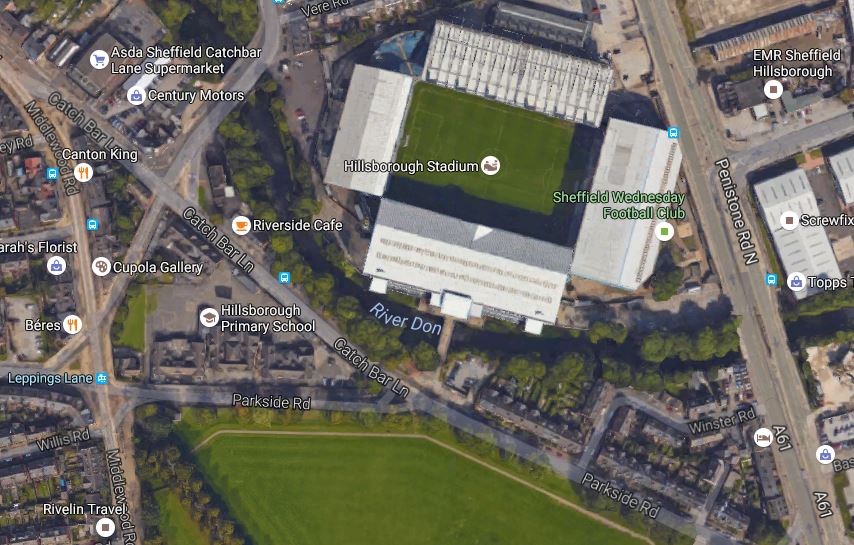
Hillsborough Stadium And The Supertram
The Supertram has a stop at the top of Leppings Lane, which is ideal for the Visitors end.
The tram route runs on the North-South road at the West of the map.
This Google Map shows the area of the Leppings Lane tram stop.
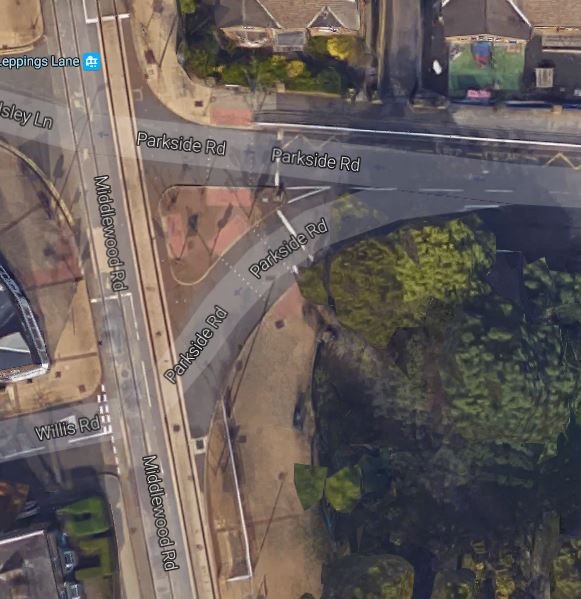
Leppings Lane Tram Stop
It doesn’t seem to be the most difficult project to improve the access to the Supertram at this stop.
Given Sheffield Wednesday’s new owners, it is not inconceivable that the club ends up in the Premier League.
From my experience yesterdsy, the current arrangements would be difficult, so something creative needs to be done.
Getting between the station and Hillsborough is not easy, as a change of tram is needed.
Leppings Lane is only one stop from the end of the line at Middlewood. Surely, on match days, one simple solution would be to run trams direct to the station from Middlewood.
But the restricted number of trams probably makes this impossible.
Conclusion
Sheffield’s public transport network needs improvement.
The Great Sheffield Tram-Train Mystery
An article on the BBC web site is entitled Sheffield to Rotherham tram-train pilot delayed further.
The article says that a full review is taking place and a new start date will be announced in the summer.
On my recent trip to Karlsruhe, I rode the German version of the Class 399 tram-train and wrote The Latest Citylink Tram-Trains In Karlsruhe. I said this.
Note that the trams I photographed are only some of the latest batch of twenty-five tram-trains of this type in Karlsruhe. So the basis of the Class 399 tram-train, must surely be well-proven on the streets of a city about the same size as Sheffield.
Incidentally, all of the new tram-trains that I saw, were running on tram routes, just as the first Class 399 tram-trains will in Sheffield, when they start running in a few months.
If the second paragraph is right and all the Sheffield-style trams in Karlsruhe are running as trams, could there be a problem with operating them as trains?
I have no idea and this is just pure speculation.
However this page on a German web-site has pictures of the tram-trains of Karlsruhe. There are twenty-five of the latest Sheffield-style tram-trains delivered from 2014-2016.
But according to this article in Global Rail News, Karlsruhe has just ordered twelve additional Flexity tram-trains from Bombardier.
Is this that some routes can’t be worked by the Citylink and need the other type? Or is it because of a problem with the Citylink?
I don’t know!
But somebody, somewhere must know the truth!
As an engineer, it all puzzles me.
Karlsruhe have been running tram-trains for some years now and surely, the track design rules are pretty well-established. They’ve also been running the Sheffield-style trams for at least several months.
Surely, Network Rail’s engineers must have been to Karlsruhe and just copied, what the Germans are doing.
So why haven’t they got it right first time?
- Not Invented Here?
- Someone in the Department for Transport giving a new twist to EU regulations?
- Refusal to talk to the Germans?
It could of course be sheer incompetence!
Another related mystery, is why are there no reports of the lone Class 399 tram-train in Sheffield testing on the existing track as a tram?
At great expense, all track in Sheffield has been changed to accept the wheel profile of a tram-train, so surely this new tram could at least be testing in the middle of the night!
Could it be that the tram-spotters of Sheffield, are lazy and don’t like getting up in the middle of the night to photograph tram movements? But then there were pictures of night-time tram testing in Birmingham and Nottingham, so I have to conclude testing is not happening.
The Latest Citylink Tram-Trains In Karlsruhe
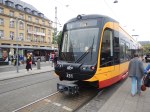
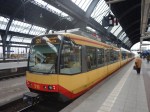
These pictures show some of the latest batch of NET2012 Citylink Tram-Trains in dervice In Karlsruhe.

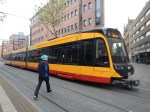
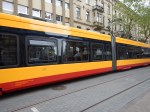
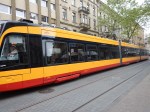
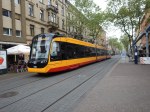

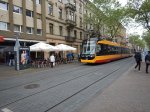

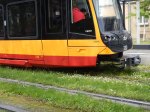
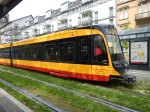
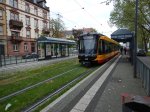
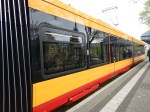
They are closely related to the Class 399 tram-trains for Sheffield, that I wrote about in My First Pictures Of A Class 399 tram-train.
They were good trams and rode well on the streets of Karlsruhe.
Note that the trams I photographed are only some of the latest batch of twenty-five tram-trains of this type in Karlsruhe. So the basis of the Class 399 tram-train, must surely be well-proven on the streets of a city about the same size as Sheffield.
Incidentally, all of the new tram-trains were running on tram routes, just as the first Class 399 tram-trains will in Sheffield, when they start running in a few months.
But their profile and nose section is slightly different between the two variants. Compare the pictures from Karlsruhe, with this visualisation of a Class 399 tram/train from the Stadler data sheet.
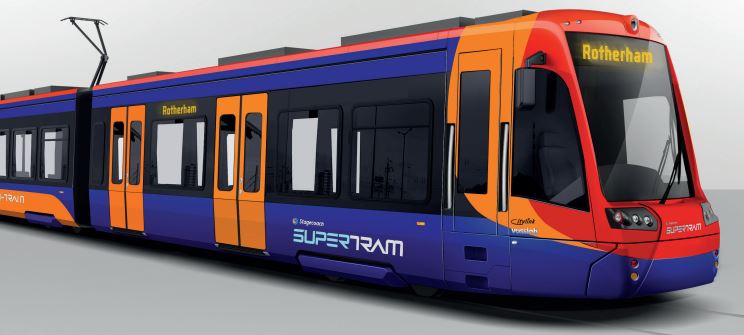
Class 399 Tram/Train Visualisation
Note the lack of a coupling, as I don’t think Sheffield’s trams will work in pairs.
This second gallery was taken as I rode another of the new trams back to Karlsruhe station?


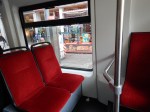
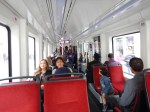
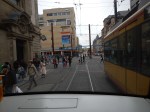
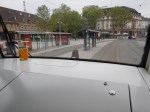
Note that the non-driving end of the tram converts into four seats with panoramic views to the rear of the tram.
Will we be seeing this feature in Sheffield?
I think it is too radical and although the design is common in Germany, I can’t see the Department of Transport allowing this passenger friendly feature.
But if it is possible and built into the tram-trains delivered to Sheffield, why shouldn’t it be used? Surely, as the tram-trains go there merry way around Sheffield and Rotherham, there must be some entertaining things to look at, out of the back of a tram!
Overall, I can see the Class 399 tram-train becoming a very popular vehicle in the UK.
- It is a modern, low-floor tram.
- It is a capable, electric multiple unit.
- It has a comfortable, if rather crowded at times, ride.
- The newer tram-trains are wheelchair-accessible.
- The passengers I spoke too, seemed to like the tram-trains.
- Longer trains can be created, by coupling units together.
- It is not an unproven concept on the streets and tracks of several German cities.
- Seventy-five tram-trains of this type and earlier variants, run in Karlsruhe alone.
- The major difference is that the Germans use 15 kVAC overhead wires for their trains and we use a more-standard 25 kVAC.
- Karlsruhe seems to have developed extensive solutions to make the train-platform transition an easy one for all passengers.
All it needs is for a successful trial between Sheffield and Rotherham.
My First Pictures Of A Class 399 Tram-Train
In Sheffield, I took these pictures of a Class 399 tram-train in the depot on the way to Meadowhall.
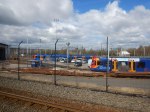
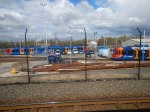
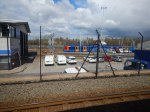
In two picture theres is also one of the current Supertrams.
The difference between the two trams, is that the current ones have full length windows in the doors, whereas the tram-trains have shorter windows.
Although, work appears to be continuing at South Meadowhall to connect the tram and heavy rail networks, nothing much was worth photographing.
 The Anonymous Widower