Extending The Elizabeth Line – Improving The Route To Windsor & Eton Central Station
This post is now complete.
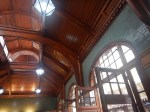
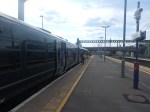
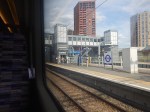
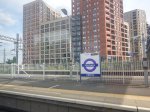
I took the Elizabeth Line to Slough station, for onward travel to Windsor & Eton Central station today and took these pictures along the route.


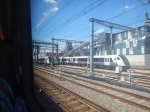







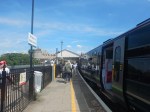
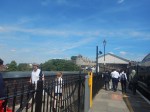


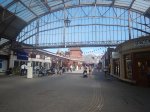



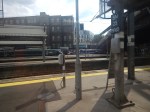
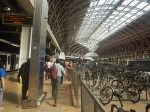
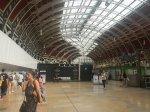
Note.
- I joined the Elizabeth Line at Moorgate station and took a train all the way to Paddington station.
- As a Freedom Pass holder, I use the Elizabeth Line for nothing.
- I changed between the Central and Western sections of the Elizabeth Line at Paddington.
- I also bought my Slough and Windsor & Eton Central ticket at Paddington from a machine, for the princely sum of £2.10. It was with a Senior Railcard.
- There is a lot of building going on along the route.
- The diesel train on the Slough-Windsor & Eton Line was a three-car Class 165 train.
I have some thoughts on how to improve the train service to Windsor.
What Do I Mean By Improving?
I don’t mean direct trains, as that would be impossible for various reasons.
- Platform length at Windsor & Eton Central station would be a problem.
- Flat crossing across the fast lines would slow the expresses.
- To make the running efficient, a flyover would need to be built. The disruption of building it and the cost would be immense.
What is needed, is a system, which means that getting from Central Elizabeth Line stations to Windsor & Eton Central station is as easily as possible.
Windsor Is One Of Our Premier Tourism Destinations
I suspect that on passenger numbers; Bicester Village, Cambridge, Oxford and Windsor are the four most visited tourist sites by rail from London.
I don’t think it’s a good idea to provide some of the services to these destinations, with the exception of Cambridge, with British Rail-era diesel multiple units.
Could A Four-Car Train Be Run On the Slough-Windsor & Eton Line?
I took this picture of the Slough end of the three-car Class 165 train in Windsor & Eton Central station.

It does appear that say a four-car Class 387 train could be fitted into the platform, with perhaps some adjustment to the platform and the track.
Would The Train Be Electric Or Battery-Electric Powered?
Consider.
- The Slough-Windsor & Eton Line is only 2.5 miles long.
- It is single-track.
- Trains take six minutes to do the trip.
- Modern electric trains with better acceleration could probably do the trip in four minutes.
- A battery-electric train will need charging.
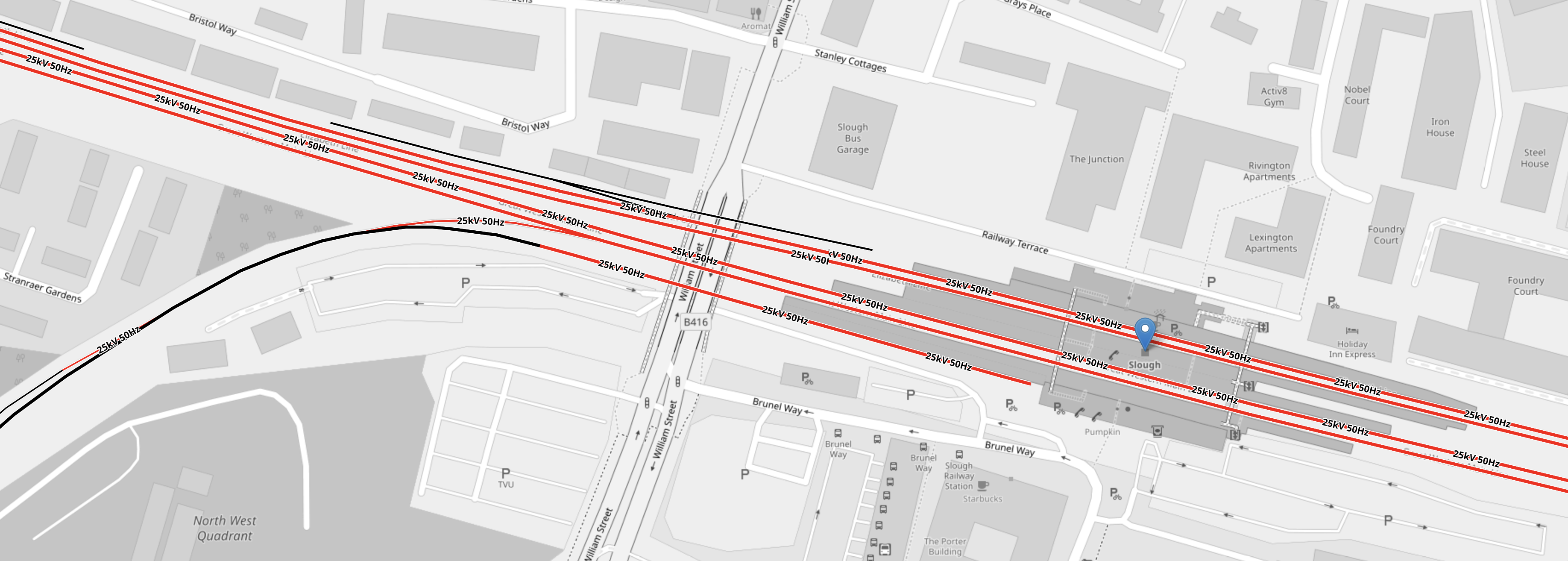
This OpenRailMap map shows the electrification at Slough station.
Note.
- 25 KVAC overhead electrification is shown in red.
- The Slough-Windsor & Eton Line leaves the map in the South-West corner of the map and runs into the electrified Bay Platform 1.
- The electrification in Platform 1 could be used to charge a battery-electric train.
- The Slough-Windsor & Eton Line appears to be partially electrified at the Slough end.
I wonder, if the simplest, most-affordable, least risky approach is to electrify the 2.5 miles with 25 KVAC overhead electrification, as it would allow a standard Class 387 train to work the route.
Operation Of The Shuttle
Currently, the Class 165 trains take six minutes between Slough and Windsor & Eton Central stations, which means that with turning the train at each end of the route, where the driver must walk seventy metres or so to change ends only a three trains per hour (tph) schedule is possible.
If I look at some of the station-to-station stops on the Elizabeth Line, I suspect that a well driven electric train could go between Slough and Windsor & Eton Central stations in perhaps four minutes. With a well-marshalled stop at either end of the route in perhaps two minutes, it could be possible to do a round trip in twelve minutes, which would allow a four tph service.
Capacity would go up from nine cars per hour to sixteen. or an over seventy percent increase in capacity.
There are several ways that, this shuttle could operate.
- As now, where the drivers have to be fit to change ends in the time.
- Two drivers are used with one in each cab.
- Drivers walk back on arrival at the terminal and then step-up into the next train. This is standard London Underground practice at stations like Brixton and Walthamstow Central.
- The train is fully-automated and the driver sits in either cab with an override, that allows him to take control, if say protestors or criminals get on the track.
As a Control Engineer, I certainly feel the fourth option is possible.
Intriguingly, I suspect the concept could be proved with two drivers in an existing three-car Class 165 train, to see if four tph are possible.
Ticketing
Ticketing is less of a problem now, than it was before March 28th 2022, as from that date Windsor & Eton Central station is now in the contactless area, so you could touch in with your bank card at any station in the London contactless area and touch out at that station.
It’s all explained on this page on the Great Western Railway web site.
I am a Freedom Pass holder, which gives me the ability to get free travel to and from anywhere on the Elizabeth line for free, so getting to and from Slough for nothing, is no problem, if I use the Elizabeth Line.
But I would need a ticket for the section between Slough and Windsor & Eton Central stations.
Before I got on the Elizabeth Line at Moorgate, I tried to buy an extension ticket between Slough and Windsor & Eton Central stations, from the ticket machines at Moorgate, but it was not possible, so in the end, I made a detour to the ticket office at Paddington and bought the ticket there. But when the Elizabeth Line is fully connected, there will have to be a rethink, as Freedom Pass holders from say Ilford would want a day out in Windsor.
Perhaps the Slough-Windsor & Eton Central line should become a fixed-fare line, where a bank card would be charged say a pound for each journey.
Note that I only paid £2.10 for a return ticket at Paddington with my Senior Railcard.
A Better Interchange At Slough
Currently, the Off Peak frequency of trains at Slough is as follows.
- Slough and Windsor & Eton Central – 3 tph
- Slough and Paddington – Elizabeth Line – 2 tph
- Slough and Paddington – Great Western Railway – 2 tph – Non-stop
- Slough and Paddington – Great Western Railway – 2 tph – Stopping
In TfL Confirms Details Of Reading Services, I wrote that the Elizabeth Line will have 4 tph to London in the Off Peak, with two extra services in the Peak.
This indicates to me, that the Slough and Windsor & Eton Central service needs four tph.
Crossrail Trains Cleared To Use The Heathrow Tunnel
This title of this post, is the same as that of this article on Ian Visits.
These are the first four paragraphs.
Last month, a significant achievement took place on the Crossrail project, which is far more important than the headlines make it seem to be.
At a basic level, the Office of Rail Regulation approved the use of the new Class 345 trains that will be used on the Elizabeth line to carry passengers into the Heathrow tunnels.
The practical implication being that TfL Rail will in the next few weeks be able to run from Paddington to Heathrow direct, as they were supposed to start doing back in May 2018.
The delay has been caused by the bane and saviour of modern railways, the signalling system.
Ian then goes on to give a full and understandable explanation of the complex nature of modern rail signalling.
Ian finishes by giving a detailed description of the Class 345 trains‘ Auto-Reverse feature.
Around half of westbound trains will terminate at Paddington, but to head back eastwards, once all the passengers are off, they carry on westwards to Westbourne Park, then return back to Paddington on the eastbound line.
Normally that means the train driver would drive to Westbourne Park, stop, walk through the train to the other end, then drive back. But with “auto-reverse”, as soon as the train leaves Paddington, the driver switches to automatic and starts walking through the train to the other end. By the time the train arrives at Westbourne Park sidings, the driver will be sitting in the drivers cab at the other end of the train ready to head back into Central London.
I feel we need more automation on trains.
Possible Uses Of Automation
These are some possibilities.
Reversing In Services
Several services, require the driver to change ends and then drive the train from the other end, when calling at a station.
- Some Nottingham and Skegness services, reverse in Grantham station.
- Maidenhead and Marlow services, reverse in Bourne End station.
- Norwich and Sheringham services, reverse in Cromer station.
I could envisage an automatic system, that took the train from A to B to C etc. under the control of the driver.
- They might just touch a screen or button to move to the next station, as drivers have done on the Victoria Line.
- Both cabs would have a remote video screen showing the view from the other end of the train.
- The driver could drive the train from either cab.
- Arriving at a station, the automation would stop the train in the correct position.
- As on a Victoria Line train, the driver would monitor the system at all times and take control and drive manually, if required.
- The driver might also have a sophisticated remote control, so that if he needed to walk through the train to change cabs, he would still be in full control.
The guard might also have a remote control, for use in the very rare case of driver incapacitation, where he would need to halt the train.
Shuttle Services
There are services in the UK, where a single train shuttles between two stations.
- Brockenhurst and Limington Pier – 11 minutes
- Grove Park and Bromley North stations – 5 mins
- St. Erth and St. Ives stations – 10 mins
- Slough and Windsor & Eton Central – 6 mins
- Sudbury and Marks Tey – 19 mins
- Twyford and Henley stations – 12 mins
- Watford Junction and St. Albans Abbey – 16 minutes
Note.
- The time shown is the time for a single journey.
- All these services use a single train, where the driver changes ends before each journey.
- The services use a dedicated platform at both terminals.
- There is a dedicated track between the terminals.
- Some of these services may need a more frequent service.
If the driver doesn’t change ends, would the time saved allow more trains per hour (tph)?
I think the following improvements are possible.
- Grove Park and Bromley North – three tph to four
- Slough and Windsor & Eton Central – three tph to four
- Watford Junction and St. Albans Abbey – If the journey time could be reduced to fourteen minutes or less, there is a chance that the service could be doubled to two tph.
It looks that if the driver change ends, then it appears the following frequencies are possible, with these journey times.
- Less than six-and-a-half minutes – four tph
- Less than nine minutes – three tph
- Less than fourteen minutes – two tph
I do wonder if an automated shuttle on the Abbey Line could run at the required two tph, with only minimal infrastructure works.
An Automated Shuttle Train On The Slough-Windsor & Eton Line
The Slough-Windsor & Eton Line has the following features.
- It is 2.5 miles long.
- It is single-track.
- It is not electrified
- Trains on the route are two- or three-car diesel trains.
- There is a single platform station at either end with no intermediate stations.
- The service frequency is three tph.
- Trains take six minutes to go between the two terminals.
The service on this line, can get exceedingly full and needs greater capacity.
To run the ideal four tph, trains would need do a round trip between Slough and Windsor & Eton Central in fifteen minutes.
If we assume that the two end stops take a total of three minutes, then that leaves just twelve minutes to cover the five miles of the round trip.
This is an average speed of 25 mph.
As with the Greenford Branch, I think that an appropriate train would be able to run an automated shuttle, with a frequency of four tph.
The train (or tram-train) would have the following features.
- It would be battery-powered
- It would have an operating speed of perhaps fifty mph.
- It would have fast acceleration and deceleration.
- It would have three- or four-cars.
The only infrastructure works that would be needed, would be to provide a fast charging station at Slough station.
 The Anonymous Widower