An Appropriate Story For Today
On Page 58, The Times has an article entitled Frictionless Flywheels Hold Balance Of Power.
This is the first two paragraphs.
Flywheels will be used to balance supply and demand on Britain’s electricity grid in a £3.5million project that could help the country to cope with more wind and solar power.
Sophisticated flywheels that can store electricity for long periods of time are to be installed next to the University of Sheffield’s battery storage facility at Willenhall near Wolverhampton, in the first project of its kind in the UK.
By using batteries and flywheels together, this makes a responsive battery that can fill in demand and overcome the degradation problems of lithium-ion batteries.
It looks a promising way of creating an affordable and reliable energy storage system.
Who needs coal? Trummkopf obviously does to buy votes!
In the United States, with its massive mountain ranges, it would be better to create construction jobs by creating hydro-based energy storage systems, as we did in the 1970s at Dinorwig and the Americans, themselves did at Bath County Pumped Storage Station a few years later.
To gauge the size of these plants, Bath County has about the same generating capacity as the UK’s largest power station at Drax, with Dinorwig being about 55% of the size.
Bath County and Dinorwig are big bastards, but their main feature, is the ability to pump water to store the energy.
Energy is like money, the best thing to do with excess is to put it in a secure storage facility.
Wattway
I was pointed to this French innovation by the Sunday Times.
Effectively, Wattway, is a system of solar panels that you can put in a road and drive on.
Click here for the Wattway web site.
I have a feeling that it will lead to all sorts of applications, especially where power is needed at a remote location.
I suspect too, that it doesn’t need planning permission as such, whereas even a small wind-turbine might!
Is The Sun The Future Of Energy?
I get up early and usually watch the BBC Breakfast programme.
On Sunday, this usually includes the short version of the BBC News on-line program Click.
Sometimes, it is rather wacky, but today they reported on something that will effect us all; solar power.
If you’d like to watch the short version of Click, it’s here on the BBC web site.
They have two segments that show the improvements coming in solar energy.
- In the first, the program shows how Oxford University are using better materials to improve the efficiency of panels.
- In the second, the program talked to a Swiss company called Insolight, who have developed a replacement panel that moves to focus the sun’s energy on highly-efficient tiny solar cells, which gives an efficiency of 36%.
Never underestimate the ingenuity of scientists and engineers to create a more efficient world.
Choose Your Energy Company With Care
This tale from the Observer is entitled Co-operative Energy didn’t bill us, but claims we owe it nearly £1,500.
It probably shows how various get-rich-quick and incompetent groups are entering the energy market.
I wouldn’t have chosen the Co-op, as on their record over the past few years, they seem incapable of organising a piss-up in a brewery.
This is said in reply to the request for help.
Frankly, Co-operative Energy hasn’t had the systems in place to issue coherent bills for nearly a year after botching the launch of a new computer system last summer.
Surely, there is a case for withdrawing the licence of Co-operative Energy.
I wouldn’t touch them with Nigel Farage’s barge-pole, let alone mine!
Especially, as I’m very happy with Ovo Energy and have no possible reason to change.
They now even pay me for the energy I generate with my solar panels.
My Solar Panels Are On The Roof
My solar panels are now on my large flat roof.
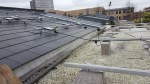
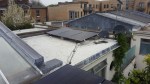
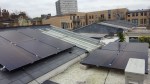
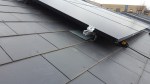
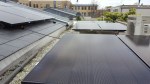
The installation was surprisingly painless, with the only work inside the house, the fitting of the control box near to my main consumer unit.
I have been monitoring all weekend on my laptop.
Power From Renewables Surges To High As Emissions Fall
This was the headline on a story in the Business section of The Times today.
Apparently nearly a quarter of the UK’s electricity was generated from renewables last year.
In 2014 it was 19.1%, but last year it was 24.7%.
It all goes to show, that we should think long and hard about building any massive power stations; nuclear, coal or whatever.
I have decided that now is the time to put solar panels on my roof.
Questions About Solar Panels
Yesterday, despite the temperature being about eight or nine outside, because the evil devil had switched the radiant heaters on, the temperature had risen to twenty-eight inside my house, due to heat coming in through my skylight and by radiation from the flat roof.
Now the flat roof has been relaid and insulated, so to make matters worse the heat once in can’t get out.
So I decided I’d had enough and have decided to do what I had already ascertained was to be the next steps.
- Put an electric shutter over the skylight.
- Fit solar panels to both generate electricity and shade my house from the sun.
Hopefully, I’d generate enough electricity to run the air-conditioner, when the sun is on.
I entered my details into a comparison site and they said they’d select six local installers.
Within half an hour, I had a call on my phone and as the guy was in his van just round the corner, he was in my house doing a survey within five minutes.
He was also very much a local supplier, as both his flat and office were within five hundred metres.
He quoted for a four kilowatt system with sixteen panels, which he said would cost £5,000 as standard including installation and VAT.
I could also have micro-inverters which would up the cost to £6,300.
He indicated that micro-inverters were more efficient and had a loner life. He also enclosed the data sheet for the Enphase microinverters.
So I asked myself what are micro-inverters and what advantages do I get.
I found this web page entitled Should I Get Micro-Inverters For My Solar PV System?
Read the page and you’ll find there are two kinds of inverters;string and micro.
With a string inverter, you have one device that converts the DC of the panels to the AC of the house. So it’s like having one charger for all your devices.
With a micro inverter, each panel has its own inverter.
So the number of electronic components probably explains the difference in cost.
But there are other differences.
- String inverters have typically a five year guarantee, whereas micro inverters have one of twenty-five. Only a madman would offer such a guarantee, if the devices failed regularly.
- String inverters gear their output to the poorest performing panel, whereas with micro-inverters each panel performs according to the sun it gets.
- If there is a chance of major shading, go for micro inverters.
- Failures do happen and surely if each panel is an complete system, if one should fail, it is a problem, which is easier to locate and remedy.
Now I’m no expert, but my electrical engineering training says that micro-inverters are a better bet.
Years ago, when I worked at ICI, some others in the office were working on automating a chemical plant. Up until 1970, traditionally each temperature, pressure and position sensor input went into a massive and extremely expensive analogue to digital converter to link to the computer. But in this development, every input had its own converter.
I ‘m not in automation these days, but I doubt they use a massive and expensive converter and each input is handled individually.
So with my panels, I’m tempted to pay the extra £1,300.
I’m still waiting for the other five installers to phone.
Big Belly Bins In Islington
I have a thing about street litter. My road isn’t particularly bad for rubbish, as we have a guy with a barrow, who patrols the area sweeping up anything that gets drops.
But it doesn’t deter people from piling waste around the litter bins in the road, as this picture shows.

Rubbish By A Bin In Hackney
I think a lot of what gets dumped is from people who have opted out of Hackney’s rcycling scheme, as bags often seem to be full of fast food packaging and disposable nappies. But some is definitely from commercial premises, as at times, I’ve seen people unloading rubbish by the bins from the back of pick-ups or vans.
I’ve passed the bin shown below at the Angel a couple of times, but today I had a good look.

An Islington Big Belly
It does appear to be in a better state than Hackney’s traditional bin. Perhaps those who think they will pile litter by bins, think that it’s got a camera inside.
The Big Belly web site, isn’t the easiest to navigate, but for a good explanation go to this page on the Islington web site. This is an extract.
The Big Belly units use solar power to compact litter so can hold up to eight times more litter than a normal bin, and email council staff when they need emptying.
Now under a pilot scheme 30 of the bins – which are also used in Times Square, New York – are being placed at busy recycling and litter hotspots in Islington, where street bins fill quickly.
I don’t know for sure, but I suspect as the bins are solar powered, they probably don’t need to be connected to any services. I did read on their web site, that they use SMS messaging to call for emptying.
I like the concept and suspect that it will get developed in the future to be even better and provide other services.
Amber Rudd Puts Onshore Wind Out Of Its Misery
I don’t like onshore wind farms so I was pleased to see this announcement by Amber Rudd on the BBC, which is titled Earlier end to subsidies for new UK onshore wind farms.
Onshore wind blights the countryside and you have to use a lot of subsidy to make a development viable.
But, I mainly don’t like the concept of wind power, because it is too mechanical, as opposed to solar, where you put up a panel and its control system and you get electricity.
Solar’s other big advantage is just emerging and that is the ability to link it to an intelligent battery such as the Tesla Powerwall to provide an independent power system for a building or something remote that needs good clean energy.
In a few years time, I predict that all new houses will have solar panels on the roof and the next generation of storage battery in the garage. Coupled with increases in insulation quality, I also think, we’ll see the likes of Barratt advertising houses with no external gas and only a stand-by electricity connection, for use on the dullest days.
The big energy companies won’t like it! But surely this is the sign of a good idea?
My energy usage isn’t high, but when the solar/battery powerplant drops in price sufficiently, I’ll fit one!

