Greeted By A Map In Bordeaux
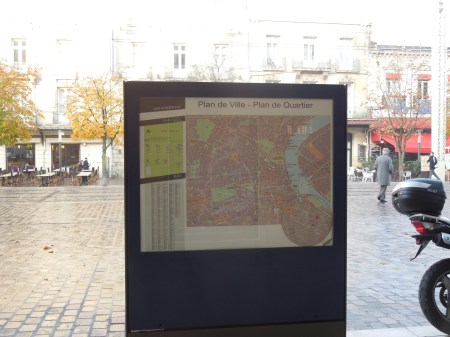
Virtually without exception at any London station, you get greeted by a map on a lith.
Greeted By A Map In Bordeaux
It was a surprise to be greeted in the same manner as I exited Bordeaux station.
Unfortunately, the detail was a bit fine and I couldn’t find the road, where my hotel was located.
But I was put right by the girls in the Tourist Office nearby and quickly bought a ticket for the trams and was on one to Quinconces near to the hotel.
It’s Only A Railway Station!
One of the reasons, I went East today, was to take some pictures of the roof structure of the new Canary Wharf Crossrail station. I went to Poplar on the DLR and these are some images that I took of the new station.


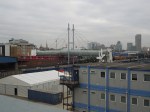
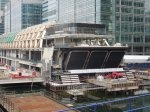
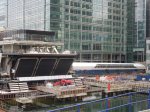
It is looking that it could end up being the most spectacular station in London.
But then the station bit will probably a bit boring, buried deep under the edifice, you see in the pictures.
Most of what you can see will be an upmarket shopping centre, with a garden on the top under the open timber roof.
It certainly isn’t a bad effort at a station on an underground suburban railway.
But then it is probably best to think of this station as part of the Canary Wharf Estate, rather than part of Crossrail. After all they are paying over half a billion pounds to build it.
How many shopping centres are integrated into the transport systems of the city or area they serve? The answer could be written on the back of a postage stamp, without disturbing the adhesive.
Speeding Between Silicon Roundabout And Cambridge Science Park
There is an article in the Sunday Times that says that Ministers want to improve the links between Silicon Roundabout and the Cambridge Science Park. Here’s the guts of the story.
The aim is to slash travelling time between them and accelerate growth in Britain’s hi-tech industries.
The trip between London and Cambridge has long been considered a stumbling block to greater collaboration between the two tech hubs.
A station is already being built at the Cambridge Science Park, which should open before 2014, although the report in the Sunday Times says this is only being considered.
The article also talks about a Shoreditch stop on a fast train from Liverpool Street station to Cambridge.
It strikes me though that if you look at the proposals for Crossrail 2, which are slated to possibly go via Dalston Junction and the Angel, then this could be eventually an integral part of the new rail route, especially if Crossrail 2 links to the West Anglia Main Line.
I say eventually, as Crossrail 2, will be unlikely to open in the next thirty years.
Alternatively, there is the option of running the fast Cambridge trains into Old Street and Moorgate stations on the Northern City line. They would then use the Great Northern route to Cambridge.The stations would need to be enlarged, but the tunnels could probably take the full-size, Class 365, trains currently used on Kings Cross to Cambridge services. Remember that Old Street station is actually under Silicon Roundabout.
There are a lot of possibilities.
Battersea Park Station
I saw something in Modern Railways about the refurbishment of this station. So I went and took a few pictures.

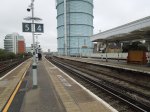


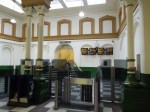


It may be a nice station, but it certainly isn’t one you’d use, if you had diofficulties with stairs.
The Bus Station At Vauxhall
According to Wikipedia, the bus station by Vauxhall station is the second busiest in London after Victoria.
However, it is certainly more dramatic, than Victoria.
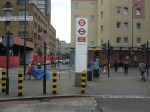


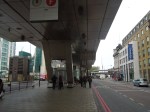
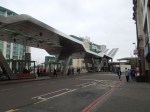

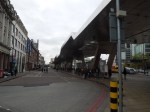
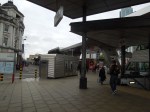
It also must be one of the few bus stations in London with a Waitrose about thirty metres or so away.
As the bus station has routes to a lot of South London, I think I’ll be looking to use this bus station more on my travels.
Hampstead Heath Station Gets Upgraded
Upgraded might be to soft a word for the work going on at Hampstead Heath station. Demolition and rebuilding might be better.

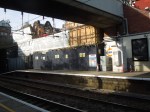
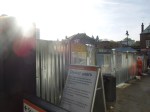

Lifts are being installed, a new ticket office is being constructed and the platforms are being lengthened to take the five-car Class 378 trains, when they arrive after the end of this year.
Sadly, not everybody would appear to be happy, according to this article in the Ham and High. But then, when the station is finished, it will be a lot better for access than most of the stations on the Victoria line, which handle a lot more passengers.
I think too, we often forget what happens in reality. Yesterday coming back from IKEA, I needed to get on the Overground at West Croydon for Dalston Junction. I had an awkward bag with me and I ended up on the wrong platform at West Croydon by my mistake. To get across, I needed to go up a ramp and down two sets of stairs. So I was asked if I needed help and I said that I didn’t! In the end a member of staff escorted me down the steps to the train.
So provided they are trained and helpful, surely one part of a disabled access strategy, is extra staff on the station. After all, one group who need assistance in unfamiliar surroundings are those who are blind or partially-sighted. I’m no expert, but surely a trained human guide is the best solution to their problems in these circumstances.
How To Do Interchanges
The London Overground wasn’t built to a generous budget and in some places it shows.
But not here in the two interchanges between the East and North London lines at Canonbury and Highbury and Islington stations.

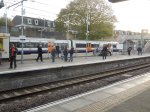
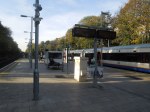

The wide central platform handles a lot of the transfers with a simple walk across and then if you need to use the footbridge, there are lifts to avoid the stairs.
At Highbury and Islington, there is also a second footbridge,
Both stations have a coffee stall on the central platforms, which also have seats and shelters.
Note too how the freight train is some way from passengers due to the wide platform. This can’t be said of all stations on the Overground.
It just shows how a tight budget and good design often produce something that works well. If money had been no object, the stations would have had escalators, but these don’t allow for disabled and buggy access, which of course the stair/lift combination does.
Underground Art
I had a letter published in The Times yesterday, under this heading.
I’ve been thinking for a long time about the way large bronze sculptures and statues keep getting nicked by Philistines and criminals, who don’t care one jot about our artistic heritage. We also have the controversy over Tower Hamlet’s Henry Moore statue, that they may have to sell.
So when The Times published a piece on art on the Moscow Metro, I wrote to the paper. This is what I said.
Your report “Moscow’s Metro is transformed into a real work of art” (Nov 7) offers a solution to the problem of what to do with the Henry Moore sculpture owned by Tower Hamlets council, as well as other statues owned by local authorities.
Many of our stations have a suitable space, and given that they are pretty secure why don’t we move some artworks there? Statues would interest more people in a station than they do tucked away in a park or housing estate, as they are now.
The more I think about this, the more I think the idea could be a runner.
Tower Hamlets incidentally, has three major stations; Canary Wharf, Shoreditch High Street and Whitechapel. The latter is currently being rebuilt for Crossrail.
All it needs to find a space for the Henry Moore, is a bit of creative and artistic thinking! To site the statue in public in a station, may actually cost less in the long term, as surely insurance would not be so expensive.
Lea Bridge Station
Lea Bridge Station is going to be reopened at the end of next year. As I was passing, I took a few pictures of the station as it is today.
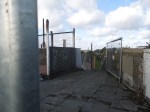
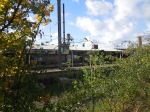
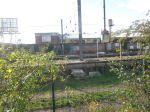



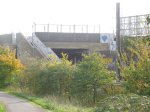
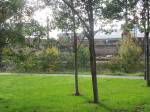
It would appear that a certain amount of clearing up has been done.
What surprised me was the landscaping around the line at this point.
It is also close to a couple of attractions in the Lea Valley Park, is well seved by buses and there were quite a few pedestrians and cyclists about. I had actually been to the nearby Lea Valley Riding Centre, to see about getting back on a horse.
So I am not be surprised that the figures showed the station is a good one to reopen. Although this article says that it might close.
I have a feeling that the figures will be nowhere like they are predicted. But whether they are higher or lower, I will not guess.
A lot depends on the service levels through the station, which currently sees two trains every hour in each direction. If that were to be doubled, it would make a lot of difference.
There is a good article and discussion on Lea Bridge station here on London Reconnections.
On a personal basis, I might use the station to go north, as it is one 56 bus to the station. So if I was going to Broxbourne or one of the other stations up the Lea Valley line, it would be a simple alternative. Especially, if the trains were four an hour.
Could We Create A Second Entrance To The Overground At Highbury And Islington Station?
Highbury and Islington station is not one of my favourites.
It has only two escalators to get to the deep-level platforms for the Victoria line and the Northern City line. At least we have now got two fully working examples, but a much needed third escalator can’t be fitted in the empty position, as there is not enough circulation space at the bottom.
It’s all because it was a typical 1960s Jerry-built station like several on the Victoria line.
One of the problems is that although since the Overground was opened at Highbury and Islington, there is more space on the concourse, at certain times, like an evening match at The Emirates, every passageway and the space in front of the station, gets seriously overloaded.
Although the Overground was built to a price, they did save money by using good design, rather than just leaving something out, as they did on the Victoria line.
For this reason, although they could have reinstated the Eastern Curve at Dalston Junction, to enable trains to go directly between Stratford and the East London line, they chose not to, but instead made Canonbury station, into a good, easy and efficient interchange. Especially, if you were coming from Stratford and going south to or through Dalston Junction! I regularly if I’m coming home from Stratford, change at Canonbury to a southbound train and go to the first stop; Dalston Junction, from where I take one of the numerous buses home. It sounds complicated, but if I have a heavy parcel, there is only one set of steps, which can be bypassed by a lift.
To facilitate train changing at Highbury and Islington station, they also built a second footbridge over the tracks, at the western end of the platforms. This footbridge is also designed to serve an emergency exit from the station.
This footbridge and its associated emergency exit, opens on to the road alongside the station;Highbury Station Road. So could this exit be expanded into a full entrance and exit to the station? I took a walk around the station to see it all from the outside.
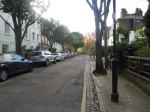
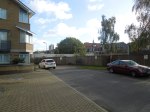
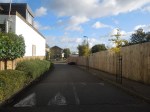

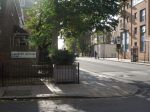

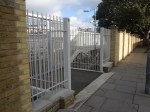
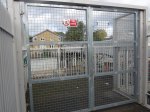
The residential developments around the north side of the station, probably wouldn’t take too kindly, to large numbers of people and especially football fans passing down their road. But it is only a short walk up Highbury Station Road on the south side to the wide expanses of Liverpool Road, which is in fact, an area poorly served by buses.
So a second entrance is probably feasible and it might give benefits to those, who live in the area to the west of the station. As Liverpool Road leads to the Emirates Stadium, a second entrance might help with congestion on the Holloway Road on match days.
Admittedly, a second entrance here would really only serve the Overground, but bear in mind that over the next couple of years, the capacity of trains on that set of lines, will be increased by twenty-five percent. This will put more pressure on Highbury and Islington station, which is a terminus of the Overground and the main northern interchange to the Underground.
I suspect too, that more football supporters will be using the Overground to get to the stadium. Remember that football fans have different travel patterns to say commuters and usually have a window of an hour or so before the match, when they can turn up. So they’ll see the extra capacity on the Overground and perhaps take a few minutes longer to get to the stadium in comfort, rather than crammed into an Underground train.
A second entrance would have certainly helped on Saturday, with all the chaos in the Balls Pond Road. If of course, the Overground had been running.
 The Anonymous Widower