Charging Battery/Electric Trains En-Route
One big need with a battery/electric hybrid train, is the need to charge the batteries quickly at a station stop.
On my last trip to Sheffield, I timed the stops from brakes on to moving again of the Class 222 train.
Times in minutes:seconds were as follows.
- Leicester 1:30
- Louthborough 1:15
- East Midlands Parkway 1:06
- Long Eaton 1:08
- Derby 1:22
- Chesterfield 1:09
So it looks like there is only a minute to charge the batteries on a typical Inter-City service.
Would it be much longer on say a long rural service like Settle and Carlisle or Inverness to Wick?
I don’t think so!
So how could we top up the train in a station stop of less than a minute.
Plug The Train Into a Power Socket
This may work with electric cars, but if you think it would work with trains and charge them in a minute, then think again!
Using A Pantograph
This may seem to be the obvious way, but to raise the pantograph, get a reasonable charge into the train’s batteries and lower it again, is an awful lot of things to cram into a minute.
There’s also many things that can go wrong.
Vivarail’s Solution
In Issue 864 of Rail Magazine, there is an article entitled Scotland High Among Vivarail’s Targets for Class 230 D-Trains, Vivarail’s solution to charging a battery-powered Class 230 train is disclosed.
A prototype rapid charging facility at its Long Marston base would use short sections of third-rail to quickly recharge a Class 230’s batteries. He said that the third-rail shoegear fitted to the trains in their London Underground service could handle higher currents than simply plugging a cable into the train.
The rapid charging concept consists of a shipping container of batteries that are trickle charged from a mains supply. When a Class 230 sits over the short sections of third-rail, electricity can be quickly transferred to the train’s batteries. When the train is away, the power rails are earthed to ensure they pose no risk The concept provides for charging a Class 230 as it pauses at a terminus before making its return journey.
What surprises me, is the claim, that third-rail is such an effective way of charging the batteries.
But then a Class 92 locomotive has a power of 4,000 kW when running on 750 VDC third rail electrification, so it would appear third-rail systems can handle large amounts of power.
This would be the sequence, as a train performed a station stop.
- The driver would stop the train at the defined place in the platform, as thousands of train drivers do all over the world, millions of times every day.
- Once stopped, the contact shoes on the train would be in contact with the third rail, as they would be permanently down and ready to accept electricity at all times.
- The charging system would detect the stationary train and that the train was connected, and switch on the power supply. to the third-rail.
- Electricity would flow from the track to the batteries, just as if the train was on a standard third-rail electrified track.
- If the train’s battery should become full, the train’s system could stop the charging.
- When passengers had finished leaving and joining the train and it was safe to do so, the driver would start the train and drive it to the next station, after ascertaining, that there was enough power in the batteries.
- When the charging system determined that the train was moving or that the contact shoe was no longer connected to the third-rail, it would immediately cut the power to the rail and connect it to earth.
It is a brilliant system; simple, efficient and fail-safe.
- Regenerative braking will mean that stopping in the station will help to top-up the batteries.
- The battery on the train is being charged, as long as it is stationary in the station.
- Delays in the station have no effect on the charging, except to allow it for longer if the battery can accept more charge.
- The driver concentrates on driving the train and doesn’t have to do anything to start and stop the charging.
- As there is no cable to disconnect or pantograph to lower, disconnection from the charging system is automatic and absolute, when the train leaves.
- The charging system never exposes a live rail to passengers and staff.
As a Control and Electrical Engineer, I believe that developments of this system, could be able to put at least 200 kWh into the train’s batteries at each stop.
The system could also be independent of the driver, whose only actions would be to check on safety, that charging was proceeding as it should and that there was sufficient charge in the batteries before continuing.
Connection And Disconnection To The Third-Rail
These pictures taken at Blackfriars station, show how the ends of the third-rail is tapered, so that the shoe on the train connects and disconnects smoothly.
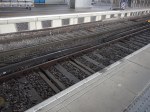
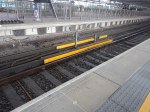
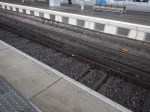
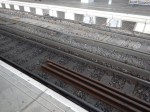
Note.
- The tapered ends of both rails on opposite side of the gaps.
- For safety, the electrified third-rail is on the other side of the track to the platform.
- One picture shows how yellow-painted wood is used for extra safety.
As a train is always on top of the third-rail, when the power to the rail is switched on in Vivarail’s charging system, I think that, the system should be very safe.
Battery-To-Battery Energy Transfer
Vivarail’s genius is to transfer the energy from trackside batteries to the batteries on the train. As batteries have a low impedance, large amounts of electricity can be passed quickly.
Batteries, Supercapacitors Or Both?
I believe that in a few years time for many applications, supercapacitors will be a viable alternative to batteries.
Energy densities are improving in supercapacitors and they have a similar low impedance, which will enable fast transfer of electricity.
So I wouldn’t be surprised to supercapacitors used on trains or in charging systems.
It may be that a mix of supercapacitors and batteries is the optimal solution.
Installing A Vivarail-Style Charging System
Installation of a Vivarail-style charging system would require.
- A length of third rail to be installed alongside the track or tracks in the station.
- The containerised batteries and control system to be installed in a suitable place.
- Electrical power to be connected to the batteries and control system.
- Appropriate-cabling between the rail and the container.
The great advantage is that to install a charging system in a station would not require any of the complicated and expensive works, often needed to install 25 KVAC overhead electrification.
Supplying Electricity To A Vivarail-Style Charging System
The Rail Magazine article talks of trickle charging the track-side batteries, using mains electricity, but I suspect some of the most cost-effective systems would use solar, wind or water power, backed up by a mains supply.
In a remote station, installing a Vivarail-style charging system powered by a sustainable power might be an opportunity to install modern low-energy lights and other equipment at the station, powered from the charging system.
A Vivarail-Style Charging System Could Be Built With No Visual Intrusion
Another advantage of using Vivarail-style charging systems, is that there is less visual intrusion than traditional continuous 25 KVAC overhead electrification.
Some visual intrusion would be down to the shipping container used to house the batteries.
But if necessary, the batteries could be housed in a classic Victorian outhouse or a modern sympathetically-designed structure.
Would A Vivarail-Style Charging System Need To Be In A Station?
Many, but not all charging systems would be in stations.
However, there are some very convenient places for charging systems, that may not be in stations.
Trains going to Bedwyn station wait for several minutes in a turnback siding to the West of the station, before returning to London. The route is not electrified and bi-mode Class 800 trains will be used on the route, because there is about thirteen miles between Bedwyn and Newbury without electrification.
If a Vivarail-style charging system were to be added to the turnback siding battery/electric trains could work the service to London. I’m sure Hitachi know how to convert a version of a Class 80x train to battery/electric operation.
There will be quite a few places, where for operational reasons, a charging system could or should be placed.
Would All Stations On A Route Need To Be fitted With A Vivarail-Style Charging System?
This would depend on the route and the need to run it reliably.
Detailed computer modelling would show, which stations wouldn’t need to be fitted with charging systems!
If a train was a limited-stop service or not required to stop at a particular station because of operational reasons or the timetable, the train would just pass through the station.
As it didn’t stop, it would not have caused the charging system to switch on power to the third-rail.
But if say due to delays caused by an incident meant a train was low on battery power, there is no reason, why the train can’t make a stop at any charging system to top-up the batteries.
Should The Driver Have Any Control?
Consider.
- It may be extra safety is needed, so the driver could give a signal to the charging system, that it is safe to start the charging process.
- Similarly, the driver should be able to pause or stop the process at any time.
But the driver would mainly be monitoring an automatic process.
Would The Charging System Be Linked To The Signalling?
I think this could be likely, as this could add another level of safety.
Conclusion
I believe it is possible to design a safe charging system using proven third-rail technology and batteries or supercapacitors to transfer at least 200 kWh into a train’s batteries at each stop.
Surely, this method of electrification could be used to allow electric trains to run through environmentally-sensitive areas and World Heritage sites like Bath, the Lake District and the Forth Bridge,
Brush Traction Signs Contract With Skeleton Technologies For Modules For Class 769 Trains
The title of this post is the same as that of this article on Rail Advent.
This is the first two paragraphs
Skeleton Technologies has announced that they have signed a contract with Brush Traction to supply SkelStart Engine Start Modules for all Porterbrook Bi Mode Class 769 trains.
The high-power density, safe and tiny size of the 24V SkelStart module were decided over other solutions during the feasibility stage to start the Auxiliary Power Supply (APS) units. Simply put, there was not enough room available for another solution.
The article then gives a few brief details on the SkelStart
Who are Skeleton Technologies?
They have a web site at www.skeletontech.com and there is a brief description on the home page.
Under a title of.
Powering Energy Savings With Ultracapacitors
There is this description.
Skeleton Technologies’ patented curved graphene is changing the world of energy storage.
Our superior technology enables us to deliver ground-breaking energy storage solutions with market leading power and energy density. Our products are used across industries from automotive to aerospace and everything in between.
Curved graphene? I know about graphene, but I’d never heard of it being curved.
There is a Press Release on the Skeleton Technologies web site, which is entitled Skeleton Technologies Signs Contract with Brush Traction to Supply Ultracapacitors for All BMU Class 769 Prime Movers.
This gives a lot more details, including this brief description of size and weight.
The 24V SkelStart has the size of a regular car battery and with its 8kg weight, it solved the space restriction we had.
It looks to be a very simple application of a capacitor with the ability to hold a lot of charge.
One of their products is called a SkelMod 170V 53F Ultracapacitor Module.
The datasheet gives these details.
- Voltage – 170 Volts
- Capacitance – 53 Farads
- Maximum Stored Energy – 0.2127 kWh
- Weight – 77 Kg.
That is a lot of energy for a capacitor.
A 50 kWh capacitor suitable for a bus or train, with this energy density would weigh eighteen tonnes, so it’s a bit impractical for this type of application at present.
But who knows what will be possible in the near future?
Skeleton Technologies would already appear to have pushed capacitor design a long way.
Skeleton Technologies Are An Estonian Company
This surprised me at first! But why not?
An Aside
Somewhere in my past about the 1960s, I remember an electronic news item, where someone like AERE Harwell, had built a one Farad capacitor, that was house-sized. Noe we get 53 Farad in a suitcase.
Conclusion
I think we’ll eventually see supercapacitors big enough to replace lithium-ion batteries in a lot of applications.
 The Anonymous Widower