Race For Clean Power Surges Ahead As New Electricity Superhighway Greenlit
The title of this post, is the same as that of this press release from Ofgem.
These three paragraphs, explain the infrastructure.
Flagged by the National Energy System Operator (NESO) as an essential element in achieving the Government’s Clean Power 2030 ambition, Eastern Green Link 1 (EGL1As part of its mission to rapidly upgrade the energy system with a minimum cost to customers, Ofgem has identified over £43m of savings which have been cut from the project costs without impacting delivery or quality. Communities that host the infrastructure in Scotland and North-East England are also set to benefit from a £7.9m social value and community benefit fund.) is a high voltage electricity superhighway able to transport 2 gigawatts of homegrown wind generated electricity between Torness, East Lothian and Hawthorn Pit, County Durham. A gigawatt (GW) is equivalent to one billion watts, and one gigawatt hour (GWh) of electricity is enough to power one million homes for one hour. Most of the 196km cable will be under the North Sea, with the remaining 20km of cables underground linking the cable to substations and converter stations in Scotland and England.
The project will reduce Great Britain’s reliance on volatile international gas markets by further harnessing the power of homegrown North Sea wind. NESO’s recent Clean Power 2030 Report has also shown that the project will deliver annual saving of over £870m by reducing the need to compensate British wind generators who are currently asked to turn off production during times of high wind due to lack of grid capacity. This in turn will help drive down consumer bills.
Note.
- Eastern Green Link 1 (EGL1) is a high voltage electricity superhighway able to transport 2 gigawatts of homegrown wind generated electricity between Torness, East Lothian and Hawthorn Pit, County Durham.
- This is the second down the eastern side of the UK.
- In Contracts Signed For Eastern Green Link 2 Cable And Converter Stations, I described how contracts were signed for EGL2 from Peterhead in Scotland to Drax in England .
- Most of the 196km cable will be under the North Sea, with the remaining 20km of cables underground linking the cable to substations and converter stations in Scotland and England.
There are another two 2 GW cables to follow in the current plan!
New Electricity ‘Superhighways’ Needed To Cope With Surge In Wind Power
The title of this post, is the same as that of this article on the Telegraph.
This is the first two paragraphs.
Energy companies are pushing for the rapid approval of new electricity “superhighways” between Scotland and England amid fears that a lack of capacity will set back the country’s wind power revolution.
Businesses including SSE and Scottish Power are calling on the industry regulator Ofgem to approve a series of major new north-south power cables in a bid to ease congestion on the existing electricity network.
These points are mentioned in the article.
- Current capacity is 6 GW, which even now is not enough.
- Another 17 GW of capacity will be needed by 2033.
- Wind farms in Scotland have been switched off and replaced by gas-fired power stations because of a lack of grid capacity.
- Another 25 GW of wind farms could be built after leases were awarded last month.
Two North-South interconnectors are being planned.
Peterhead And Drax
This is being proposed by SSE and National Grid.
- It will be an undersea cable.
- It will be two cables, each with a capacity of 2 GW.
- Peterhead and Drax power station are four hundred miles apart by road and 279 miles as the seagull flies, as a lot of the route would be over the sea. So an undersea connection would appear to be sensible.
- Peterhead is on the coast, so connecting an undersea interconnector shouldn’t be too challenging or disruptive to the locals.
- Drax power station is a 4 GW power station and the largest in the UK, so it must have good grid connections.
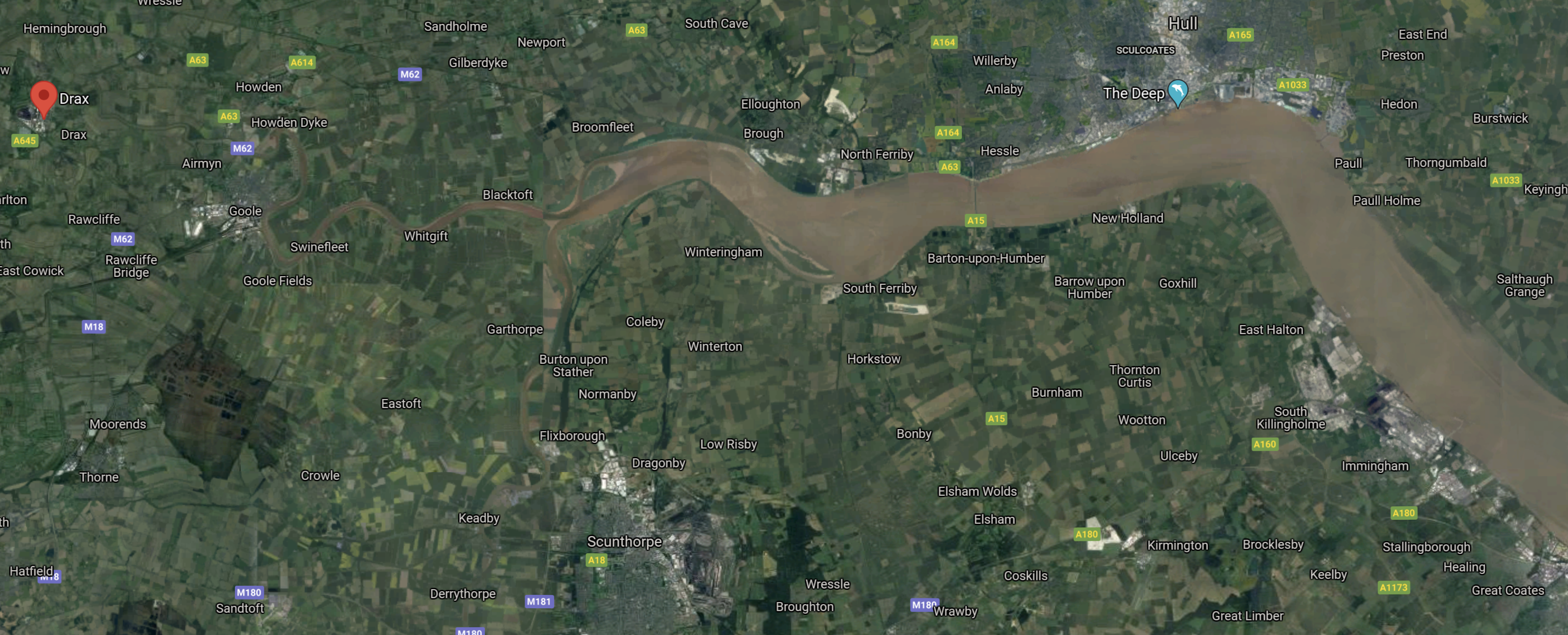
This Google Map shows the location of Drax power station in relation to Hull, Scunthorpe and the rivers in the area.
Note.
- Drax is marked by the red arrow in the West of the map.
- The large body of water in the East is the Humber Estuary.
- Hull is on the North Bank of the Humber.
- Scunthorpe, which is famous for its steel industry is South of the Humber in the middle of the map.
- To the West of Scunthorpe the Humber splits into the Trent and the Ouse.
- The Ouse leads all the way to Drax power station.
I suspect an undersea cable could go up the Humber and Ouse to Drax power station.
Is it a coincidence that both Drax power station and the proposed link to Peterhead are both around 4 GW?
Consider.
- Drax is a biomass power station, so it is not a zero carbon power station.
- Drax produces around six percent of the UK’s electricity.
- Most of the biomass comes by ship from North America.
- Protest groups regularly have protests at Drax because of its carbon emissions.
- Drax Group are experimenting with carbon capture.
- Drax is a big site and a large energy storage system could be built there.
- Wind is often criticised by opponents, saying wind is useless when the wind doesn’t blow.
- The Scots would be unlikely to send power to England, if they were short.
This is also said about Drax in Wikipedia.
Despite this intent for baseload operation, it was designed with a reasonable ability for load-following, being able to ramp up or down by 5% of full power per minute within the range of 50–100% of full power.
I take this it means it can be used to top up electricity generation to meet demand. Add in energy storage and it could be a superb load-follower.
So could the similar size of the interconnector and Drax power station be deliberate to guarantee England a 4 GW feed at all states of the wind?
I don’t think it is a coincidence.
Torness And Hawthorn Pit And Torness and South Humberside
These two cables are being proposed by Scottish Power.
- Each will be two GW.
- Torness is the site of the 1.36 GW Torness nuclear power station, which is likely to be decommissioned before 2030.
- Torness will have good grid connections and it is close to the sea.
- Hawthorn Pit is a large closed coal mine to the North of Newcastle, with a large substation close to the site. I suspect it will be an ideal place to feed power into the grid for Newcastle and it is close to the sea.
- Just South of Hawthorn Pit are the 1.32 GW Hartlepool nuclear power station, which will be decommissioned in 2024 and the landfall of the cables to the massive Dogger Bank wind farm.
- As I showed earlier with Drax, the Humber would be an ideal estuary to bring underwater power cables into the surrounding area. So perhaps the cable will go to Scunthorpe for the steelworks.
- As at Drax, there is backup in South Humberside, but here it is from the two Keadby gas-fired power stations.
The article in the Telegraph only gives the briefest of details of Scottish Power’s plans, but I suspect, that given the locations of the ends of the interconnectors, I suspect the cables will be underwater.
Conclusion
It strikes me that all three interconnectors have been well thought thought and they serve a variety of objectives.
- Bring Scottish wind power, South to England.
- Connect wind farms to the two nuclear power station sites at Hartlepool and Torness, that will close at the end of the decade.
- Allow the big 4 GW biomass-fired station at Drax to back up wind farms and step in when needed.
- Cut carbon emissions at Drax.
- Use underwater cables as much as possible to transfer the power, to avoid the disruption of digging in underground cables.
It looks to be a good plan.
 The Anonymous Widower