Is The BBC Anti-Rail?
Consider.
- One of the lead stories on BBC Breakfast this morning, is very negative about how there is tremendous disruption because of engineering work this weekend.
- They keep finding negative stories about the upgrading of Waterloo, when all my observations seem to have been positive.
- One of the most significant rail events of this month has been the start of running of the Aventra trains for Crossrail has been ignored.
I am going to the football in Ipswich on Saturday and according to the BBC, services out of Liverpool Street are severely disrupted.
But I have looked at the Internet and services appear like any other Saturday.
The BBC would appear to have an agenda.
Risky Business: Train Fleets In A State Of Flux
The title of this post is the same as this article in Rail Magazine.
The article is certainly in the must-read category and it illustrates the perils of not getting your investments right.
You could argue that rolling stock leasing companies (ROSCOs) are sucking money out of the UKs railways.
I would argue differently.
The cause of the troubles for the ROSCOs is threefold.
- Train operating companies would prefer to have lots of similar trains, as this makes, maintenance, training and timetabling easier and more affordable. Some successful companies like c2c, London Overground, Virgin Trains and Merseyrail are one- or two-class companies and others like TransPennine Express and Great Western Railway are moving that way.
- New leasing companies have seen the returns, that the three original ROSCOs have made and have entered the market. As they are leasing new trains, they make it more difficult to find homes for existing rolling stock, many of of which have perhaps twenty years of life left and are priced accordingly.
- The ROSCOs have also badly misjudged the technology. Bombardier, CAF and Stadler have come up with innovative solutions to the problems of our unique Victorian-designed railway and the train operating companies have liked what they have seen and ordered them.
It is interesting to note, that few of the large orders for rolling stock have not been financed by the three original ROSCOs; Angel Trains, Eversholt and Porterbrook.
Greater Anglia
As I know Greater Anglia well, I’ll look at their current fleet, which is being replaced train-for-train by new rolling stock.
- Class 90 locomotives – These are thirty years old and will probably end up pulling freight or be cannibalised for spares.
- Mark 3 coaches – These do not meet the latest regulations for passengers of reduced mobility and most will probably be scrapped, although one rake has been sold to be used by 60163 Tornado.
- Driving Van Trailers – I doubt these will find a use and will join the many others in store or they will be scrapped.
- Class 153 trains – At twenty-five years old, I doubt these single-carriage trains will see serious passenger use again.
- Class 156 trains – At nearly thirty years old, these two-car DMUs may have use on rural lines, but they will need refurbishment.
- Class 170 trains – These two- and three-car 100 mph DMUs will certainly find another operator.
- Class 317 trains – At thirty-five years old, but in good condition, these 100 mph EMUs will be difficult to place, as newly-electrified lines will inevitably deserve new trains.
- Class 321 trains – These 100 mph EMUs will be difficult to place, despite some having been recently upgraded.
- Class 360 trains – These 100 mph EMUs are only fifteen years old and will probably find a new operator.
- Class 379 trains – These modern 100 mph EMUs are only a few years old and will will certainly find a new operator.
Quite frankly most of this rolling stock is not worth much!
The Class 360 and Class 379 trains will be the easiest to release.
The sheer numbers of Class 317 and 321 trains, with little new electrification planned, mean that something innovative will, have to be done to find them a home. I speculated aboutwhat will happen to all these Mark 3-based multiple units in What Will Happen To The Class 319, Class 455, Class 321 And Cl;ass 317 Trains? I certainly suspect that some will find uses, with the upgraded Class 321 trains probably the first in the queue.
As I said in the article, I feel that some Class 321 trains could become small parcel and pallet carriers.
The Class 707 Trains
The Rail Magazine article talks about the problem of the Class 707 trains, that were ordered by South West Trains and will be returned by South Western Railway.
It suggests they could be converted to run on 25 KVAC overhead working, but that will be expensive and in my view a new Desiro City is far inferior to a new Aventra.
So would a quality Class 317 or 321 be a good alternative for an operator, that needed some new trains to perhaps open a new electrified route?
It looks even more of a bad decision of Angel Trains to fund the Class 707 trains.
Is It Innovate Or Die?
Porterbrook saw problems coming with the Class 319 trains, they were leasing to Thameslink.
But they got together with Northern and designed an affordable bi-mode, which is now the Class 769 train.
Thirteen have been ordered!
In anotherf project, InterCity 125 trains are being shortened and updated to last another decade.
Will we be seeing more developments like this, where redundant trains are turned into useful ones for a different purpose?
We could even be seeing some innovative export deals!
Conclusion
It’s a tough world out there!
But those that innovate will survive and make money!
Does The North Get A Raw Deal In Trains To And From London?
In the August 2017 Edition of Modern Railways, this is said, when talking about Great Western Railwat’s new Class 800 trains.
Thus both Bristol Temple Meads And Bristol Parkway will get four trains an hour to London, an even better service than Manchester’s three trains.
Admittedly, the Manchester service is a few minutes over two hours, whereas the Bristol service will be 90 minutes.
So what sort of service do other cities get?
- Birmingham – 7 trains per hour (tph)
- Cardiff – 2 tph
- Edinburgh – 3 tph
- Exeter – 3 tph
- Glasgow – 2 tph
- Leeds – 2 tph
- Leicester – 4 tph
- Liverpool – 1 tph
- Newcastle – 3 tph
- Norwich – 2 tph going to 3 tph in 2020.
- Nottingham – 2 tph
- Sheffield – 2 tph
- Southampton – 3 tph
- York – 4 tph
They are an interesting set of frequencies and you can read your own theories into the numbers.
Bury St. Edmunds: A Town With Dreadful Rail Access
If you need to go to Bury St. Edmunds by train from London, it is usually a cross-platform change every hour at Ipswich station.
It is actually, a journey that will get better in the next couple of years, because Greater Anglia are doing the following.
- Introducing new Class 745 trains between Liverpool Street and Ipswich
- Running three express trains per hour (tph) between Liverpool Street and Ipswich
- Reducing Liverpool Street to Ipswich times to sixty minutes.
- Introducing new Class 755 trains between Ipswich and Bury St. Edmunds.
- Running two tph between Ipswich and Bury St. Edmunds.
Journeys will get more frequent and there will be more seats.
A quick calculation on Greater Anglia’s non-electrified routes gives the following.
- They are currently served by a total of thirty-two coaches in excellent trains like Class 170 trains and twenty-nine coaches in scrapyard specials.
- They will be replaced by a total of fourteen three-car and twenty-four four-car bi-mode Class 755 trains consisting of a total of one hundred and thirty-eight coaches.
That is a 4.3 to 1 increase, so you can’t accuse Greater Anglia of not making a generous promise.
Greater Anglia have not disclose much about their plans, but I would suspect that they could include.
- At least two tph on as many routes as possible.
- A much improved service between Bury St. Edmunds and Cambridge.
- More services at Cambridge North station.
- Direct services between Bury St. Edmunds and London.
They’ve certainly got the trains for a major expansion of services and stations like Cambridge, Cambridge North, Colchester, Ipswich and Norwich are excellent transport hubs.
But stations like Bury St. Edmunds let the others down and don’t provide the service passengers expect.
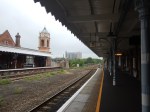
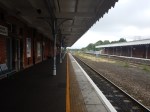


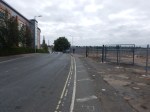


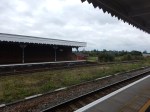
I think to quote any optimistic Estate Agent, it is a building with possibilities.
Consider.
- I suspect that Greater Anglia wish the track and platform layout was more train operator friendly.
- There is a cafe on the Ipswich-bound platform.
- Facilities are limited.
- The only shop is a barbers.
- Car parking is limited.
- The town centre and the bus station is a stiff walk away.
- There is no shuttle bus to the town centre.
- It is a Grade II Listed building.
For a town of 40,000 people it is a disgrace.
Improving Access To Trains
I’ve read in several places that Cambridge and Greater Anglia would like to create a frequent service between Cambridge and Bury St. Edmunds with several new stations, to help in the development of Greater Cambridge.
For example, a simple triangular route could be run between Cambridge, Ely and Bury St. Edmunds.
To do this efficiently would probably need a West-facing bay platform at the station.
But as this Google Map shows, that would be difficult.
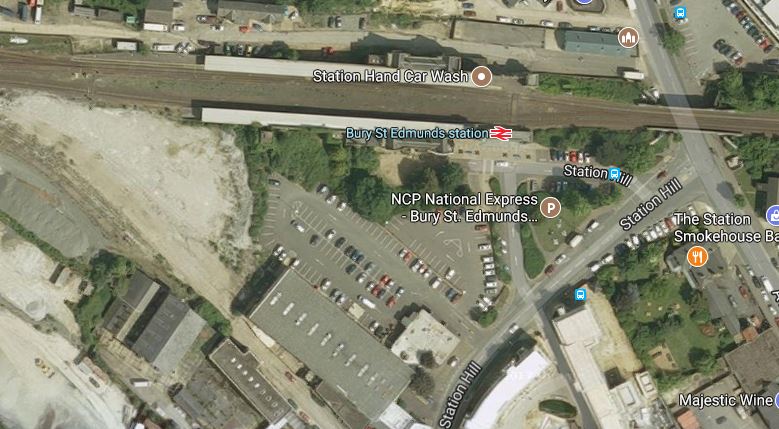
It might be possible to split one or both platforms, as happens at Cambridge.
When you consider, that the space in the middle of the platforms, is large enough for at least one extra track, I’m sure Network Rail have ideas to create a more usable station without spending an enormous amount.
One thing that surely helps, is that it is unlikely that many trains will be longer than four-cars.
Do The Addresses Of Train Operating Companies Put People Off Writing?
I write the odd letter of complaint or praise to various companies, although I can’t remember writing one to a train operating company for some time.
I have a feeling it might have been to London Overground about something, but I do remember a reply, but what it was about, I have no idea.
In going through Chris Gibbs report on Govia Thameslink Railway, I asked myself, where their customer support is situated.
The page is comprehensive with the postal address being in Ashby-de-la-Zouch in Leicestershire.
So if you were complaining or praising something would you think that this disconnected address is in some anonymous Call Centre in Leicestershire and not bother?
I checked a few other companies.
- Chiltern – Banbury
- East Midlands Trains – Derby
- Greater Anglia – Norwich
- London Overground – Swiss Cottage
Incidentally, Great Western don’t say, but the address is Freepost GWR Customer Support.
I think the GWR approach is probably the most professional, as it means they can put the customer support in the most convenient place and if they should move it, the post will still get through.
A Branch To Penicuik From The Borders Railway
I started this post as part of Extending The Borders Railway To Carlisle, but as I research it more and talk to my correspondent in the Borders, I feel it needs to be a separate post.
There is an article in the Scotsman from 2013, which is entitled Borders rail link: £150m plan for Penicuik spur. This is the first paragraph.
A vital £150 million rail line connecting Penicuik to central Edinburgh could be reopened for the first time in half a century.
The article then gives a lot of favourable comments about the possibility of the link. My correspondent, grew up in the town and feels that a rail link is needed, especially, as when he was a boy, the town had three rail lines.
In the Wikipedia entry for the Borders Railway, this is a paragraph about a future branch to Penicuik.
In May 2013, it was reported that Heriot-Watt University had been asked by Midlothian Council to carry out a feasibility study on a 10-mile (16 km) rail link connecting Penicuik with the Borders Railway. At least 6 miles (9.7 km) of the new line would follow the Edinburgh, Loanhead and Roslin Railway, the alignment of which is generally intact between Millerhill and Straiton.
This proposal is not mentioned in the recent CBR report, which is entitled A Summary Case For A New Cross-Border Rail Link, that can be downloaded in PDF form from this location.
Newcraighall Station And Park-And-Ride
Newcraighall station will be North of where the proposed branch to Penicuik joins the Borders Railway.
This Google Map shows the station and the surrounding area.
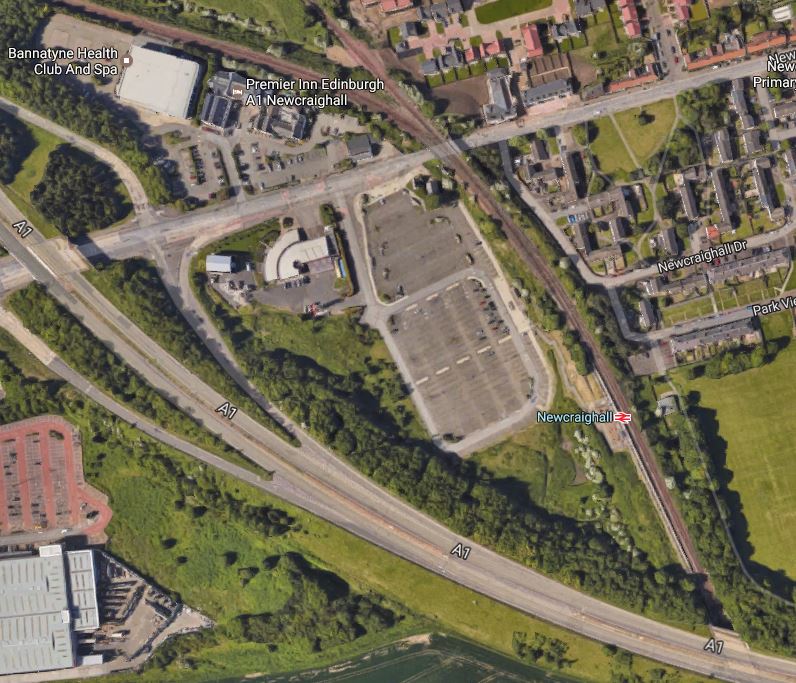
Note the A1 and the convenient Park-and-Ride.
Wikipedia says this about Services from Newcraighall station.
Monday to Saturday daytimes there is a half-hourly service to Edinburgh and to Tweedbank, and an hourly evening and Sunday service. Four weekday morning peak services run beyond Edinburgh to Glenrothes with Thornton via Kirkcaldy and a similar number run in the opposite direction in the evening. When the station was a terminus, many services ran through to/from the Fife Circle Line but this practice ended prior to the reopening of the full route to Tweedbank.
I believe that a Park-and-Ride of this size, location and probable importance needs at least four trains per hour (tph) all day.
Currently, two tph between Edinburgh and Tweedbank call at Newcraighall. As it takes two hours for a train to do the round trip, this means that four trains are needed to provide a two tph service.
Four tph all the way to Tweedbank would need eight trains, but due to limitations in the design of the Borders Railway would probably be very difficult to operate.
Terminating them at Newcraighall and perhaps running beyond Edinburgh to Fife is obviously a possibility, but Newcraighall station only has one bi-directional platform.
Two Trains Per Hour To Penicuik
Opening a branch to Penicuik and running two tph would give Newcraighall station and the Park-and-Ride the four tph train service it needs, when combined with the two tph along the Borders Railway.
The Edinburgh, Loanhead and Roslin Railway
Wikipedia says the route would probably follow the route of the Edinburgh, Loanhead and Roslin Railway.
- Much of the route is visible on Google Maps.
- The original line closed in the 1960s.
- There were stations at Gilmerton, Loanhead, Roslin and Glencourse.
- The major engineering feature of the line was a visduct over Bilston Glen.
Penicuik was served by a freight-only line.
Shawfair Station
It would appear that the Northbound and Southbound trains on the Borders Railway seem to call at Shawfair station around the same time.
This must make operation of the line much simpler and it probably meant that Newcraighall station only needed one platform.
This Google Map shows the Borders Railway passing through Shawfair station.
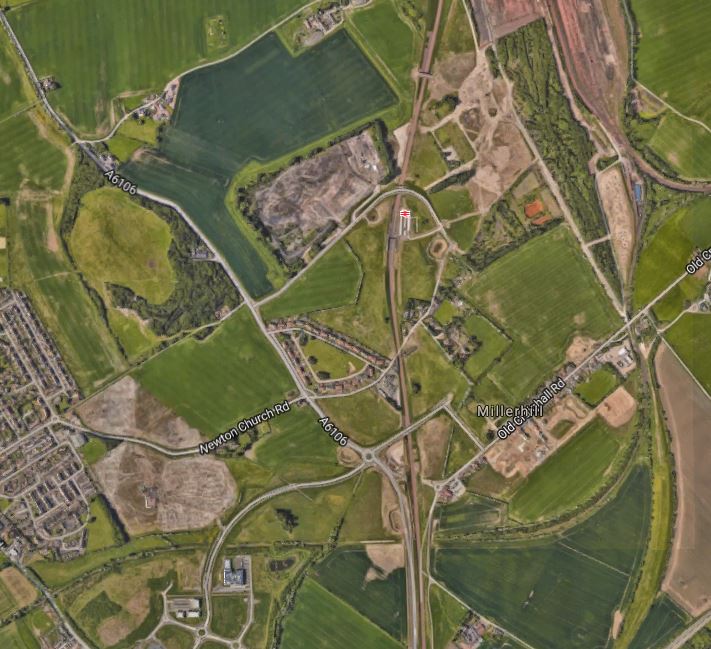
Note the disused track of the Edinburgh, Loanhead and Roslin Railway crossing the Borders Railway at right-angles and then curving Northwards to the freight yard at Millerhill.
Trains could go via Millerhill, to join the Borders Railway South of Newcraighall station, but surely, it would be better if the branch to Penicuik, joined the Borders Railway South of Shawfair station.
This would allow trains to and from Penicuik to pass at Shawfair station.
As trains to and from Tweedbank station seem to call between
- XX:08 to XX:10
- and XX 38 to XX:40
So Penicuik trains could use times of perhaps .
- XX:23 to XX:25
- and XX 53 to XX:55
Which would mean a train would have thirty minutes to go from Shawfair to and from Penicuik.
The way Shawfair station is used also means the following for the Borders Railway.
- A convenient spacing is imposed for trains to call at the single platform at Newcraighall station, as that is just four minutes towards Edinburgh.
- Effectively, the Borders Railway to Tweedbank station runs a two tph service with two widely-seperated trains South of Shawfair station at any one time.
- Two widely-separated trains, South of Shawfair station enables the use of single-platform stations at all stations except Stow and Tweedbank.
- Shawfair station is the only station with an expensive footbridge.
I also suspect that four tph is possible, with trains passing at Shawfair and Stow stations, perhaps with faster trains and improvements to the signalling.
By clever design and selective use of two-platform stations and double-track, it would appear that the engineers have designed an efficient affordable railway, that is mainly single track and has only one footbridge.
The Junction Of The Borders Railway And The Penicuik Branch
This Google Map shows where the track-bed of the Edinburgh, Loanhead and Roslin Railway passes under the Borders Railway to the South of Shawfair station.
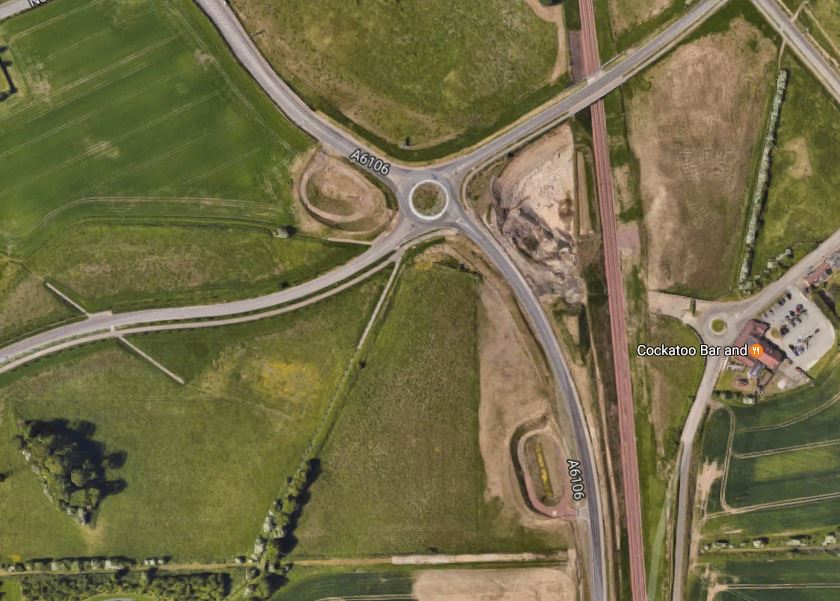
Note the old track-bed of the Edinburgh, Loanhead and Roslin Railway running East-West across the bottom of the map.
The roads in the area don’t appear to have been built with a suitable space for a chord to connect.
But even so, I suspect it would be a practical proposition for a single-track chord to be built between the Borders Railway and the Edinburgh, Loanhead and Roslin Railway.
The only difficult construction would be crossing the A6106 road to the South-East of the roundabout.
A cross-over would be needed South of Shawfair station to allow Southbound trains to access the branch to Penicuik. But as there would only be no more than four tph South of Shawfair station, this wouldn’t be a large operational problem.
Single-Track To Penicuik
Wikipedia says that the proposed Penicuik branch is ten miles in length.
Surely, if it were a single-track branch, trains could go from Shawfair to Penicuik station and return within thirty minutes.
Consider.
- It would take five minutes for the driver to change ends at Penicuik
- Two stops each way with a modern train could take a total of just five minutes.
- The train would be the only one on the branch.
- A well-designed line could have an operating speed of at least 75 mph and possibly 90 mph.
All this would mean that there would be ten minutes for each leg of the journey between Shawfair and Penicuik.
Should A Future Penicuik Branch Be Electrified?
Electrification of a future Penicuik Branch would not be difficult.
- Electrification would need to be extended from Newcraighall station.
- Electrification would be easier, if the branch were single-track with single-platform stations.
- Electrification of a new railway must be easier than electrifying an existing line.
Electrifying between Newcraighall and Penicuik may give advantages.
- There will be a fairly plentiful supply of cascaded electric trains, that could be suitable for the route.
- Electrifying may allow electric trains to access the Millerhill TMD.
- Electrifying would help in running bi-mode trains on the Borders Railway, if that were thought necessary.
- Electrifying may save a few minutes between Shawfair and Penicuik.
Obviously, electrification would allow politicians to boast about their green credentials.
The only disadvantage of electrification is that some bridges may need to be raised.
Surely, if the ten-mile branch was well-designed as mostly single-track, perhaps with electrification, and run by modern trains, two tph would be possible, even with one or more intermediate stops.
Could A Future Penicuik Branch Be Worked By Bi-Mode Trains?
A bi-mode train like a Class 319 Flex train could certainly work the route and as they have lots of power, they could probably achieve the Shawfair to Penicuik and return time of thirty minutes.
Could A Future Penicuik Branch Be Worked By Battery Trains?
As it is only ten miles between Shawfair and Penicuik, I suspect that in the future,, trains with onboard energy storage will be able to work the branch.
Single-Platform Stations
If the future Penicuik Branch could be a single-track railway, where only one train was on the branch at any one time, all stations could be built with a single-platform and no expensive footbridge, as most stations were built on the existing Borders Railway.
As five-cars seems to be becoming the new standard train length, I would build all platforms to accept five-car trains.,
A North-South Service Across Edinbugh
Peak Hour services link Tweedbank and Newcraighall beyond Edinburgh to Glenrothes with Thornton via Kirkcaldy.
There is obviously a need for a service in the Peak, but if there was a second Southern terminus at Penicuik would it be sensible that if a total of four tph were running from Newcraighall to Edinburgh, that a proportion cross the Forth.
Note that Cross-Forth services.
- Call at both Edinburgh and Haymarket stations in the City Centre.
- Have an easy interchange with the Edinburgh trams at Haymarket and Edinburgh Gatway station.
- Probably have an easier route to Edinburgh Airport.
There are certainly lots of possibilities.
Could A Future Penicuik Branch Be Worked By Tram-Trains?
The Germans would probably use tram-trains in a city the size of Edinburgh.
Compared to the tram networks in Nottingham and Birmingham, Edinburgh trams always strike me that it was a network designed without ambition and that doesn’t provide the maximum benefit to the largest number of residents and visitors.
If you look at Edinburgh Gateway station, it could have been modified to allow tram-trains like the Class 399 tram-train to come from the Airport and then go straight onto the Fife Circle Line to South Gyle, Haymarket and Edinburgh stations.
At present this line is not electrified, but doing that is probably in Scotrail’s wish-list.
Once at Edinburgh station, the tram-trains could take any of the electrified routes to North Berwick, Dunbar or perhaps Penicuik.
Passengers would finally get a proper interchange between trains on the East Coast Main Line and the Edinburgh tram.
I also think that the Germans would run tram-trains on the Fife Circle Line and its proposed extension to Leven.
Currently, the frequency of trains on the Fife Circle Line is low and tram-trains could probably give a four tph service to all stations, if electrification was put in place.
Conclusion
I believe that it would be possible to open a single-track branch to Penicuik with single-platform stations and these objectives.
- Provide a two tph service between Penicuik and Edinburgh.
- Boost the service between the Park-and-Ride at Newcraighall and Edinburgh to four tph.
- Provide an alternative Southern terminal for a North-South service across Edinburgh.
Electrification of the line might give operational advantages to Millerhill TMD, the Borders Railway and the branch itself.
Extending The Borders Railway To Carlisle
Summary Case For A New Cross-Border Rail Link
This is the title of a report by the Campaign For Borders Rail (CBR) about extending the Borders Railway to Carlisle.
The report is in PDF form at this location.
It goes into detail about why they believe that the railway is worth building and the excellent report is recommended to anybody who wants to know more about the possible reasons for creating a rail service between Edinburgh and Carlisle via Hawick.
Before discussing the proposed route and the problems in detail, I will give my views on some general issues, that affect the design of the railway.
Single-Track Or Double-Track?
In the Wikipedia entry for the Borders Railway, there is a section entitled Infratructure Capability, which starts like this.
The line’s construction has been described as resembling a “basic railway” built to a tight budget and incorporating a number of cost-saving features. This is in contrast to the reopened Airdrie-Bathgate Rail Link, which was built as a double-track electrified railway from the outset.
The section then says that dynamic passing loops were shortened, bridges were built single-track and there is a lack of a siding, which could make it difficult for a locomotive to recover a broken down train.
The railway was designed down to a cost, but these factors applied.
- There were two tunnels at Bowshank and Torwoodlee, three major viaducts and several stations to be refurbished or built.
- Despite the best efforts of forecasters, no-one had any clue as to how many passengers would use the line.
I think that in the design of the rest of the route the following factors will apply.
- The engineers will have the benefit of 20/20 hindsight from rebuilding the first section and its successful operation.
- The expected passenger traffic will be more easily forecast.
- There are several viaducts.
- There is the single-track Whitrope tunnel, which is over a kilometre long.
- Recent developments in construction, rolling stock and signalling will help.
- The CBR report suggests five stations at Melrose, St. Boswells, Hawick, Newcastleton and Longtown.
- The CBR report suggests using the line for freight.
- The CBR report suggests using the line as a diversion route.
But surely the biggest factor affecting the line will be the connection to Carlisle, as it will open up several possibilities.
- Carlisle could become a very important hub for tourists.
- Carlisle could become an even more important shopping and leisure centre.
- Carlisle will be very important in the event of Scottish independence.
- Carlisle could become a distribution centre and interchange for Anglo-Scottish road and rail freight.
So instead of just designing to a cost, when designing the second half of the Borders Railway, they will be building a railway, that maximises return from a line to handle a particular capacity.
Given some sections like the Whitrope tunnel are single-track and that in some places it could be difficult to squeeze a double-track through, I think we’ll see the some innovative use of single-track.
Electrification Or Self-Powered?
There is already some short sections of electrification on the original Waverley Route from Edinburgh to Carlisle.
- Edinburgh to Newcrasighall – Just over five miles.
- Longtown to Carlisle – Around twelve miles.
As electrifying the route could be difficult for engineering and environmental reasons, I suspect that like the first section of the Borders Railway, the route will generally be built without electrification.
Although, I wouldn’t be surprised if the existing electrification, were to be extended for a few miles, if it gave operational advantages, if the line were to be run using bi-mode trains, perhaps if they were trains with onboard energy storage.
But as there is already a much faster fully-electrified route via Carstairs, they would have to be very good reasons to electrify more of the Borders Railway.
What Will Be The Operating Speed Of An Extended Borders Railway?
The current operating speed of the Borders Railway is 90 mph, so I would assume that at least this speed will apply to the whole line.
South of Hawick, there might be scope for slightly higher speeds, if the track-bed is profiled for modern trains.
What Trains Should Be Used?
Because of the electrification at both ends of the route, I would use bi-mode trains or perhaps ScotRail’s 2+4 or 2+5 High Speed Trains.
Looking at the specification of the economy bi-mode train; the Class 319 Flex train, it has the following characteristics.
- Four-cars
- Legendary Mark 3 coach ride.
- 100 mph capability on overhead electrification.
- 90 mph capability on diesel.
- Toilets
- The ability to change from diesel to electric at line speed.
The train can also be refurbished to any required standard, which as the trains are Mark 3 coach-based, means it could be to a very high standard.
I have no doubt, that a Class 319 Flex train or a new train to a similar specification would be an ideal train for the Extended Borders Railway.
As it appears that trains like bi-mode Class 800 and the new Class 720 trains might be able to work the route in the future and they are five-car, all platforms will have to be this length or the trains could use selective door-opening.
I know there is no bi-mode Class 720 train ordered at the moment, but the Aventras have been laid out in such a way, that I suspect they could be built as bi-modes.
Don’t discount the possibility, that the next generation of bi-mode trains will have onboard energy storage, regenerative braking and the ability to do perhaps thirty miles on stored energy.
Currently, trains take fifty-seven minutes to go from Edinburgh to Tweedbank and fifty-five minutes to return, and it looks like ScotRail uses four trains to provide two trains per hour (tph).
If you assume that the average speed of the journey to Carlisle is the same, then that gives a time of two hours forty minutes for Edinburgh to Carlisle. I suspect that with modern bi-mode trains with a 100 mph capability and better stopping performance, that a time of two hours thirty minutes will be possible.between Edinburgh and Carlisle,
But it has to be born in mind that much faster times between Edinburgh and Carlisle are currently achieved on the fully electrified route via Carstairs.
So train operators will have plenty of scope to provide a quality service between Edinburgh and Carlisle.
Will High Speed Trains Work The Extended Borders Railway?
Now there’s a though!
Network Rail will probably want the route to be available to the New Measurement Train, so that they can adequately check the track.
Effectively, the NMT is just a High Speed Train in a garish yellow, with lots of sophisticated test equipment on board instead of passengers.
So this will mean that ScotRail’s 2+4 or 2+5 High Speed Trains, will be able to work the route, subject to platforms being long enough.
What Level Of Passenger Service Will Be Provided On The Borders Railway?
Currently, there is generally a two tph service between Edinburgh and Tweedbank and I would feel that all stations on the line need at least this level of service.
But as a stopping service from Edinburgh to Carlisle will take well in excess of two hours, I don’t think we’ll be seeing that sort of service.
But don’t rule out a semi-fast train stopping at perhaps the important stations like Galashiels, Melrose, St. Boswells and Hawick.
Will Freight Trains Work The Extended Borders Railway?
The CBR report is suggesting that freight trains will work the route, to get timber from the Keilder Forest.
This and other specialist freight trains will certainly be possible.
On the other hand, I suspect it will be unlikely, that container trains will use the route between Edinburgh and Carlisle, as the other route via Carstairs is electrified and will surely be faster.
Anything more than the occasional specialist freight train would probably be very different to schedule on the route.
Will The Extended Borders Railway Be Used As A Diversion For The West Coast Main Line?
It would need to be designed for such use.
There should be no problem with freight trains provided the route can handle trains up to about eight hundred metres long. So there may need to be adjustment to some of the passing loops on the existing section from Edinburgh to Tweedbank.
With passenger trains, if the Borders Railway can handle five-car trains, then running a shuttle train between Edinburgh and Carlisle, using a bi-mode Class 800 train, wouldn’t be a problem.
It’s a good reason for making sure that HSTs can work the Extended Borders Railway.
Would the capacity at the Northern end, be able to handle more than the occasional diverted train?
But I question the need for the need for the route to have the capability
When Storm Frank damaged the viaduct at Lamington in December 2015, it effectively blocked the West Coast Main Line routes to Edinburgh and Glasgow.
There are four routes to Edinburgh and Glasgow from England.
- The West Coast Main Line to Glasgow
- The West Coast Main Line to Edinburgh
- The East Coast Main Line to Edinburgh
- The Glasgow South Western Line to Glasgow.
But in a couple of years, there should be big differences to 2015.
- There will be a frequent high-capacity electric train route between Scotland’s two largest cities.
- Virgin Trains East Coast will have a large number of Class 800 bi-mode trains, that could use the Glasgow South Western Line to get to Carlisle.
- Scotrail will have a number of short-formation High Speed Trains, that will always get through somewhere.
- Edinburgh to Newcastle and Manchester will have extra capacity.
- Carlisle to Newcastle will have more capacity.
Network Rail have even future-proofed the Settle and Carlisle Line, which would enable Virgin Trains East Coast’s Class 800 trains to get to Leeds via Carstairs and Carlisle, in the event of closure of the East Coast Main Line.
I think any sane railway engineer would say that although it would be nice to be able to use the Extended Borders Railway as a diversion route, because of other developments, it wouldn’t be necessary.
Perhaps the following should be done instead of making the Extended Borders Railway a fully-functioning diversion route.
- Increase the resilience of the current four routes between Edinburgh and Glasgow and England.
- Increase the capacity between Carlisle and Edinburgh via Carstairs.
- Increase the capacity on the Glasgow South Western Line.
In the medium to long term, the Glasgow South Western Line should probably be electrified.
Extending The Borders Railway To Hawick
The CBR report revealed to me, something that I hadn’t realised. Newtown St. Boswells is the headquarters of the Scottish Borders Council.
Surely, this means that Newtown St. Boswells needs a rail connection to Edinburgh and good transport connections to the rest of the region.
This Google Map shows the area from the end of the Borders Railway at Tweedbank station to the two villages of Newtown St. Boswells and St. Boswells.
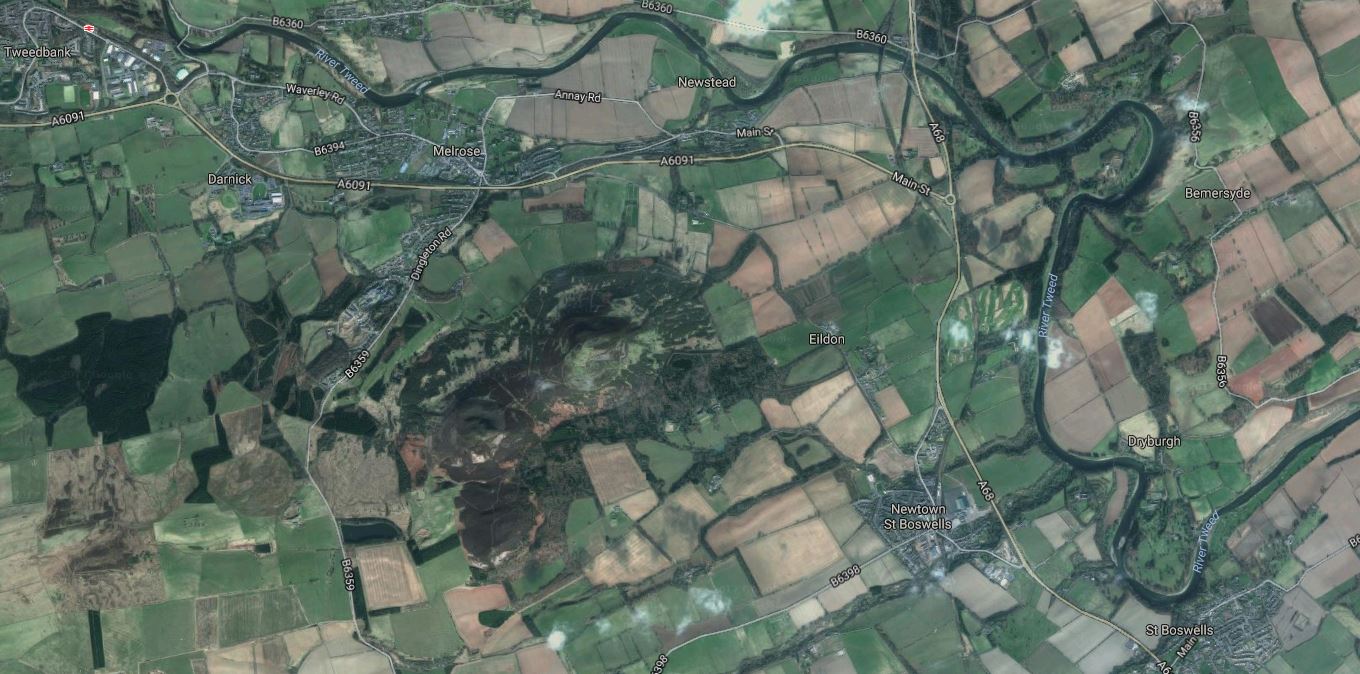
Note.
- Tweedbank station is in the North-West corner.
- Newtown St. Boswells and St. Boswells are in the South-East corner
- The route passes the Borders General Hospital and the town of Melrose.
A lot of the track-bed is still visible and this Google Map shows the villages of Newtown St. Boswells and St. Boswells in more detail.
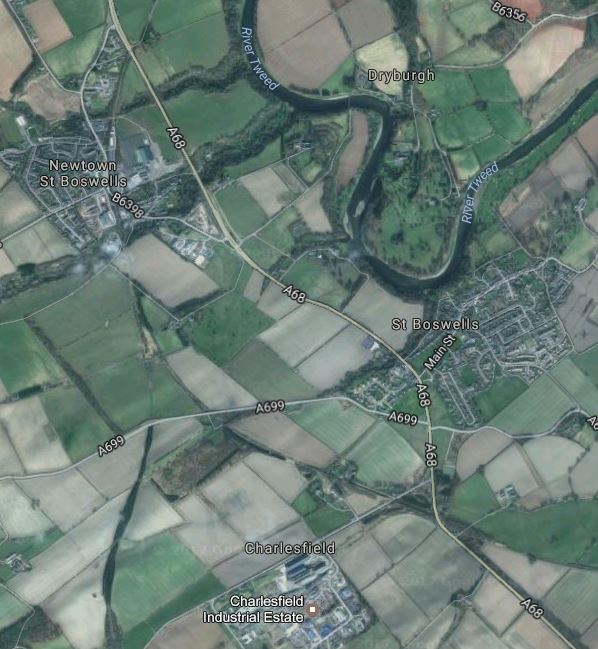
It would appear that the old Waverley Route splits into two, just South of Newton St. Boswells with the Waverley Route going South to Hawick and the Kelso Line going East to Kelso.
I have flown my virtual helicopter on the route from Tweedbank to Hawick and it would appear that the challenges of extending to Hawick are as follows.
- Squeezing a double-track railway alongside the A6091 to the South of Melrose.
- Crossing the A68 at Newton St. Boswells, where there may already be a road bridge over the track-bed.
- Squeezing a double-track railway through Newtown St. Boswells.
- The Ale Water Viaduct
There are also a few farm buildings and factories that may block the track-bed.
It would appear that extending the Borders Railway from the current Tweedbank station to a new station on the outskirts of Hawick, would not be the greatest of engineering problems, but it would link the railway to important stations at the following locations.
- Borders General Hospital and/or Melrose
- Newton St. Boswells
- Hawick
Modern signalling might allow the efficient use of single-track railway, where it was needed for reasons of space.
Tweedbank, Melrose Or Hawick As An Interim Terminal For The Borders Railway
In the Wikipedia entry for the Borders Railway, there is a section called Failure To Continue To Melrose. This is said.
The Scott Wilson Report did not consider extending the line beyond Tweedbank due to the increased capital and operating costs of continuing further without a corresponding increase in passenger demand. The Campaign for Borders Rail consider nevertheless that there would have been a strong case for reaching Melrose on the basis of the town’s role in Borders tourism.
I do wonder, if Scotrail wanted Tweedbank because of the following.
- Edinburgh to Tweedbank takes around 55-57 minutes, so two tph can be achieved with four trains.
- Edinburgh to Melrose would take just over the hour, so is very difficult to timetable and would need more trains.
If the current Edinburgh to Tweedbank time of around 55-57 minutes, is used to estimate a time for Hawick, you get something just over eighty minutes, which makes a three-hour round trip very feasible.
If two tph were to run between Edinburgh and Hawick, you’d need six trains.
Scotrail could have even said no to Melrose, as mathematically it’s all wrong and expensive for a train operator.
But Hawick is much better!
An Edinburgh To Hawick Passenger Service
I can’t help feeling that the mathematics of the route and response of the people of the Borders to their new Borders Railway, says very strongly, that the route of the initial Borders Railway should have been between Edinburgh and Hawick, with intermediate stops at Borders General Hospital/Melrose and Newtown St. Boswells.
Scotrail seem to be proposing three-car Class 170 trains for the current route, which would be ideal for Edinburgh to Hawick.
If these three-car trains, running at a frequency of two tph, should not prove to be enough, then four or even five-car trains could provide the extra capacity.
Could Kelso Be Linked To The Borders Railway?
Previously, I noted that a branch leads from St. Boswells to Kelso. From Kelso, it used to lead to the East Coast Main Line and also to Jedburgh and Coldsteam in the South.
It would appear that the line can’t be easily reinstated, as the route has been used for a new road, although much of the track-bed is unobstructed and easily spotted on Google Maps.
But it might be possible to create a branch to the outskirts of Kelso, if that were to be needed.
I suspect though, it would only be needed, if Kelso staged a major sporting event, like the Olympic or Commonwealth Games.
A Branch To Penicuik
In the Wikipedia entry for the Borders Railway, this is a paragraph about a future branch to Penicuik.
In May 2013, it was reported that Heriot-Watt University had been asked by Midlothian Council to carry out a feasibility study on a 10-mile (16 km) rail link connecting Penicuik with the Borders Railway. At least 6 miles (9.7 km) of the new line would follow the Edinburgh, Loanhead and Roslin Railway, the alignment of which is generally intact between Millerhill and Straiton.
This proposal is not mentioned in the CBR report, so I have made it a separate post with a title of A Branch To Penicuik From The Borders Railway.
This was my conclusion
I believe that it would be possible to open a single-track branch to Penicuik with single-platform stations and these objectives.
- Provide a two tph service between Penicuik and Edinburgh.
- Boost the service between the Park-and-Ride at Newcraighall and Edinburgh to four tph.
- Provide an alternative Southern terminal for a North-South service across Edinburgh.
Electrification of the line might give operational advantages to Millerhill TMD, the Borders Railway and the branch itself.
I very much think that the branch to Pencuik will be built..
Hawick
This Google Map shows the centre of Hawick. Hawick station occupied what is now the site of the Teviotdale Leisure Centre.
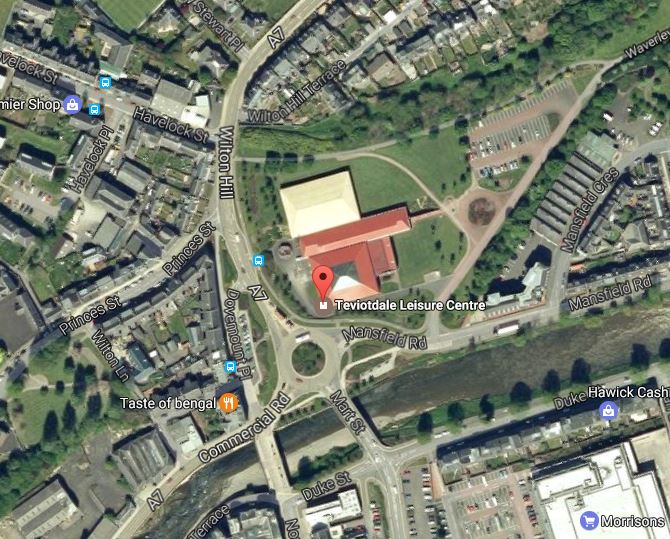
After the station, the line crossed the River Teviot on a viaduct, to the East of the two bridges.
This entry for Hawick in Disused Stations, gives a lot more details on the station and says that the station site was cleared and the viaduct was demolished in the 1970s.
Getting the Borders Railway through Hawick would appear to be a very challenging engineering problem.
I suspect that Network Rail looked hard at the Waverley Route, when they were designing the current Borders Railway and decided that the cost would be too great if the railway was reconstructed through Hawick.
Incidentally, I can’t find any plans or speculation on the Internet about how to get the Borders Railway through the town.
So what do I think will happen?
Looking at maps of the area, it could be that an avoiding line swinging around the East of Hawick to pick up the line going South to England, might be possible, but the River Teviot meanders all over the place and gets in the way.
So perhaps the solution is to use a modern bow-spring bridge on the original route taken by the Victorians.
Certainly, bridge design has been on an upward curve for the last few years.
But then the good citizens of Hawick might not like to have a massive intruder in their midst.
If pushed, I would say the Borders Railway through Hawick will have the following characteristics.
- Single-track through the town.
- An elegant bridge over the Teviot.
- A simple station in the town centre.
- A Park-and-Ride station, to the North-East of the town with good access to the A698.
- No freight trains, except Network Rail maintenance trains.
I think designed properly, services from both stations could be something like.
- Two tph to Edinburgh stopping at all stations.
- Two tph to Carlisle stopping at Newcastlton and Longtown.
This would mean that Hawick would also have a Park-and-Ride with a four tph service to the town centre.
But I’m sure that modern signalling and good driving can get four tph in each direction between two stations.
Both stations might have two bi-directional platforms on an island, with one face for through trains and the other for trains terminating in the station.
Hawick To Longtown
It does appear from my virtual helicopter, that a lot of the track-bed is intact South of the River Teviot in Hawick to Longtown on the other side of the Border.
The track-bed can be picked out and in many places it runs through gaps in the trees.
It doesn’t seem to be the most difficult of projects, with three obvious parts with possible difficulties.
It certainly looks to be one of the easier parts of the route of an Extended Borders Railway.
A Branch To Langholm
This article on the BBC is entitled Langholm station considered in Borders Railway extension study.
This map from Wikipedia shows the location of Langholm station with respect to Newcastleton and Longtown stations.
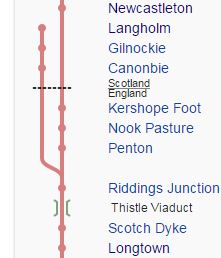
Opening a station at Langholm is an idea, that could make it easier to provide a four tph service between Carlisle and Longtown, with two tph to each of Hawick and Langholm.
Transporting Timber By Rail
The CBR report says this about transporting timber by rail.
The huge forestry plantations across the border area, including Keilder, have reached maturity and provide a continuous supply of timber. Part of the output is taken by lorry to a Carlisle railhead for transport to English markets. A new railhead would allow loading closer to the forests, cutting environment impacts and road traffic, and extending the customer base.
It wouldn’t be the greatest additional cost to create a rail head, where timber could be loaded.
But any thoughts of reopening the Border Counties Railway to Keilder, should probably be discounted.
Longtown To Carlisle
In Enthusiasm For The Borders Railway In Carlisle, I talked about the English section of the route.
This was my conclusions about the section.
The CBR report, recommends a Park-and-Ride at Longtown and I wonder, if developments there might be the key to rebuilding the Waverley Route on a more economic basis.
A lot would depend on whether the Defence Munitions Centre at Longtown continues to be used, but the following could be built in the area.
- The proposed Park-and-Ride.
- A Strategic Rail Freight Interchange.
- Distribution warehouses.
- Factories that need lots of space and good rail and road access.
A lot would depend on what the locals want and whether Scotland became independent, for which the site must be ideally placed.
If the track-bed of the old Waverley Route is still present and can be used to Carlisle, this route could be developed as a rail route, which might have advantages.
- It has its own route to Carlisle station with a separate bridge over the River Eden.
- The West Coast Main Line bridge over the River Eden appears to be only double-track.
- Would it improve timings to and from Glasgow and Edinburgh on the West Coast Main Line?
- Could it be used as a diversion route for freight trains on the West Coast Main Line through Carlisle?
- Extra stations could be opened on the route, that could improve connectivity in the City
- There is probably few paths on the West Coast Main Lines for extra trains from Longtown and/or a reinstated Waverley Route to Edimburgh.
But would the extra cost be justified?
Done properly, as the CBR report says, improving the railways between Carlisle and a new Park-and-Ride at Longtown, would surely improve the Carlisle economy.
I very much feel that there are a great many advantages in improving the West Coast Main Line at the same time as the Waverley Route is rebuilt.
A Carlisle To Longtown Passenger Service
From Carlisle to Longtown, there could be a lot of passengers because of the employment opportunities and Park-and-Ride facilities and four tph will probably be needed for a Turn-Up-And-Go service.
There won’t be any shortage of trains that could stop at both Carlisle and Longtown as they could include these passing trains.
- Two tph between Carlisle and Hawick
- Two tph between Carlisle and Edinburgh via Carstairs.
- Four tph between Carlisle and Glasgow.
If Langholm is served by a branch of the Borders Railway, this would be an ideal terminus for a two tph service to Carlisle, that stopped at all stations.
Longtown station could be a real engine of growth for the area and a superb Park-and-Ride for the city.
A Carlisle To Hawick Passenger Service
I think it is likely that Newcastleton station, which is the only proposed station between Longtown and Hawick, will not generate a lot of revenue.
- Newcastleton is not that far from Longtown, so if you are going from the area to Edinburgh,you’d probably be more likely to go to a station with masses of parking and much faster trains to Edinburgh.
- Similarly, if you were going to Carlisle, you’d probably drive to Longtown, unless you could walk or cycle to the station.
- Some would question, whether a station is needed at Newcasstleton.
In the days of the Waverley Route, stations like Newcastleton weren’t very busy.
I think that this points to doing something like the following.
- Make the operating speed of the line between Longtown and Hawick as fast as possible.
- Design Newcastleton station, so that stops can be performed in as short a time as possible.
- Run two tph between Carlisle and Hawick only stopping at Longtown and Newcastleton.
The service could terminate at either Hawick or Edinburgh.
If it was the latter, it would have an appropriate stopping pattern to the capital.
A Carlisle To Edinburgh Via Hawick Passenger Service
The Carlisle to Edinburgh service on the electrified line via Carstairs, running approximately every thirty minutes, has a journey time of an hour and twenty minutes.
Not only is it faster now, than the two hours and thirty minutes, I estimate a train will take via Hawick, but the following applies.
- The service via Carstairs will get faster.
- The service via Carstairs also calls at Haymarket station.
- Services could stop at Longstow station with its Park-and-Ride.
So how many passengers between Carlisle and Edinburgh will take the slower Borders Railway?
I might be that the best use of trains, is to split the service at Hawick and run the following trains.
- Two tph between Edinburgh and Hawick stopping at all stations.
- Two tph between Hawick and Carlisle stopping at Newcastlton and Longtown.
Passengers between say Carlisle and Galashiels would change at Hawick.
There is certainly some serious thinking to do, as to what service to provide.
An Anglo-Scottish Project
The more, I seem to find positive English newspaper reports on the proposed extension of the Borders Railway to Carlisle, the more I’m convinced that the project should be an Anglo-Sottish project.
The rebuilding of the Waverley Route between Edinburgh and Carlisle can be split into the following sections,
- Carlisle To Longtown – English – Totally within England.
- Tweedbank To St. Boswells – Scottish
- St. Boswells To Hawick – Scottish
- Hawick To Longtown – Anglo-Scottish
- The Line Through Hawick – Scottish
The sections would be done in the order shown.
- Carlisle to Longtown is a major project in its own right, which would increase the capacity and speed trains through Carlisle on the West Coast Main Line.
- Tweedbank To Hawick would give a much needed link to Edinburgh for Melrose, St. Boswells and Hawick.
- Hawick To Longtown would connect Hawick to England.
Temporary stations might be provided on both sides of Hawick, They could be linked temporarily by a shuttle bus.
Only when everything else was complete would the link across Hawick be connected.
Conclusions
These are my conclusions about the project.
Two Conventional End Sections And A Very Tricky Hawick
I very much feel that the Extended Borders Railway will effectively be two very busy end sections, dominated by commuting, shopping and leisure at Carlisle and |Edinburgh, with a very tricky centre section at Hawick.
The end sections and South from Hawick will be very conventional.
- The Edinburgh end needs to be extended via the Borders General Hospital, Melrose and Newtown St. Boswell to a Park-and-Ride station at Hawick.
- The Carlisle end needs to be remodelled both to creeate a decent service between Carlisle and Longtown and increase the capacity on the West Coast Main Line.
- From Hawick to Longtown, there is one large viaduct and a long single-track tunnel that will need refurbishing.
- There is probably a maximum of six new stations. to be built.
I suspect that good design will cut the building costs to a minimum.
One thing that is needed is an innovative solution for getting through or around Hawick.
My solution, probably won’t work, but I don’t care, as my mission is to inform and make people think of solutions that will.
Bi-Mode Trains
I also believe that services on the Borders Railway should be run by bi-mode trains, as the two ends of the route are electrified.
The next generation of b-mode trains will have onboard energy storage, which will be used to handle regenerative braking energy, thus making the trains more energy efficient and less dependent on diesel power.
Hawick Is A Better Terminal For The Borders Railway Than Tweedbank
It’s all in the mathematics, which say that Melrose is a non-starter.
Langholm Branch
As it helps increase frequency, where it’s needed between Carlisle and Longtown, it’s a good idea.
Few Passengers Will Go Between Carlisle And Edinburgh
Speed is everything and I can’t see many passengers between the two largest cities on the route, using the Extended Borders Railway instead of the traditional electrified route.
It will be so much slower and not as convenient.
The Southern Part Of The Route Is Mainly About England And Hawick
Carlisle to Longtown needs improvement to create employment, improve the West Coast Main Line and local rail routes in Carlisle.
Hawick will benefit, as it is on the route, but there are few people between Hawick and Carlisle, who will need the railway! And there’s only one station.
The CBR Report Says Nothing About HS2
HS2 will happen and the CBR report says nothing about it.
A Cut Down Project Might Be Better Value
It could be argued, that the following two separate projects would be better value.
An English project which improves the West Coast Main Line from Carlisle to Longtown. This would.
- Create employment at the Defence Munitions Centre at Longtown.
- Build a Park-and-Ride for Carlisle.
- Improve the West Coast Main Line through Carlisle.
- Get ready for HS2.
It might even create a commuter railway to Newcastleton and/or Langholm
A Scottish project that extends the current Borders Railway to Hawick. This would.
- Build a Park-and-Ride station just outside Hawick, with good connections to the A698.
- Build intermediate stations at Borders General Hospital/Melrose and Newtown St. Boswells.
- Expand Edinburgh’s commuter area.
- Enable new housing around Newtown St. Boswells.
I also think that if the Borders Railway terminated at Hawick, the distance makes it easier for the train operator to provide a clock-face passenger service of two trains per hour.
Scenic Rail In Britain
The Association Of Community Rail Partnerships have put all the scenic rail lines on one web site called Scenic Rail In Britain.
Links to Heritage Line websites are also included.
Should We Rethink City Centre Public Transport Access And Pricing?
In my view, certain city and town centres in the UK, have too many vehicles going through.
London certainly does!
But London has a plan to increase capacity on its Underground and Overground network.
- Crossrail to increase E-W capacity – Opening by 2020.
- Thameslink to increase N-S capacity – Opening in 2018.
- The Northern Line Extension to Battersea to increase N-S capacity – Opening by 2020.
- The Northern Line will be split into two lines, after rebuilding Camden Town station – From 2025.
- The New Tube for London to increase capacity on the Deep Tube Lines – From 2023.
- The Sub-Surface Lines are being upgraded
- New trains on the Overground from Liverpool Street – From 2018.
- New trains on the Gospel Oak to Barking Line – From 2018.
- Infrastructure on the Underground is being improved with more lifts, escalators, wi-fi and 4G access.
- The Bakerloo Line is being extended – From 2028/2029.
In addition, there will be a lot of improvement to walking and cycling routes in the City Centre.
Crossing the City Centre will be the Magnificent Seven
- Crossrail will be running 24 nine-car trains per hour between Whitechapel station in the East and Paddington station in the West, via the massive combined Moorgate/Liverpool Street, Farringdon, Tottenham Court Road and Bond Street stations.
- Thameslink will be running 24 eight/twelve-car trains per hour between Kings Cross St. Pancras station in the North and London Bridge and Elephant and Castle stations in the South, via Farringdon, City Thameslink and Blackfriars stations.
- The dear old Victoria Line will be running 40 six-car trains per hour between Finsbury Park station in the North and Vauxhall station in the South., via seven intermediate stations including Victoria.
- The two Northern Line branches; Bank and Charing Cross, will each be running 36 six-car trains per hour between a rebuilt Camden Town station in the North and Kennington station in the South.
- The Central Line will be running over 30 six-car trains per hour between Liverpool Street station in the East and Notting Hill Gate in the West, via ten intermediate stations including Bank and Marble Arch.
- The Jubilee Line will be running 36 seven-car trains per hour between Canary Wharf station in the South-East and Baker Street station in the North-West, via eight intermediate stations including London Bridge, Waterloo and Bond Street.
Just these major services add up to a total of over three thousand cars an hour passing through the City Centre.
Note.
- The Northern Line counts as two lines, as once Camden Town station is rebuilt, it will be split.
- The other five lies are either new or have been substantially modernised.
- I have deliberately chosen end stations either in Zone 1 or Zone 2.
- The Central and Jubilee Lines can almost be considered subsidiary lines of Crossrail, running stopping services that call at a lot more stations.
And then there are the second level of unmodernised lines or ones just outside the City Centre.
- The Bakerloo Line will be running at least the current twenty six-car trains per hour between Paddington station in the North and Elephant and Castle station in the South, via ten intermediate stations including Marylebone, Baker Street, Oxford Circus, Charing Cross and Waterloo.
- The Circle Line will be running at least six seven-car trains per hour in a circle around Zone 1 and on a spur to Hammersmith station.
- The District Line will be running at least eighteen seven-car trains per hour between Whitechapel station in the East and Earl’s Court station in the West across the South of Zone 1, via fourteen intermediate stations including Cannon Street, Blackfriars, Charing Cross and Victoria.
- The East London Line will be running at least twenty six-car trains between Shreditch High Street station in the North and Canada Water station in the South, via four intermediate stations including Whitechapel and Shadwell.
- The Hammersmith and City Line will be running at least six seven-car trains per hour between Whitechapel station in the East and Paddington station in the West across the North of Zone 1, via nine intermediate stations including Liverpool Street, Moorgate, Farringdon, Kings Cross St. Pancras and Baker Street.
- The Metropolitan Line will be running at least eleven eight-car trains per hour between Aldgate station in the East and Baker Street station in the West via seven intermediate stations including Liverpool Street, Moorgate, Farringdon and Kings Cross St. Pancras.
- The Northern City Line will be running at least ten six-car trains between Highbury and Islington station in the North and Moorgate station in the South, via Essex Road station.
- The Piccadilly Line will be running at least the current twenty-one six-car trains per hour between Finsbury Park station in the North and Earl’s Court station in the West, via fourteen intermediate stations including Holborn, Piccadilly Circus and Green Park.
- The Waterloo and City Line will be running at least eighteen six-car trains per hour between Waterloo and Bank stations.
Note.
- I have included some Overground and National Rail Lines in this group.
- These routes add approximately forty percent capacity to the City Centre routes.
- Don’t underestimate the Northern City Line.
All of these lines create an extensive network of lines in London’s City Centre.
London’s City Centre has the following problems.
- Traffic congestion.
- Virtually no available parking.
- Limited parking for the disabled.
- The air pollution is getting worse.
- No space to put any new roads or parking spaces.
- Safety for pedestrians and cyclists could be improved.
I return to half the question I asked in the title of this post.
Should We Rethink City Centre Public Transport Access?
I think the answer is yes, as get it better and travellers might be persuaded to abandon their cars further away from the City Centre.
These are a few things, I’d improve or change.
Enough Car Parking At Outlying Stations
This is not always the case. There should also be enough parking for the disabled.
Good Bus Routes At Outlying Stations
Outlying stations in London are better than most, but some stations need more and better bus routes with better information.
Get it right and it might mean that the need for more car parking is avoided.
Step-Free Access
All stations, platforms, lifts and trains must be suitable for a list of approved scooters, wheel-chairs and buggies.
Better Interchanges
Some interchanges like Kings Cross St. Pancras, Green Park and Waterloo are designed for people, who like to walk down endless tunnels. Transport for London can do better as this picture from Bank station shows.
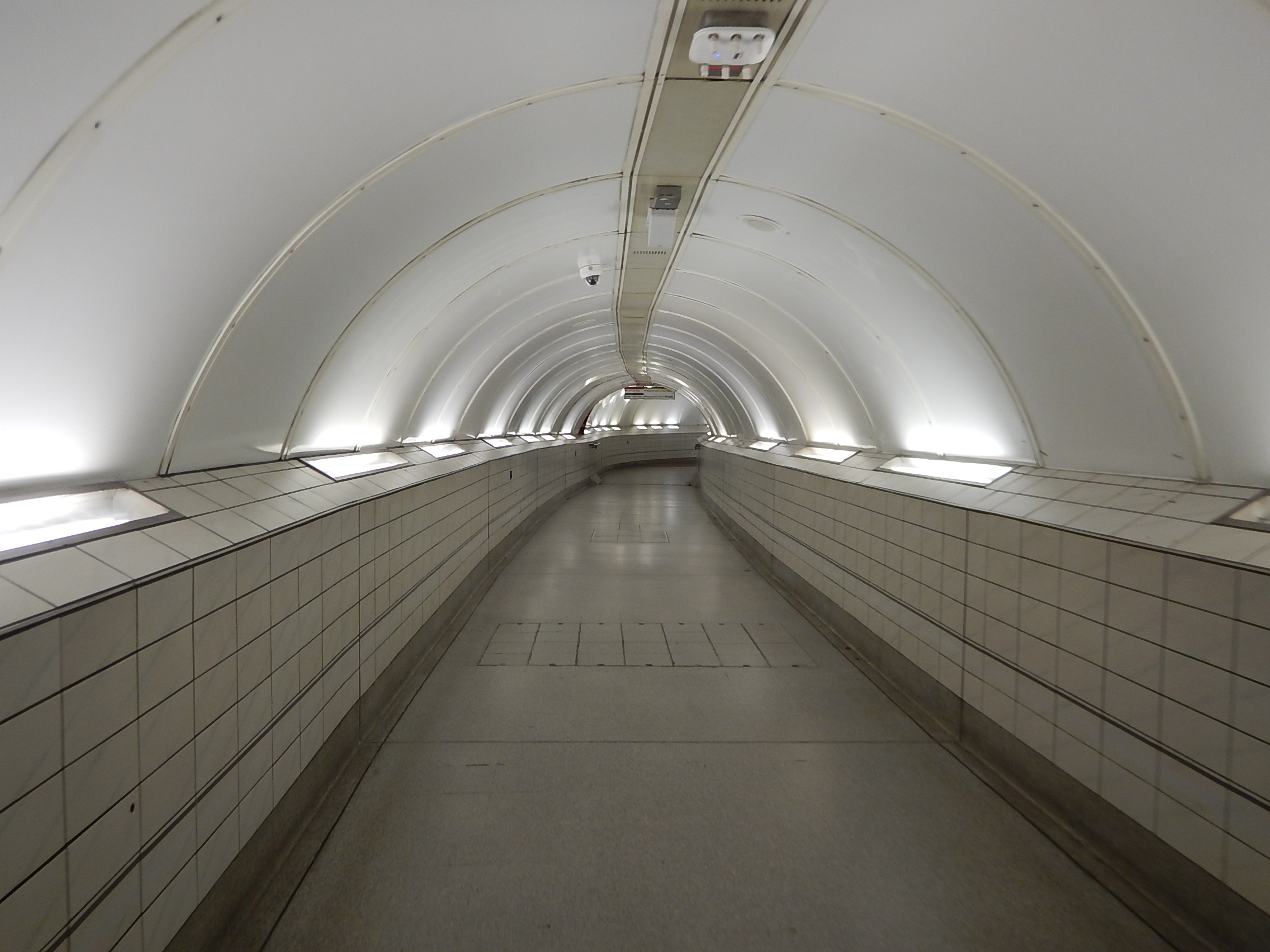
Some certainly need travelators and more escalators and lifts.
My particular least favourite station is Kings Cross St. Pancras, where I always go by bus and come home by taxi, as Underground to and from train, can be a real case of walking for miles.
It’s as if the station complex was designed by someone with a real sadistic streak.
I’m going to Chesterfield from St. Pancras on East Midlands Trains today and will get a bus to in front of the station and walk the length of the station to the platforms at the other end.
When Thameslink is fully open, everybody will be complaining about the lack of lift connections between Thameslink and the EMT platforms, which are on top of each other.
You can’t win with St. Pancras!
More Entrances And Exits At Stations
At Victoria and Shepherds Bush stations, new entrance/exits have been added, and the future Bank, Bond Street and Camden Town stations, will have multiple ways to get in and out.
In addition the massive Crossrail stations at Moorgate/Liverpool Street and Tottenham Court Road will be labyrinthine, with two or more entrances.
More Interchanges
This map from carto.metro.free.fr shows how the East London and Central Lines cross at Shoreditch High Street station.
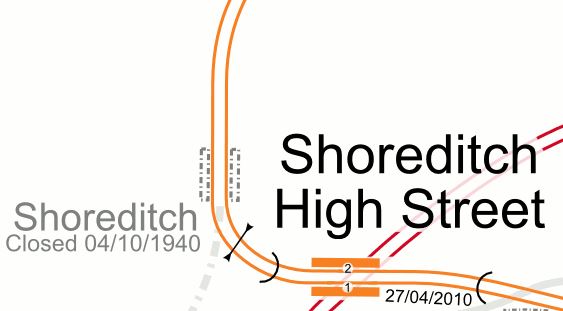
This would be my choice for an extra interchange, as it would mean that I would get easy access to the Central Line after three stations from Dalston Junction station, which is my nearest access to trains.
And What About Pricing?
Crossrail and Thameslink could be railways with an unusual usage profile. I believe that outside of the Peak, the central sections of these two routes could have a much more relaxed feel with the ability to handle lots of passengers in the Off Peak. They will also be like express motorways taking the pressure off lines like the Central, Jubilee, Northern and Piccadilly in the City Centre.
So will this spare capacity, change passengers habits and attract more leisure travellers into the City Centre?
Get the access right and make the City Centre, easy to access from everywhere, with all stations step-free and especially in the City Centre itself, and couple this with the new capacity, I believe that we can reduce the traffic in the City Centre, by encouraging drivers to leave their vehicles further out.
Pricing of tickets could be the smart weapon to encourage this use of Park-and-Ride.
London’s ticketing system, which is based increasing on contactless bank cards collects masses of data about passengers movements and thus Transport for London know all the busy routes and stations.
The system works by logging your various journeys throughout the day and then charging the card overnight, applying any daily, weekly or monthly caps.
Very radical ideas could be applied to the ticketing rules.
For example, anybody who has come into the City Centre from the suburbs can have as many Zone 1 journeys in the day as they want.
So a couple of typical Essex Girls might leave their expensive wheels at Chadwell Heath and just tap in and out all day, as they travelled between Bond Street, Eastfield, Knightsbridge, Marble Arch and Westfield.
How much economic activity would this sort of behaviour generate?
Secondary Effects
If London can persuade anybody coming into the Centre, that the place for a vehicle is not in the Centre, then there will be secondary effects.
- Air pollution levels will drop, especially if all taxis and commercial vehicles are zero-emission.
- Bus numbers can be reduced, if the Underground is more convenient and free for short journeys in the City Centre.
- If traffic in the centre drops, more and more journeys will be done on foot or a bicycle.
Would it also mean, that vehicles could be properly charged for coming into the Centre and checked.accordingly. Would this drop all forms of crime?
What About Other Cities?
Some towns and cities in the UK are developing city centre networks.
To be continued…
Heathrow Plan To Build Third Runway – On Stilts Over M25
This is the title of an article in the Business section of the Sunday Times.
Apparently, three viaducts would be built over the M25, with a wide one for the runway and two narrower ones for the taxi-ways.
Sounds fine by me!
I also feel that the technique of using stilts could be applied to build new housing and commercial properties over roads and railways.
Look at all that space over some city centre stations!
 The Anonymous Widower