Gidea Park Station – 15th May 2017
In Before Crossrail – Gidea Park, I said of Gidea Park station that The Bridge Is Falling Down and I gave it a reasonable score of 6/10
Today, I found that a lot of work had been done on the bridge.

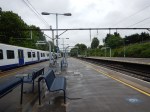

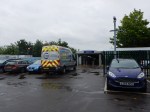
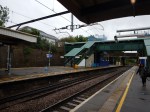
The bridge still needs to be finished, although it is more solid now, and some detailed work like information screens and signs need to be installed.
Manor Park Station – 15th May 2017
In Before Crossrail – Manor Park, I likened Manor Park station to A Ruin With Serious Issues and gave it a score of 1/10.
I also said.
Manor Park is very unusual architecturally. I do wonder if the Luftwaffe tried to demolish the station.
Perhaps the builders just ran out of money and couldn’t afford to put in windows.
With hindsight, I think I was being generous with one point.
But these are the pictures I took today.



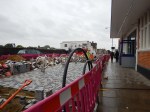
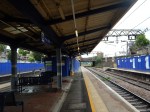

The builder is certainly not our friend Jerry.
When my train arrived, I stepped out close by the driver’s cab. I was surprised to see that half the old station had disappeared and it must have shown, as the driver asked me if I was OK!
I certainly was and it looks like the builders and the architects are well on the way to turning one of London’s worst stations, into one of the better.
- Judging by the position of the gate line on the South side of the Ticket Hall, it will lead to a series of passages to the stairs and the lifts to the platforms.
- I particularly liked the use of strips of LED lights to illuminate the Ticket Hall and the area outside the doors.
- The staff seem to have a good view of the front glass doors from the Ticket Counter.
- It looks to me that any bits of the old station that there were good reasons to keep, have been kept.
- It could be a very welcoming station, that I suspect Transport for London hopes will attract a lot of new passengers.
- I was told that the lifts are only a couple of months away.
Importantly with my Project Manager’s hard hat on, it would appear that they have managed to create much of the new station without too much disruption.
What A Fine Mess Thameslink And The Midland Main Line Is In
This article is prompted by an article in the May 2017 Edition of Modern Railways, which is entitled Crunch Time Nearing For MML Thameslink Timetable.
The author of the report; the respected Roger Ford, explains the problems of getting a timetable that is acceptable to a number of parties.
Govia Thameslink Railway (GTR) want to do the following.
- Run 20 trains per hour (tph) through the central core of Thameslink by May 2018.
- Run 24 trains per hour (tph) through the central core of Thameslink by December 2018.
- Run eight, four and four tph respectively to Bedford, Luton and St. Albans.
East Midlands Trains (EMT) and/or their successor, want to do the following.
- Run their current diesel services.
- EMT want to run new new electric services to Kettering and Corby.
- EMT want to run 6 tph at 125 mph into St. Pancras.
And both companies will have to satisfy the politicians.
Network Rail’s original plan is described under Political Developments in the Thameslink entry in Wikipedia. This is said.
Network Rail had planned to terminate Sutton Loop Thameslink trains at Blackfriars station, rather than have them continue through central London as at present. This would increase the capacity of the central core as the Sutton Loop could only accommodate shorter trains. This upset many residents in South London and their local politicians, who saw it as a reduction in services rather than an improvement. In response to pressure, government has ordered Network Rail to reverse the decision.
It is an awful lot of trains to squeeze into the Midland Main Line.
Some improvements were planned to help with the capacity North of Bedford.
- A fourth track between Bedford and Kettering/Corby.
- !25 mph electrification.
Both these should happen, but the electrification South of Bedford will only be 100 mph capable and there is no date for its upgrade.
So it looks like we have the classic pint pot and everybody is trying to put a quart in it.
Roger points out that the knock-on delays for a late train, could be horrendous and felt all over the North, with several minute increases in journey times to Sheffield and Nottingham.
Roger does highlight a couple of solutions.
Turning Thameslink Services At Kentish Town
The first Roger Ford outlines is to turn some services from the South at Kentish Town.
- ,There is stabling capacity.
- EMT might take over some of the fast outer-suburban commuter services.
- There is a good connection to the Northern Line, which will have an increased capacity in a couple of years.
Perhaps too, a connection could be made with the Gospel Oak to Barking Line at West Hampstead Thameslink and Tufnell Park to improve connectivity.
But would the politicians accept a solution like this?
Has Thameslink Got The Wrong Length Of Trains?
If you look at some recent train orders, they seem to suggest a train and a half-train philosophy.
- GWR’s order for Class 80x trains.
- VTEC’s order for Class 80x trains.
- Greater Anglia’s order for Aventras.
- SWT’s order for Class 707 trains.
In all these orders, it would appear that two half-trains are used to create a full train, when needed. This coupling and uncoupling is done throughout the day and often on an automatic basis.
But Thameslink’s Class 700 trains only come in lengths of eight and twelve cars.
The eight-car train is needed for short platforms on the Sutton Loop Line.
But eight-car trains have disadvantages compared to say a six-car train.
- two trains can’t be joined together to make a long train.
- An eight-car train uses one of the valuable twenty-four hourly paths through the central core of Thameslink, just as a twelve-car train does.
The train length is patently inefficient.
The Sutton Loop Line could be run by using six-car trains that split and join at Streatham station.
Splitting Regional Services With A Change Of Train
This diagram from the Wikipedia entry for East Midlands Trains shows the company’s routes.
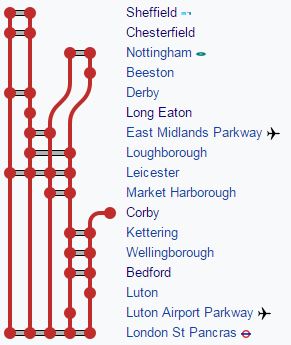
I can’t see that expecting passengers to change trains on a journey say between London and Sheffield would be welcomed by everyone.
Electrification To Leicester, Derby And Nottingham
This section is an aside, but I think that it could be the key to solving the capacity problem.
Electrification to these three cities, shouldn’t be a problem other than the usual one of Network Rail’s competence and it could be completed by 2023, which would include Sheffield.
However, there is a serious problem with electrification between Derby and Sheffield, in that the line goes through the World Heritage Site of the Derwent Valley Mills.
But there is an alternative plan, which is to electrify the Erewash Valley Line, which avoids the World Heritage Site and provides a more direct and possibly faster route between London and Sheffield.
Under Future in the Wikipedia entry for the Erewash Valley Line, this is said.
Network Rail as part of a £250 million investment in the regions railways has proposed improvements to the junctions at each end, resignalling throughout, and a new East Midlands Control Centre.[1]
As well as renewing the signalling, three junctions at Trowell, Ironville and Codnor Park will be redesigned and rebuilt. Since the existing Midland Main Line from Derby through the Derwent Valley has a number of tunnels and cuttings which are listed buildings and it is a World Heritage Area, it seems that the Erewash line is ripe for expansion. As the new signalling is rolled out, train detection is moving away from the traditional Track circuit detection of trains to Axle counting.
I hope all of the work done on the Erewash Valley Line has made sure that whenh they do electrify the line, the bridges are high enough and the signalling cables are well out of the way.
As the East Midlands Hub station for HS2 will be close to Toton TMD on the Erewash Valley Line and would open in 2032/3, it strikes me that it would be sensible to plan electrification of the Midland Main Line and HS2 together.
Bring On The Bi-Modes
Roger Ford dismisses the bi-modes in strong words.
A bi-mode doesn’t really work on the high-speed main line.
Under the wires it is a very heavy EMU, while under diesel power it is an underpowered DEMU. Just consider the roles on the MML. From London to Bedford it would need to run as a 125 mph diesel. From Bedford to Kettering the pantograph would go up for some 125 mph running. And after that it would go back to diesel. So why bother with the electric traction?
I would agree with that, but the Class 80x bi-modes may have other characteristics, that could get the timetable out of trouble.
The current hourly timetable out of St. Pancras is as follows.
- XX:00 – Corby, stopping at Luton, Bedford, Wellingborough and Kettering.
- XX:15 – Nottingham, stopping at Market Harborough, Leicester and East Midlands Parkway
- XX:26 – Sheffield, stopping at Leicester, Loughborough, East Midlands Parkway, Long Eaton, Derby, Chesterfield
- XX:29 – Nottingham, stopping at Luton Airport Parkway, Bedford, Wellingborough, Kettering, Market Harborough, Leicester, Loughborough, Beeston
- XX:58 – Sheffield, stopping at Leicester, Derby, Chesterfield
When Bedford to Corby is electrified, there will be another path.
Note that all the paths except those to Corby go through Leicester.
Currently the services are run by a mixture of 27 x Class 222 trains of 4, 5 and 7 cars and 12 x InterCity 125s of a 2×8 formation.
I said that the Class 80x trains may have other characteristics, that could get the timetable out of trouble.
One is that, two closely-related Class 395 trains can automatically couple and uncouple in under a minute, so I suspect that the Class 80x trains will have the same capability.
So supposing a pair of Class 80x trains ran from St. Pancras to either Bedford, Kettering or Leicester, where they would divide, with each train going to a separate destination.
This would mean that six paths would give twelve services to each of three destinations, Corby, Nottingham and Sheffield via Derby and Chesterfield.
EMT could balance the number of trains with their passenger statistics and could extend services from Corby, Nottingham and Sheffield, as they felt appropriate.
Modern trains would also be able to execute stops quicker than the current Class 222 trains and Inter\City125s.
So could extra stops be introduced South of Bedford to enable Thameslink services to be simplified and thinned out?
Conclusion
These may be consequences.
- Four tph might be able to call at Luton Airport Parkway and East Midlands Parkway.
- Sheffield and Nottingham might get marginally slower services, but they could get four tph.
- All EMT might stop at Bedford, to enable Thameslink services to Bedford to be reduced from 8 tph to 4 tph.
- Two tph between Sheffield and London might use the Erewash Valley Line and stop at Alfreton and Ilkeston.
There’s an optimal solution in there somewhere.
Reverse Commuting To Cambridge North Station
Cambridge North station opens on the 21st May 2017.
Around 1070, I commuted from London to Welwyn Garden City. It was much more relaxing than sharing the busy trains into London and on early trips to Cambridge in the last few years, I’ve noticed that quite a few people commute from London to Cambridge.
So given the proximity of the new Cambridge North station to the Cambridge Science Park, I wonder how many will use the service to get to and from their place of work?
The Service On Sunday, 21st May 2017
Trains would appear to be every hour at XX:42 taking about ten minutes under two hours.
The Service On Monday, 22nd May 2017
The weekday service would appear to be more comprehensive.
- 06:08 KX 1:02
- 06:44 KX 0:53
- 06:52 KX 1.14
- 07:04 KX 1:32
- 07:28 LS 1:32
- 08:04 KX 1:29
- 08:14 KX 1:00
- 08:28 LS 1:33
Note that KX is Kings Cross and LS is Liverpool Street.
All the trains shown arrive before 10:00 or a few minutes after.
Given that Thameslink will improve this service in May 2018, by adding another two trains per hour, it is certainly a good start.
MTR Plans More Intensive Crossrail Service
The title of this post is the same as an article in the International Railway Journal.
The Planned Central Service
According to Wikipedia, it is planned that the services through the central section is as follows.
Peak
4 tph (trains per hour) Abbey Wood–Heathrow Terminal 4
6 tph Abbey Wood–Paddington
2 tph Abbey Wood–West Drayton
8 tph Shenfield–Paddington
2 tph Shenfield–Reading
2 tph Shenfield–Maidenhead
Off Peak
4 tph Abbey Wood–Heathrow Terminal 4
4 tph Abbey Wood–Paddington
4 tph Shenfield–Paddington
2 tph Shenfield–Reading
2 tph Shenfield–Maidenhead
Which gives totals of 24 tph in the Peak and 16 tph in the Off Peak.
The article suggests that more Off Peak services will be provided.
This is probably only following the rules of the Victoria Line, which runs at a frequency of around 30 tph most of the day and 6 tph at night.
A Train Every Two And A Half Minutes
One of Crossrail’s nine-car Class 345 trains will come through the central section, every two and a half minutes, linking the following stations between Paddington and Stratford stations.
- Bond Street
- Tottengham Court Road
- Farringdon
- Moorgate
- Liverpool Street
- Whitechapel
I think that the frequency of the trains and the design of the stations, will encourage walkers and short distance travellers to use the line.
So could we see a very different pattern of use on Crossrail, when compared to the existing Central Line.
Other factors will make predicting traffic difficult.
- The line runs along one of Europe’s busiest shopping streets.
- The line and connects to Heathrow,
- Many journeys across London will now be made without changing trains.
Being able to increase train frequency would;d be a useful contingency to avoid train overcrowding.
So it looks like MTR are being prudent.
How Times Change
Several hundred years ago, those living in the North of England, would have waited with fear and trepidation at the thought of invasion from those living across the Border.
But not anymore!
According to this article in the Cumbria Crack, which is entitled Settle-Carlisle groups welcome Scottish rail study.
This is said.
Putting this into historical context, Mark Rand, Joint Vice Chairman of the 3500-member Friends of the Settle-Carlisle Line said: “People often ask why did the Victorians build a railway line from tiny Settle to the border city of Carlisle. It was part of a much greater whole – the Midland Railway’s main route from London St Pancras to Scotland via Leeds and Carlisle, from where what is today called the Borders Railway continued to Edinburgh. What opportunities the full Edinburgh-Carlisle re-opening would enable! The Friends of the Settle-Carlisle Line welcomes this study with open arms.”
Further, the full re-opening would give a railway offering world-class scenery for much of the 211 miles from Leeds to Edinburgh, attracting huge numbers of international tourists, as happens in countries such as Norway and Switzerland, an industry so vital to the UK economy.
Unlike many railway projects, this project only needs the railway to be built, as the trains that would be ideal for Leeds to Edinburgh via Caelisle, were built forty years ago.
What better route would there be to serve with refurbished examples of Terry Miller‘s masterpiece, the InterCity 125?
Hybrid Trains In The Former East Germany
In my travels from Göttingen, most of the local trains were diesel multiple units as local lines like the South Harz Railway are not electrified. On the other hand, the main lines through Göttingen, are all electrified.
In September 2016, I wrote German Trains With Batteries, which indicated a project in Germany to create hybrid trans, based at technical universities in Chemnitz and Dresden.
As some of the journeys I took in diesel trains, were under electrification, it would certainly appear that the German’s approach is sensible.
There would also appear to be lots of lines without electrification and diesel passenger services all over the area.
- Annaberg-Buchholz–Flöha Railway
- Bautzen–Bad Schandau Railway
- Chemnitz–Adorf Railway
- Flöha Valley Railway
- Gera Süd–Weischlitz Railway
- Glauchau–Wurzen Railway
- Heidenau–Kurort Altenberg Railway
- Herlasgrün–Oelsnitz Railway
- Karlovy Vary–Johanngeorgenstadt Railway
- Löbau–Zittau Railway
- Mid-Germany Railway
- Vejprty–Annaberg-Buchholz Railway
- Zwickau–Schwarzenberg Railway
If the universities can come up with an economic and practical solution, there are certainly a lot of places to use these hybrid trains.
I think it is interesting to compare the German approach with that of Porterbrook/Northern with their development of the Class 319 Flex train.
- The Germans are starting with a diesel Desiro Classic, whereas the British are starting with an electric Class 319 train.
- Batteries are an important part of the German solution, but may not be part of the British one.
- The German trains are nowhere near as old as the thirty-years-old British ones.
But the objectives of the two projects are to improve passenger services without doing a lot of expensive electrification.
Level Crossings And Signal Boxes
As I travel around Germany on trains, I am surprised at the number of level crossings and signal boxes.
Level Crossings
On the South Harz Line, there must have been half a dozen between Northeim and Nordhausen.
I don’t know if the Germans have a similar policy to Network Rail of aiming to remove all crossings, but if they do, they have a lot to do.
But the area did suffer the serious Langenweddingen Level Crossing Disaster in 1967.
Signal Boxes
Every station seemed to have a signal box.
Although, I did find this in the Wikipedia entry for the South Harz Railway.
Signalling on the South Harz line will in future use electronic interlockings that are remotely controlled from a centre in Göttingen.
So it does seem there is a certain amount of ongoing modernisation.
Conclusions
I’m very much of the opinion, that there is still a lot of technical modernisation to be done on German railways.
Wernigerode Station
Wernigerode station is the Northern terminus and main depot of the Harz Narrow Gauge Railways.
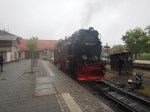
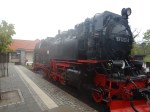

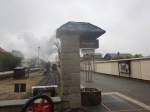
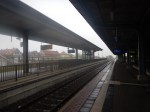
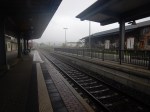



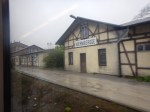
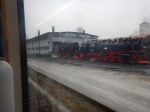
It has an interchange with the Deutsche Bahn, that runs between Goslar and Magdeburg.
This Google Map shows the layout of the station.

It appears to me that the station has a common layout for this part of Germany, where there is a loop that serves the platform closest to the station building.
Trains on Deutsche Bahn seem to be about every hour and although the local diesel services seem to link together fairly well, the information isn’t as good as it might be.
I certainly think that if the weather had been better, it would have been a more interesting town to visit.
Drei Annen Hohne Station
Drei Annen Hohne station is a junction station on the Harz Narrow Gauge Railways.
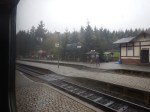
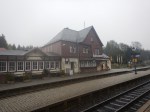
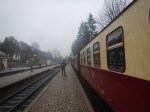
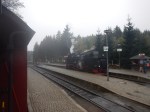

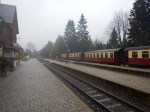
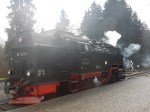
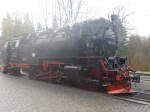
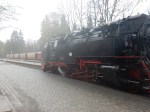
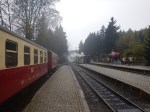
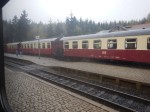
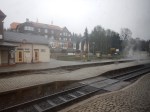
We stopped on our way to Wernigerode to change locomotives, so that our locomotive could be replenished with water.
 The Anonymous Widower