Nottingham to Newmarket
This is one of those journeys that works, but because od the limited services in East Anglia, it takes a lot longer than it should. I got a direct train to Ely, but then it was another train to Cambridge and then another to Newmarket. But everything was on time and I met the booked taxi, which got me home about four hours after I left Nottingham.
At least though the train wasn’t very crowded after Grantham and I just sat there reading.
I did have to wait for perhaps twenty minutes at Ely and forty at Cambridge but it wasn’t cold and I had an excellent cappuccino from AMT at Cambridge.
So how could this jouney have been better?
East Anglia to the Midlands and the North needs more and bigger trains. At present we have Stansted/Cambridge-Birmingham (hourly) and Liverpool/Manchester-Norwich (3-hourly) , all of which pass through Ely and Peterborough. In addition, there is an hourly service from Ipswich to Peterborough. But even so, it is just not enough!
The trains that connect to these long distance services are not big enough either. At least today, I got a two-coach, Class 156, to and from Cambridge, but sometimes it is just a decrepit single coach, Class 153.
I ope this all gets sorted out in the next few years. But whatever happens, we need some bigger and better trains. But then as long as I can remember, East Anglia has always had evrybody else’s hand-me-downs.
Dullingham to Nottingham
I actually left fromy my local station at Dullingham, rather than my return destination of Newmarket as it was easier to get to at 9:15 in the morning. The cost of the return ticket is the same at £27.65 from both stations, so ticketing was not a problem.
To get to Nottingham was a double change at both Cambridge and Leicester. This is one of the problems about getting trains from East Anglia to the rest of the country. Nothing is ever straightforward unless you drive to either Ely or Peterborough first and I can’t drive at present.
The second problem is that the East Anglia to Midlands and North trains are just too small. The train was very crowded all the way to Leicester from Cambridge, but luckily I had a seat by the window. After Leicester I was in one of the larger Meridean expresses to Nottingham.
Everything otherwise was fine and I arrived in Nottingham just a few minutes over three hours after I’d started my journey, which was as should have been expected.
The only problem I had, was that the station information at Leicester wasn’t up to the standard I usually find and I could have missed my connection, if I hadn’t guessed right. It probably wouldn’t have been serious, as there are quite a few trains between Leicester and Nottingham. But what if I’d been going the other way, where missing the connection would mean a sizeable wait.
I’d never been to Leicester on a train before today, which is surprising, as in the past I’ve used trains to quite a few cities in the Midlands. I sometimes wonder if I’ve got a thing about the city, as it was one of the last trips C did by train for her business. She had just finished the radiotherapy for her breast cancer and had gone there by train and she then took a train to London to see a friend sworn in as a judge. Except for the odd trip to London, I don’t think she ever went on a train again. I also remember that I’d been to see Ipswich lose at Leicester. the day before she told me, that she had breast cancer. So perhaps it is a town for me to avoid! Although they do have a Carluccio’s there now, so at least the food will be good.
An Exhilirating Ride
The full video of my cab trip from Edinburgh to Inverness is just too long, so here’s a shortened version of just a few minutes as the HST runs northwards from Perth at 90 mph, through the trees.
I’ve also selected this section, as it shows how the journey brings the conversation out of the two drivers in the cab.
Are There Fewer Container Trucks on the A14?
Today was the first time, I’d been along the A14 during the day and especially on a Saturday for some months. I may have been in a bus, but I couldn’t help thinking that there were very few container trucks on the road. It could either be the recession or perhaps more and more are going by rail to and from the Midlands and the North. After all the latteris what the work in Boxing Clever is all about. When I returned, between Bury St. Edmunds and Newmarket, we only saw three in pehaps twenty minutes!
Jointed Track in the Highlands
As the train journeyed from Inverness to Kyle of Lochalsh, I noticed a sound that I hadn’t heard for years; the clickety-clack of traditional jointed rail, as opposed to the much-more-normal continuously welded rail, which is virtually standard in the UK. It’s generally considered to be safer too!
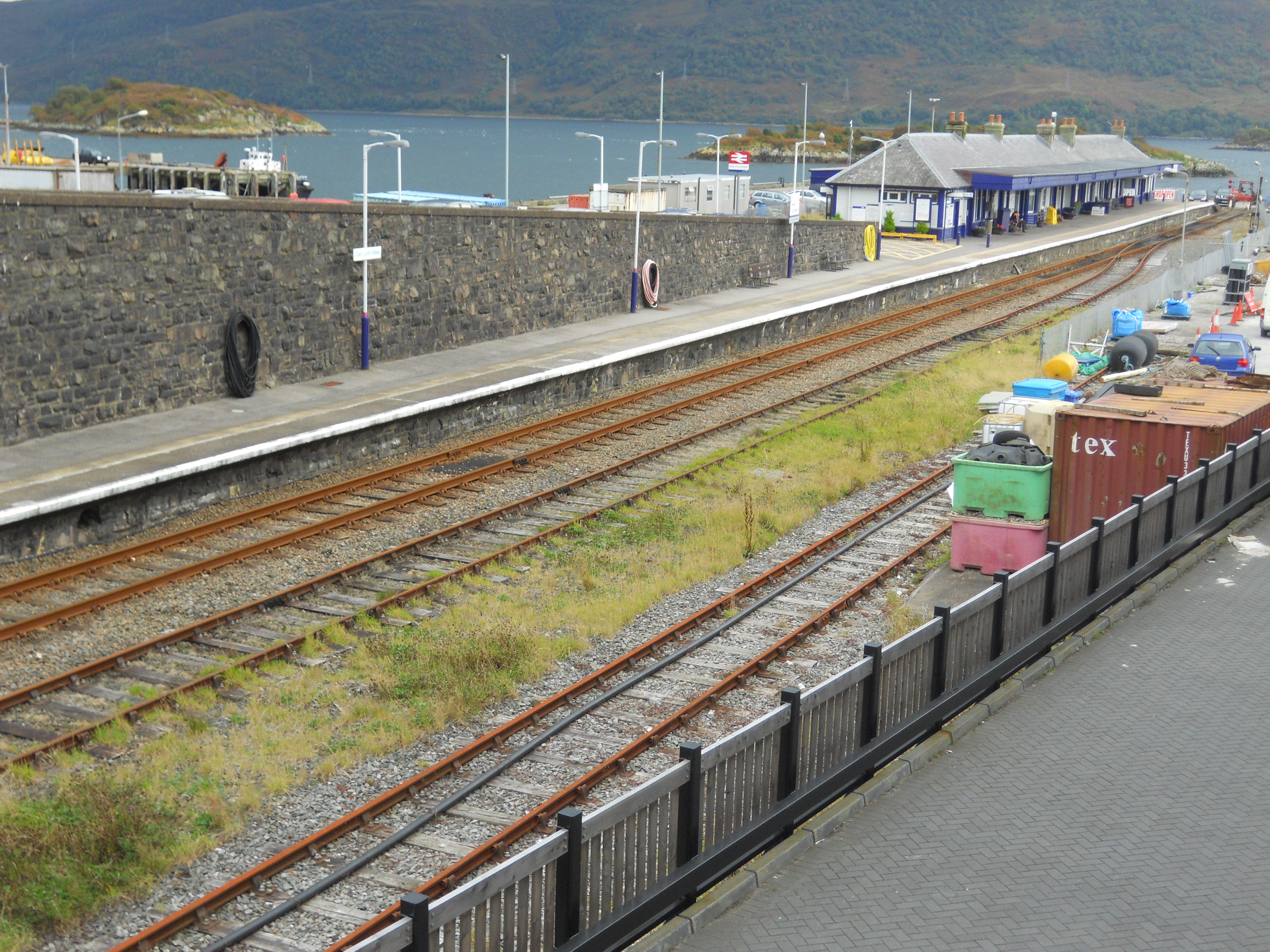
Traditional Jointed Rail at Kyle of Lochalsh
This photograph confirmed the rails.
I suspect that it could be that the cost of continuously welded rail isn’t justified on such a branch or it just might be some other reason of accessibility or distance.
But it was nice to here the sound again on a main line train.
A Train for the Highlands
We have a rolling stock crisis in the UK, with not enough of the right kinds of trains. One manifestation is that we’re still using obsolete Pacers, as I found on my way to Scunthorpe.
Between Inverness and Kyle of Lochlash and between Mallaig and Fort William, the trains were not in bad condition, but they were too small and overcrowded, as I suspect they are on many branch lines and especially those to places worth a visit, like say Great Yarmouth.
Alan Williams in his column in Modern Railways, says that there are surplus diesel locomtives in good condition and quite a few rakes of Mk. 3 coaches. He advocates using these to replace the Pacers. I wouldn’t, but would use them to replace the trains I rode in Scotland and other scenic and other lines to release fairly modern units to kill off the Pacers.
If you take the Scottish Highland routes, they could be developed into a tourist attraction in their own right. How about?
- Wi-fi evetywhere.
- Perhaps a Dining/Buffet Car in Summer. Aren’t there some Mk 3 ones about?
- At seat trolley service.
- Low density seating.
- Wide windows for the view. What would Health and Safety say?
- Bicycle racks
Reflections on My Journey to Scotland
In my Modern Railways for October, which I bought in Doncaster, there was an heretic article by Chris Stokes, asking if we really needed HS2 or the High Speed Line to the North, which would go to just Birmingham at first. He described it as a vanity project.
Twelve months ago, I was a sceptic on whether we needed a High Speed Line to the North, mainly because I didn’t think it would do anything for anybody in East Anglia where I lived. If I needed to get to the North, I wanted a fast line from somewhere I could drive to easily like Peterborough.
But when it was announced that the route would be to Birmingham in the last days of the disastrous NuLabor experiment, I warmed to it a bit, although I did think it needed to go via Heathrow. I also thought very much that it was a Nimby’s charter.
But Chris’s article has now turned me back to very much a sceptic. Competition being what it is, his argument, that unless you virtually close down the West Coast and Chiltern Birmingham services, no-one will pay a premium to go from London to the Midland’s premier city. My son incidentally always goes by Virgin and has never thought about using Chiltern, as Euston is on the same Underground Line as where he lives.
Chris also argues, that the amount of First Class traffic will decrease due to austerity, good housekeeping and modern technology removing the need to travel. Some years ago, I installed a Management Information System in a company, which was web-friendly and even allowed the computer-phobic CEO to find out how the company was doing from any computer in the world. But also, the modern traveller will become First Class smart and book it when and where they need it. So if you think there is a premium market that saves a few minutes, forget it!
Put simply, a lawyer say going to Birmingham from London for the day, will choose his route and class dependent on what is best for his needs. Hopefully, when I move to London, it will be in walking distance of Canonbury. Who’s to say that in 2015, someone isn’t running an express to say Milton Keynes, Coventry and Birmingham from Stratford and East London on the North London Line and possibly the Primrose Hill Tunnel?
So what will happen to lines to the North, if we don’t build HS2 on schedule? We’ll get the usual whining, we always get when the investment is cut, but let’s look at the reality of what will happen!
We now have two good and pretty reliable and fast train lines from London to the North of England and Scotland. I was told on my trip to to Inverness that it should be possible to be some minutes under four hours from Edinburgh to London. This compares with a fastest journey now of about four hours twenty minutes, although Operation Peppercorn is aiming for the magic four hours flat for the fastest trains with a stop at Newcastle. Glasgow to London by comparison is now about four hours and twenty minutes. Many of my Scottish friends say this is fast enough to mean they won’t bother to fly to London, as airport checks and delays are getting worse and they can use phones and laptops on the trains.
If there is a problem with the two stiles of a possible ladder reaching up the United Kingdom, is that some of the interfaces to other lines are poor. But the basics and some of the rungs of the ladder are already in place.
There are a succession of large stations on both lines, such as Peterborough, Crewe, Doncaster, York and Newcastle, which can be developed into easy change stations to other places. As I said earlier, Doncaster isn’t bad and I think Peterborough is going to be developed and hopefully linked to the nearby shopping centre, but a lot of work needs to be done.
As I rode out of Edinburgh towards Inverness, I was impressed to see that electrification has started to link Edinburgh and Glasgow. As it is trains now run every fifteen minutes and most take just fifty to link Scotland’s two capitals. I suspect that this will become a very important link between the two fast lines, not only because of level cross-platform interchange from the South to local trains, but also because full electrification would allow fast direct trains from Glasgow to York and Edinburgh to Liverpool. Taking the first journey, my road atlas estimates that at four hours ten minutes, which compares with about four hours by train now with two changes and two different companies. I estimate that something like a Pendelino could do this journey direct with perhaps just a stop at Newcastle in about three hours fofty-five minutes. Who would back against, Peppercorn 2, squeezing more minutes out of the East Coast Line.
A similar situation could exist between Newcastle, York and Doncaster in the East and Manchester, Liverpool and Preston in the West, by expanding and electrifying the TransPennine network. Edinburgh to Sheffield is a journey that uses either a direct diesel service or a change to TranPennine at Newcastle. If TransPennine was a level change at Newcastle from one fast electric to another, there would be a much better service.
London too has a strong link across, although as I said Euston is not a welcoming station, but when you’ve got three world-class stations in Kings Cross, St. Pancras and Euston, as you will have, an innovative transport solution along Euston Road could surely be achieved. For a start let’s have a proper walking route a hundred metres or so north of Euston Road, with cafes and shops. But I’m certain that people should be encouraged to take the Metropolitan Line rather than the Victoria or Northern. Perhaps we need a moving walkway! Euston is supposed to be being developed and also be a terminal for HS2. If the latter does happen, there will be a lot of grief and opposition in that area of London. That development, whether it incorporates HS2 or not, will divert rail passengers to other routes, such as Chiltern for Birmingham and East Coast for Scotland.
There is also another link that might be brought into use, especially if Euston has to be partially closed to traffic, whilst it is rebuilt. That is the link to Manchester out of St. Pancras, which was used reasonably successfully as Operation Rio during the West Coast Main Line upgrade. I’ve always argued that this should have stayed in place, as it interfaces well with the A14 at Wellingborough for those going from East Anglia to the North Midlands,Sheffield and ultimately Manchester.
So what’s missing?
As I found going to Scunthorpe, it’s not what’s missing in this case, but what’s still here; Pacers. All of these links to the two stiles of the ladder must be upgraded to the standard of the diesel trains, I used in Scotland. And where possible, they should link easily to the fast services. I think that this will happen, but in some ways it depends on a strong electrification program to release suitable diesel units.
The real problem though is the lack of a full East-West route between say Peterborough and Birmingham or perhaps Milton Keynes and Stevenage or Cambridge. The Peterborough to Nuneaton route is being upgraded for frieght and passenger trains between the two towns take seventy-five minutes. So it would look like that route could be another rung in the ladder. The other route is the possible Oxford-Cambridge Line, which could be built, if funds were made avaialable.
I believe strongly that the two route ladder offers advantages over just building a speculative line from South to North, which would cost several times the amount needed to build the two route ladder.
For example, as electrification progresses, subsidiary lines like Birmingham to Bristol could be further improved, so that more and more people had less than two hour access to the main network. More rungs could be opened up, by any company that feel there was a niche to be filled.
So should HS2 be built? I think that one day it might be built, so we must safeguard the route, so that at some future date it could be added as another part of the network.
If Beeching made one big mistake it was not in making sure that abandoned rail lines were able to be rebuilt. How many lines hastily abandoned in the 1960s are needed now? But perhaps it would mean knocking down a hundred or so houses and a Tesco’s!
Trains Uncoupling and Coupling at Cambridge
Unusually, my connection out of Cambridge to Newmarket was late, so I had to wait about ten minutes before I moved on.
Whilst I waited, my train from King’s Cross split into two, with the first part going on to Kings Lynn and the remainder waiting patiently at the platform in Cambridge. A couple of minutes later an incoming train from Kings Lynn attached itself to the coaches in the station. Everything was quick and easy, just as it had been, when I’d seen trains do similar things at Crewe.
To some this might seem pointless, as why don’t the longer trains run all the way, but I suspect the procedures get the appropriate number of seats in trains. Surely, if it is done as professionally as I have seen, then it is a way of getting the capacity right and saving fuel to everybody’s advantage.

