Musings On Freight And The New Thames Tunnel On The Goblin Extension
It may seem strange that freight has such a large affect on the Gospel Oak and Barking Line, which is essentially a passenger railway across North London.
But at the Barking end of the line there could be very good connections to London Gateway and the other end has good connections to the main routes to the north. So a container unloaded at the port, which is destined for say the large distribution centre at Daventry, could go on a train up the Goblin to the West Coast Main Line. Other large distribution centres are planned or being constructed, like the one at Radlett, so we will see more trains from the London Gateway taking this route as the port gets larger.
In a few years time, the line will be carrying a lot of freight trains, many of which will be hauled through at night. At least the line is being electrified, so the noisy thuds of the dreadful Class 66 locomotives will hopefully be replaced by smooth electric power.
If a new Thames Tunnel is built between Barking and Thamesmead, this will be a game changer, if it is a tunnel that is capable of taking the biggest freight trains. It should probably be built to the loading gauge of the Channel Tunnel, so allowing any train capable of using the Channel Tunnel to be able to use the new link.
London Gateway is one of the few ports capable of handling the new breed of ultra large container ships. Obviously, this will generate more freight train traffic for the UK out of London Gateway, but will some of these containers be destined for Europe? At present there is a route to get them onto HS1 for the Channel Tunnel, but a new Thames Tunnel might give opportunities for these trains to go along the North Bank of the Thames and then through the tunnel to pick up the North Kent Line for HS1. The advantage is that it avoids sending trains through the crowded North London rail system. Obviously freight going from Europe to London Gateway for onward shipping, could be routed in the reverse direction.
Increasingly, over the last few years there has been a significant stirring of the practice of sending freight trains through the Channel Tunnel. Car components and perishable fruit, are just two of the cargoes seeing an increase.
We will see a large increase in future with exports such as complete cars going both ways on special trains. Although, it’s a common site in Europe, large trains of new vehicles are rarely seen here.
All of these flows will probably be best routed through the new Thames Tunnel and over the upgraded Goblin.
We shouldn’t forget that the main reason for a rail tunnel between Barking Riverside to Thamesmead is to vitalise the housing developments in the east of London, as I outlined in A Divided City.
But could the Goblin Extension be used for extra passenger trains given that it would link HS2 at Old Oak Common to HS1 at Ebbsfleet via the North Kent Line.
During the day there probably aren’t enough paths for an intensive service from the North via HS2 to link with HS1. And anyway, is the demand there for direct trains between say Paris and Manchester or Cologne and Leeds?
But it would allow overnight sleeper services, which might be a better proposition.
On the other hand to run a regular service from Old Oak Common to Ebbsfleet might be worthwhile, especially if it stopped regularly in between, at say Abbey Wood, Barking, Walthamstow and West Hampstead.
The Fifteen Billion Pound Railway
I’ve just watched the latest episode of the BBC documentary on Crossrail call the Fifteen Billion Pound Railway.
Part of this episode told a history of tunneling through the last fifty years, through old film and the eyes of one of the tunnellers, who’s been digging for fifty years, starting with manual methods on the Victoria line.
It is fascinating to see how techniques have improved even over the last couple of decades.
Just as with North Sea Oil exploration, where projects got easier, as cranes got bigger, it looks like tunnelling will get easier, as tunnel boring machines get bigger, more powerful and better designed.
So when they build Crossrail 2 will it be a quick and more financially efficient project? Having spoken to some of the planners of the project on Friday at Dalston Library, I suspect it will be. Especially, as they are cutting out one of the Hackney stations to save a billion and moving one terminus from Alexandra Park to New Southgate stations.
The lessons learned on Crossrail will also effect HS2, where I suspect we’l see even more tunnels, in the final design.
Is Molley The Runt Of The Litter?
I don’t know what the collective noun is for tunnel boring machines. But if it is litter, then surely Molley is the runt. According to this article in Construction Index she is the smallest machine used in the construction of Crossrail.
TBM Molley will build a new Thames Water sewer in west London. She is just 1.45m in diameter and 3.3m long. The main TBMs digging the train tunnels, by contrast, are 7.1m diameter and 150m long. Molley is too small to carry workers on board so is controlled remotely from the surface.
Molley is being used to build a new sewer, as the current one will be in the way of construction works for the tracks.
Why Wasn’t The Picc-Vic Tunnel Built?
The Picc-Vicc Tunnel, which would have been a rail bypass under Manchester. Having experienced the tunnel under Liverpool,earlier in the day, I was wondering, why a similar tunnel hadn’t been built in Manchester.
On the way back from Huddersfield to Manchester, I was discussing with several Huddersfield fans, how the Northern Hub would affect their journeys. All seemed to be welcoming the upgrade, so I asked why the Picc-Vicc tunnel wasn’t built.
One guy, said that he’d been to a lecture at the local historical society. He said that British Rail and the government were planning three tunnels in the 1970s; Liverpool, Manchester and the Tyneside Metro.
So because of cost, one had to be dropped, and Manchester was chosen.
As we’re getting much better with tunnels every year, I wouldn’t say that the Picc-Vicc tunnel is dead. Crossrail was on the back-burner for so long, no-one ever thought it would happen!
Could we for instance see a tunnel under part of Manchester for HS2?
The Cost Of Tunnelling
I, like probably many others, have often thought that parts of city infrastructure can be improved by the odd strategic pedestrian tunnel or perhaps an inclined one for some escalators. Underground stations, like Oxford Circus and Highbury and Islington are stations, that could probably be improved in this way.
But an interesting insight into the cost of these connections is given in this article in Construction Enquirer about the contract for a pedestrian tunnel to connect Crossrail to the Bakerloo line at Paddington station. Here’s the start of the article.
London Underground has shortlisted three bid teams for a £55m underground tunnel link at Paddington Station.
The 100m long passenger tunnel will link the new Crossrail station to the London Underground Bakerloo Line station at Paddington.
So this hundred metre tunnel is not cheap.
Will We Get HSW Before HS2?
In this post about the BBC’s knocking of HS2, I jokingly referred to the Great Western Main Line as HSW, for High Speed West or High Speed Wales.
But is it that far from the truth?
A high speed railway is defined as one where speeds of 200 kph or 125 mph are possible. The fastest lines run at 320 kph or 200 mph.
So what speed can we expect to see on the Great Western Main Line, after it is fully modernised in 2017?
Currently the fastest trains in the UK are the Class 373 ( 300 kph) used by Eurostar, the Class 390 ( 225 kph) used by Virgin and the InterCity 225 (225 kph) used by East Coast. The latter two trains are restricted to 200 kph, due to signalling restrictions on their lines and because they have to mix it with slower trains.
It is also interesting to note that the Class 395, which bring the high speed Kent commuter services into St. Pancras run at 225 kph.
The new trains for the electrified Great Western Main Line are based on the Class 395 and are called Class 800 and Class 801. These have a design speed of 225 kph, but will be limited to 200 kph on traditional lines.
But Brunel built the Great Western for speed and a lot of the route it is pretty straight and much has four tracks. It is also going to be resignalled to the highest European standards with in-cab signalling. The latter is necessary to go above 200 kph. So it shouldn’t be one of the most difficult tasks to make much of the line capable of 225 kph or even more.
The only real problem on the line is the Severn Tunnel. But as Crossrail has shown, we have some of the best tunnel engineers in the world. So just as the Swiss dealt with their railway bottleneck of the Simplon Tunnel, all we need to do to improve the Severn Tunnel is give the best engineers their head and let them solve the problems, whilst the politicians sit around and watch and wait. After all it’s only a baby compared to the massive twin bores of the Simplon.
As an aside here, I do wonder if one of the most affordable solutions might be to use a modern tunnel boring machine to create a new tunnel alongside the current one.
Conclusion
So I believe that even if it still goes slower on opening, trains to Bristol and Wales will be doing 225 kph before the end of this decade.
If that isn’t a high speed railway like HS1, I don’t know what is?
But whatever we call it, it’ll be here several years before HS2!
I think we need to call for three cheers for Brunel, who got the route right in the first place.
Pudding Mill Lane Station – 17th July 2013
From Stratford I moved on to the area around Pudding Mill Lane station to see progress on both the new station and Crossrail.
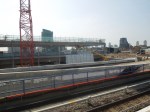
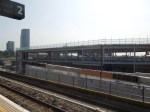
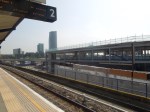

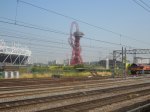


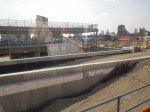



The pictures show that things are moving on quite well.
Note.
1. According to this entry in Wikipedia, the new station should be finished in 2013.
2. The current station will have to be demolished to allow work to proceed on Crossrail.
3. There is no sign of the tunnelling machines at Pudding Mill Lane, which will drive from there to Stepney Green.
Miliband Gets The Digger Out
In East London, there is TUCA, which I call London’s University of Hole Digging.
Judging my Ed Miliband’s pronouncement in the last few minutes on his party’s relationship with the Trade Unions, he has certainly done the first part of the course at that University.
Unfortunately, he doesn’t seem to have done part two, where you learn how to get out of hole, you’ve just dug!
How To Make A Big Hole In Solid Concrete
This video will be one of the most watched news stories tonight around the world and the Independent seems to have got there first.
The BBC are also running it this lunchtime in the local news.
Do We Need Another Thames Crossing?
There have been plans released today about building another crossing of the Thames close to or downstream of the current Dartford Crossing. It’s all here on the BBC.
It will be of no use to me, as I think, I’ve only been over the current crossing, once since I moved here and that was because I was getting a lift home from Ipswich by a friend who lives in Kent.
Even my friend going home to the Netherlands on Friday, crossed under the Thames in the Blackwall Tunnel.
It could be one of those questions, where now, we might actually need the new crossing, but in say a couple of years, we might not.
London Gateway will be operational by then and will this cut down the number of truck movements around the M25?
Hopefully, there will be more trains from St. Pancras into Europe to new destinations like Amsterdam, Cologne and Geneva.
Will too, passengers for Gatwick be less likely to use a car to get there, when Thameslink is fully operational?
And who’s going to predict the effect of Crossrail?
It is a very complex problem and perhaps spending £5billion on a new bridge, might have better effect, if it was spent elsewhere?
 The Anonymous Widower