The Minotaur Lives
Imagine my surprise, when a parcel appeared on my doorstep carried by a man who looked like he was doing an impression of Pete Henry, except that he was a few years older than my last recollection.
In the parcel, was about a hundred copies of the infamous Metier Minotaur. This was the edition that had the tall Pete’s picture where he was trying to get into a compromising position with the diminutive Karen, in what looked like the dining room of my old house at Debach with the infamous wallpaper. It was also probably the laste edition as it had Metier’s obituary. On the last page it asked if the hamster really did it.
Pete told me that he had had a vision from God and this had sent him to a dark, satanic print works in Clerkenwell, where in exchange for a fistfull of used notes, he had received these magazines from an atttractive young lady.
So what am I to do with this manna from heaven?
My son died of pancreatic cancer, so these priceless works of great literature will be sold with all proceeds going towards research into the cancer at Liverpool University, where a world-class team has been assembled.
I am not restricting the sales, as the excellent printer, has informed me that if need be he can print enough copies to completely cover every window of the gherkin.
Halfway to the Emirates
This road is halfway between my house and the Emirates.

Ramsey Walk, Islington
Perhaps Ipswich fans, should all go and pay homage on Tuesday.
The Improved Staircase
I’ve now replaced a lot of the bolts with brass ones and I think it looks a lot better. But then I’m biased.
Here’s what it looked like.
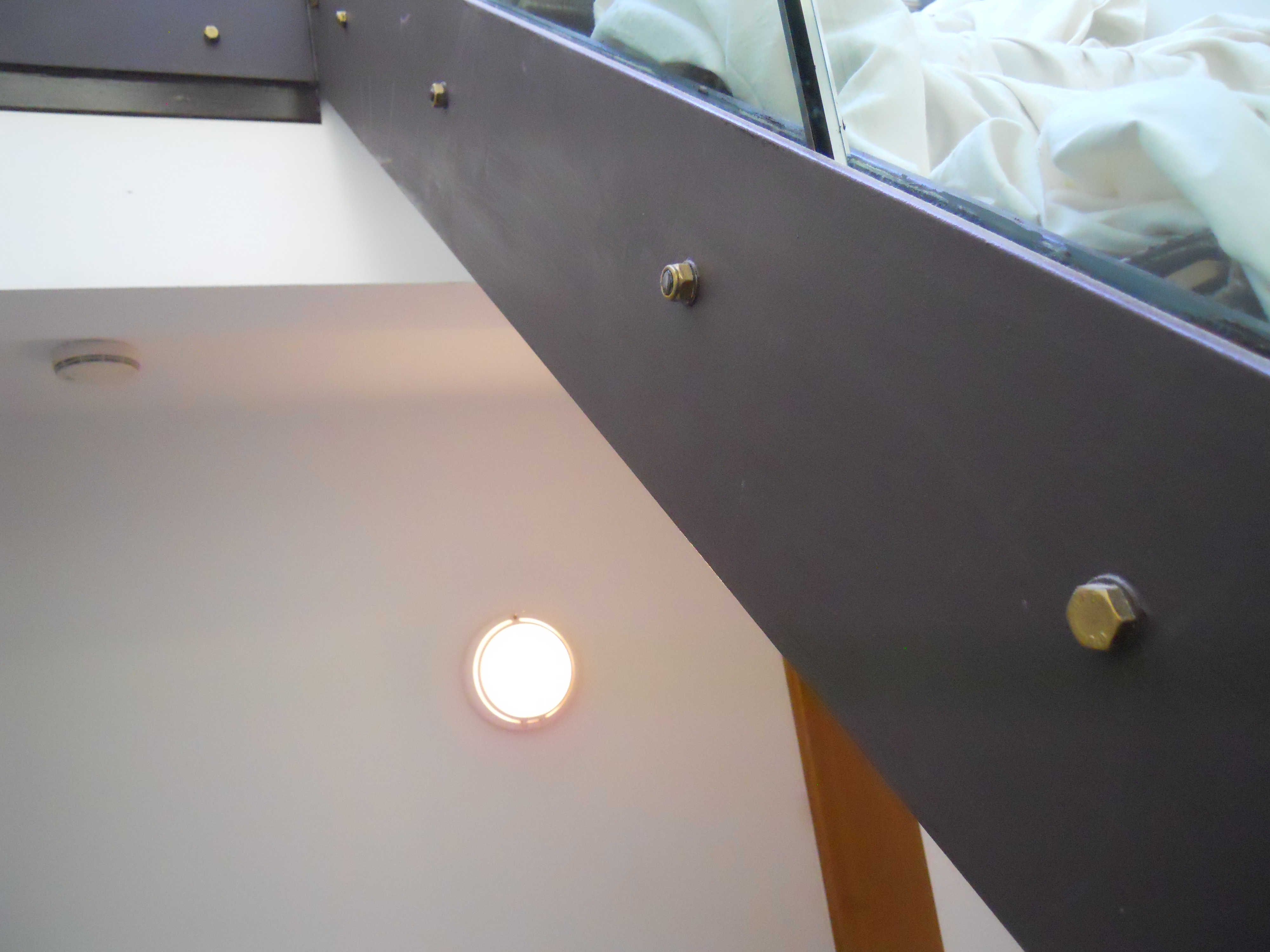
The Old Bolts
This picture was taken today from a similar angle.
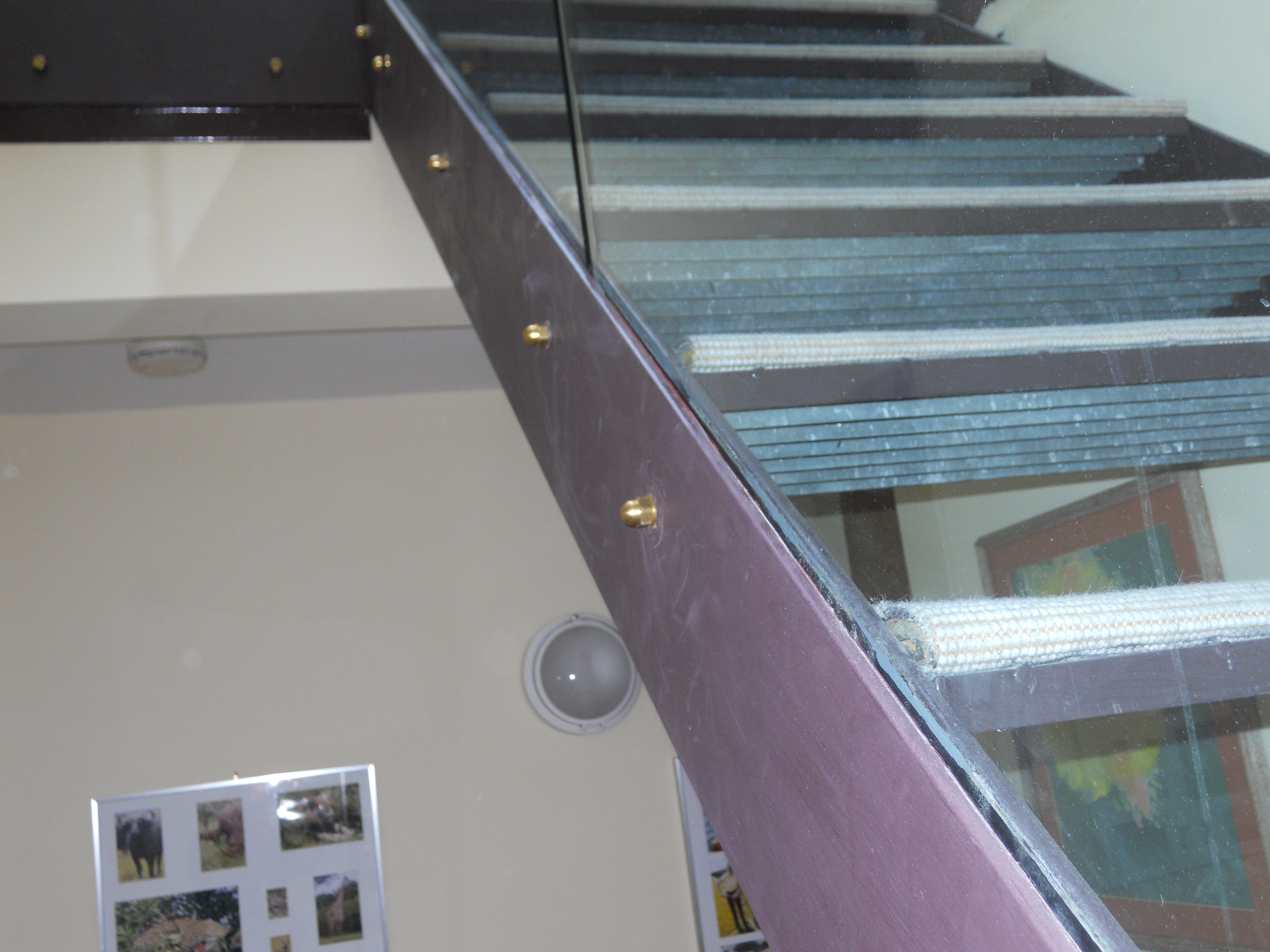
The New Bolts
Note the domed heads of the brass nuts, all round the same way.
But it’s not all perfect yet, as this picture shows.

Not All Perfect
I need to get some special bolts made with domed nuts as heads. This shouldn’t be too difficult. What complicates matters is that the steel is held to the floor using Rawlbolts, so how Jerry got two backwards I don’t know. I suspect that the best way to deal with the problem is to screw the new bolts in using some strong bonding agent.
What is the Longest Word, You Can Create from the Letters in a Single Row of a Keyboard?
The answer is here.
But it is rather predictable, if you believe in conspiracy theories.
Gossip About Polythene
I’m putting in this post, as it was just office gossip with a guy I shared an office with at ICI Mond Division in Runcorn, but feel it ought to be recorded before I forget it again.
Bert Cross was ICI Mond’s infra-red analysis expert and he was a man who’d worked for the company from well before the Second World War. I remember one classic tale about the visit of the then Lord Melchett to the laboratories, where Bert then worked in Northwich and the Lord’s meeting with a researcher, who let’s say didn’t like the idea of capitalism. Whenever, I hear the current Lord Melchett mentioned, I chuckle at Bert’s tale.
Bert also told how when polythene was discovered at ICI’s laboratories by accident, when they were applying high pressures to ethylene gas. They found this waxy substance in the experiments. but they had no idea what to do with it. One idea that was current, was that it might be added to candles to stop them bending. In the end it was polythene’s excellent electrical insulation properties combined with the need to develop better radar systems in the Second World War, that were to prove polythene’s earliest substantial use.
In the early days, it was thought that polythene was a perfect polymer, with no cross linking or imperfections. Bert disproved this using infra-red analysis and always claimed he was nearly fired for his work.
Later when I worked at ICI Plastics Division, I didn’t actually work on polythene, but I worked with others who did.
At the time, ICI made low-density polythene and this was an amazing process with high-pressures, whirling shafts to mix it all and bearings that were lubricated by molten polythene. It was engineering at its most difficult and best. The section I worked for, had actually applied computer control to two plants, using IBM 1800 computers.
At the time, one of ICI’s products was a high-grade cable-grade polythene used where a high-degree of electrical insulation was required. A lot of this product went to Tupperware, as it made the containers look perfect.
Building Scientific Models with Computers
This was the title of a lecture at University College London, that I attended yesterday lunchtime.
It was an excellent lecture and in some ways it was like going back forty years to when I worked at ICI Plastics in Welwyn Garden City. In fact two topics, that were discussed by Professor Catlow, were similar to problems I tackled all of those years ago.
The first was the problems of turbulent and other flows. We had been interested in what happened inside an extruder as you used it to force plastics, such as polyethylene, polypropylene and PVC into moulds to produce the products needed. It was an intractable problem then and I suspect it might be almost as bad today. Although computers are now bigger and can handle many more nodes than the hundred or so, we could handle on our PACE 231R or with IBM 360/CSMP.
I also found his discussion of the various forms of molecules and how they could be predicted fascinating and if we’d had someone with his knowledge, we’d have got a lot farther with another problem.
When you create polymers, you create long chains of molecules like ethylene and propylene etc. which lock together like a series of odd-shaped Lego bricks. These chains then bind together to form the items we need.
At the time, ICI were trying to create an engineering plastic, which would be stronger and have a greater temperature range. I won’t name it here, as I don’t want to break any confidentiality, but suffice to say that the monomer or polymer building block, needed to be created as a straight molecule for the integrity of the plastic. It was known that several forms of monomer could be created and that there was a rather complicated separation process to extract the straight ones. Just as in Professor Catlow’s example yesterday, water in the reaction, was one of the factors, that affected the proportion of desired monomer.
Now I’m not a chemist but I was asked to look at the physics and dynamics of the reaction, with respect to removing the errant water from the reaction vessel as soon as possible after its creation, to reduce the damage it could do. In the end, I made myself very unpopular, as I often did, by finding a method that removed the water. I can remember searching Chemical Abstracts and finally found the data I wanted in a paper published by a Chinese researcher working in Canada in 1909. We don’t know how lucky we are with Google and the Internet.
I left ICI soon after I completed this work, so I don’t know the final outcome!
But to me, the exercise proved the value of using dynamic computer models based on differential equations, to understand difficult systems.
In some ways, I was able to do this work, because I was properly taught calculus and how to form differential equations at school. Would such an important subject now be taught to sixteen-year-olds as was regularly done in the 1960s at schools similar to the one I attended?
 The Anonymous Widower