Trans Pennine Services
I’ve crossed the Pennines several times so far on a train. Sometimes I used the smart Trans Pennine expresses and at other times the slower trains of Northern Rail.
It would appear that a word of advice is not to use any of the expresses that go anywhere near Manchester Airport without a reservation, as they are generally overcrowded with both people and luggage. I first experienced the problems on Day 3, when getting from Horwich Parkway to Manchester Piccadilly. There also on that train seemed to be a surfeit of obese people sitting in more than one seat. A guy I talked to who was on his way to Prague for business says it was always like that.
But the line from Leeds to Preston is very pleasant as it winds its way through Bradford, Burnley, Accrington, Blackburn and other places, at a fairly leisurely but purposeful pace. On one trip two freight drivers said that the driver of our train was going a bit slower than he might. So do freight drivers think themselves the Kings of the Rail?
And of course there is the Tyne Valley line that I took from Carlisle to Newcastle, which winds through almost spectacular countryside, stopping at stations, straight out of film sets for Victorian melodramas.
How much pressure could be taken of the West Coast Main Line, by doing a small amount of evelopment on these lines? The expresses need more carriages and the slower services need modern units with an extra carriage or two.
Until the 1980s, if you had done the journey I’d done from Morecambe to Newcastle, you’d have just had one change at Leeds, rather than two at Lancaster and Carlisle. Go back even further and it was electrified all the way from Leeds to Heysham. Now the electrification ends at Skipton. Such is progress!
But then on another trip across the Pennines, I sat with a guy, who used to commute on the old Woodhead electrified line from Manchester to Sheffield. A lot of that line doesn’t even exist any more.
All of this just illustrates one of the real problems of railways all over England. East-West routes have not been developed as they should have been. Try to do a journey like Ipswich to Shrewsbury or Hereford?
Virgin Trains Glasgow Services
Inevitably in the last couple of weeks, I’ve ended up on some of Virgin Trains services that have started at or are going to Glasgow. If I take Day 21, where I went from London to Milton Keynes and then from Crewe to Lancaster for Morecambe, before going from Lancaster to Carlisle, all on trains going to Glasgow. The early train had plenty of space, although, a lot of people use it to commute to Milton Keynes, but the other two were very overcrowded. I didn’t have a seat reservation on either leg and although I got a seat from Crewe to Preston, it was stand up for the rest of the way.
It almost seems that there is a division, where trains are bearable south of Warrington, Wigan or Preston, but often unbearable to the north. More capacity is urgently needed, both on the Pendolino and Super Voyager services. I think the problem is compounded, by the fact, that the trains get used by locals, travelling just one or two stops. I met one guy commuting from Lancaster to Carlisle.
There are a few TransPennine services from Manchester Airport to Glasgow that use the route, but they are short 100 mph trains, which at best add a few seats to the route and at worst make it more congested. I experienced one going south and detailed it in this post. Perhaps, there is a case for a couple of High Speed Diesel Trains to replace the small Class 185‘s on this route until the line is fully-electrified and electric multiple units arrive.
It has been announced that extra Pendolino trains will be available soon, but some seem to have been put into store, rather than service. Surely, if the sums added up four years ago, and we’ve had an increase in passengers since then, that they are better earning revenue rather than getting rusty.
Remember that my particular expertise is resource scheduling. I just think, that someone’s objective function is not comprehensive enough or there are some dark politics involved. If nothing, adding extra seats to the Glasgow services might encourage people to use them rather than flying, which would reduce our carbon footprint.
Given the overcrowding, something should be done as soon as possible.
At present all I can advise, is make sure you have a seat reservation when you travel anywhere between Warrington and Glasgow.
But the real problems of the West Coast Main Line are historic, as Wikipedia states.
Because of opposition by landowners along the route, in places some railway lines were built so that they avoided large estates and rural towns, and to reduce construction costs the railways followed natural contours, resulting in many curves and bends. The WCML also passes through some hilly areas, such as the Chilterns (Tring cutting), the Watford Gap and Northampton uplands followed by the Trent Valley, the mountains of Cumbria with a summit at Shap, and Beattock Summit in southern Lanarkshire. This legacy of gradients and curves, and the fact that it was not originally conceived as a single trunk route, means the WCML was never ideal as a long-distance main line, with lower maximum speeds than the East Coast Main Line (ECML) route, the other major main line from London to Scotland.
And this still means that for long distances north of Crewe, that only a double track is possible. So this limits the number of paths available, which means that running say a slower connecting service from Warrington to Carlisle, is just not on, even though it would remove the one or two station travellers.
And then you have the freight trains!
So perhaps the problem is not actually about trains, but is more about tracks and paths. The only way then, to get more through, would be to increase the size of the trains from nine to eleven coaches, for which many of the carriages have been built and are in store.
But at some point, the West Coast Main Line will have to have extra tracks, especially if more and more freight trains need to run to and from Scotland from the south. As I believe has been shown around Ipswich, the more freight trains you can run, the less trucks use the roads and you get greater capacity for cars and coaches.
I add the latter, as there is now a London to Glasgow coach service with sleeping berths.
My Local Bus Stop
My local stop is just around the corner and has buses that go everywhere, as this picture shows.
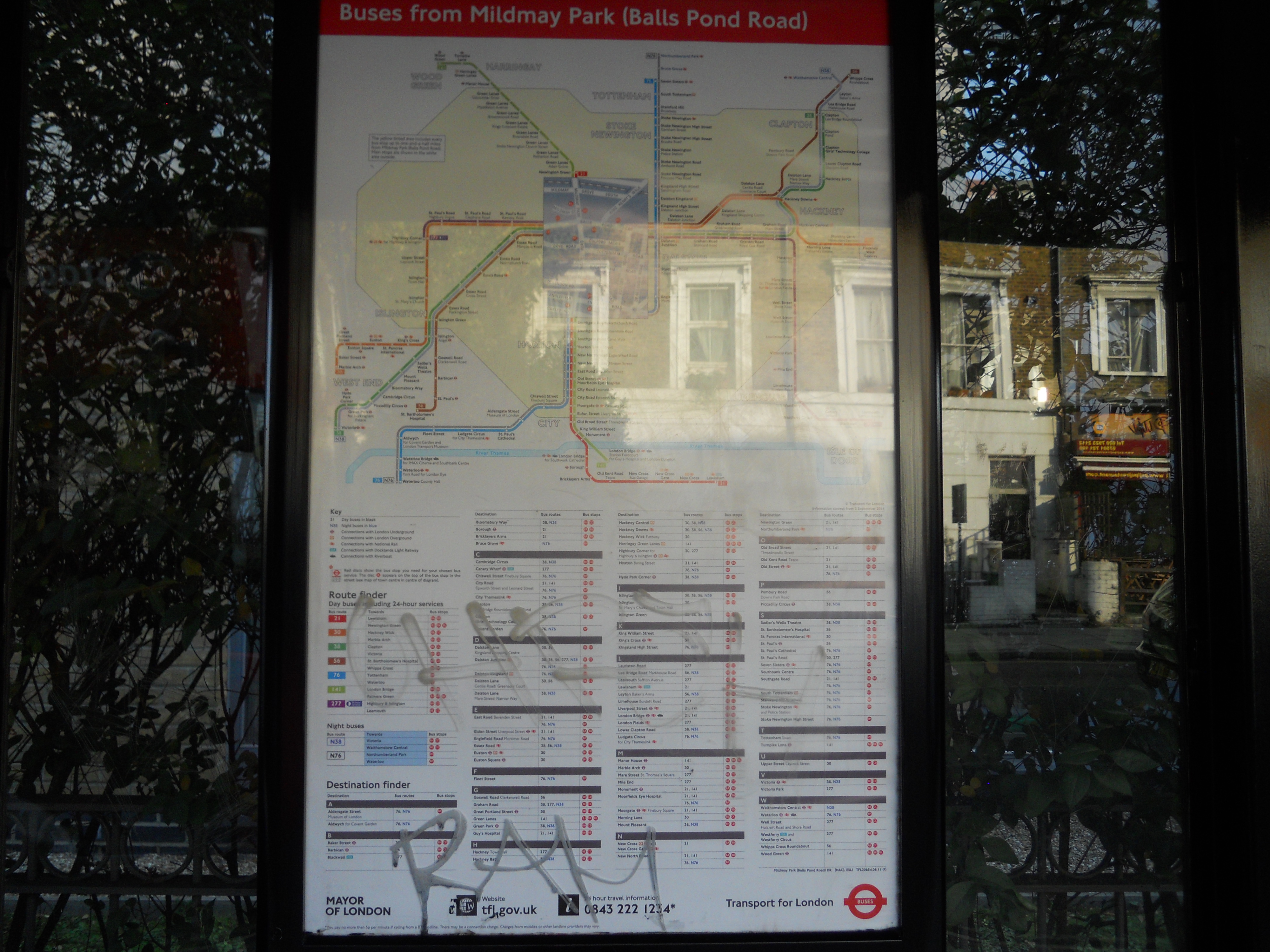
Mildmay Park (Balls Pond Road) Spider Map
Note that the actual spider maps, like this one have more information than their equivalent on the web.
The stop also has a Next Bus Information Number.
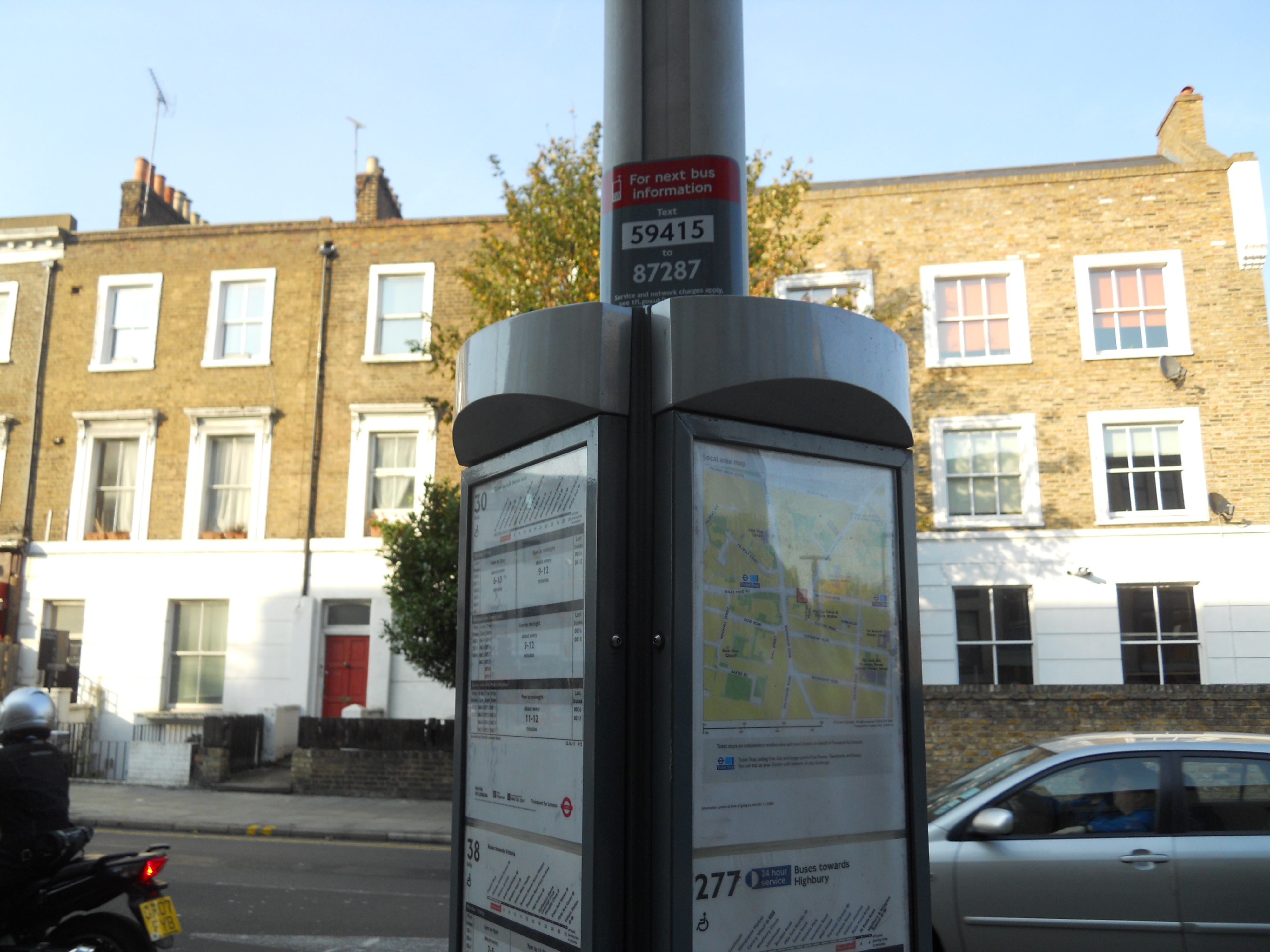
Next Bus Information Number
Note in the picture, the local street map.
The stop also has a Next Bus Display.
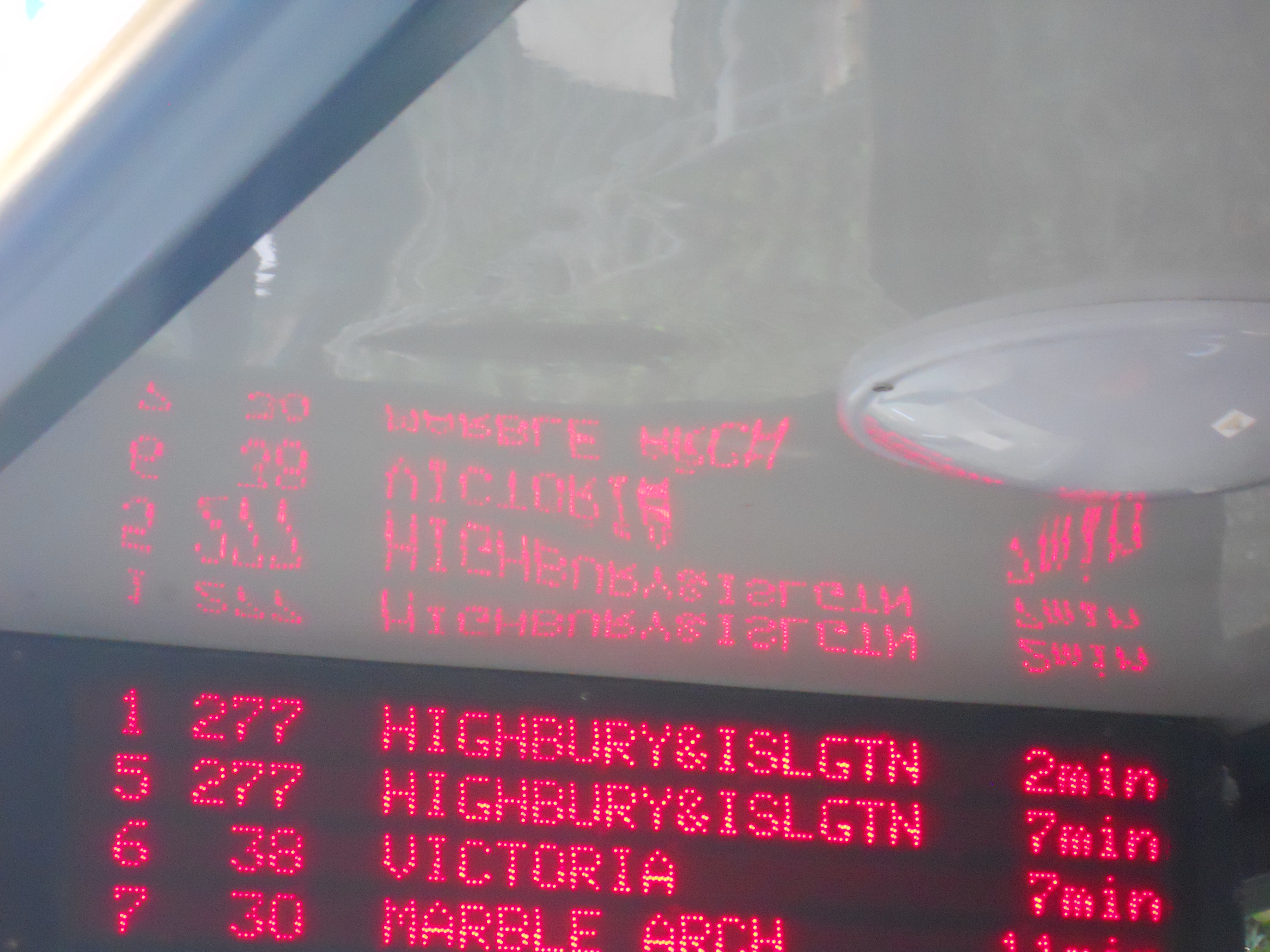
Next Bus Display
I wonder how long we’ll keep it though, as for many people the text message system will be better.
It is too much to expect all stops to be to this standard, but all important ones should have all the information, travellers might need.
I’m using the system in several ways now.
- I often check before I leave home when the next bus is due, to avoid waiting in the cold, say when I have an early train out of Kings Cross.
- If I’m expecting a visitor, I often ask them to text from say The Angel and then I can be at the appropriate stop to meet them.
- If a suitable bus doesn’t appear imminent, then I might change plan and say walk to Daldston Junction.
The only prediction is that these systems will get better and better. You might for instance text the number with say Euston attached to find the quickest way to get to that station. And I still haven’t brought up the subject of a smart phone. But then who needs one, for this purpose, if you have a smart text messaging system.
Suppose to find your way home in London, all you needed to do was text the stop code like 59415, followed by your post code to 87287. You would then be sent instructions on which bus to catch and where to change to get home.
As children, my friends and myself would wander all over London on Red Rovers. Children probably don’t do that now! But it was great fun. Being able to text to get you to your home, could make it safer.
Should We Londonise All Buses?
I know I’m a Londoner and live in the finest city in Europe, let alone the UK or England, but in my travels around the country, I have come to the conclusion, that most bus services outside the capital are very second-rate.
To start with, I should say that in most places it isn’t mainly the buses themselves, as towns and cities like Leeds, Manchester, Bristol and several others have buses that on a quick look to be on average to be the same condition and age, as those in London.
But there are three major differences.
- Most London buses are front entrance and centre exit, which effectively means that they pick up and set down passengers a lot quicker. It also means in London’s case, that a wheelchair passenger has an easier route to get on and off, as he or she uses the middle door. Because of the smaller dwell time at stops, two door buses actually travel faster and carry more people more efficiently. Whether this means the capital cost per passenger journey is lower, I don’t know. But it may well be so!
- London buses also announce the next stop both visually and audibly. Many visitors to my house are very surprised, when I say something like take the 141 to Balls Pond Road and get off there. The system also announces route changes and can be used by the driver to send a selection of common messages to the passengers.
- But the biggest difference is that all London buses are touch on, either with an Oyster card or a concession like my Freedom Pass. If you have a paper ticket, you show it to the driver and they tell you to get on. There is no timewasting mucking about with paper tickets, that London obviously deems to be just litter.
- From next summer, you will be able to touch in on your bus journey with any credit card, as Oyster is being augmented for the Olympics.
But it is the field of information that London buses are streets ahead of every other bus system in the UK.
- As a child, you were always told, that every tube station had a street map of the local area. So if you got lost, just go to the Underground station. So now, like many Londoners, when you are going somewhere foreign like Croydon for a North Londoner or Wembley for a South Londoner, you never carry a map and rely on the map at the destination station. It usually works. Now this street map system has been extended to the buses and most bus stops have a local street map. Only last night, whilst walking back from the pub, I used a map on a stop to show a tourist from Germany, how to walk to the pub where he was meeting a friend.
- These street maps are paired with spider maps, which show all the routes in the area, where they go and at which stop you catch the bus. Frank Pick and Harry Beck would be proud of this idea from their successors. Spider maps work well and if I’m lost after a walk, I just find the nearest bus and work out how to get home. Incidentally, Transport for London call them bus route diagrams, but you can’t argue with umpteen million Londoners, who call them spider maps and that term is now the one generally used by all.
- London has recently introduced text messaging at stops to find out how long you have to wait for the next bus. Other cities have this and it should be the norm everywhere.
- Important London bus stops have displays showing how long you’ll have to wait for the next bus. But as people are starting to use the text system more and more, I suspect, the number of these displays will decrease.
- You can also see when buses will arrive at a stop either through the web or from a phone app. I don’t have a smartphone, but my dumb Nokia 6310i is perfectly capable of telling me if a 30 bus, which is my preferred route home, is due ten minutes out of Kings Cross or Euston.
So how do some of the places I’ve visited compare to London in various areas?
Two Door Buses
You see the odd ones about, but not many.
On-Bus Information Systems
I’ve never seen one, but I’m told Colchester has them.
Maps at Bus Stops
Very few and most that I’ve seen have been very inferior and totally useless for visitors.
Text Information
This is a typical London next bus information notice.

London Sign For Bus Information By Text Message
And here’s one from Leeds.

Leeds Sign For Bus Information By Text Message
No prizes for guessing, which is the simpler system.
Not only is London, just a five digit number but the sign is easily read and is as low as they can put it, so that everybody from say eight to eighty can read it with ease. I can’t believe that there are over 45 million bus stops in Yorkshire! The london sign has the great advantage that it is small and just strapped to the post. So perhaps it could even be used on a temporary bus stop at road works.
I’ll let Frank Pick have the last word on this.
The test of the goodness of a thing is its fitness for use. If it fails on this first test, no amount of ornamentation or finish will make it any better; it will only make it more expensive, more foolish.
And he was born before the age of modern technology. He would have had a field day, if he was still alive and in charge of transport for the whole of the UK.
So to answer my original question, the answer must be an undoubted yes! London has proven that good, frequent and understandable bus services attract more riders, so the sooner we Londonise all buses the better.
People will go on about cost, but the first thing to do is get the maps at stops in place and get sensible text messaging systems working. And then we just have to make all new buses to the London standard! Remember too, that London retires quite a few buses each year. Many of these with a bit of refurbishment would be very suitable for lighter use in the provinces. Certainly, many of the older ones in London are much better, than the disabled-unfriendly old banger, I got back to the centre from Elland Road.
I think too, that we will underestimate the benefits of having the same bus information systems all over the country.
As an example, how much of my time and effort have I wasted trying to find out where to catch a bus on my challenge? And how much money have I wasted on unnecessary taxis?
So if it made travel easier and cheaper, would it make it easier for people to travel to work in the next town or perhaps have a day with Aunt Edna in Felixstowe?
We need any economic stimuli however small.
Remember too, that if we need new buses, that these are generally built in the UK, so much of the capital cost of new buses stays here. So if that is the case, why did Red Ken betray British workers, by buying a load of useless bendy buses? Few liked them, except perhaps fare dodgers.
92 Clubs – Day 22 – Northampton
That was all I managed, on a day, when I intended to do Northampton in the morning, then take the train to Ipswich for the match against Crystal Palace and then visit Norwich in the evening.
But I did get to Northampton on a train from Euston and a taxi from the station.
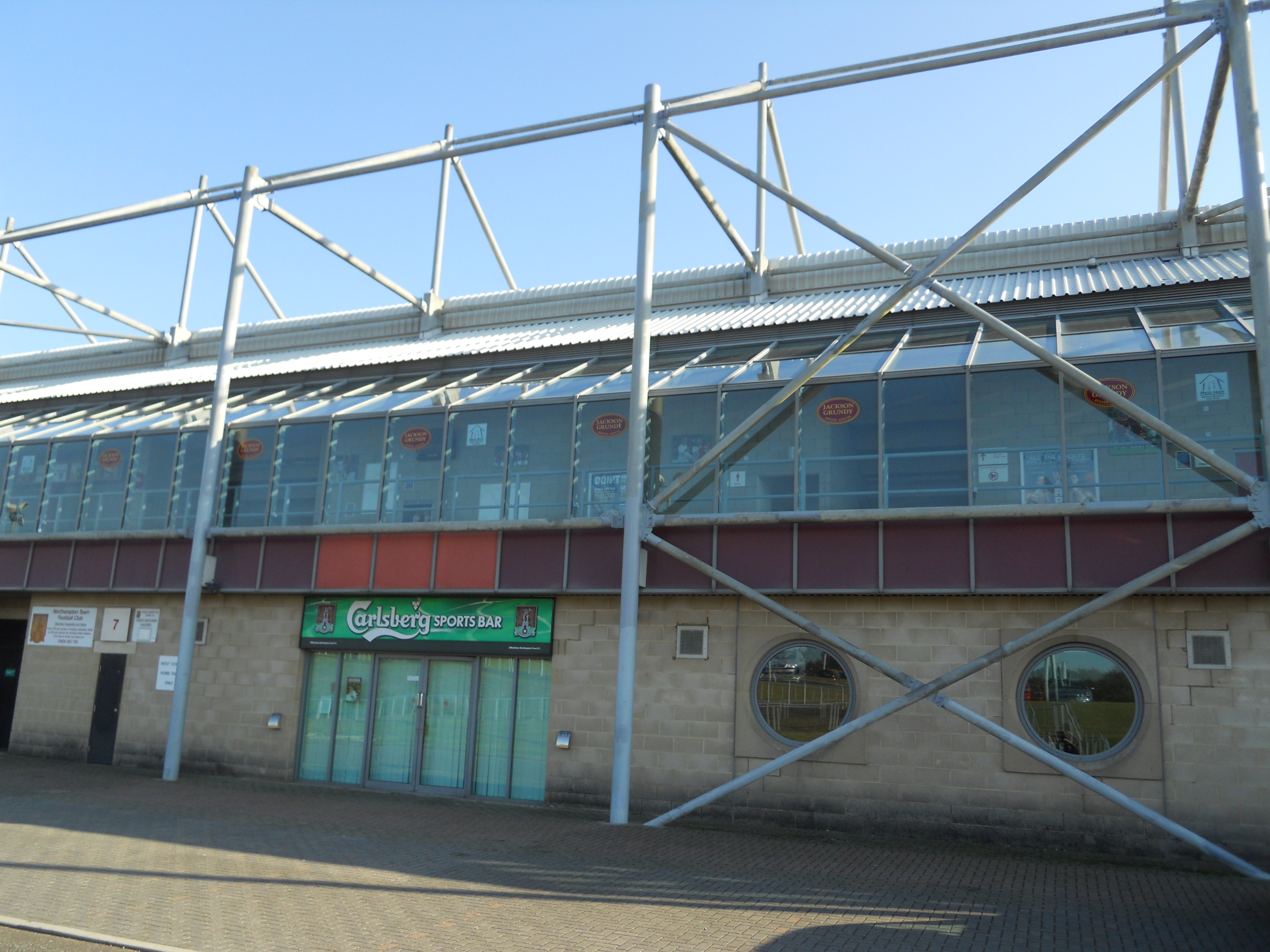
Northampton Town's Sixfields Stadium
I got back to London quickly and then my troubles started.
I thought I might get my paper at Euston, but in the end I gave up, as despite about twenty people queuing in W H Smith’s there was only one till open. The obvious way to Liverpool Street on the Circle line was closed due to engineering work, so I took the Northern line to Moorgate and walked to the station.
I tried to buy another paper and guess what. Twenty people queuing and one harrassed and very overworked assistant trying desperately to show customers how to use the automatic tills. I can’t use those, as they don’t accept my prepayment vouchers for The Times. So I left, vowing never to cross the threshold of any of their shops again in a very loud voice. I am very stubborn and never ever will.
I then got my gluten-free sandwiches for lunch in Marks and Spencer, and then knew that I could just about catch the one o’clock train to Ipswich to get me to the match on time. So instead of buying a ticket from the booking office, where I can get a cheaper ticket to Ipswich from the Zone 6 boundary, I bought a slightly more expensive one in a machine.
I then needed to look for the platform and found that the indicator board showed only a few trains. Nation Express East Anglia were advising people to go to Newbury Park on the Underground and then get a replacement bus. In other words, I might get to Ipswich in time for the second half.
But of course it had completely mucked up my day, as if they were in this state now, what was it going to be like getting back from Norwich later in the evening.
I thought perhaps that if I got to Cambridge, I might be able to replan, so using my Freedom Pass, I took a train to Cambridge via Tottenham Hale. On the train, I phoned a fellow Ipswich fan, who I thought might be going. But he wasn’t, so I got out at Tottenham Hale, intending to get a bus home, as I knew the Victoria line wasn’t running.
In the end, I walked to South Tottenham station and got the Overground to Harringay Green Lanes, from where I got a 141 bus home.
And then of course Ipswich lost!
What particulaely annoys me about all this, was that there were no prominent signs about the engineering works in the station and especially at the entrance, where London Underground always place prominent signs.
I suppose I should have checked more thoroughly, so when I got home I checked the National Express East Anglia web site and they allow you to book tickets without warning you that your journey will be on a replacement bus. The only clue on the booking page is that it was two changes between Liverpool Street and Ipswich.
After all of the disruption of Tuesday, I had hoped I would have had a better trip. But then Tuesday was much better, as we at least had a train.
My heartfelt thanks go out to National Express East Anglia for ruining my day and charging me £22.30 for the privilege.
I know I wasn’t the only person, who’d missed the disruption, as several other Ipswich and Crystal Palace fans were at Liverpool Street in a seriously muddled state.
I know it was my fault for not spotting that engineering work was taking place. In fact, I usually buy my ticket a few days in advance at the station and tried to on Tuesday, but it was impossible in the chaos that evening. And of course on Wednesday, Thursday and Friday, I had better things to do than make a special trip to Liverpool Street to buy a ticket. On the other hand, what idiot decided that the best day to do engineering work, was when quite a few football fans would be travelling between London and Ipswich?
In all my travels around the country visiting the 92 clubs, I’ve never had a wasted day like this.
I should also say that I’ve never missed a football match, after leaving home with the intention of going in all of my sixty-four years.
So what would I have done, if I had been the Fat Controller at National Express East Anglia.
- I know that engineering work has to be done, but surely to organise it when Ipswich are at home to a London club is not a good idea. Especially, when the day is the first day of half-term and there will be a lot of families trvelling on the trains anyway. So I would have made sure that the work was done at some other time, or if it had to be done then, I’d have arranged for announcements and program notices at the two clubs previous home matches. I was at Ipswich on the Tuesday and no announcement was made, either at the stadium or on the train. I can’t speak for the program, as I didn’t buy one, as I was so tired and stressed after the journey up, due to the crowded train.
- I’d make sure that the engineering works were fully publicised throughout the week, with notices at the entrance to the station.
- I would have made sure that Radio London and BBC Radio 5, gave full details on the Saturday, so that passemgers were forewarned.
- I’d also set up an alternative route out of London for Norwich and Ipswich passengers. The new trains to Cambridge are much bigger and could be used to shuttle passengers to Whittlesford, which has a large parking area, from where buses could be used to take passengers to an onward station like Needham Market, where they connect to Ipswich, Norwich and Colchester. It wouldn’t be perfect, but better and faster than the current route via Newbury Park and Ingatestone.
 The Anonymous Widower