Hauled By A Diesel Locomotive To Birmingham
Since yesterday, I’ve tried to think when was the last time I was hauled around the country by a diesel Locomotive. You may get the occasional diesel multiple unit, but rakes of carriages hauled by a diesel locomotive are pretty rare, and even more so in Europe.
Except for a trip on a sleeper, it must be in the 1980s, when I was last hauled by a diesel locomotive, probably between Ipswich and London.
So yesterday on my trip North to Birmingham, I decided to go from Marylebone for a change.
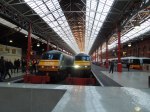







It was definititely a smoother and more comfortable ride in a Mark 3 Coach hauled by a clean Class 67. Compare the engine, with the blood spattered Class 90, I got for the trip to Ipswich on Saturday.
It was also nice to see Mark 3 Coaches laid out in Standard Class how they had been designed, with a table and a window for all passengers.
If all Standard Class coaches were like this, would anybody pay the extra for First Class?
And when will we be seeing comfortable Mark 3 coaches with sliding doors on London to Norwich?
I wonder how many people, who travel between London and Birmingham on Chiltern Railways, realise that they’re sitting in a coach that dates from the 1970s or 1980s?
What this line now needs is electrification and some appropriate electric locomotives to haul the trains between the two cities and probably on to a few places beyond Birminhgham. If for no other reason, we’ll need extra capacity, if and whilst Euston is rebuilt for HS2.
Next time, I go to Birmingham, I’ll use Chiltern from Marylebone. It is slower at one hour and forty-four minutes, as against one hour twenty-six on Virgin, but it avoids Euston, the trains are more comfortable, wi-fi is free and outside of the peak, I can lay my paper out to read it properly.
Light And Dark Over The City Of London
I was in the Members Room of the Tate Modern and took these two pictures.


I’ve talked before about the views from this room here. I must take a few more!
A Delicious Way To Cook Salmon
Last night i cooked one of Lindsey Bareham’s recipes. it’s called Roast Salmon with Paprika, Garlic And Parsley.
I just put the salmon in a dish and after brushing it with olice oil gave it ten minutes in the oven at 200°C. I then covered the fish with a mixture of paprika, garlic abd fresh parsley.

Roast Salmon with Paprika, Garlic And Parsley
It was delicious.
Some might not like the broccoli I served with it, but that is personal taste. C wouldn’t have put her mouth, nose or fingers near it!
lindsey incidentally, has a new cookbook out called Just One Pot. You can buy it here from her web site. I shall be getting a copy!
Brazil World Cup Doesn’t Seem Much Better
Under their report on Sochi and its troubles, there is an article with this heading.
World Cup protest threat as corruption bill hits £32bn
Given all of the other well reported troubles in Brazil, it does seem that watching sport on television in 2014, is going to be an interesting experience to say the least.
Is Sochi A Monstrous Scam?
I have just read this report on the BBC’s web site.
Admittedly it is from May last year, but in a few weeks time, we’ll see whether the Games will be worth the reported $50 million spent.
The Times had a news report yesterday, where Giuan-Franco Kasper, the Head of World Skiing, said that a third of the cost had been lost to fraud.
The 2014 Winter Olympics could be one of the best examples of car crash television for some time. Especially, after reading about the climate on Wikipedia and reading reports that there hasn’t been much snow in the area.
Is Beeching To Blame?
I remember the railways in the 1950s and 1960s well. Some will look upon that period as a golden age. But in truth trains and stations were terrible, with some of the diesel multiple units, like these Class 105, seemingly designed to remove the fillings from your teeth. Living in London, you used the Underground, where you could, rather than put up with the dirty local trains and stations. This was all before the Beeching reports, and it showed how bad our railways were. Very few people, who didn’t have to for commuting or work, used the trains and everybody preferred their new-found freedom given by a car.
Something had to be done, especially to cut costs and improve standard. The cuts are outlined here in Wikipedia.
When I was travelling up and down to Liverpool University in the 1960s, the trains were starting to get better, as electrification of the line was added. But still, it wasn’t anywhere near as clean, comfortable and reliable as it is now!
Generally, I believe Beeching was right to recommend closing many of the lines he proposed. They weren’t being used and the country couldn’t afford to fund a white elephant.
But it was the way that politicians and management did the downsizing of the railways, that is to blame for some of our railway problems today.
The way that line closures was done in a sometimes unthinking way, is illustrated by the problems of trying to restablish a rail route from Oxford to Cambridge. The original route was called the Varsity Line, and Wikipedia says this about its closure.
Services were withdrawn from the Oxford – Bletchley and Bedford – Cambridge sections at the end of 1967, even though the line had not been listed for closure as part of the Beeching Axe in 1963.
Although parts could still be reinstated, some parts are blocked by housing and other developments, and the Cambridge University Radio Telescope. The status of the line is described here.
So did an overzealous accountant or politician see the short term gain and lost sight of the future. As Beeching felt the line should stay, they must have thought, they had very good reasons to effectively close it for ever.
But now the government has stated that an East-West Rail Link should be built and they have funded the first part from Oxford to Bedford to open in 2017. The proposals for the link from Bedford to Cambridge are detailed here. Whatever happens, it looks like finding an acceptable route will be difficult.
In some places in the UK, rail closures were done, so that they could be reinstated. Scotland has recently recreated some of these lines and is currently rebuilding some of the Waverley Route.
Did the Scots have the vision, did managers and politicians not have a destroy policy or was it just luck?
London had a different policy. Both the Overground and the Docklands Light Railway were created out of the remains of old forgotten train lines. But then London was lucky, in that roads that could have used the space, were off the agenda and no-one had any decent vision on how to reuse the lines. So they were saved for their renaissance!
Lord MacClaurin’s Unworkable View
Lord MacClaurin has just suggested that the solution to the woes of English cricket is to cut the number of counties to twelve. Alan Lamb agreed and they went on to suggest mergers like Kent with Sussex and Northants with Warwicks.
It may be right, but can you imagine those that run and occasionally support the counties will take this. I have lived in both the old counties of East Suffolk and West Suffolk, which were combined with the County Borough of Ipswich to form Suffolk. The only thing that those in the new county are agreed on, is that you support Ipswich Town, but those in the west, still resent that Ipswich was chosen as the county town.
So will merged counties ever happen? I doubt it!
Hackney On The Rise
BBC Radio 5 asks this morning about views on the economy. I sent them this text.
Three years ago, I retired to Dalston after a stroke stopped me driving. Every month the area gets better and a lot is down to the London Overground, which takes people to jobs, shopping and leisure activities. It shows how investment in transport can improve the lot for us all! Next year Tottenham gets the overground. We live in interesting times.
So has the Overground really improved things?
I first rode the Overground towards the Olympic Park in July 2010, before I moved here in December of that year. Since that first short run, the system has expanded. but gone are the dingy stationsa, dirty trains and lack of staff of the pre-Overground era. The Class 378 trains, started as three cars, but as they couldn’t handle the demand, they were lengthened to four cars and now they’re going to five. Have we ever built a railway, for which much-need extra capacity can be provided so easily?
But the capacity is needed, as more and more people use the line contributing to the affluence and well-being of the areas it serves, like Hackney.
You could call the Overground a rebranding exercise, but that would be unfair. Give a railway line, better clean stations, reliable frequent trains, visible staff and a simple ticketing system and the passengers will arrive. Visitors will also come and bring prosperity to an area.
London will use the Overground to run trains on the Lea Valley Lines to Tottenham, Enfield, Cheshunt and Chingford. North East London will surely be on the up.
One of the great things about the way the Overground is implemented, as effectively a rebuilt, resignalled and fully-staffed train line first with a deep clear of trains and stations and Oyster ticketing, means that the concept can be brought in, in affordable stages.
I suspect that the Lea Valley lines have a good enough line and signalling for a few years, so it’ll be the grotty and unstaffed stations, and the ticketing, that get the most attention at first. As new Cl;ass 378 trains are delivered, they can of course be run in combination with the ageing Class 315 trains on the lines at present, as their bigger brother, the Class 379 does already. Dripping new trains in surely gives passengers hope that something is happening to improve their dismal line.
With a grand project like Crossrail, you only see the improvement, when the line opens. With the Overground, the upgrade is continuous and now the London boroughs seem to be getting involved in the development of the stations, many of which are on prime sites.
I suspect that the way the Overground has been implemented could be applied to various train lines around the country. The Cambridge to Ipswich line, which I know well could benefit, especially if the main line was electrified for freight and the various councils got involved, to facilitate the development of the stations. Bury St. Edmunds station, is a classic, where a good architect could create a mixed housing and commercial development that did justice to the town.
I believe that if you get the railway right, then the investment and development around stations will follow.
Birdstrike On An Electric Locomotive
It would appear that whatever bird this Class 90 hit, didn’t have much of a chance.
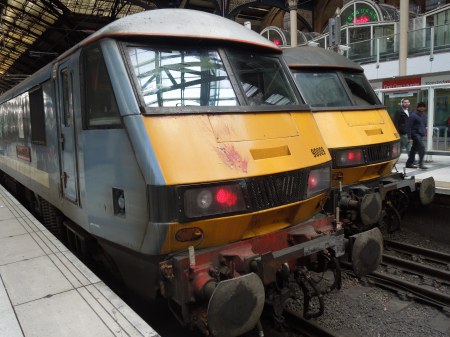
Birdstrike On A Class 90
But then none of us would, if hit by 84.5 tonnes of electric locomotive.
Winning Over The Anti-Frackers
Edmund Marshall is a retired MP. In a letter to the Times today, he talks of his part in the Zetland County Council Act 1973 and the effect of the Act, on the Shetland Islands. This is talked about here on the Scottish Government web site, with this paragraph being the most relevant.
Closer to home, we have an example of the way in which one local community – Shetland – was able to accrue a legacy for its future on the back of oil and gas exploration. Shetland Islands Council showed foresight in securing via, primarily, the Zetland County Council Act 1974 a lasting revenue stream for the benefit of the islands from the development of the Sullom Voe terminal. The result of this Act and subsequent contractual negotiations is that Shetland today has a lasting legacy of around £216m. 7 This figure is over and above the funds contained in the Shetland Reserve Fund, administered by Shetland Islands Council.
30. The Shetland Charitable Trust, established in 1974 to manage the income stream accrued to Shetland, today provides funding to a number of charitable organisations and projects where there is a clear benefit to the Shetland community. Over the years, the Trust has made a contribution to creating a modern, positive and healthy community in Shetland. Shetland Charitable Trust’s financial strength has also given it the power to establish joint venture projects to move into the renewable energy generation market.
Dr. Marshall finishes his letter, by saying that fracking could be dealt with by similar provisions.
It would lead to some rather heated arguments in some councils, as to whether to accept the fracker’s shilling. It is a choice about whether you want lower Council Tax and new community facilities, or fracking.
I very doubt that a similar Act will happen in the greater UK, as payments like this really get the Treasury’s ire. I’m surprised that they allowed the Shetlands to get this independent finance! Perhaps none of the Treasury’s mandarins had been north of Watford and Shetlands meant Rockall to them.
 The Anonymous Widower