Why Does Bradford Have Two Stations?
When I wrote The New Apperley Bridge Station, I noted that on my journeys on the Calder Valley Line on Saturday and today, my trains called at Bradford Interchange, but that the trains through Apperley Bridge station called at Bradford Forster Square station.
So I asked myself, the question, that is the title of this post.
This Google Map shows the two stations.
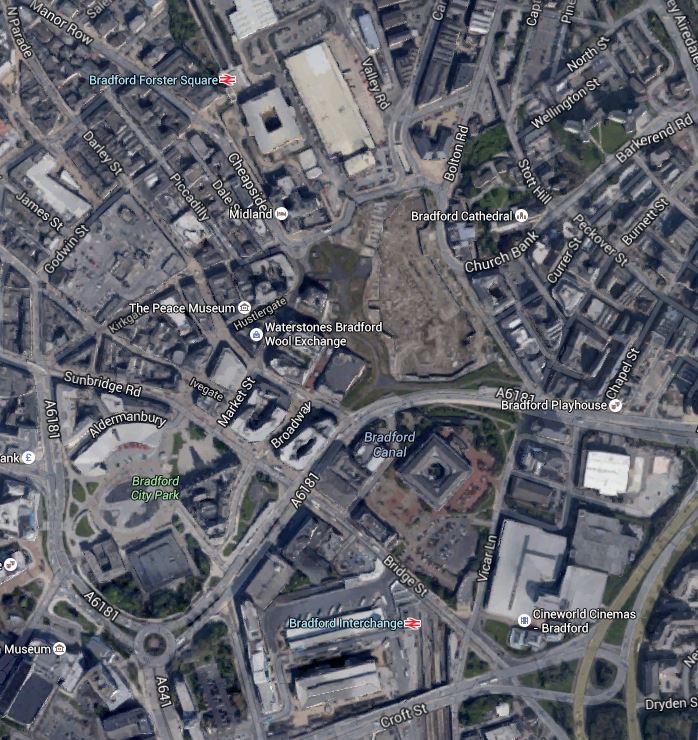
Bradford Stations
Bradford Forster Square station is towards the top and Bradford Interchange station is towards the bottom of the map.
Bradford Interchange, which is a combined bus and rail station rebuilt and opened in the 1970s, which is not an outstanding period for superbly executed Rail stations.
To make matters worse, all trains must reverse at Bradford Interchange, which means the driver changes ends.
Note that between the two stations, there is a large shopping centre, that has been opened in 2015.
You’d have thought with all this rebuilding that a solution to the two station problem would have been found.
Two solutions have been proposed.
- Bradford Crossrail – A heavy rail link between the stations.
- A tram-train is outlined in this article in the Bradford Telegraph and Argus.
I know the Germans would squeeze a tram-train through somewhere, but I suspect there might be something more imaginative and much more affordable.
After all the distance is 0.7 km. and the stations only have seven platforms between them.
Around the world, there are several successful lightweight people movers in city centres.
- High-tech and expensive monorails.
- Light railways like the Docklands Light Railway in London.
- Tram shuttles.
- Travelators and escalators.
- Free mini buses as in Manchester.
Surely, a good engineering solution at an affordable price must exist., which could connect the two stations to each other and to the shopping centre.
But what about some eco-friendly battery buses, as the distance is under a kilometre.
.
Leeds Station And The New Entrance
On my trip up to Burnley, I went up via Leeds station and because of the weather, I came back the same way.
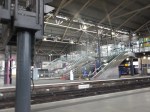
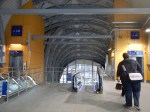

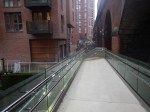

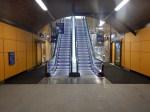
On the way up the new southern entrance to the station wasn’t open, but it opened on Sunday morning.
Apart from a few snags, it seemed to be a great addition to the station.
This Google Map shows the new entrance under construction in the South-west corner of the station.
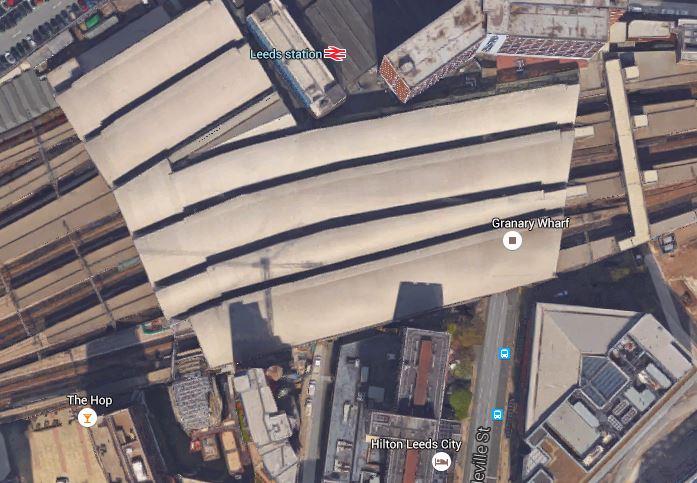
New Southern Entrance To Leeds Station
This image also shows the solid nature of the 2002 station roof, which is glass and not plastic like Manchester Victoria, Birmingham New Street and Crystal Palace stations.
Roof technology has moved on and I suspect costs have moved down.
One problem they may have is the shops like Boots, WH Smith and M & S are outside the barriers in the old (north) entrance.
So passengers needing these shops after entering the station on the south side, will have to go through the barriers to do it.
This problem will probably be solved with a new south concourse.
With other expansion, including new platforms and splitting Platform 1 into three separate platforms and the arrival of HS2, Leeds station is certainly having a lot of men (and women!) in!
From Hebden Bridge To Leeds
The weather was bad and on the last leg from Hebden Bridge to Leeds, I didn’t see much.
According to the Bradford-Halifax section in the Wikipedia entry for the Calder Valley Line, there are five tunnels of which two are over a thousand yards.
So as on the rest of the line electrification could be challenging.
On the other hand some sections, like Sowerby Bridge-Halifax might be easier to electrify.
But I can’t help feeling, that whatever Network Rail decide to do about this line, that IPEMU technology will be part of the solution.
Say you have a section of a couple of miles, that because of various issues would be virtually impossible or very expensive to electrify.
Could a train approaching the neutral section drop its pantograph, use battery power in the neutral section and then automatically put the pantograph up to reconnect to the electricity supply, once the neutral section was passed?
As a Control Engineer, I know such automation is possible, but can it be implemented on a train at 100 mph?
I suspect that the answer is yes and by the end of 2017, there’ll be videos of an IPEMU, swapping from overhead to battery power and back at high speed.
Hebden Bridge
I’m treating Hebden Bridge and the Grade II Listed Hebden Bridge station as a single post, as one would do other places where the station welcomes you to the town or city and is most certainly part of the identity. I would also place Brighton, Cambridge, Liverpool Lime Street, Portsmouth and Rochester, in that category, but there are others.
These pictures show my very wet visit.
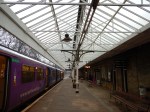
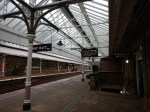
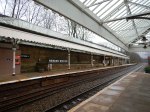

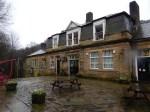
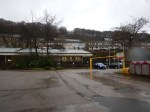
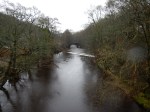
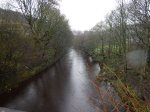
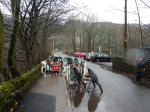
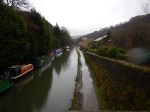
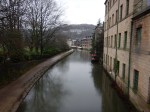
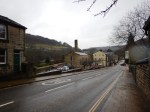
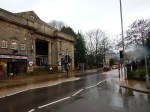
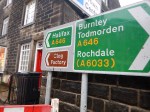
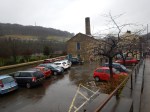
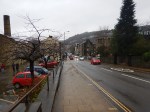
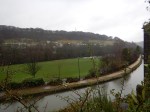
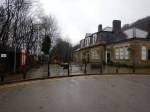
I shall go back one dsy, when the weather is better.
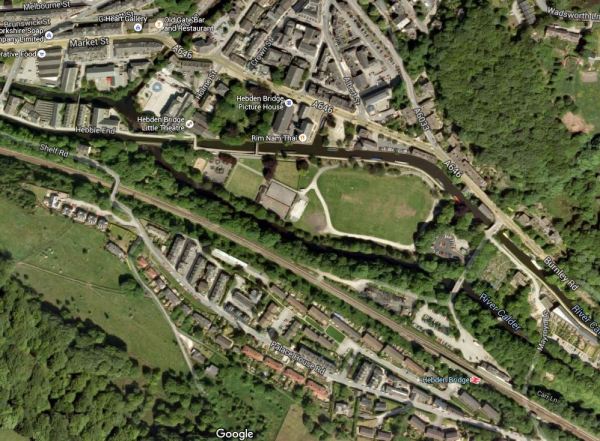
This Google Map shows the town and the station.
Hebden Bridge
Note the Rochdale Canal and the River Calder running in the same direction as the railway.
I believe that Hebden Bridge could be key in the electrification strategy of the Calder Valley Line.
A personable member of Northern Rail’s staff told me a tale about step-free access at the station. There is a subway under the tracks and this used to be served by two parcels lifts. I was told, that it was suggested that the lifts be replaced by passenger lifts, to make the station step-free, but as the station is Grade II Listed, this was not allowed.
What will happen in the end over access, I know not, but in my dealings with Listed Buildings Officers in Suffolk, they tend to be practical and lookfor a compromise, that satisfies all parties. Surely, there could be a design of lift, that would satisfy both the heritage and disabled lobbies without an outrageous expense.
This leads me to the electrification through Hebden Bridge station.
Look at this enlarged Google Map of the station.
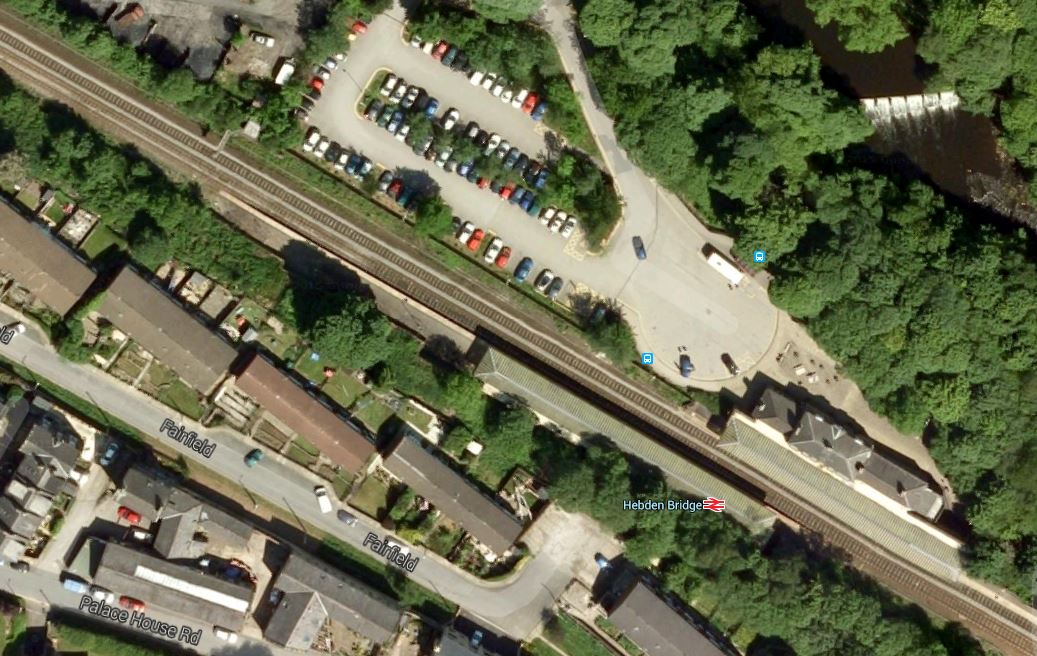
Hebden Bridge Station
I think you can see the following.
- The platforms aren’t that long and would need to be lengthened for the four-car trains that would surely be appropriate after electrification.
- The canopies of the platforms will have to be cut back, so that the overhead wires and their supports can be erected.
I don’t think the heritage lobby will like either of these changes.
But what could they object to, if the electric trains were quiet four-car Class 387 IPEMUs, using selective door opening on the current platforms?
These trains could serve Hebden Bridge station tomorrow, if Leeds to Bradford and Blackburn were electrified.
There would be no other overhead wiring needed
Manchester Victoria To Hebden Bridge
The weather wasn’t good as I took the hourly train on the Calder Valley Line between Manchester Victoria and Hebden Bridge stations.
The train was a Class 150 train, which as the first picture shows had been refurbished, but really on a line between the two of the biggest cities in the north, shouldn’t something better be used.
As with my earlier trip from Burnley Manchester Road to Manchester, the line has a fair selection of viaducts, tunnels and challenging structures.
The tunnels include the Summit Tunnel, which is a masterpiece of Victorian engineering, that has been in continuous use since the 1840s.
I don’t know whether Network Rail will want to electrify the Summit Tunnel, but I believe that it could be declared safe for IPEMUs to pass through without extensive modification.
East Of Todmorden
Between Todmorden and Hebden Bridge, there is the Hall Royd Junction, which incorporates the Todmorden Curve and three more smaller tunnels. This Google Map shows the line East of Todmorden.
Note that the Todmorden Curve had not been built, when the Google Map image was taken. The three tunnels are not as long as the Summit Tunnel and are each about two hundred metres long.
The engineering isn’t probably as challenging as that between Burnley and Todmorden, but there will be a lot of it.
If IPEMUs are used, provided the track, tunnels and viaducts are up to scratch, then all that will need to be done is check everything out.
Exchange Square Metrolink Stop
The new Exchange Square Metrolink stop on the Metrolink Second City Crossing has opened.
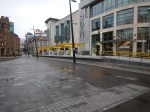
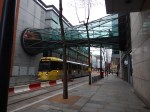

Where’s the map at the stop?
I don’t know Manchester City Centre that well, so I need help, without getting my smart phone out.
Manchester Victoria Station Is Nearly Finished
It’s getting to the point, where the upgrade of Manchester Victoria station is nearly finished.
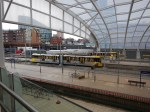
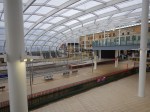
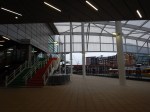

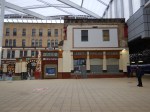

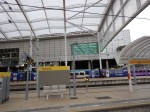
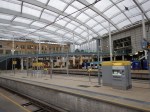
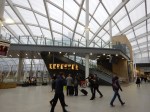

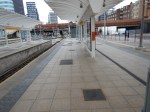

It really does show how good design can take a dark dump and make it a place you are happy to visit. Unlike Manchester Piccadilly, which now looks very third-rate.
There’s lots of space and it’s only a short walk to the trams.
In my view the following needs to be done to finish Victoria.
- Walking maps around the station.
- The Metrolink could do with better maps and information.
- A few litter bins.
- Contactless bank card ticketing.
But then the devil is in the detail.
Manchester should start to realise that it will get lots of visitors, who won’t know their way around the city centre.
An Early Sunday Start From Burnley To Manchester
I started early and took the 08:39 train from Burnley Manchester Road station to Manchester Victoria station.
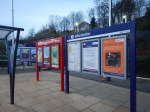
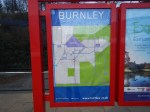
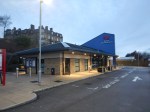
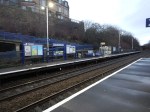
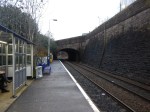
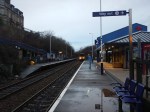
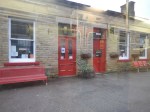
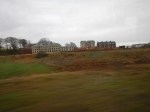
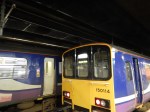
It is a picturesque ride around the Todmorden Curve, over valleys on high viaducts and through traditional stone-built villages and towns, with the hills of the Pennines in the background and quite a bit of water alongside the rail line.
The line has improved greatly in the last few years and there are lots of tidy stations, with seats, shelters and information boards. The only larger ones are Burnley Manchester Road, Todmorden and Rochdale.
Despite the early hour on a Sunday, there were quite a few passengers and the train was about three-quarters full at Manchester Victoria.
Thinking back to my first time by train to Burnley in 2011, the rail link has improved dramatically.
- A smart new station has been built.
- The Todmorden Curve has been opened to provide a direct train service to Manchester.
- An hourly service links Burnley and Manchester Victoria via the curve.
From reports, I’ve read, the line is well-used.
This question has to be asked – Could the line be electrified?
Look at some of the pictures and they show the challenging nature of electrifying the line.
- From Burnley to Todmorden, there are a number of well-built Victorian stone over-bridges.
- Also on this stretch there are at least two high stone viaducts.
- There are several tunnels, includin the Summit Tunnel, which is 2.6 km. long and has been in continuous use since the 1840s.
- Many stations have been upgraded or rebuilt recently.
- Also in this area, some new bridges across the line for new roads and the Metrolink, seem to appear to be rather low.
Also, look as this section of the line between Burnley and Todmorden.

Between Burnley And Todmorden
Note how the rail line curves between the hills and the houses, using tunnels and viaducts to get go on its way.
It’s one of those lines, where you’d try to find an alternative to traditional electrification. If it’s not space, it’s heritage issues and there would be lots of bridges, viaducts and tunels to rebuild.
Go west from Burnley and the line has a couple of high viaducts and a couple of tunnels, but the East Lancashire Line seems to get easier west of Blackburn station, with a line over mainly flat countryside with plenty of space on either side. At Preston it connects to the electrified West Coast Main Line.
Electrifying from Preston to Blackburn, would open up several routes to the use of IPEMU trains.
- Blackpool South to Colne – A substantial part of the route of the fifty mile route from Blackpool South to Colne would be electrified and from the performance figures I’ve seen, this route would be an easy one for something like an IPEMU-variant of a four-car Class 387 train.
- Burnley to Manchester – The service I rode from Burnley to Manchester starts at Blackburn and finishes in a fully electrified Manchester Victoria. So to answer my original question about whether the route could be electrified, there is actually no need to electrify, as IPEMUs could easily link two electrified terminals over that distance.
- Manchester to Clitheroe – Look at the Ribble Valley Line on Wikipedia and there are five viaducts and three tunnels listed, in a line of around thirty miles. However, the good news is three-fold. The line has been well looked after, it’s promoted as a tourist attraction and soon, it will be electrified from Manchester as far as Bolton. I can’t see why with a small top-up at Blackburn, that this route couldn’t be run by an IPEMU.
- Blackpool North to Settle – This route is run as a tourist train called DalesRail on Sundays in the Summer, when it goes all the way to Carlisle. An IPEMU could certainly run a service between Blackpool North and Settle, but I doubt it could stretch all the way to Carlisle along the Settle-Carlisle Line, as there are some massive gradients on that line.
- Blackpool North to Leeds – This route along the Calder Valley Line via Hebden Bridge, Halifax and Bradford would be totally within range of an IPEMU, once Blackburn to Preston is electrified. If necessary, Leeds to Bradford could be electrified as well. A train fit for the Northern Powerhouse, powered by batteries and built in Derby!
This all illustrates how an IPEMU can benefit from even short sections of electrification. Blackburn to Preston would be under twenty miles of electrification without troublesome viaducts and tunnels across fairly flat country and it opens up several routes to new electric trains.
It’s funny, but if you are going to use IPEMU trains, you electrify all the lines, that you can electrify and maintain with ease and leave all the difficult bits to the battery feature in the trains.
 The Anonymous Widower