Linking Chiltern To Crossrail
In the November 2016 Edition of Modern Railways, there is an interview with Dave Penney of Chiltern Railways, as the company is opening their service to Oxford station on the twelve of December.
In Connecting To Crossrail, this is a summary of what is said or implied.
- Chiltern could get a couple of platforms at Old Oak Common station, sandwiched between the Crossrail platforms.
- Access to Northolt Junction is possible, to allow services to connect to the Chiltern Main Line using the Acton To Northolt Line.
- Marylebone is almost at capacity.
- Old Oak Common would give Chiltern a second London terminus and access to Crossrail.
- Two trains per hour (tph) could start from Old Oak Common.
- Aylesbury and High Wycombe could get access to Crossrail.
Chiltern would also get access to all the services calling at Old Oak Common.
I think it is an exciting concept.
A Fur Coat And No Knickers Station
St. Pancras station is not my favourite.
My hate affair with the station started when I wrote Could St. Pancras Thameslink Station Have Had An Island Platform?, where I first called the dreadful concoction a fur coat and no knickers station. I said this.
St. Pancras is very much a fur coat and no knickers station!
Show on top and draughty and lacking at the bottom!
I don’t take back one word of what I said.
The station is the interchange between the following lines.
- Metropolitan and Circle Lines of the Underground
- Midland Main Line to Corby, Derby, Leicester, Nottingham and Sheffield.
- Piccadilly Line of the Underground
- South-Eastern Highspeed services to Kent.
- Thameslink between Bedford and Brighton
- Victoria Line of the Underground.
So to say the least it’s complicated.
Problems For Train Operators
The three main operators of the services in the above ground station, must despair at how few platforms, they have been allocated.
If you catch a Midland Main Line train to Nottingham say, you often have to walk to the second train in the platform. If they had a couple more platforms, then this walk would be avoided and extra services like a Luton Airport Express, that I wrote about in Luton Trains Its Eye On Sub 30-Minute Express, would become possible.
It’s the same with South-Eastern Highspeed services on the other side of the station.
Eurostar is perhaps better. But, if other operators wanted to run services, is there the space to accommodate their trains and the services they require?
Endless Walking For Passengers
Problems for passengers are very much concerned with the difficulty of changing between the various lines at the station.
I’ll give exchanging between the Victoria Line and Thameslink as an example.
It’s a very long walk down a tunnel to get from the Victoria Line to St. Pancras station and then you have to descend into Thameslink.
I wonder how many trains out of St. Pancras are missed because first-time passengers, assume that the time they’d habitually allow at Waterloo, London Bridge or Euston, is totally inadequate?
Thameslink Is Not An Island Platform
Thameslink needs this so that passengers on the Bedford branch can easily walk across the platform to get the Cambridge/Peterborough branch.
But it’s all too late now to do anything.
Elizabeth Line
It is a mistake that the Elizabeth Line doesn’t call at King’s Cross St. Pancras station for Eurostar and East Coast services.
Crossrail 2
How do you fit Crossrail 2 into this mess?
What Would I Do?
I would ask a friendly earthquake to completely destroy the complex, so it is rebuilt as a properly functioning station.
My serious ideas follow.
Short Term Improvements To St. Pancras
These would mainly be concerned with handling passengers.
- Thameslink needs a link at the Southern end of the platforms to the Metropolitan Line Ticket Hall.
- The Metropolitan Line Ticket Hall is decluttered and just serves as an interchange between lines.
- Eurostar needs to educate its passengers, so they use contactless bank card ticketing or Oyster.
- Perhaps Eurostar in-train staff, should sell a suitably-valued Oyster on board.
- Less shopping and more ticket machines and staff to handle passengers from and to Eurostar.
- More escalators are needed to the Midland Main Line platforms.
I suspect all operators have their own pet projects.
A Luton/Gatwick Express
Four Thameslink trains an hour between Gatwick and Luton Airports could be dedicated as Luton/Gatwick Expresses.
- Paint them red, so passengers don’t end up in Peterborough instead of Luton.
- Use trains with tables, wi-fi and space for luggage.
- Run them between Bedford and Brighton.
- Stop at Luton, Luton Airport Parkway, St. Albans City, West Hampstead Interchange, St. Pancras, Farringdon, City Thameslink, Blackfriars, London Bridge, East Croydon, Gatwick Airport, Three Bridges and Haywards Heath or whatever travel patterns say.
This would give Luton Airport the service they desire, without needing any extra platforms in the Midland Main Line station.
Since the opening of the Luton DART, services to Luton Airport have improved.
It would be interesting to see the passenger patterns to and from the airports. Do they have a different pattern than that of commuters, so some degree of smoothing numbers, will be naturally applied?
A Heathrow Express
Four trains per hour to Heathrow via West Hampstead Interchange and Old Oak Common for HS2, would be what Heathrow and HS2 needs.
But where do you find the single platform to turn the trains at St. Pancras?
More Platforms At St. Pancras
On resource grounds alone this is essential.
Conclusion
The architects who created this mess, shouldn’t be let near a station again.
Progress On The Cowley Branch
I first wrote about the Cowley Branch in Oxford Takes A Leaf Out Of Cambridge’s Book In November 2014.
Much of my post was based on this article on the BBC, which is entitled Cowley line passenger train service planned for Oxford.
So how is the planning of the branch progressing?
In the November 2016 Edition of Modern Railways, there is an interview with Dave Penney of Chiltern Railways, as the company is opening their service to Oxford station on the twelve of December.
In Science Park Next?, this is a paragraph.
Extending services from Marylebone through Oxford’s platform 3 to Kennington Junctionfor the Cowley Branch might be trouble; the problem is coming back, with Oxford Parkway-bound services having to cross the main lines on the flat at Kennington and into constrained line capacity on the route into Oxford station Extending the down goods loop into the station would help here, but that is some way down Network Rail’s list of priorities, so an Ocford Science Park service seems unlikely to happen anytime soon.
But help might be at hand, in that a new Oxford station might be built, which I wrote about in Could This Be A Ground-Breaking Idea In Station Design?
Surely, if a new station is built, current and possible future services will be taken into account, in the design.
I have no idea if the Cowley Branch will be opened to passenger trains.
I do think that there could be good reasons to create this service.
- Oxford Science Park, Oxford Business Park, Oxford United Stadium and the Mini Factory would gain a passenger rail link.
- Extending Along The Cowley Branch may make operation easier.
- It fits well with the East West Rail Link
- It would greatly increase Chiltern’s catchment area in Oxford.
But, I don’t think we’ll see any progress until planning and building of the new Oxford station has started.
This is Google Map shows the route of the Cowley Branch.
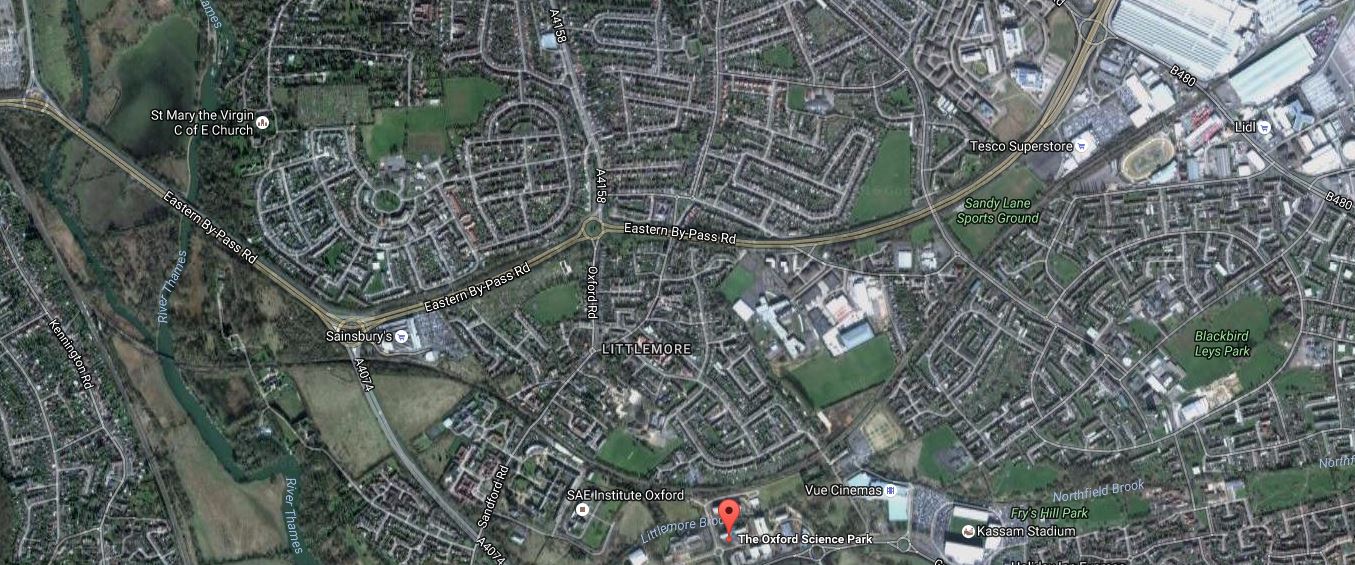
Kennington Junction is where the branch leaves the Oxford to Didcot Line and then curves across the South of the City to the Mini Factory, which is the massive set of light-coloured buildings in the North-East corner of the map.
The Oxford Science Park is indicated by the red arrow, with the stadium to its East.
Can All Bi-Mode Trains And Locomotives Do This?
The November 2016 Edition of Modern Railways has an article about the new Class 88 locomotive.
It is an electro-diesel locomotive, than can run on both overhead electric power or its own onboard diesel engine.
This is said.
The loco can transition from electric to diesel power on the move, dropping the pantograph without losing speed.
That must make operation very flexible.
I wonder if all bi-mode trains and locomotives can do this!
 The Anonymous Widower