What A Fine Mess Thameslink And The Midland Main Line Is In
This article is prompted by an article in the May 2017 Edition of Modern Railways, which is entitled Crunch Time Nearing For MML Thameslink Timetable.
The author of the report; the respected Roger Ford, explains the problems of getting a timetable that is acceptable to a number of parties.
Govia Thameslink Railway (GTR) want to do the following.
- Run 20 trains per hour (tph) through the central core of Thameslink by May 2018.
- Run 24 trains per hour (tph) through the central core of Thameslink by December 2018.
- Run eight, four and four tph respectively to Bedford, Luton and St. Albans.
East Midlands Trains (EMT) and/or their successor, want to do the following.
- Run their current diesel services.
- EMT want to run new new electric services to Kettering and Corby.
- EMT want to run 6 tph at 125 mph into St. Pancras.
And both companies will have to satisfy the politicians.
Network Rail’s original plan is described under Political Developments in the Thameslink entry in Wikipedia. This is said.
Network Rail had planned to terminate Sutton Loop Thameslink trains at Blackfriars station, rather than have them continue through central London as at present. This would increase the capacity of the central core as the Sutton Loop could only accommodate shorter trains. This upset many residents in South London and their local politicians, who saw it as a reduction in services rather than an improvement. In response to pressure, government has ordered Network Rail to reverse the decision.
It is an awful lot of trains to squeeze into the Midland Main Line.
Some improvements were planned to help with the capacity North of Bedford.
- A fourth track between Bedford and Kettering/Corby.
- !25 mph electrification.
Both these should happen, but the electrification South of Bedford will only be 100 mph capable and there is no date for its upgrade.
So it looks like we have the classic pint pot and everybody is trying to put a quart in it.
Roger points out that the knock-on delays for a late train, could be horrendous and felt all over the North, with several minute increases in journey times to Sheffield and Nottingham.
Roger does highlight a couple of solutions.
Turning Thameslink Services At Kentish Town
The first Roger Ford outlines is to turn some services from the South at Kentish Town.
- ,There is stabling capacity.
- EMT might take over some of the fast outer-suburban commuter services.
- There is a good connection to the Northern Line, which will have an increased capacity in a couple of years.
Perhaps too, a connection could be made with the Gospel Oak to Barking Line at West Hampstead Thameslink and Tufnell Park to improve connectivity.
But would the politicians accept a solution like this?
Has Thameslink Got The Wrong Length Of Trains?
If you look at some recent train orders, they seem to suggest a train and a half-train philosophy.
- GWR’s order for Class 80x trains.
- VTEC’s order for Class 80x trains.
- Greater Anglia’s order for Aventras.
- SWT’s order for Class 707 trains.
In all these orders, it would appear that two half-trains are used to create a full train, when needed. This coupling and uncoupling is done throughout the day and often on an automatic basis.
But Thameslink’s Class 700 trains only come in lengths of eight and twelve cars.
The eight-car train is needed for short platforms on the Sutton Loop Line.
But eight-car trains have disadvantages compared to say a six-car train.
- two trains can’t be joined together to make a long train.
- An eight-car train uses one of the valuable twenty-four hourly paths through the central core of Thameslink, just as a twelve-car train does.
The train length is patently inefficient.
The Sutton Loop Line could be run by using six-car trains that split and join at Streatham station.
Splitting Regional Services With A Change Of Train
This diagram from the Wikipedia entry for East Midlands Trains shows the company’s routes.
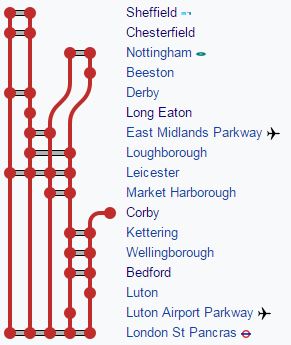
I can’t see that expecting passengers to change trains on a journey say between London and Sheffield would be welcomed by everyone.
Electrification To Leicester, Derby And Nottingham
This section is an aside, but I think that it could be the key to solving the capacity problem.
Electrification to these three cities, shouldn’t be a problem other than the usual one of Network Rail’s competence and it could be completed by 2023, which would include Sheffield.
However, there is a serious problem with electrification between Derby and Sheffield, in that the line goes through the World Heritage Site of the Derwent Valley Mills.
But there is an alternative plan, which is to electrify the Erewash Valley Line, which avoids the World Heritage Site and provides a more direct and possibly faster route between London and Sheffield.
Under Future in the Wikipedia entry for the Erewash Valley Line, this is said.
Network Rail as part of a £250 million investment in the regions railways has proposed improvements to the junctions at each end, resignalling throughout, and a new East Midlands Control Centre.[1]
As well as renewing the signalling, three junctions at Trowell, Ironville and Codnor Park will be redesigned and rebuilt. Since the existing Midland Main Line from Derby through the Derwent Valley has a number of tunnels and cuttings which are listed buildings and it is a World Heritage Area, it seems that the Erewash line is ripe for expansion. As the new signalling is rolled out, train detection is moving away from the traditional Track circuit detection of trains to Axle counting.
I hope all of the work done on the Erewash Valley Line has made sure that whenh they do electrify the line, the bridges are high enough and the signalling cables are well out of the way.
As the East Midlands Hub station for HS2 will be close to Toton TMD on the Erewash Valley Line and would open in 2032/3, it strikes me that it would be sensible to plan electrification of the Midland Main Line and HS2 together.
Bring On The Bi-Modes
Roger Ford dismisses the bi-modes in strong words.
A bi-mode doesn’t really work on the high-speed main line.
Under the wires it is a very heavy EMU, while under diesel power it is an underpowered DEMU. Just consider the roles on the MML. From London to Bedford it would need to run as a 125 mph diesel. From Bedford to Kettering the pantograph would go up for some 125 mph running. And after that it would go back to diesel. So why bother with the electric traction?
I would agree with that, but the Class 80x bi-modes may have other characteristics, that could get the timetable out of trouble.
The current hourly timetable out of St. Pancras is as follows.
- XX:00 – Corby, stopping at Luton, Bedford, Wellingborough and Kettering.
- XX:15 – Nottingham, stopping at Market Harborough, Leicester and East Midlands Parkway
- XX:26 – Sheffield, stopping at Leicester, Loughborough, East Midlands Parkway, Long Eaton, Derby, Chesterfield
- XX:29 – Nottingham, stopping at Luton Airport Parkway, Bedford, Wellingborough, Kettering, Market Harborough, Leicester, Loughborough, Beeston
- XX:58 – Sheffield, stopping at Leicester, Derby, Chesterfield
When Bedford to Corby is electrified, there will be another path.
Note that all the paths except those to Corby go through Leicester.
Currently the services are run by a mixture of 27 x Class 222 trains of 4, 5 and 7 cars and 12 x InterCity 125s of a 2×8 formation.
I said that the Class 80x trains may have other characteristics, that could get the timetable out of trouble.
One is that, two closely-related Class 395 trains can automatically couple and uncouple in under a minute, so I suspect that the Class 80x trains will have the same capability.
So supposing a pair of Class 80x trains ran from St. Pancras to either Bedford, Kettering or Leicester, where they would divide, with each train going to a separate destination.
This would mean that six paths would give twelve services to each of three destinations, Corby, Nottingham and Sheffield via Derby and Chesterfield.
EMT could balance the number of trains with their passenger statistics and could extend services from Corby, Nottingham and Sheffield, as they felt appropriate.
Modern trains would also be able to execute stops quicker than the current Class 222 trains and Inter\City125s.
So could extra stops be introduced South of Bedford to enable Thameslink services to be simplified and thinned out?
Conclusion
These may be consequences.
- Four tph might be able to call at Luton Airport Parkway and East Midlands Parkway.
- Sheffield and Nottingham might get marginally slower services, but they could get four tph.
- All EMT might stop at Bedford, to enable Thameslink services to Bedford to be reduced from 8 tph to 4 tph.
- Two tph between Sheffield and London might use the Erewash Valley Line and stop at Alfreton and Ilkeston.
There’s an optimal solution in there somewhere.
Yprkshire Gets Excited About The Borders Railway
The headline of Rail study looks at linking Leeds to Edinburgh along historic line in this article in the Craven Herald says it all.
After all England has its spectacular line in the shape of the Settle to Carlisle Line and linking it to Edinburgh would only be restoring its original purpose, when the route was built by the Midland Railway.
Reverse Commuting To Cambridge North Station
Cambridge North station opens on the 21st May 2017.
Around 1070, I commuted from London to Welwyn Garden City. It was much more relaxing than sharing the busy trains into London and on early trips to Cambridge in the last few years, I’ve noticed that quite a few people commute from London to Cambridge.
So given the proximity of the new Cambridge North station to the Cambridge Science Park, I wonder how many will use the service to get to and from their place of work?
The Service On Sunday, 21st May 2017
Trains would appear to be every hour at XX:42 taking about ten minutes under two hours.
The Service On Monday, 22nd May 2017
The weekday service would appear to be more comprehensive.
- 06:08 KX 1:02
- 06:44 KX 0:53
- 06:52 KX 1.14
- 07:04 KX 1:32
- 07:28 LS 1:32
- 08:04 KX 1:29
- 08:14 KX 1:00
- 08:28 LS 1:33
Note that KX is Kings Cross and LS is Liverpool Street.
All the trains shown arrive before 10:00 or a few minutes after.
Given that Thameslink will improve this service in May 2018, by adding another two trains per hour, it is certainly a good start.
MTR Plans More Intensive Crossrail Service
The title of this post is the same as an article in the International Railway Journal.
The Planned Central Service
According to Wikipedia, it is planned that the services through the central section is as follows.
Peak
4 tph (trains per hour) Abbey Wood–Heathrow Terminal 4
6 tph Abbey Wood–Paddington
2 tph Abbey Wood–West Drayton
8 tph Shenfield–Paddington
2 tph Shenfield–Reading
2 tph Shenfield–Maidenhead
Off Peak
4 tph Abbey Wood–Heathrow Terminal 4
4 tph Abbey Wood–Paddington
4 tph Shenfield–Paddington
2 tph Shenfield–Reading
2 tph Shenfield–Maidenhead
Which gives totals of 24 tph in the Peak and 16 tph in the Off Peak.
The article suggests that more Off Peak services will be provided.
This is probably only following the rules of the Victoria Line, which runs at a frequency of around 30 tph most of the day and 6 tph at night.
A Train Every Two And A Half Minutes
One of Crossrail’s nine-car Class 345 trains will come through the central section, every two and a half minutes, linking the following stations between Paddington and Stratford stations.
- Bond Street
- Tottengham Court Road
- Farringdon
- Moorgate
- Liverpool Street
- Whitechapel
I think that the frequency of the trains and the design of the stations, will encourage walkers and short distance travellers to use the line.
So could we see a very different pattern of use on Crossrail, when compared to the existing Central Line.
Other factors will make predicting traffic difficult.
- The line runs along one of Europe’s busiest shopping streets.
- The line and connects to Heathrow,
- Many journeys across London will now be made without changing trains.
Being able to increase train frequency would;d be a useful contingency to avoid train overcrowding.
So it looks like MTR are being prudent.
Ovo Energy Snaps At Heels Of Big Six With Corgi HomePlan Takeover
Ovo Energy seem to be making a play for the big time according to an article in City AM, with the same title as this post.
If it comes about, I think I’ll sign up for my boiler, as I’m with Ovo.
How Times Change
Several hundred years ago, those living in the North of England, would have waited with fear and trepidation at the thought of invasion from those living across the Border.
But not anymore!
According to this article in the Cumbria Crack, which is entitled Settle-Carlisle groups welcome Scottish rail study.
This is said.
Putting this into historical context, Mark Rand, Joint Vice Chairman of the 3500-member Friends of the Settle-Carlisle Line said: “People often ask why did the Victorians build a railway line from tiny Settle to the border city of Carlisle. It was part of a much greater whole – the Midland Railway’s main route from London St Pancras to Scotland via Leeds and Carlisle, from where what is today called the Borders Railway continued to Edinburgh. What opportunities the full Edinburgh-Carlisle re-opening would enable! The Friends of the Settle-Carlisle Line welcomes this study with open arms.”
Further, the full re-opening would give a railway offering world-class scenery for much of the 211 miles from Leeds to Edinburgh, attracting huge numbers of international tourists, as happens in countries such as Norway and Switzerland, an industry so vital to the UK economy.
Unlike many railway projects, this project only needs the railway to be built, as the trains that would be ideal for Leeds to Edinburgh via Caelisle, were built forty years ago.
What better route would there be to serve with refurbished examples of Terry Miller‘s masterpiece, the InterCity 125?
Welcome To The Corbyn Comedy Channel
The leaking of the Draft Labour Manifesto is to my mind, proof, if it were needed, that the current Labour Party can’t be trusted to organise a piss-up in a brewery.
I have only read summaries, but most of the policies show such a disregard for the rules of economics, taxation and politics, that it could have been written by someone with Monty Python’s grasp of comedy.
The New Platform 6 At Shenfield Station
These pictures show the new double Platform 5 and Platform 6 at Shenfield station, which opened a few days ago.

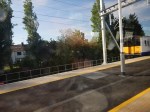

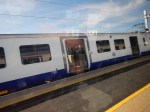
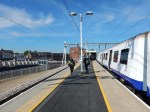


I think that it is a good design.
- Platform 5 is a through platform, where trains can go through the station to and from the sidings to the East of the station.
- Platform 6 is a new bay platform.
If these two platforms are for the exclusive use of Crossrail services, that means that in the Peak, they will be handling sixteen trains per hour (tph) or eight tph on each platform. The Victoria Line handles over twice as many trains on each of its four terminal platforms at Brixton and Walthamstow Central, so the more modern Crossrail should handle the number of trains with ease.
There has also been a major restructuring of the other lines through the station. But as services terminating at Shenfield are not now handled by Platform 4, I would assume that it is a much more operator-friendly layout.
These could be platform assignments.
- Southend Branch to London trains
- Great Eastern Main Line to London trains
- London to Great Eastern Main Line trains.
- London to Southend Branch trains
- Crossrail
- Crossrail
As there is more platform capacity, it will be interesting to see how Greater Anglia use their share of the extra capacity.
Current and Crossrail times between Liverpool Street and Shenfield are as follows.
- Shenfield Metro – Current – 43 minutes
- Single-Stop at Stratford – Current – 24 minutes
- Crossrail – 41 minutes.
The interesting time will be what will be achieved by Greater Anglia’s Aventras, with just a single-stop at Stratford. I wouldn’t be surprised to see a sub-twenty minute time.
I think passengers between Shenfield and London will choose a route appropriate to their journey.
Crossrail will be a line for the duck-and-divers.
Could The Romford To Upminster Line Handle Four Trains Per Hour?
If you look at the current version of this page on Transport for London’s web site, which is entitled Track Closures Six Month Ahead, you will notice that there are the following closures on the Romford to Upminster Line.
- Sunday May 28th to Monday May 29th 2017.
- Sunday Aug 27th to Monday August 28th 2017.
- Saturday Oct 21st to Sunday October 22nd 2017.
It could be a periodic closure for track or station maintenance as the three closures are three months apart, but I’ve noticed closures on this line before.
I’ve also searched the Internet and can find no references to any ongoing work or improvements on the line or the intermediate station at Emerson Park..
But the entries got me thinking about whether services could be improved on this line.
Various factors will come into play.
The Crossrail Affect
From May 22nd 2017, the new Class 345 trains will start running through Romford station on Crossrail‘s initial service between Liverpool Street and Shenfield stations.
How will Crossrail affect usage of the Romford to Upminster Line?
A lot of journeys from c2c territory in South East Essex will be quicker or easier using Crossrail and the Romford to Upminster Line.
I’ll give Southend to Heathrow as an example.
c2c’s Ambitions
It should also be pointed out that c2c are an ambitious company with new Italian owners and I think they will add new destinations and routes to their network.
I can see a lot of commercial and residential property being built along the North Bank of the Thames at Tilbury and London Gateway.
But if c2c have a problem, it is that it has good connections to the City of London at Fenchurch Street station, but getting to some parts of London like Euston, Kings Cross, the West End and Heathrow Airport is not easy.
There are good onward connections across the City at Barking, Limehouse and West Ham stations, which will be improved with the electrification of the Gospel Oak to Barking Line.
c2c To Liverpool Street
c2c use Liverpool Street station at occasions on Saturdays and Sundays and I have read that they would like to open a second London terminal at Liverpool Street, as this would also allow services to serve Stratford station with the Eastfield Shopping Centre and the Olympic Park.
But I can’t see Greater Anglia and London Overground allowing another operator into the crowded Liverpool Street station.
Could c2c Have Direct Access To Romford?
In an ideal world, where the Romford to Upminster Line would be double-tracked feeding into adequate bay platform or platforms at Romford station, c2c would be able to run a direct service between Romford and Grays stations via Upminster, Ockendon and Chafford Hundred Lakeside, if they felt the service would be worthwhile.
It is one thing to run a four-car shuttle between Romford and Upminster, but look at this Google Map of Upminster station.

Note.
- The c2c lines are South of the District Lines.
- The Romford to Upminster Line goes off to the North-West.
A c2c train going between Romford and Grays would have to cross the busy District Lines, that terminate at Upminster station.
It would probably be possible, but only with the great expense of a massive fly-over or dive-under.
c2c’s Best Access To Crossrail
I would think that c2c’s best access to Crossrail would lie in a frequent service along the Romford to Upminster Line. The current two trains per hour is not enough, so could the branch handle three or even four trains per hour?
The Current Service On the Romford To Upminster Line
The single Class 315 train, that I saw today trundles along at 60 kph and takes a total of nine minutes to go between Romford and Upminster. Turnroumnd at Romford and Upminster take eight and four minutes respectively.
The single train does a round trip in thirty minutes, so it easily does two round trips in an hour.
Emerson Park Station
I went to Emerson Park station this afternoon to see if there was any evidence of improvements.
I found the following.
- The catenary appears to have been given a good refurbishment.
- The station has been tidied up.
- The station is now staffed.
- CCTV is being installed.
- An office is being built.
- New hand-rails are being fitted.
- The station couldn’t accept a train longer than four-cars.
I got the overall impression that London Overground are expecting a lot more passengers to be using Emerson Park station. Wikipedia says this about passenger usage at the station.
It has relatively low but fast-growing patronage for a suburban railway station, with 260,000 passenger entries/exits in 2015/16, compared to 82,000 five years prior and just 32,000 ten years prior.
Given the platform length restriction and the convenience of passengers, I am led to the conclusion that a higher frequency of trains would be beneficial to passengers and operator alike.
How Fast Could An Aventra Travel Between Romford And Upminster?
If you look at a typical three station run on the Overground, such as Dalston Junction-Haggerston-Hoxton, it can tqke between three and five minutes in a Class 378 train, which is probably marginally slower than the new Aventra.
But that is only part of the time, as the driver of the train has to change ends between trips. I walked the length of a Class 378 train today and it took me a minute, so with a well-designed cab and some degree of automation, I suspect that a driver could safely change ends in under two minutes.
As the Aventra will be optimised for fast trips like these, I can see no reason, why a train can’t travel between Romford and Upminster in seven minutes.
Conclusion
A seven minute trip would mean the train could perform the required four trips per hour.
One major problem would be if say there was an incident on the train, like a passenger becoming seriously unwell. The driver would call the emergency services and proceed to the next station. After dealing with the emergency and perhaps seeing the passenger safely in the care of paramedics, the driver would resume the timetable. As there is only one train on the line at all times, service recovery is just a matter of restarting.
 The Anonymous Widower