Cockfosters Station To Be Made Step Free
These pictures show Cockfosters station.


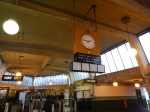





As a child, I used to go to the barbers in Cockfosters station to get my hair cut. I suppose, I went by myself from the time I joined Minchenden Grammar School at eleven. But I could have gone earlier, as it wasn’t that far from where we lived.
The barbers is not there anymore!
The station hasn’t changed much underground, although there’s now a cafe and there are barriers to check the tickets.
As to step-free access, there will need to be a lift on both sides of Cockfosters Road, as stairs are impossible, exzcept for the fully able-bodied.
There will certainly be more difficult stations to make step-free.
Once passengers are down in the station, it is a completely level walk, push or drag to the trains.
What Are Transport for London’s Plans?
Transport for London have stated that their aim is to eventually have all Underground stations with full step-free access.
But Cockfosters station may attract a large number of visitors with bikes, buggies and wheelchairs.
- The station is on the London Outer Orbital Path.
- Trent Park is nearby.
- Cockfosters is at the end of the Piccadilly Line. So is it a stations, where passengers are dropped for Central London, Kings Cross and Heathrow?
Christ Church, Cockfosters is nearby, where C and myself got married. Possibly more importantly,the UK Memorial Service for Elivis Presley was held in the church, as this page recalls.
One thing that appears to be better at Cockfosters station from my childhood are the buses.
- There are more bus routes calling at the station.
- All the buses now have wheelchair spaces and access ramps.
- Bus information is better.
So will we see the bus routes from Cockfosters station further developed to serve new housing developments?
Stealing With Pride: Testing Automotive Industry Tech On Swiss Trams
The title of this post, is the same as this article on Global Rail News. This is first two paragraphs.
Swiss public transport operator Baselland Transport (BLT) is testing Bosch Rail Transport’s light rail collision-warning system in collaboration with Stadler.
Should the tests prove successful, BLT plans to equip its entire fleet of Tango trams with the technology – which is already established in the automotive industry.
In my working life, I often stole ideas and especially methods from other industries and obscurer mathematical papers.
This use of an automotive system on a tram is a good way of the application of proven technology in another area.
Study Concludes There Is Demand For A Light Rail System In Bath
The title of this post is the same as that of this article in Global Rail News.
This is the first two paragraphs.
Plans to bring a light rail system to the historic city of Bath, UK, have taken a step closer after it received backing from a preliminary study.
The study was produced by consultants Atkins and followed suggestions from the public to look at the potential for a new tram system, according to Bath and North East Somerset council.
Consider.
- Atkins are one of best consultants in the world, with lots of experience.
- Many Continental cities, the size of Bath have a tram network
- Darmstadt with a population twice that of Bath has nine tram lines.
- Tram systems in historic towns and cities can be built without catenary, using batteries for motive power.
- Smaller lightweight tram systems are being developed.
So I’m not surprised that, it was recommended that Bath get a tram network.
But if Bath can develop a viable tram network, then surely any town or city with the right set of problems and needs should be looking at trams.
My list of possible cities and large towns, where trams could start by connecting the the railway station to the main town centre would include.
- Cambridge
- Colchester
- Coventry
- Huddersfield
- Ipswich
- Leicester
- Middlesbrough
- Norwich
- Wigan
There must be loads more.
Wimbledon Park Station To Be Made Step Free
These pictures show Wimbledon Park station.

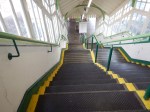


The stairs are very bad at this station and as it is an island platform, only one lift would be needed.
To illustrate the poor quality of the access, as I sent down the stairs, a passenger was helping a mother get her baby in a pushchair up the stairs.
The station is a disgrace!
No wonder Transport for London are making the station, step-free.
Railway That Could Bridge Middle East Divide
The title of this post is the same as an article by Roger Boyes in today’s copy of The Times.
The sub-title of the article is.
A new track from Israel to Saudi Arabia offers economic growth and stability in the region.
Read the article!
Thoughts On The National Lottery
The phone-in on BBC Radio 5 Live this morning is discussing the National Lottery.
I sent in this text.
The lottery, like religion, is just another way to extract money from the poor. If people need the buzz of gambling, there are much better ways of using sums of surplus money like local charities, crowd-funding bob-sleighers and peer-to-peer lending.
The lottery has served it’s purpose, but no politician dare kill it!
I doubt it’ll be read out!
Bristol Gets Serious About A Local Metro
A few days ago, a short article appeared in The Times, which was entitled Bristol Tube Plan To Beat Congestion.
This is the first two paragraphs.
Bristol could become the fifty city in Britain to get an underground rail system under plans to ease crippling congestion.
The council is investigating plans to build three lines, including one linking the city’s airport to the south, at a cost of about £4billion.
The article also notes that Cambridge is thinking along the same lines.
The problem is that tunnelling is expensive, as the Bristol estimate shows.
We also have the problem that some areas of the country are much easier to tunnel than others. The asymmetric nature of the London Underground is explained by London’s patchy geology, where tunnelling is easier, where there is London clay.
Bristol are also looking at improving their network of local rail lines, called MetroWest. Wikipedia says this about the network.
MetroWest, formerly known as the Greater Bristol Metro, is a proposal to improve the rail services in Bristol, England, and the surrounding region. It was first proposed at First Great Western’s Stakeholder Event in March 2008. The aim of the project is to develop half-hourly services through central Bristol which will also serve the surrounding West of England region. Transport campaigning group, Transport for Greater Bristol are actively supporting the proposal,[3] as are the four unitary authorities. Services are expected to start in 2019 for phase 1 and 2021 for phase 2.
Nothing much seems to be happening, although a new Portway Parkway station is going to built.
This article in the Bristol Post is entitled Bristol Could See Hydrogen-Powered Trains To Tackle Carriage Shortage.
This is said.
Bristol train lines could see new eco-friendly hydrogen trains introduced as the future of planned electrification remains uncertain.
The new regional trains are being tipped as an alternative to diesel powered trains and transport secretary Chris Grayling says he would like to see the technology introduced “within a short period of time.”
The article also includes Alstom’s promotional video.
If nothing else, the two articles show that Bristol is thinking seriously about some form of integrated rail system in the city.
 The Anonymous Widower