Did The Queen Ever Ride In This Train?
These pictures show the British Rail BEMU, which was an experimental two-car battery electric multiple unit, that ran on the Deeside Railway between Aberdeen and Ballater stations, in the late 1950s and early 1960s.
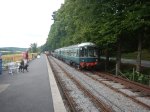
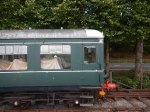
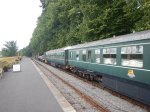
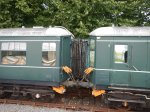
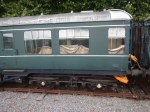
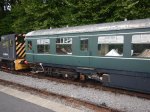


It is now parked at the Royal Deeside Railway awaiting restoration.
As the bodywork is aluminium, it struck me that it wouldn’t be an impossible restoration project.
Someone, I spoke to, said the biggest problem and probably expense were the batteries.
Perhaps, they could use some recycled batteries from electric buses or other vehicles, which some companies are going to use as house storage batteries.
A Memory From A Lady
I travelled to the Royal Deeside Railway on a bus and sat up front on the top deck. Next to me was a lady, who was perhaps in her seventies like me, who remembered using the train several times.
From what she said, it appeared to work reliably for a number of years.
Did Her Majesty Ever Use The Train?
No-one at the Royal Deeside Railway has any proof, that the Queen ever rode in the train.
But they are pretty sure, that the Queen Mother used the train. Apparently, she liked the steady speed as it proceeded through the countryside.
Conclusion
With the current developments in battery transport, I feel that this prototype might well be worth restoring to operation condition.
ScotRail’s Four-Car High Speed Trains
I took these pictures at Aberdeen station.
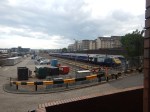
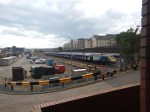

Unfortunately, I couldn’t really get any closer.
Looking at the pictures, it appears that the new sliding doors to the coaches have not been fitted.
It also looked as if windows had been added to the sides of one power car. Why?
Dundee Station
Dundee station has recently been rebuilt and it is now a mixture of old and new.








The old part are the platforms, which are below street level, and are now connected to the surface by lifts and escalators.
The surface buildings are new and bring back an old Victorian idea; the station hotel. But this is not a massive five star edifice, but an affordable Sleeperz hotel.
There’s a lot to like about the station.
- The platform layout of two long platforms with two bay platforms in between, must be ideal for operators.
- The lift and escalators to the surface.
- The snack bar between the platforms.
- The convenient hotel.
- The short walks to the attractions, which will soon be joined by a branch of the V & A.
- It was designed by local architects; Nicoll Russell Studios.
And all for a total cost of £23million.
I hope we see more stations like this one.
Alloa Station
Alloa station is ready for new electric services.


Currently, there is only an hourly service, which is just not enough for a town of 20,000 residents.
Note too, that there is a double-track through the station, although it looks like the second track is not electrified.
But it does appear that the gantries have been built so, that the second track could be electrified, so that electric trains could be run through the station to reopened stations to the East.
Class 365 Trains To The Rescue
I had intended to get a ride on a new Class 385 train, but I only caught a glimpse of one going the other way, from a Class 365 train, that I used both ways between Edinburgh and Glasgow.

Passengers seemed to be quite happy with the Class 365 trains cascaded from the Cambridge Cruiser.
I really think that Hitachi have got their production of the Class 385 trains, seriously wrong here.
The body shells are made in Japan and then sent to Newton Aycliffe by sea. This must be an easy way to ensure a slow production of trains.
Bombardier make the body shells in the same factory as they design and assemble the trains.
Even if CAF make their body shells in Spain, that is a much shorter and probably more reliable journey.
I must admit if I was the CEO of a train operating company, I wouldn’t buy a Hitachi train.
But then Tony Blair only wanted a new factory, close to his constituency!
Glasgow Queen Street Station – August 10th 2018
I took these pictures as I passed through Glasgow Queen Street station.




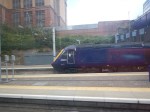
Note the four-car InterCity 125 in the station, testing and training staff for new services to Aberdeen, Dundee, Inverness, Perth and Stirling.
The Tram-Train Platforms At Rotherham Central Station
When I passed through Rotherham Central station, I took these pictures of the tram-train platform extensions.
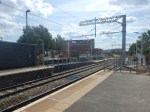
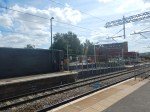
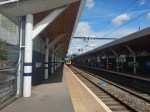


I do wonder, if the design is right.
- I was going to the New York stadium and if I’d arrived on a tram-train from Sheffield city centre, I would have walked a long way down the full platform to cross the line using the stairs or lift.
- Going back to Sheffield, will I be able to avoid walking to the station entrance.
- Passengers expect to be able to walk directly to a tram platform without any barriers.
- Tram passengers also expect to be able to walk across the lines to get to the other platform.
I shall be interested to see how bad the design is when it’s finished.
Could Rail Access To Heathrow Be Formed Of The Best Bits Of Various Schemes?
Various schemes have been proposed to improve rail access to Heathrow.
There are also two schemes in progress, that will improve rail access to Heathrow.
- Crossrail, which will open in 2019.
- Piccadilly Line Upgrade, which will be complete in 2025.
I also believe that if the West London Orbital Railway is created, then this could have a positive affect on travelling to and from Heathrow.
Heathrow In The Future
Heathrow are disclosing a master plan, for rebuilding a lot of the airport to make it more efficient and up with the best.
- There will be two main terminals; Heathrow West and Heathrow East with satellites in between handling the actual planes.
- These two terminals and the satellites will be between the two existing runways, with a passenger and baggage transport system beneath.
- Terminal Five will become Heathrow West.
- An extended Terminal Two will become Heathrow East.
- Crossrail, Heathrow Express and the Underground will serve both main terminals.
I believe that this rebuilding will happen, whether or not a third runway is built and it could start in the next few years.
Heathrow’s Pollution Footprint
Heathrow is a big polluter, but it is not so much the planes, as the diesel cars, buses and trucks serving the airport.
Uses For Improved Rail Access
There are several uses for improved rail access to Heathrow.
Passengers
Many passengers feel they must drive to and from Heathrow.
Next year, Crossrail will connect Heathrow directly to the City of London, Canary Wharf, the West End and to the heart of London’s Underground, Overground and National Rail system.
An example journey will be Bond Street to Heathrow Central in twenty-six minutes.
New trains on the Piccadilly Line are planned to enter service in 2023 and will offer more capacity and more pleasant journeys.
Currently, Piccadlly Circus to Heathrow Central takes fifty-two minutes and I would hope that this time is reduced to perhaps 40-45 minutes.
I think, these two upgrades will change the way many in Central, North East, East and South East London access the airport.
- Trains will be more comfortable.
- Trains will be frequent.
- Crossrail will be completely step-free.
- The Piccadilly Line will have more step-free stations.
- The Crossrail trains will have masses of space.
- Trains will take passengers to all the terminals
But Crossrail and the Piccxadilly Line upgrade, will do little for those in North West and South West London and those living to the West of the airport.
Workers
Workers at Heathrow, range from highly-paid pilots down to lowly-paid cleaners, with a full spectrum in between.
Many though have a problem, in that they need to get to and from the airport at times, that are inconvenient for public transport.
A station guy at Staines said that getting between there and Heathrow for an early start or after a late finish is difficult.
The lower-paid workers also need good links to areas of lower-cost housing.
In an ideal world, Crossrail and Piccadilly Line services, should run on a twenty-four hour basis, with appropriate frequencies.
Supplies For The Airport And The Aircraft
I wonder what percentage of the supplies for Heathrow is brought in by diesel truck.
In the Heathrow of the Future, surely many supplies could be loaded onto smart trolleys and taken on electric freight trains to delivery points under the airport.
Air Cargo
Heathrow is an important air cargo terminal, but as with supplies, surely the cargo can be collected outside of the airport and delivered by electric shuttle trains.
The Best Bits Of The Various Actual And Proposed Rail Routes Into Heathrow
Crossrail
- Connectivity to large parts of London and the East.
- Connectivity to lower-cost housing areas in East and West London.
- High capacity.
- Frequent trains
- Modern trains
- All terminals served
- Extra trains could be added.
The capability for 24 hour operation has hopefully been built in.
Heathrow Southern Railway
- Connectivity to Waterloo, Clapham Junction, South and South West London
- Extends Heathrow Express to Woking and Basingstoke
- Adds a new route for commuters into Paddington.
- Extends Crossrail from Heathrow to Staines.
- It will be built alongside the M25 with a tunnel to Terminal Five.
- All terminals served
- Provides a freight route into the airport from the South West.
- Privately funded.
HS4Air
- Connectivity to HS2, the Midlands, North and West of England and Wales
- Possible connection to Gatwick and Ashford for the Continent.
- North-South station in a tunnel deep under Heathrow.
- The Heathrow station will be able to handle full-length high speed trains from Birmingham, Cardiff and Manchester.
- Heathrow could become a High Speed Rail hub serving Greater Western London.
- Sneaks along the M25.
- All terminals could probably be served, by escalators and lifts from the deep station.
- Provides a freight route into the airport from the North and West.
- Privately funded
I’m keener on the section North of Heathrow, than that to the South.
Piccadilly Line Upgrade
- Connectivity to West and North London
- Connectivity to lower-cost housing areas in West London
- Frequent trains
- All terminals served.
- No new infrastructure
Probably needs 24 hour operation.
Western Rail Approach To Heathrow
- Connectivity to Slough and Reading and further West with a change.
- All terminals served.
- Provides a freight route into the airport from the West.
- Network Rail’s proposed scheme.
- Government funded (?)
West London Orbital Railway
- Connectivity to North West London with a change at Old Oak Common.
- Connectivity to low-cost hosting areas in West London.
- Created as part of the Overground.
- Eight trains per hour (tph) through Old Oak Common.
- Connectivity for high-value passengers in affluent parts of North London.
- Connectivity for important workers in less-affluent parts of North West London.
- Probably, Transport for London funded.
- No difficult construction.
The West London Orbital Railway should go ahead, because it connects so much of West London to Crossrail, Old Oak Common and High Speed Two.
Windsor Link Railway
- Connectivity to Slough and Reading and further West with a change.
- All terminals served.
- Provides a freight route into the airport from the West.
- Privately funded
This scheme also unlocks development of upmarket housing in Windsor.
Conclusions
I have seen railway stations and airports all over Europe.
Many airport stations are cramped, as they have been built as an afterthought.
But some like Schipol and Frankfurt have a comprehensive station, where you can get trains to a very long list of places without a change.
Heathrow Connectivity
Heathrow needs a very high level of connectivity, for passengers, workers and freight.
Two schemes provide that.
- Heathrow Southern Railway, which extends Heathrow Express to the South West and provides links to Waterloo and Greater South London.
- HS4Air, which has an elegant expandable station deep under the airport and connects to High Speed Two and the Great Western Railway in the North. Extending to Gatwick and Ashford for the Continent could also be possible, if required.
Western Rail Approach To Heathrow only does what it says in the name and HS4Air does that without bagging valuable platforms at Terminal Five.
What About The Workers!
Heathrow’s other big need is rail access for the increasing numbers of people, who work at the airport and live locally.
- Heathrow Southern Railway links the airport to South West London and also allows an extension of Crossrail to Staines.
- Windsor Link Railway links the airport to Windsor, Slough and Reading.
- Crossrail links the airport to Old Oak Common with its housing developments and rail connections with High Speed 2 and the London Overground.
- West London Orbital Railway will bring more workers and passengers to Old Oak Common from all over North West and South West London.
Old Oak Common will be important for many working at the airport.
Old Oak Common station
Old Oak Common station will become an important interchange for workers and passengers travelling to and from Heathrow.
- It must be totally step-free.
- Some of the long interchange walks on current plans should be augmented by travelators.
- Crossrail is planning six tph between Old Oak Common and Heathrow. Is that enough?
Get Old Oak Common right and all those needing to go to and from Heathrow will benefit.
Heathrow And Gatwick
The connection between Heathrow and Gatwick airports is tortuous at present, but will get better as the years progress, as Crossrail and Thameslink improve.
As the airports grow, with a third runway at Heathrow and a second one at Gatwick, how many people will want to travel quickly between the two airports, as increasingly, both airports will offer services to more destinations?
As a Londoner, I also believe that we will see more split flights, where passengers stopover in London for a night or two, when they are going halfway around the world. Terminal London will be the best airport transfer terminal in the world.
Predicting the number of travellers between the two airports will be extremely difficult and only a direct measurement will be a worthwhile figure.
If a direct rail link is needed, HS4Air should be extended to Gatwick to provide a frequent fifteen minute connection.
Heathrow And High Speed One
I will be very surprised if many travellers need to go quickly between Heathrow and High Speed One.
Why would anybody between say St. louis and Paris not fly direct? Perhaps only, if you were spending time in London between the two legs of your journey.
For those that need to do it, using an extended Crossrail between Heathrow and Ebbsfleet will probably be good enough.
But when passenger numbers say it would be viable, extending HS4Air to Ashford would be a distinct possibility.
Heathrow And High Speed Two
For all sorts of reasons Heathrow needs good connectivity to High Speed Two.
If I was the CEO of Heathrow, I would want to have a station at my airport, where passengers could travel to and from the major cities of Birmingham, Leeds, Liverpool, Manchester, Newcastle and Nottingham in as direct a manner as possible.
Using Crossrail to Old Oak Common will give access to all High Speed Two trains, but the ability to get a train to the North within thirty minutes of clearing immigration and customs, would be a major selling point for my airport.
Suppose HS4Air was providing four tph to Birmingham of which two tph, went to each of Crewe/Manchester and Nottingham/Leeds.
Or the four tph could be double trains, with one half serving each Northern route.
This would make Heathrow a viable alternative to regional airports.
Heathrow will strongly support HS4Air, as it would be like having a whole series of regional flights, with a thirty minute transfer to and from long-haul routes.
Western Rail Approach To Heathrow
The Western Rail Approach To Heathrow is far inferior to the HS4Air proposal.
Consider.
- The Western Rail Approach To Heathrow only connects the Great Western Railway to Heathrow.
- HS4Air connects High Speed Two as well.
- HS4Air creates a new expandable station under the airport, which would be capable of handling the longest trains.
- HS4Air can be expanded to Gatwick and Ashford.
- HS4Air is privately funded.
Direct access between Slough and Heathrow can be provided by the Windsor Link Railway.
A Final Conclusion
All these schemes have their good points and I think that the best way to get the rail access that Heathrow and Gatwick need, is to let the private sector build what the airports need, subject to the correct planning permissions.
A Railway That Needs Electric Trains But Doesn’t Need Full Electrification
This article on Rail Magazine is entitled ScotRail Targets Further Electrification Schemes.
This is the first paragraph.
The five years from 2019 could feature more wiring in Scotland, with ScotRail Alliance Managing Director Alex Hynes telling RAIL: “I’d love to see more electrification – Stirling to Perth, East Kilbride and the Edinburgh South Suburban.”
In this post, I will look at electrification of the Busby Railway to East Kilbride station.
- The station is 11.5 miles from Glasgow Central station.
- The station has an altitude of 504 feet.
- It is a single platform station.
- The route to Glasgow is double-track, except for the last section from Busby station, which is single track, with a passing loop at Hairmyres station.
- A two trains per hour (tph) service is provided between Glasgow Central and East Kilbride using two two-car diesel Class 156 trains.
This picture shows East Kilbride station.
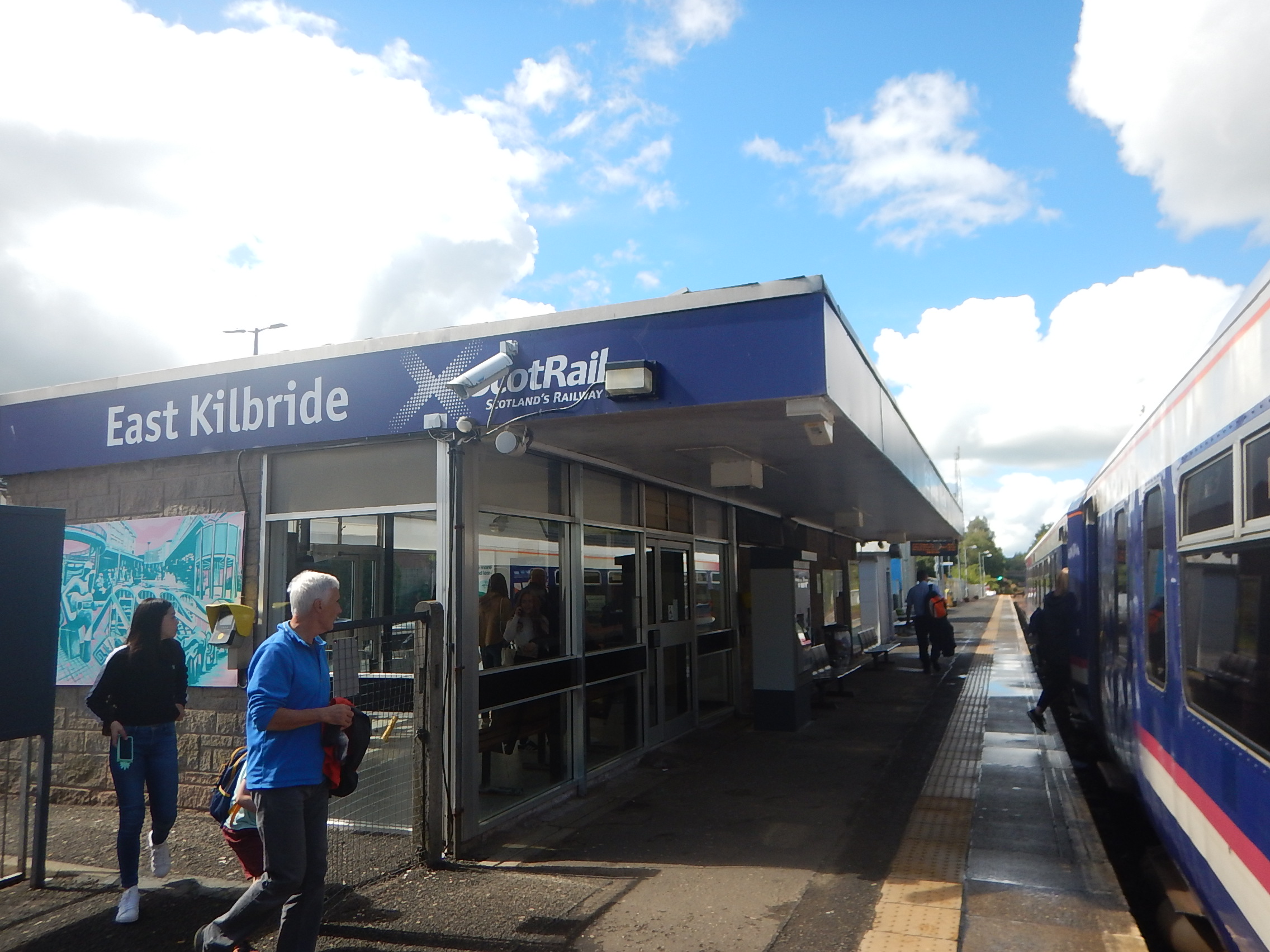
Nothing complicated at this station and it comfortably handles two tph.
In the UK, there are several stations where four tph are handled using a single platform.
- Chester, Kirkby and Ormskirk on Merseyrail.
- Clapham Junction, Dalston Junction, Highbury & Islington, New Cross and West Croydon on the London Overground.
Transport for Wales also intend to run four tph to several single-platform stations including Rhymney, which is high in the valleys.
I suspect that with modern signalling and driver aids, Glasgow’s drivers would be capable of running four tph between Glasgow Central and East Kilbride stations.
Judging by my trip on the route, there is certainly a need for more capacity, as if every seat is taken at two in the afternoon, two-car trains running at a frequency of two tph is just not enough.
So surely running new four-car electric trains to the current timetable, would be the standard solution for this route?
But!
Look at these pictures of the route..







It wouldn’t be a nightmare to electrify, but because of the stone bridges and the steel footbridges, it would be expensive and very disruptive.
The following should also be noted.
- The railway has never gone further than East Kilbride station.
- There is no freight on the line, except for that needed for maintenance.
I am very much drawn to the conclusion, that to electrify the whole route would use money that would probably be better spent on improving step-free access at some of the stations.
Electric Trains To East Kilbride Without Full Electrification
Before I detail the solutions, I shall look at the energy required to raise a train from Glasgow to East Kilbride station.
Consider.
- A four-car electric train like a Class 321 train weighs 138 tonnes.
- This train has 309 seats, so could probably accommodate 400 passengers.
- Assuming each weighs 90 kg with buggies, baggage, bicycles and bagpipes, this gives a train fully-loaded train weight of 174 tonnes.
Using Omni’s Potential Energy Calculator, it would take 73 kWh of energy to raise the train to the 504 feet altitude of East Kilbride station.
It should also be noted that Glasgow Central station and the approaches to the station are fully electrified almost as far as Crossmyloof station.
What solutions are available to have as-new electric trains running between Glasgow Central and East Kilbride station?
The Rhymney Line Solution
The Rhymney Line runs between Cardiff Central and Rhymney stations.
In the design of the new South Wales Metro, the highest section of this line between Ystrad Mynach and Rhymney stations will be run on battery power.
- This section is about eleven miles long.
- It is a mixture of single and double-track.
- The height difference is 410 feet.
This is very similar in severity to the Busby Railway.
Transport for Wales are proposing to use Tri-Mode Stadler Flirt trains on this route.
These trains would be able to handle the East Kilbride route without any modification to the track or electrification.
It would just mean.
- Trains identical to those on the South Wales Metro.
- Building and delivering the trains.
- Training the drivers and other staff.
There would be other advantages.
- Stadler trains seem to be one of the best for step-free access, with automatic gap fillers between platform and train.
- They are 100 mph trains.
- They are ready for modern signalling.
- They can change mode at line speed.
These trains which will be Class 755 trains in Abellio Greater Anglia service, have a central power-pack, that can incorporate diesel or battery power to supplement power from the electrification.
Good engineering design would probably mean.
- The four slots in the power pack, can be fitted with a diesel engine, battery or perhaps even a hydrogen fuel cell to give a power profile tailored to the route.
- The battery would weigh a similar amount to the Deutz diesel engine, which would give a battery capacity of perhaps 100-120 kWh.
- There is an intelligent computer system controlling the power and braking systems.
- The trains come in various lengths from three-cars upwards.
This is a summary of the Stadler multi-mode trains ordered for the UK.
- Abellio Greater Anglia – Electric/Diesel – 14 x three-cars – Two Deutz diesel engines
- Abellio Greater Anglia – Electric/Diesel – 24 x four-cars – Four Deutz diesel engines
- Trains for Wales – Electric/Diesel – 11 x four-cars – Four (?) Deutz diesel engines
- Trains for Wales – Electric/Diesel/Batteries – 7 x three-cars – One Deutz diesel engine and three batteries (?)
- Trains for Wales – Electric/Diesel/Batteries – 17 x four-cars – One Deutz diesel engine and three batteries
I’m sure Abellio Greater Anglia won’t leave Abellio ScotRail, short of operational information.
In addition, they might be ideal for other routes in the Glasgow area.
- The Glasgow South Western Line to Kilmarknock, Dumfries and Carlisle.
- The Ayrshire Coast Line to Ayr and Stranraer.
- The West Highland Line to Oban and Mallaig.
They would use the electrification, when close to Glasgow.
I can’t see any reason, why another version of the Tri-Mode Stadler Flirt won’t be able to run services between Glasgow Central and East Kilbride stations.
The Battery Solution
Transport for Wales intend to run their Tri-Mode Stadler Flirts on battery from Ystrad Mynach to Rhymney. I can’t see any reason why a well-designed battery train can’t do the similar climb to East Kilbride station.
Of the major train manufacturers, only Stadler seem to have declared their hand with the Rhymney Line proposal.
- Bombardier have run prototypes in the UK and Germany, but are very protective with solid information.
- CAF have run battery trams and will introduce them to the UK in the next year or so.
- Hitachi use batteries in their trains and have run battery trains in Japan.
Also, consider that between Glasgow Central and Pollokshields East stations is electrified and extending this electrification to say Busby Junction. where the Busby Railway leaves the Glasgow South Western Line, would have the following benefits.
- The distance to run on batteries would be reduced by about three miles.
- There would be more electrification to ensure that train batteries were full before the climb to East Kilbride.
- If bi-mode trains were to run to Kilmarnock, Dumfries and Carlisle, they would have more electrified line to use.
This short section of electrification would certainly improve the mathematics of running battery trains to East Kilbride.
As Busby Junction to Kilmarnock is around twenty miles, it might even make it possible to run battery trains between Glasgow Central and Kilmarnock stations.
I have no doubts that, a battery train can be built to handle services between Glasgow Central and East Kilbride.
The Hydrogen Solution
I tend to think of trains powered by a hydrogen fuel cell, as battery trains with an environmentally-friendly onboard power source.
The Busby Line route is ideal for battery trains, especially, if there is a few miles of new electrification at the Glasgow Central end of the route.
Alstom’s proposed hydrogen-powered Class 321 train, could also be ideal for this route.
Four-car trains with a decent interior, would certainly solve the overcrowding on the route.
In A Class 321 Renatus, a comment was put, that says that the hydrogen-powered Class 321 trains will share the Renatus interior.
I’d suspected that would be the case, as why would the train’s owners; Eversholt Rail Group, design two different interiors for the same purpose?
The train would be able to leave Glasgow Central station with a full battery and with the help of electricity from the hydogen fuel cell, it would be able to climb to East Kilbride.
Coming down, the train would be partly powered by the battery, but mainly by gravity. Energy generated by the regenerative braking would be stored in the battery.
Alstom will be building a mathematical model of the train and its performance on various routes, so they will know the energy flows, when the train is working.
I said earlier that the following routes would be ideal for Stadler’s bi-mode trains.
- The Glasgow South Western Line to Kilmarknock, Dumfries and Carlisle.
- The Ayrshire Coast Line to Ayr and Stranraer.
- The West Highland Line to Oban and Mallaig.
I feel the same logic applies to Alstom’s hydrogen trains.
Conclusion
All three solutions, I outlined in this post, could be possible.
The solutions have several things in common.
- All will be fully tested elsewhere on the UK rail network.
- None need any electrification between Busby Junction and East Kilbride.
- All would benefit from a few extra miles of electrification between Busby Junction and Glasgow Central station.
- All solutions are backed by respected train building companies.
I think there will be a very keen contest to see who supplies the trains for this and other related routes from Glasgow.
The Stone Arch Railway Bridges Of Scotland
There are a lot of stone arch railway bridges in the UK, but they do seem to more numerous in Scotland, than in England.
These pictures show a selection of bridges on the Borders Railway.








I counted to about fifteen between Edinburgh Waverley and Galashiels stations.
There were probably about an equal number of bridges where a stone arch bridge had been replaced by a modern concrete structure, like this one.
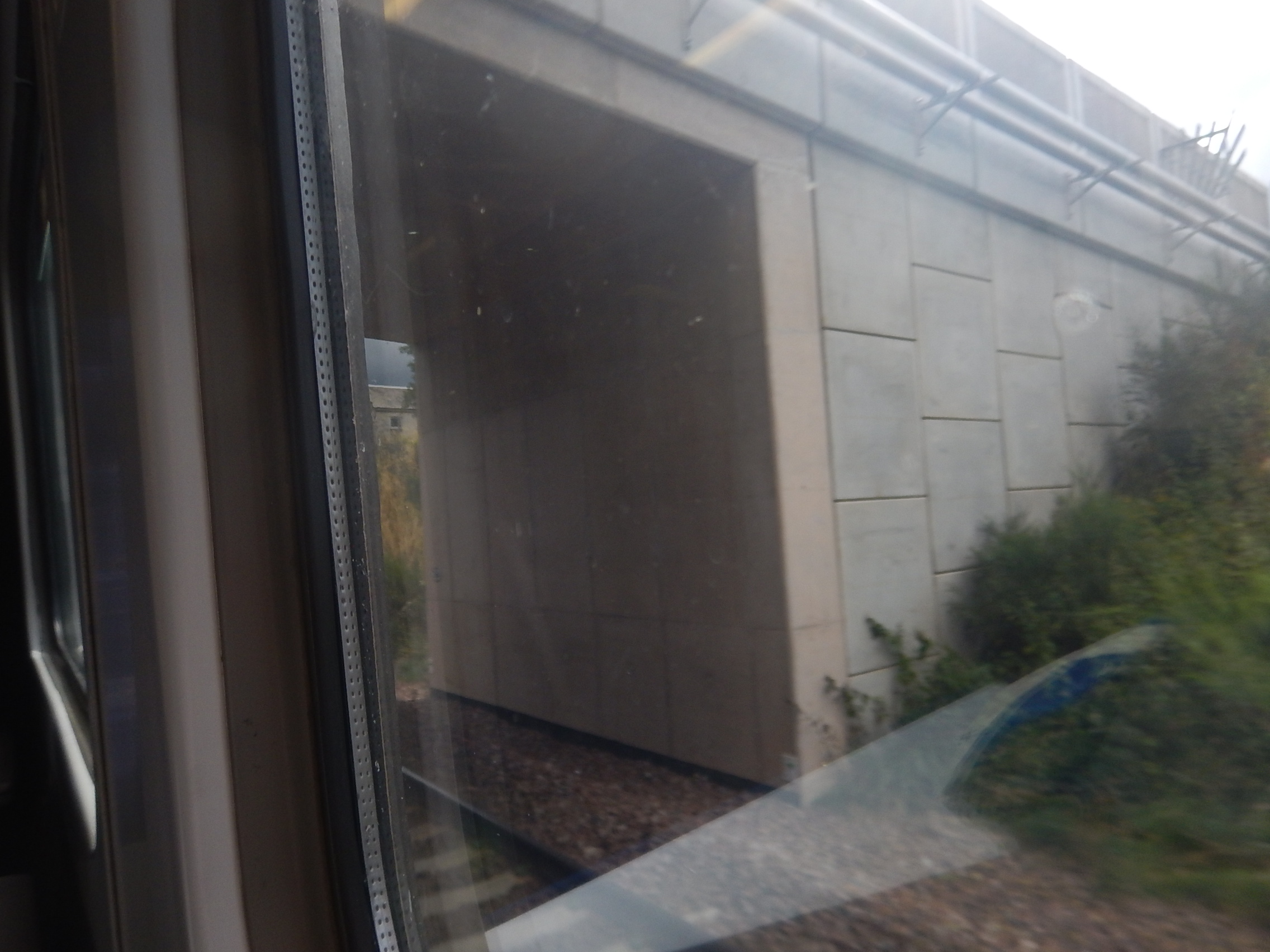
They’ll probably last a thousand years, but they lack the charm of the stone arch bridges.
These pictures show a selection of bridges on the Busby Railway between Glasgow Central and East Kilbride stations.
These pictures show a selection of the many bridges between Aberdeen and Montrose stations on the Edinburgh – Aberdeen Line.










I took pictures of at least twenty.
Freight Trains
Freight trains, especially those with the larger containers need a loading gauge, that is big enough to accept them.
The loading gauge in the UK, is summed up by these two sentences from Wikipedia.
Great Britain has (in general) the most restrictive loading gauge (relative to track gauge) in the world. This is a legacy of the British railway network being the world’s oldest, and having been built by a plethora of different private companies, each with different standards for the width and height of trains.
These are the commonest gauges.
- W6a: Available over the majority of the British rail network.
W8: Allows standard 2.6 m (8 ft 6 in) high shipping containers to be carried on standard wagons.
W10: Allows 2.9 m (9 ft 6 in) high Hi-Cube shipping containers to be carried on standard wagons and also allows 2.5 m (8 ft 2 in) wide Euro shipping containers.
W12: Slightly wider than W10 at 2.6 m (8 ft 6 in) to accommodate refrigerated containers.
W12 is recommended clearance for new structures, such as bridges and tunnels
The Borders Railway appears to have been built to at least W8, so it could handle standard freight containers.
But the line doesn’t carry freight!
On the other hand, I suspect the following were considered, when designing the Borders Railway.
- Network Rail and rail maintenance companies, may need to bring some large rail-mounted equipment along the line for regular or emergency maintenance.
- If the line is extended to Carlisle, the route could be used as a diversion for freight trains, if the West Coast Main Line is closed, due to weather or engineering works.
- There may be a need to use the Borders Railway to extract timber from the forests of the Borders.
The need for freight on the Borders Railway, explains why there are so many new overbridges.
Electrification
Electrification with overhead wires needs extra clearance.
It looks to me, that the Borders Railway has been given enough clearance for future electrification.
Problems With EGIP
Electrification under the Edinburgh to Glasgow Improvement Program (EGIP), proved to be difficult.
It wasn’t helped by the standards changing half-way through the project and the numerous bridges and tunnels that had to be rebuilt.
An important route like Edinburgh to Glasgow probably needs to be fully-electrified, but the difficulties encountered and those in Lancashire have encouraged Network Rail and the engineering consultants to look at other methods of electrifying lines in the UK.
Electrification Between Edinburgh And Aberdeen
I doubt this will ever happen in a conventional manner.
- Would electrification of the Forth Bridge and Tay Rail Bridge be allowed?
- The disruption of rebuilding the stone bridges would be enormous.
- The line only has a maximum speed of 100 mph.
Diesel and alternative power sources like hydrogen will be able to maintain the fastest speeds, that are possible on the line.
Money would probably give better value, if it were to be used to increase line speed.
Opposition To Rebuilding Bridges
This article on Rail Technology Magazine is entitled Network Rail Electrification Plans Stalled After Council Rejects Bridge Removal Bid.
This is first paragraph.
Campaigners are celebrating after plans from Network Rail to demolish a bridge as part of its electrification scheme were rejected by a local council.
The bridge in question is a Grade II listed overbridge at Steventon in Oxfordshire.
It is not unlike those in Scotland, that are shown in my pictures.
In the 1960s, British Rail would have just blown it up and replaced it with a concrete monstrosity.
I am not advocating a return to this policy, but Network Rail has a problem at Steventon, that they need to fully electrify the line, if electric trains are to use the route on electric power, rather than using environmentally-unfriendly diesel power.
Since the new Class 800 trains for the route were designed and ordered, the technology has moved on.
In South Wales, discontinuous electrification and trains with a battery capability will be used.
Conclusion
Scotland and other parts of the UK, like the Pennines and in the valleys of South Wales, have a serious problem with the way the Victorians built our railways.
\development of the UK rail network with electrification and an enhanced freight capability needs to be thought out carefully and with great ingenuity.
 The Anonymous Widower