DHL Teams With Volvo Trucks To Speed Up Transition To Fossil-Free Trucking
The title of this post is the same as that of this article on CleanTechnica.
This is the introductory paragraph.
Electric buses, electric garbage trucks, and even electric construction equipment are becoming more and more commonplace in urban landscapes, but there’s still some debate over whether or not battery electric vehicles will take over open-road, long distance trucking any time soon. To help make the case that electric trucking is the way forward, DHL Freight and Volvo Trucks have partnered to speed up the introduction of heavy duty electric trucks to be used for regional transport throughout Sweden.
Read the article and see what you think.
The author takes the view that electric trucks may be able to handle heavy duty road transport and that would sideline expensive fuel cell trucks powered by hydrogen.
This is a paragraph.
If it’s successful, the move to battery electric trucking could be one of the final nails in the coffin of expensive hydrogen fuel cell projects like Nikola Trucks and Volvo’s own recently acquired Daimler truck division.
I am not so sure, that he is right!
Recently, I wrote Holyhead Hydrogen Hub Planned For Wales and Felixstowe And Harwich Ports Submit Bid For ‘Freeport’ Status, where hydrogen hubs are proposed at the posts of Holyhead and Felixstowe.
- This is a distance of 335 miles.
- As trucks average 55 mph on motorways and dual carriageways, this journey would take six hours.
- Six hours is the maximum time a truck driver can work without a break.
- Tesla have said that their battery Semi Truck will have a range of 300 or 500 miles.
I feel that this rough calculation shows that both electric and hydrogen trucks could handle the Felixstowe and Holyhead route.
- With the battery truck, the weight and size of the battery would probably reduce the payload.
- Factors like cost of ownership, payload and drivers hours would probably play a big part in the choice.
- Trucks would need to be refuelled at the start of the journey, if they’d just come off a ferry.
- On Tesla’s figures, recharging a battery truck would take thirty minutes.
Once we start looking at practical journeys like say Cologne and Dublin, if you want to do it with one truck, it has to be hydrogen.
But a container between Felixstowe and Holyhead could probably be handled by an electric truck.
If you look at between Dover and Holyhead, that is 370 miles and at 55 mph, it would take almost seven hours. So the driver would need a break.
Conclusion
There will need to be extensive modelling to decide, what type of truck is best for a particular route, operator and cargo.
Daimler’s Philosophy
In Daimler Trucks Presents Technology Strategy For Electrification – World Premiere Of Mercedes-Benz Fuel-Cell Concept Truck, I examined Daimler’s strategy for hydrogen and electric trucks.
This is a summary of their philosophy.
- Mercedes-Benz GenH2 Truck, a fuel-cell truck with a range of up to 1,000 kilometres and more for flexible and demanding long-haul transport – customer trials in 2023, start of series production in second half of this decade.
- Mercedes-Benz eActros LongHaul, a battery-electric truck with a range of about 500 kilometres for energy-efficient transport on plannable long-haul routes – projected to be ready for series production in 2024.
- Mercedes-Benz eActros, a battery-electric truck with a range of well over 200 kilometres for heavy urban distribution to go into series production in 2021.
Note.
- 500 kilometres is 310 miles,
- The Mercedes-Benz eActros LongHaul will be able to handle Dover or Felixstowe and Holyhead with a thirty minute driver break/battery charge somewhere in the Midlands.
- The Mercedes-Benz GenH2 Truck will be able to handle Dover or Felixstowe and Holyhead without refuelling.
- The Mercedes-Benz GenH2 Truck will be able to handle a 620 mile out-and-back journey from Dover or Felixstowe without refuelling. This would allow journeys to Birmingham, Derby, Leeds, Liverpool, Manchester, Nottingham and Sheffield
The flexibility built into Daimler’s philosophy is probably a sensible approach and ideal for truck journeys from Dover and Felixstowe.
Daimler would appear to have done a lot of modelling.
There’s Gold In Them There Hills
And lots of other things too!
Since the 1950s, there has always been talk of a mining revival in the UK.
This article on Proactive Investors is entitled The Great British Mining Revival Is Needed Now More Than Ever.
Sixteen mining companies are listed.
Malta Inc Energy Storage Explained
Malta Inc first came to my notice in 2018 and I wrote Gates Among Billionaires Backing Alphabet Energy Spinoff.
But I couldn’t find much information at the time, but they now have a web site that gives a good explanation.
This page on the web site is entitled Our Solution.
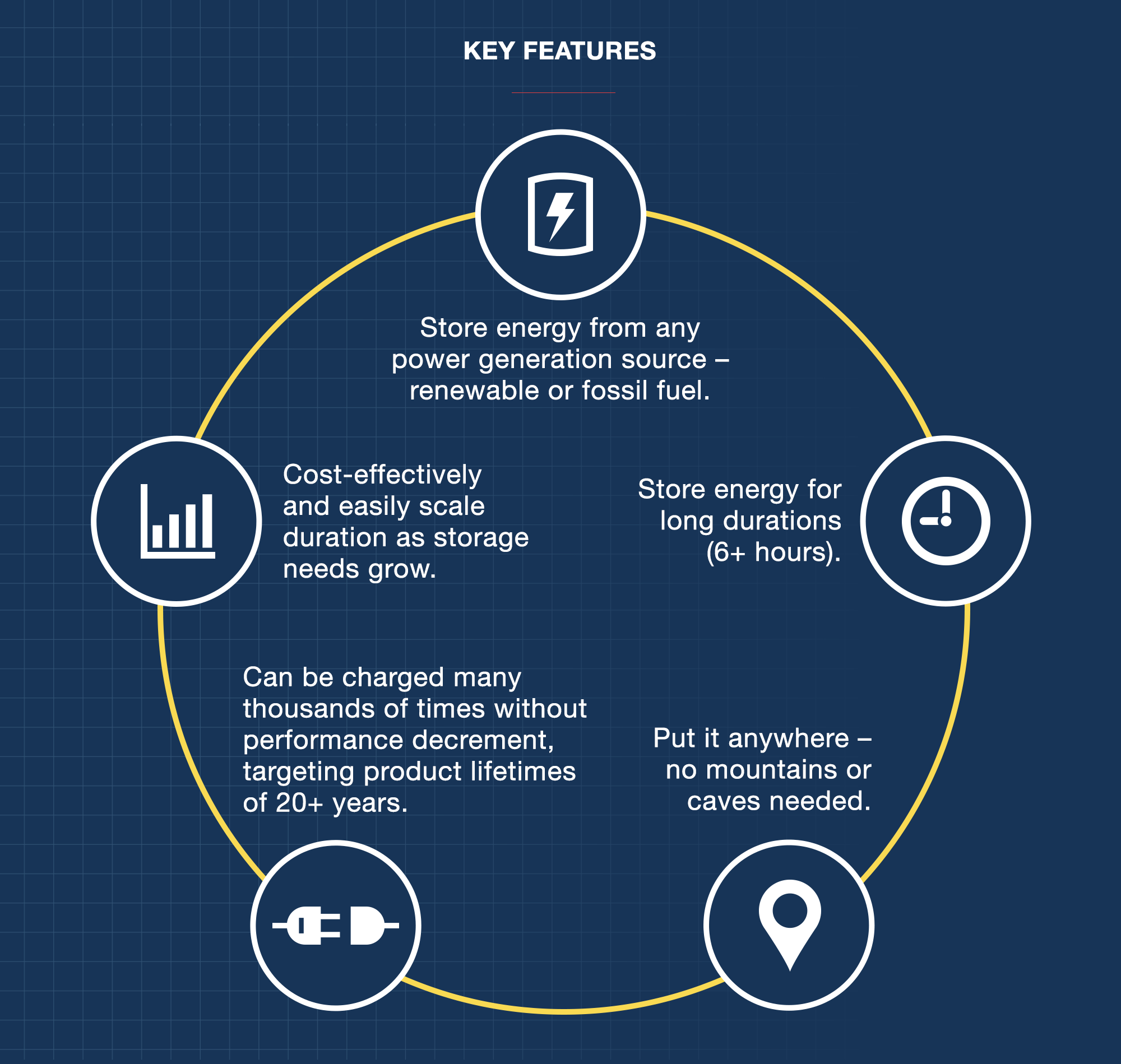
This infographic from the web page, lays out the key features.
This sentence outlines the method of operation.
The Malta energy storage system takes electricity, converts and stores that electricity as heat, and then converts it back to electricity to be redistributed on the electric grid. In charge mode, the system operates as a heat pump, storing electricity as heat in molten salt. In discharge mode, the system operates as a heat engine, using the stored heat to produce electricity.
The operation is explained in five stages.
- Collects – Energy is gathered from wind, solar, or fossil generators on the grid as electrical energy and sent to Malta’s energy storage system.
- Converts – The electricity drives a heat pump, which converts electrical energy into thermal energy by creating a temperature difference.
- Stores – The heat is then stored in molten salt, while the cold is stored in a chilled liquid.
- Reconverts – The temperature difference is converted back to electrical energy with a heat engine.
- Distributes – Electricity is sent back to the grid when it is needed.
Note.
- The operation of the system is based on well-understood thermodynamic principles.
- Entergy is stored as both heat and cold.
- It provides several hours of energy storage.
- Systems are built using standard components, that are readily available.
In some ways the Malta Inc PHES is based on similar principles to Highview Power’s CRYOBattery and Siemens Gamesa’s ETES.
Conclusion
This is a company to watch, as they seem to have got the technology right.
 The Anonymous Widower