A Cute Refuse Truck
I took these pictures on Moorgate.
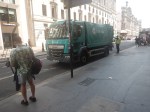
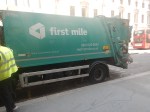

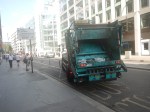
Note.
- This truck was built on a DAF LF chassis.
- It normally has a Cummins B-series diesel engine.
- It looks like it was registered in late 2022.
Some DAF LF chassis have a hybrid transmission.
I have a few thoughts.
Cummins B Series Engine
The Wikipedia entry for the Cummins B Series engine starts like this.
The Cummins B Series is a family of diesel engines produced by American manufacturer Cummins. In production since 1984, the B series engine family is intended for multiple applications on and off-highway, light-duty, and medium-duty. In the automotive industry, it is best known for its use in school buses, public service buses (most commonly the Dennis Dart and the Alexander Dennis Enviro400) in the United Kingdom, and Dodge/Ram pickup trucks.
Since its introduction, three generations of the B series engine have been produced, offered in both inline-four and inline-six configurations in multiple displacements.
Note.
- It is a very versatile engine.
- When I did some data analysis work for Cummins about twenty years ago, they told me, that they are happy to create a new configuration of their engines for a new application.
- Engines for the UK are made in Darlington.
- A version of the B series engine is used in London’s New Routemaster buses.
Cummins have made a lot of these engines.
Cummins And Hydrogen
Cummins realise they have a lot to lose, as the world decarbonises and doesn’t need diesel engines anymore.
Cummins have adopted the hydrogen route to zero-carbon with a large degree of enthusiasm.
- In 2019, they took a majority stake in hydrogen company; Hydrogenics.
- In Cummins Fuel Cell Technology Powers Coradia iLint Fleet In Germany, I described how Cummins supply the fuel cells for Alstom’s hydrogen trains in Germany.
- In Electrolyser System To Linde For Green Hydrogen Production In Niagara Falls, New York, I describe how Cummins are providing a 35 MW hydrogen electrolyser .
- In Cummins Shows Hydrogen Internal Combustion-Engined Concept Truck At IAA Transportation Exhibition, I describe how Cummins have developed and released a powerful hydrogen internal combustion engine based on the B series.
I believe that in Ricardo Supports Industry Leaders To Develop Innovative Dedicated Hydrogen Engine, I talk about the most significant development involving Cummins and hydrogen.
This is how I started the post.
The title of this post, is the same as that of this press release from Ricardo.
This is the sub-heading.
Ricardo, a global strategic, environmental, and engineering consulting company, has delivered a hydrogen-fuelled research engine to global engine specialist Cummins and automotive supplier BorgWarner, as part of Project BRUNEL part funded by the Advanced Propulsion Centre (APC)
These four paragraphs outline the project.
Cummins is a global specialist in diesel and alternative fuel engines and generators, and related components and technology. BorgWarner is an automotive tier 1 supplier and specialist in the design and manufacture of systems for electrified and conventional propulsion types, that includes injection equipment for conventional and renewable fuels. BorgWarner recently announced the intention to spin off its Fuel Systems segment. The intended company name is PHINIA Inc. PHINIA is expected to be a product leader in fuel systems, starters, alternators and aftermarket distribution.
The project aims to support internal combustion engine (ICE) sub-system suppliers to increase their use of hydrogen as an alternative zero-emissions fuel solution across the light commercial vehicle market.
The engine is specifically designed to burn only hydrogen – with no supporting fuels that could give rise to any carbonaceous, or excessive air quality emissions.
Experts in hydrogen technology and integration, Ricardo has provided an engine based upon its world-renowned series of single cylinder research units, which can help the research teams evaluate a wide variety of fuels. The engine is designed to help engineers evaluate a variety of injector types and will support increased fuel efficiency, reduced air quality emissions and the move towards carbon-free heavy-duty propulsion.
Reports of the death of the internal combustion engine are greatly exaggerated.
Cummins already have larger sizes of the B series engine that will run on hydrogen, so are BorgWarner, Cummins and Ricardo going to fill the gap in the range?
Are the companies going to develop B series hydrogen engines for the DAF LF trucks, Dodge RAM pickups and the New Routemaster buses?
North Korea: Residents Tell BBC Of Neighbours Starving To Death
The title of this post, is the same as that of this article on the BBC.
This is the sub-heading.
People in North Korea have told the BBC food is so scarce their neighbours have starved to death.
These are the first two paragraphs.
Exclusive interviews gathered inside the world’s most isolated state suggest the situation is the worst it has been since the 1990s, experts say.
The government sealed its borders in 2020, cutting off vital supplies. It has also tightened control over people’s lives, our interviewees say.
How long are we going to let Kim Jong Un starve his people?
Battery Wagons To Lower Mining Railway Emissions
The title of this post, is the same as that of this article on Railway Gazette.
These two paragraphs introduce the concept of the wagons.
Intramotev is to supply three ReVolt battery wagons to enable regenerative braking on a industrial railway.
The battery and automation technology company said this would be the first deployment of self-propelled battery-electric wagons in a traditional freight train, with regenerative braking and battery technology used to reduce locomotive diesel consumption and thus costs and emissions.
It may seem an unusual concept, but it’s one of those ideas, where if the maths and the costs stack up, it will work.
Intramotev’s web site gives more details on their Product & Technology page, where this is said.
Combining the low energy usage of steel wheels on steel rails with the efficiency of electric drivetrains to create the most energy-efficiency overland transport.
This article on electrek is entitled A Company Is Developing Self-Propelled, Battery-Electric Railcars You Can Control With Your Phone has two paragraphs, which describe their two current products.
In a few short years, the company has been able to develop unique freight solutions using software and battery-electric propulsion technology. This includes the TugVolt battery electric railcar (seen above and below), which can decouple from the consist (the group of railcars as a whole) and operate independently for first and last mile legs.
The company has also developed a ReVolt railcar that can be positioned to stay within the train’s consist and capture energy using regenerative braking to reduce diesel consumption from the line’s locomotive.
As a Control Engineer, I feel strongly, that this technology would work very well in the UK.
East West Rail: Could A New Rail Link ‘Tear Apart’ A Village?
The title of this post, is the same as that of this article on the BBC.
This is the sub-heading.
A new £5bn railway line connecting Cambridge and Oxford will transform much of the area between the two university cities. It could see one Bedfordshire village grow from a population of about 600 to more than 44,000. What would that change mean for people living there and how do they feel about it?
This Google Map shows the village.
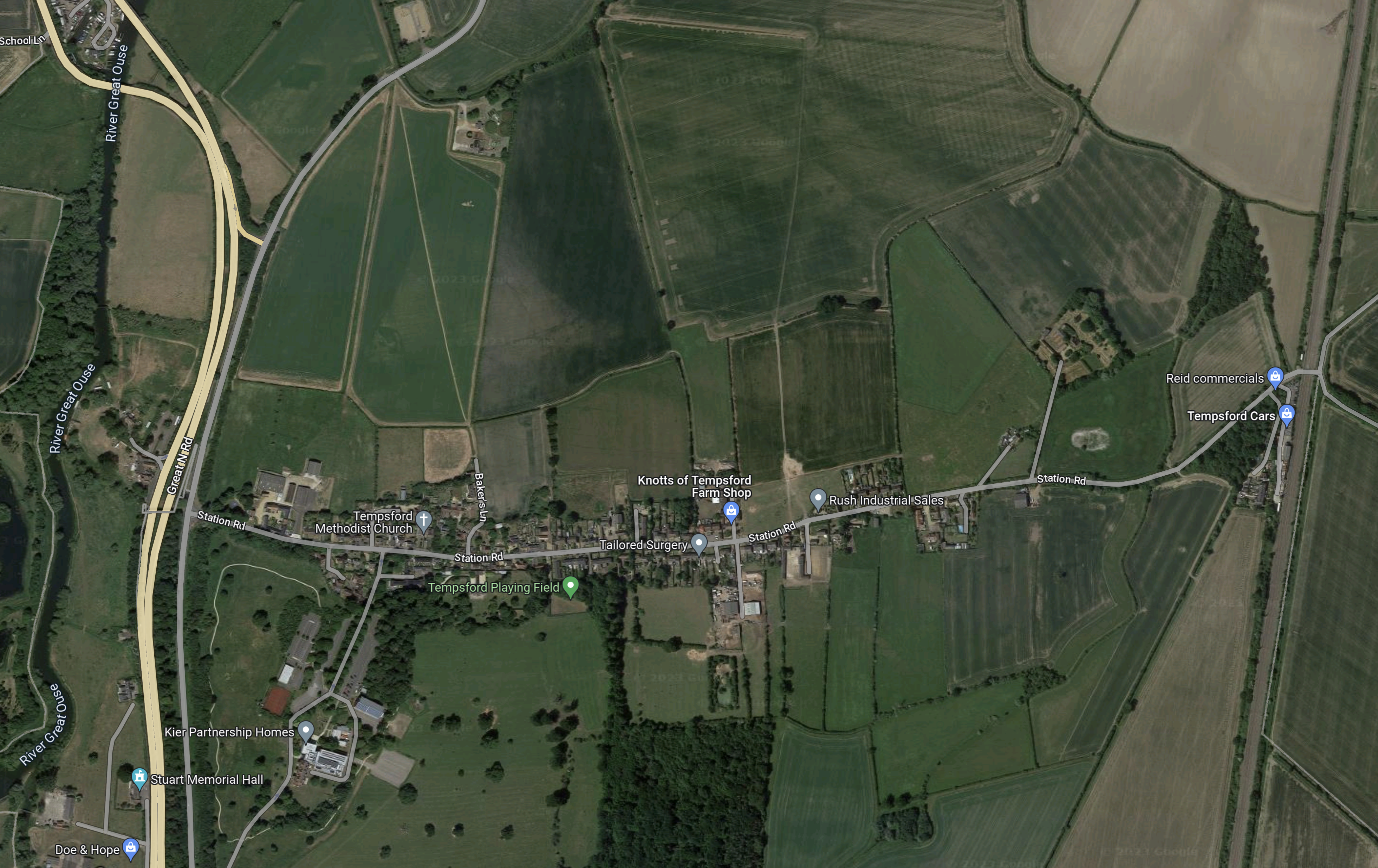
Note.
- On the West side of the map there is the Great North Road and the Great Ouse.
- On the East side of the Map, there is the electrified East Coast Main Line.
- The village is strung along the East-West lane in the middle of the map, which is inevitably named Station Road.
It appears to have a surgery, a playing field and a Methodist church, but not much else.
I have some thoughts.
Bedford And Tempsford
This Google Map shows Bedford and Tempsford.
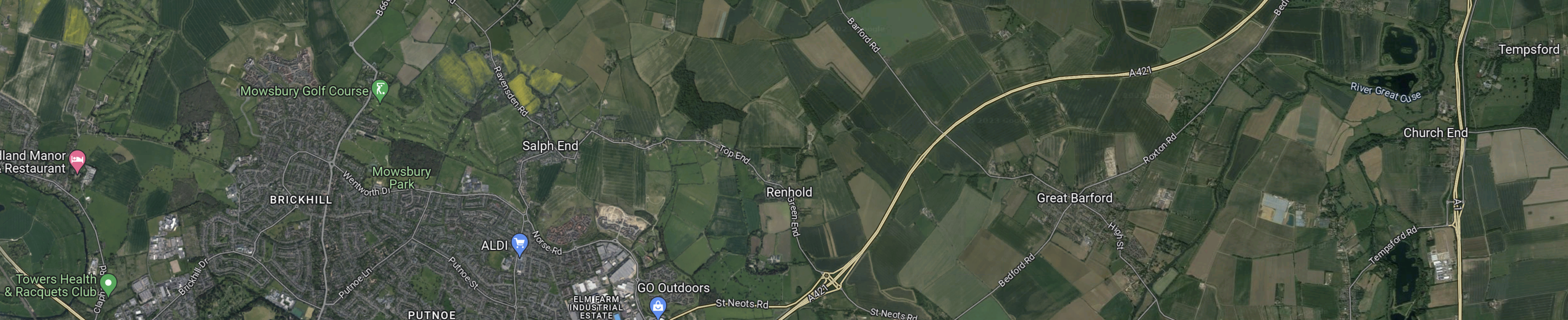
Note.
- Bedford is in the South-West corner of the map.
- Tempsford is in the North-East corner of the map.
I wouldn’t be surprised to see the East West Railway take an East West route to Tempsford, that skirted to the North of Bedford.
In East-West Rail: Through Bedford, I discuss how the East West Railway could branch away to the East from the Midland Main Line.
Tempsford And Cambourne
The next station to the East is Cambourne station.
This Google Map shows Tempsford and Cambourne.
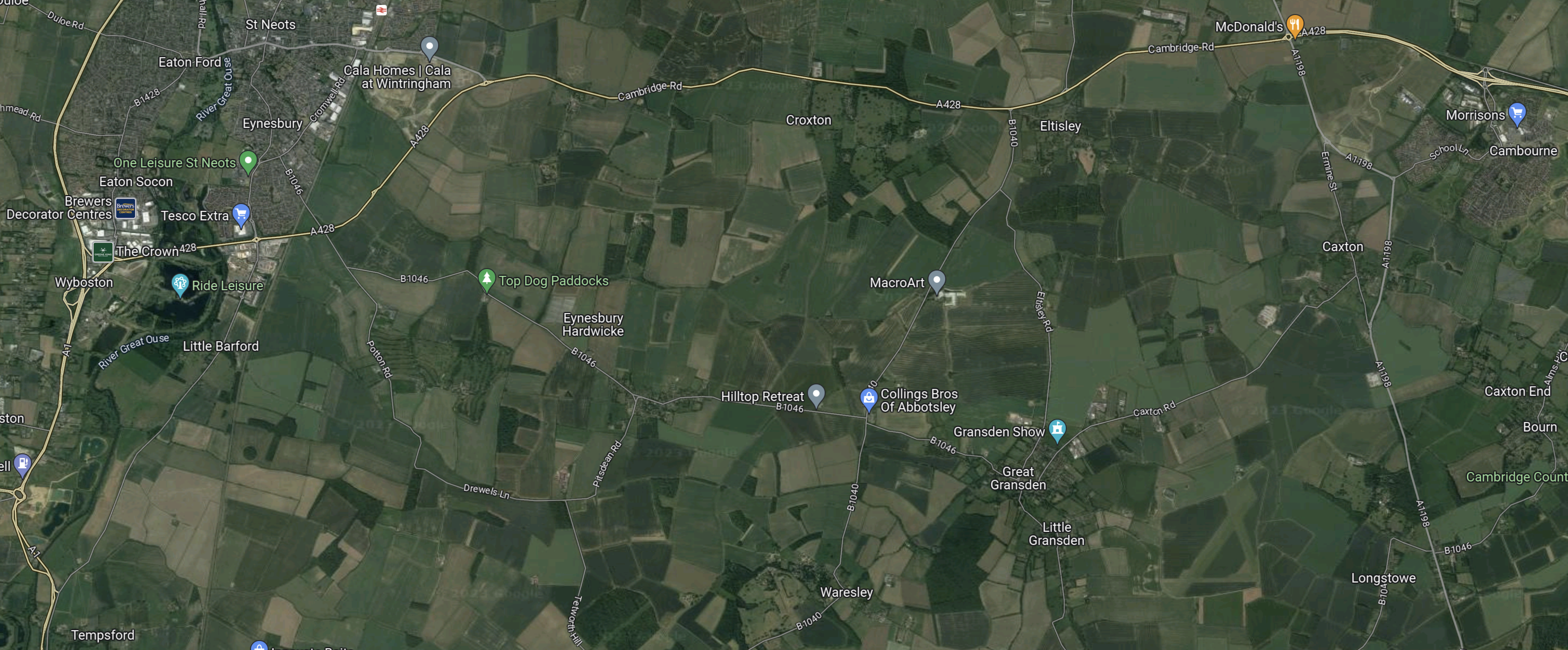
Note.
- Tempsford is in the South-West corner of the map.
- Cambourne is in the North-East corner of the map.
- St. Neots station can be picked out on the Northern edge of the map.
I wouldn’t be surprised to see the East West Railway take a North-Easterly route from Tempsford.
The Possible Station Site At Tempsford
This Google Map shows where Station Road crosses the East Coast Main Line.

Note.
- There are a few industrial businesses on what was probably the old station site.
- There doesn’t appear to be any housing.
I flew my virtual helicopter lower and took this image.
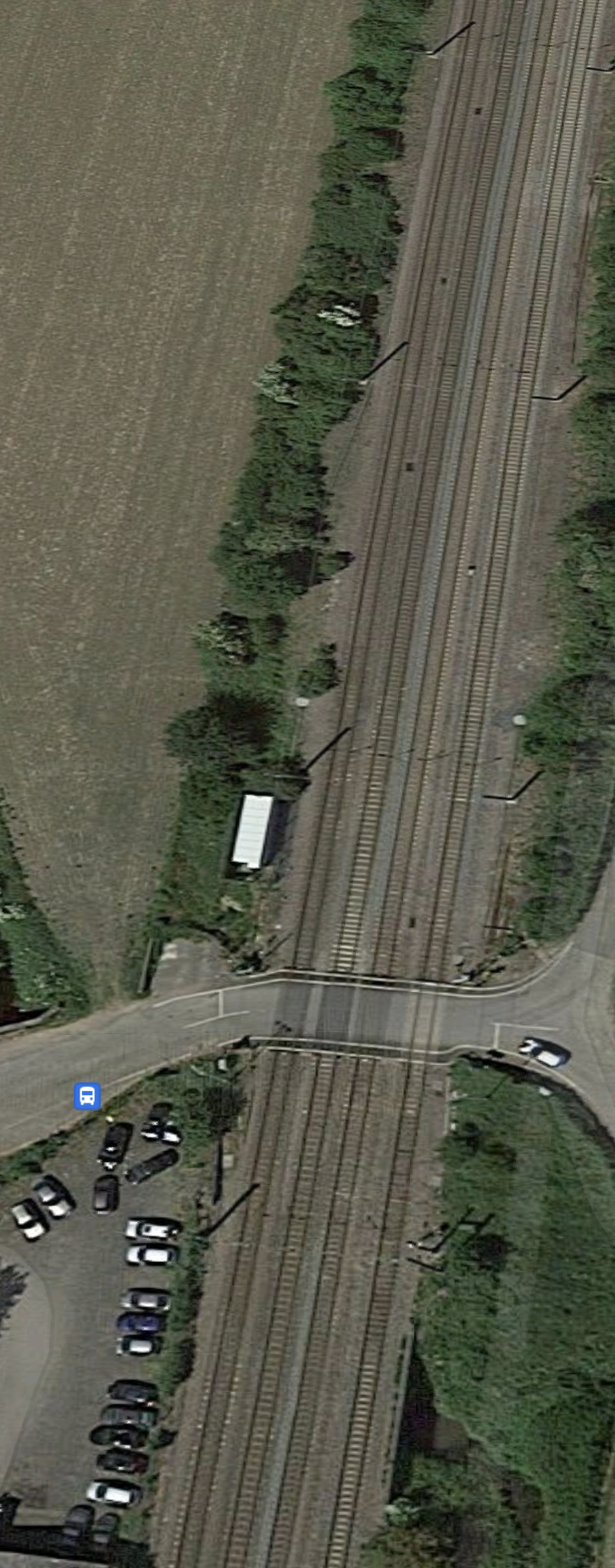
Note.
- It is a level crossing.
- There is a car waiting to cross on the Eastern side.
- There is also a bus stop on the Western side.
This must be an accident waiting to happen as the speed limit on the trains through here is 125 mph. Remember Upton Nervet, where seven were killed and sixty-six were injured!
Hopefully, the new design of Tempsford station will incorporate a combined rail and road bridge or tunnel.
The Route Of The Railway At Tempsford
I think it is more likely that the railway would go roughly East-West to the North of Station Road.
 The Anonymous Widower