New Train Service Connects Finland And Sweden For First Time In Decades
The title of this post, is the same as that of this article on the BBC.
This is the sub-heading.
A new passenger train linking Finland and Sweden has begun running, creating the first rail connection between northern Finland and southern Europe in nearly 40 years.
These three paragraphs add more detail.
Shortly after 05:00 local time (03:00 BST) on Monday, a double-decker train set off from the coastal Finnish city of Oulu, rumbling its way across the border to Sweden.
As the inaugural service crossed the Torne river from Finland and pulled into Sweden’s Haparanda station, it was met by crowds of people waving Finnish and Swedish flags.
The route was initially suspended in the late 1980s to the early 1990s, due to low passenger numbers and technical differences in the tracks between Finland and Europe.
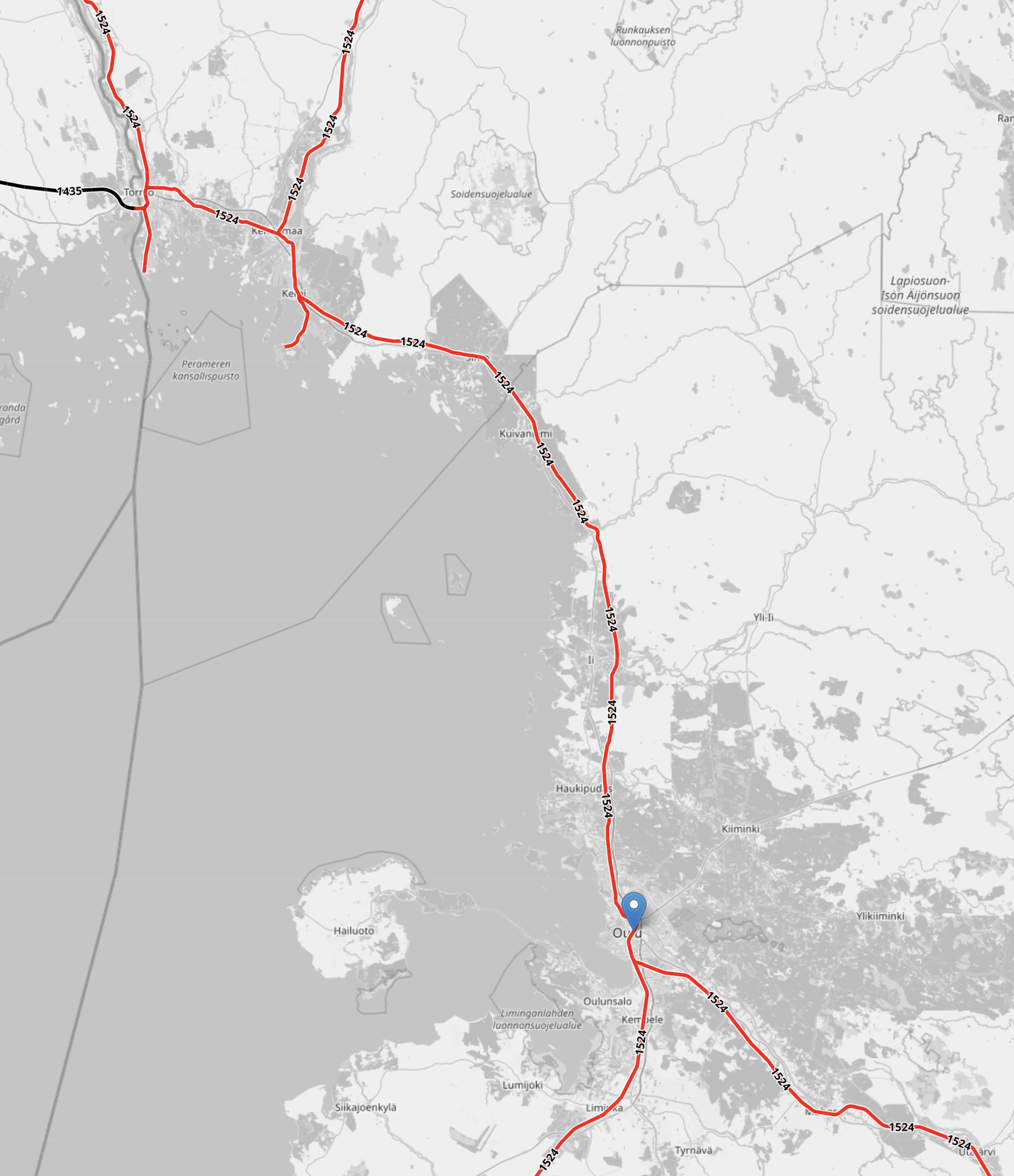
This OpenRailwayMap shows the route between Oulu and Haparanda stations.
Note.
- The map is drawn by track gauge.
- Finnish gauge tracks are shown in red.
- Swedish gauge tracks are shown in black.
- The location of Oulu in Finland is shown by the blue arrow.
- The location of Haparanda in Sweden is at the Eastern end of the black track in the North-Western corner of the map.
- The route seems very much along the coast.
- I wouldn’t be surprised that the sea views are excellent.
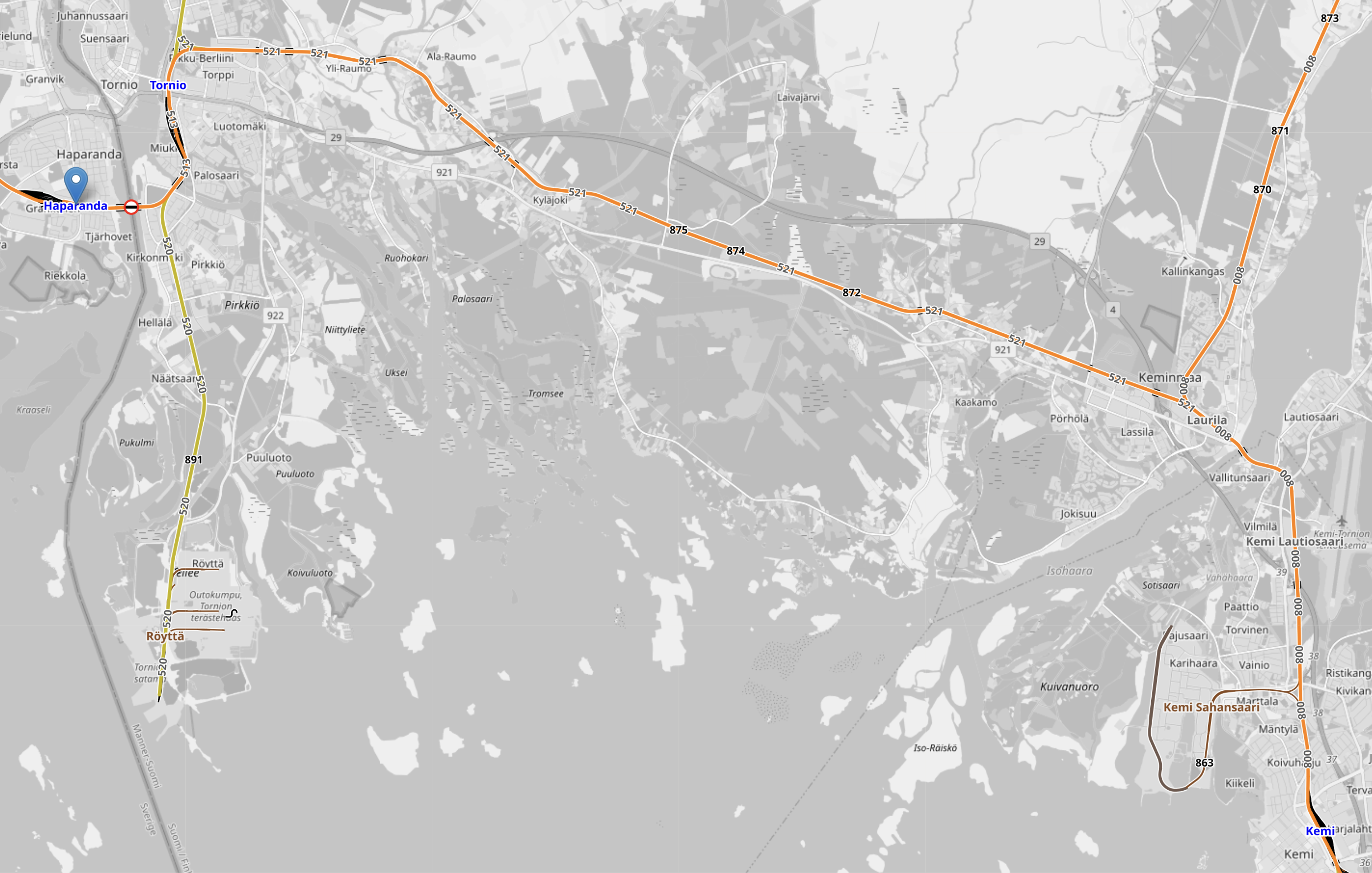
This second OpenRailwayMap shows the route between Kemi and Haparanda stations.
Note
- The location of Haparanda in Sweden is shown by the blue arrow.
- The location of Tornio in Finland is indicated by the blue lettering to the North-East of Haparanda.
- The location of Kemi in Finland is indicated by the blue lettering to the South-East corner of the map.
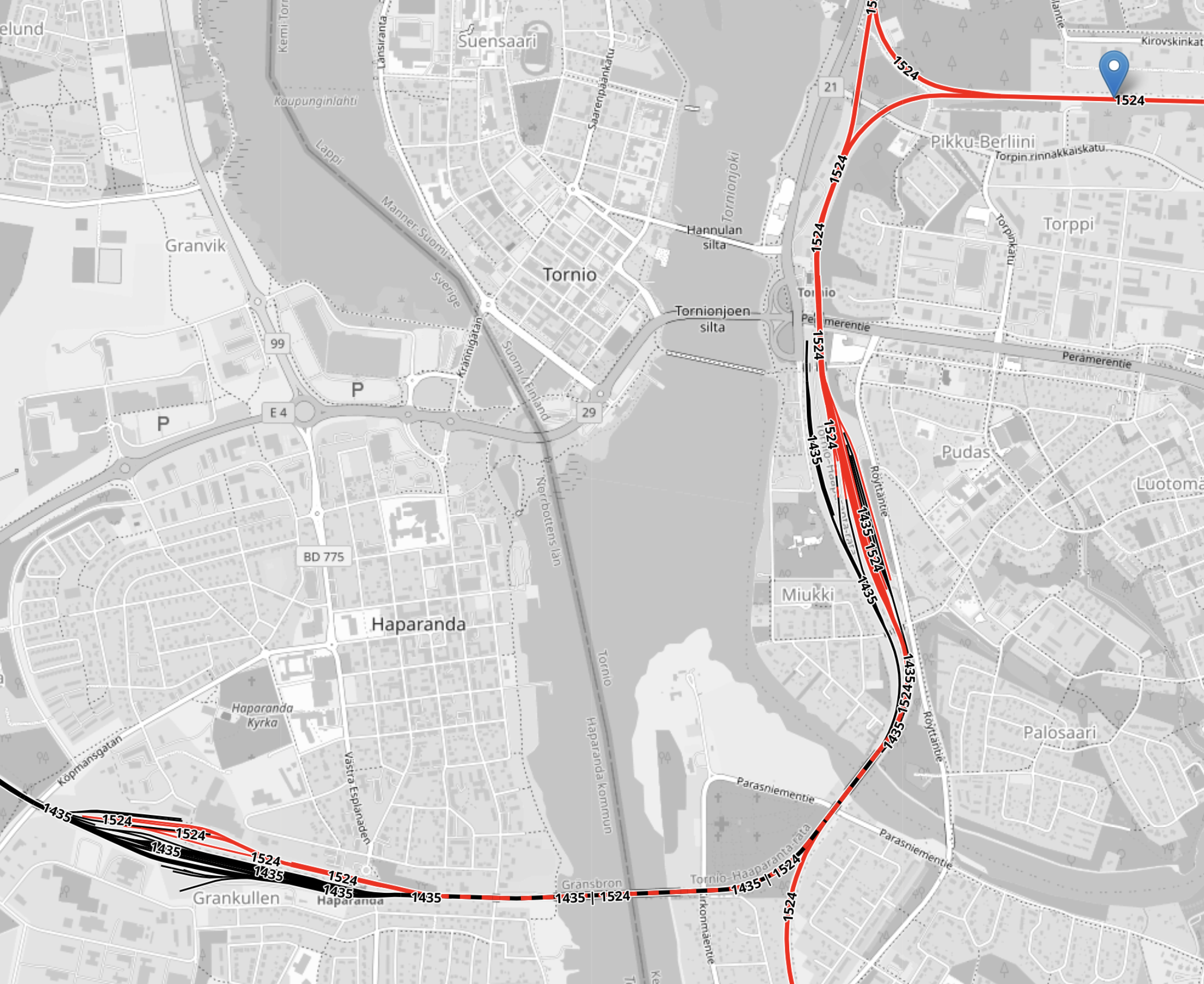
This third OpenRailwayMap shows the route between Tournio and Haparanda stations.
Note.
- The map is drawn by track gauge.
- Finnish gauge tracks are shown in red.
- Swedish gauge tracks are shown in black.
- The track to Oulu in Finland is shown by the blue arrow.
- Tornio station is by the marshalling yard on the Finnish side.
- Haparanda station is by the marshalling yard on the Swedish side.
- The track between Haparanda and Tornio is shown dashed red and black, as it accepts trains of both Finnish and Swedish gauges.
I have some thoughts.
Torne River Railway Bridge
This is is the first paragraph of the Wikipedia entry for the Torne River Railway Bridge.
The Torne River Railway Bridge is a dual gauge railway bridge on the Tornio–Haparanda railway between Haparanda, Sweden and Tornio, Finland; the bridge can be used by the 1524mm gauge trains of Finland, as well the 1435mm gauge trains used in Sweden. A temporary ice river track was built over the Torne River in 1917.
Note
How Do Trains Cross The Torne River Railway Bridge?
I asked Google AI the title of this section and received this answer.
Trains cross the Torne River Railway Bridge on dual-gauge tracks featuring four rails.
This setup accommodates both Finland’s wider 1,524 mm track gauge and Sweden’s standard 1,435 mm track gauge, allowing freight and specialized rail equipment to pass directly between Tornio, Finland, and Haparanda, Sweden, without stopping.
Bridge and Track Design
Dual-Gauge System: Four physical rails are laid on the bridge deck. They interlace the wide-gauge and standard-gauge tracks so different wheel sets fit.
Electrification: The 410-meter truss bridge and connecting line feature overhead catenary wires aligned with Finnish electric standards.
Control and Operations: Train movements across the bridge and its shared dual-gauge sections are managed by Finnish rail traffic control.
Cross-Border Travel
Freight Transport: Freight trains and containerized goods (such as shipments from Outokumpu) use the dual-gauge tracks to move directly between the marshalling yards of both countries.
Passenger Services: While regional passenger train connections operate across the border via the Tornio–Haparanda railway, regular passenger operations involve seamless station transfers at Haparanda rather than continuous through-running for all service types.
It is a simple but ingenious system.
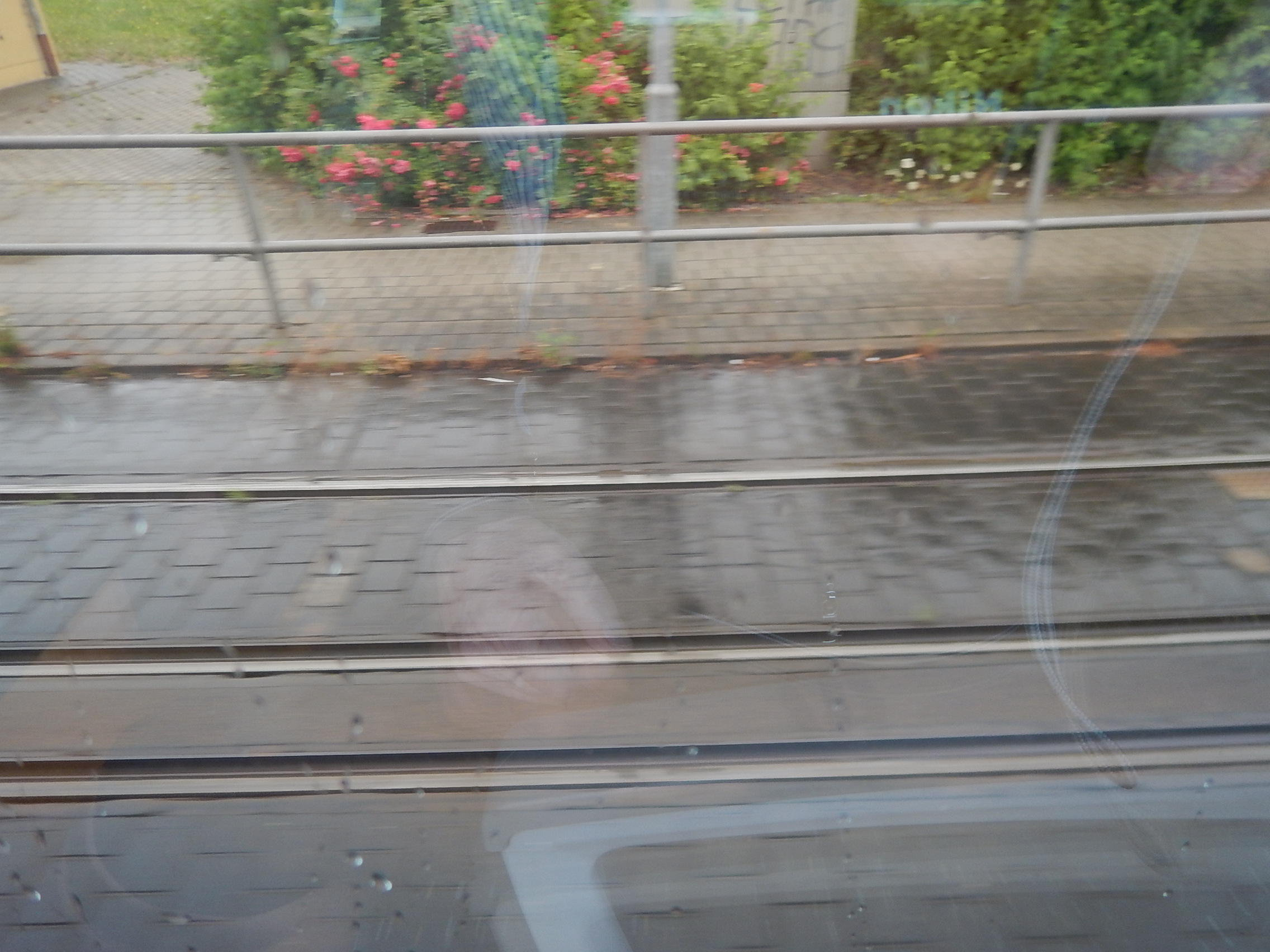
I’ve never seen one anywhere else, although I have ridden on the three rail track at Zwickau.
Note.
- Standard gauge trains use the two outer rails.
- Metre gauge trams use the two far rails, which are a metre apart.
- In the UK, all modern trams are standard gauge, so we don’t have the problem.
But say a narrow-gauge heritage railway wanted to connect into a standard gauge station, I’m sure that the Zwickau system could be used.
Do Other Bridges Use The Same Interleaved Dual Gauge Track As The Torne River Railway Bridge
I asked Google AI the title of this section and received this answer.
Yes, other rail locations use an interleaved dual-gauge track setup (technically known as a gauntletted or four-rail configuration) when two track gauges are too close together to share a common rail.
Why Interleaved Tracks are Used
Gauge Proximity: When the difference between two track widths is small (such as Finland’s 1,524 mm and European standard 1,435 mm, a difference of only 89 mm), a standard three-rail shared setup cannot fit the necessary rail-fastening hardware.
Space Constraints: Interleaving four separate rails inside the same restricted width allows different trains to cross narrow infrastructure like bridges or tunnels without building entirely separate parallel spans.
Examples of Similar Infrastructure
Russia-North Korea Border: The crossing over the Tumen River utilizes multi-gauge configurations to accommodate Russian broad gauge and standard gauge connecting to the port of Rajin.
Historical and Industrial Lines: Short interlaced stretches have been historically deployed on restricted-width civil engineering structures like the Boyne Viaduct in Ireland during structural renewals, or on specific quarry tramways (such as the Ravenglass and Eskdale Railway in the UK) to temporarily interchange standard and narrow gauge wagons.
No Panic At The Pumps … South Koreans Just Stop Driving On Wednesdays
The title of this post, is the same as that of this article on The Times.
This is the sub-heading.
President Lee Jae-myung has urged the public to ‘save every drop of fuel’ and introduced a number-plate rotation to keep drivers off the road
These first three paragraphs deeply illustrate the differences between the energy situation in North and South Korea.
From the lookout point atop Mount Dora, in the heart of the demilitarised zone that has separated the peninsula since 1953, you can clearly see where South Korea ends and North Korea begins.
The trees that proliferate across Korea’s undulating topography come to an abrupt halt. On the land that sits beyond, a farmer can be seen guiding an ox pulling a plough.
Sealed off from the world economy for 73 years, communist North Korea has resorted to cutting down much of its vegetation to burn for fuel. Democratic South Korea, by contrast, has established deep global trading ties that allow the country to import vital natural resources it cannot produce domestically.
North Korean communism certainly can’t be considered green.
I find these two paragraphs extremely significant.
South Korea may have to import almost all of its crude oil, but the country plays a huge role in refining it into petrol, diesel and jet fuel before shipping it around the world. This means that demand from overseas for Korea’s refined products is greater than ever, which has forced the government to step in. The country’s Ministry of Trade, Industry and Energy has implemented mandatory caps on refined petroleum products.
Of all South Korea’s refined products, kerosene, or jet fuel, is the most in demand. The country is one of the biggest exporters of jet fuel in the world. The US, for instance, relies on it for 70 per cent of its total jet fuel imports.
They could also be problematical for the country, as they will surely need to replace these jet fuel exports with exports of sustainable aviation fuel (SAF).
Most viable processes, that I’ve seen need the following ingredients.
- Lots of hydrogen or masses of GWhs of electricity to make it.
- Some carbon atoms, which can even be captured from the air or a gas-fired power station.
- Some form of Fischer-Tropsch process to force the atoms to make sustainable aviation fuel.
There are several companies that can do this, with British ones seeming to often to be connected to Oxford University.
There is also this Anglo-Korean connection over hydrogen.
I asked Google AI, who are investors in innovative hydrogen production company; HiiROC, which is a spin-out of the University of Hull, and received this answer.
HiiROC, a UK-based developer of “turquoise” hydrogen technology, is backed by a consortium of major industrial and financial players, including Centrica, Melrose Industries, HydrogenOne Capital Growth, Hyundai, Kia, Wintershall Dea, VNG, and Cemex Ventures. The company has raised over £40 million to develop its thermal plasma electrolysis technology.
Note the presence of two of the biggest Korean companies ; Hyundai and Kia.
HiiROC is also five times more efficient than traditional electrolysis.
Google AI says this about South Korean offshore wind.
South Korea is aggressively developing its offshore wind sector, targeting 14.3 GW to 15 GW of installed capacity by 2030, with over 116 projects and 44 GW of capacity under development. The country aims for a 2030 renewable energy share of 20-30%, leveraging floating technology for massive projects like the 3.2 GW Jindo project.
It appears to me, that South Korea will replace their market share of the jet fuel market with sustainable aviation fuel (SAF).
I’m also sure, that if the Koreans need to produce more hydrogen to make more SAF to power the world’s aircraft, Centrica will help them to rent some of our empty seas.
I can see the Koreans, with a little help from their friends, including the UK, dominating the SAF market.
SeAH Wind Goes On Recruitment Spree For UK Monopile Factory
The title of this post, is the same as that of this article on offshoreWIND.biz.
This is the sub-heading.
South Korea’s SeAH Wind has started its large-scale drive to recruit for positions including welders, platers, roll bending machine operatives, mechanical and electrical technicians, supervisors, and general operatives for its XXL monopile manufacturing facility on Teesworks, the UK.
These are the first two paragraphs.
Applications will be accepted via the company’s dedicated recruitment website where individuals can sign up for job alerts, register their expressions of interest, and apply directly for jobs.
SeAH Wind will hold events across multiple Teesside towns, including Middlesbrough, Redcar, Cleveland, and Hartlepool over the coming months where more details will be shared about vacancies and training opportunities at the South Bank site.
These three paragraphs talk about the education and training, and the number of jobs.
As part of the recruitment drive, the South Korean firm has also joined forces with Nordic Products and Services and Middlesbrough College to create two programmes under its SeAH Wind Academy programme.
During the 24-week training and development programme, 30 people will be trained to become welders for SeAH Wind.
Once fully operational, it is expected that a total of 750 direct jobs and 1,500 further supply chain jobs are set to come from the SeAH manufacturing facility.
I suspect, this the sort of investment that Teesside needs and will welcome.
North Korea: Residents Tell BBC Of Neighbours Starving To Death
The title of this post, is the same as that of this article on the BBC.
This is the sub-heading.
People in North Korea have told the BBC food is so scarce their neighbours have starved to death.
These are the first two paragraphs.
Exclusive interviews gathered inside the world’s most isolated state suggest the situation is the worst it has been since the 1990s, experts say.
The government sealed its borders in 2020, cutting off vital supplies. It has also tightened control over people’s lives, our interviewees say.
How long are we going to let Kim Jong Un starve his people?
Agent Orange Shows Fatty The Third The Art Of No Deal
The title of this post is my translation of the front page headline of today’s Evening Standard.
- Agent Orange is Spike Lee’s nickname for the current US President.
- Fatty The Third is how the Chinese refer to Kim Jong-un on social media.
These two imbeciles deserve each other!
A Scoop For Train-Spotters
Various news sources are reporting that Kim Jong-Un’s visit to China was first noticed by train spotters.
This article on the Washington Post, says this.
The detective work started Monday when train spotters and North Korea watchers noticed two suspicious developments: tight security at the China-North Korea border and train delays across the northeast.
The article also says that a popular Chinese nickname for the North Korean dictator is Fatty the Third.

